Midsommar mural explained: what the opening image spoils
From the queen and the bear to the number nine, the hidden images and metaphors in Ari Aster's folk horror point to Dani's fate and Christian's
 Heavy Spoilers (AI-assisted)17 November 2026Editor: Digital Fox Talent Editorial TeamOn YouTube since 2009 · more than 1.6 million subscribers

Midsommar (2019), starring Florence Pugh and Jack Reynor, is full of subliminal images, hidden meanings and metaphors. The biggest is the mural that opens the film, because it spoils everything that follows. It's a creepy cult classic, with cult being the key word.
Ari Aster directed it after his hit Hereditary, which was A24's highest grossing film at the time, so the studio moved quickly on this one. Aster built a story around two characters on the verge of a breakup and dressed it up as folk horror. The Wicker Man inspired it, and Aster has also cited The Wizard of Oz. He studied May Day and the traditions of Hälsingland and devised a plot around the Midsommar celebrations.
Midsommar's Christian echoes The Wicker Man's Christian versus pagan story
The pagan religion stood as an affront to Christianity. In real life, Christians came in, subjugated the religion and replaced it with their own. The Wicker Man was about Christianity versus paganism, and its Christian character ends up trapped and burned alive.
The main male character here is also called Christian, and he is burned alive at the end after being put in a death trap. The difference is that where The Wicker Man's hero turned down the advances of Willow, Christian gives in to Maja. Meanwhile, his girlfriend Dani is celebrated as the May Queen, having broken free of their toxic relationship. The pair drift apart, and in the last half of the film neither of them speaks to the other.
Dani also embodies grief. She sinks to her lowest point before being reborn at the end. After losing her family at the start, she finds a new one in the cult and embraces becoming their queen.
Midsommar director's cut versus theatrical cut
The director's cut is the most complete version of the film. Personally, I find the pacing of the theatrical cut a lot better: you get a leaner meal with the same ingredients. I think the director's cut is very good, though, and it cleans up many of the questions people have. If you just want a nice, easy film, the theatrical cut is probably better.
How the opening mural spoils Midsommar
The film opens with a mural you don't catch the first time, and it makes me want to crown Ari Aster the spoiler king. It starts with death, representing Dani losing her family, and it's set in winter, just as the film begins in winter. Look closely and there are pipes connected to them, a hose that shows they're killed by exhaust fumes. Next comes Dani's grief and despair as Christian tries to console her, with Pelle sketching in a tree beside them.
Then the group travel, are greeted by the Hårga, and Dani becomes the May Queen. There's also the bear, people falling from a cliff, and Pelle leading the group with a flute in his mouth. That's like the Pied Piper, a classic tale of people led to an unknown fate, and it shows they're being strung along.
The mural also covers the seasons, which the Hårga use to divide life. Under 18 is spring, and 18 to 36 is summer, the bracket the central cast fit into. As someone who is 37, that one didn't hit me well. The film is also set in summer, hence the title, which is why it focuses on them. Autumn is 36 to 54 and winter is 54 to 72, and the Hårga end their lives on reaching that point, believing the cycle begins again. Death is central to winter, which is why both the mural and the film start there. The sun god, a deity of summer, appears at the end of the mural, and it was present in The Wicker Man too.
Dani's parents and the theory Pelle planned their deaths
The family's name means fire and passion, and in their room there's a photo of Dani adorned with flowers. Because of this, it's believed that Pelle may have orchestrated their deaths so the cult could adopt her, though that theory is people grasping at straws. Pelle does say his own family died in a fire and he was raised by the Hårga. Could be that they were sacrificed too.
According to the trivia, the name Hårga comes from a legend in which the devil disguised himself as a fiddler and led teenagers up a mountain, playing until they danced so long they wore away and decayed, much like the dance at the end.
Dani is on medication for her crushing anxiety, something she doesn't take on the trip, and the Hårga use their own drugs to control her. After a strange message from her sister, she discovers her parents dead. Her family returns later in the crowd when she's crowned, and her sister haunts her, appearing behind her during a bad trip, and her face shows up in the trees after the ritual. When we first see her parents, they're visibly breathing, and rather than call the police, Dani phones Christian, who tells her she's overreacting. Had she not listened, she possibly could have saved them, and so she subconsciously hates him.
Behind her as she cries on the couch is a painting of two moons, symbolizing an almost endless night. At the festival, the days feel everlasting, with a big sun doorway and a sun painted on the central platform. Her real life is darkness and despair, while with the Hårga it's bright and beautiful.
The wailing scene and the candle Christian can't light
That couch scene pays off brilliantly later when Dani catches Christian cheating and cries in a very memorable scene. The women ritualistically join her, contrasting with Christian, who doesn't seem to react or care. He has very little empathy for her, while the women give her a shared empathy. At one point he also tries to light a candle for her and can't, a metaphor for their struggle to keep the flame alive.
The queen and the bear painting points to Christian's fate
As Dani lies in bed, there's a painting of a queen kissing a bear, representing Dani and Christian's eventual fate. Inside the hut where Christian cheats, a bear burns on the wall. The kiss reads as a kiss goodbye: she goes on to live while he goes on to die, and he's placed facing that bear because it's his fate.
Most of Dani's clothes are baggy and don't fit her well. The one outfit that doesn't hang off her is the dress made for her at the village, showing she fits in better there. Pelle gives her a birthday sketch already showing her as the May Queen, implanting the idea, while Christian forgot her birthday altogether. Pelle cares more about her than he does.
The couple go round in circles, refusing to end things though both are unhappy. That's mirrored in the Maypole dance, where Dani spins until she breaks free, and in that moment breaks free of Christian too. Maja, rearranged, is May, and she seduces Christian with a love potion. Look closely and his drink is a slightly different color from the rest of the group's.
Mirrors and boxes show Dani as an outsider
Christian hasn't told Dani about the trip, and the friends stand around her as if she's outside the inner circle, a circle completed when she finds a home with the Hårga. Back in their room, Christian sits in a chair, creating a smaller box in the mirror, while Dani stands in a doorway. The painting in her frame shows a woman looking up at a house, as if leaving it behind.
Christian plays dumb about going, but Dani knows he already has the tickets, and he claims he was planning to invite her as a surprise. When he tells the gang, it's in the reflection of a mirror above the sofa, again linking Dani to distance and being boxed in. When she runs to the bathroom, there's a scarecrow doll on a bookcase, representing the hay stuffed corpses beside Christian at the end, and a picture of the scarecrow from The Wizard of Oz.
Runes, an upside down drive and a bad trip in Sweden
Josh studies runes, including ones the Nazis created, and realizes the Hårga are an insular and white supremacist group obsessed with racial purity, which is why they have their inbred oracle child. He pieces it together too late. The Othala rune means a journey, growth or evolution, and the death rune on Christian's clothing marks him for sacrifice. On the drive in, the shot turns upside down, as if we're entering the other side of the mirror, then flips back after the banner.
Pelle's friend has recruited Simon and Connie, clearly the cult's method. The group take drugs and argue about the time, and Pelle calls it the new sun, feeding the sense of everlasting daylight. The Hårga start in white but gain color, mostly red, for the blood shed. Dani's bad trip shows her sister in a mirror, an even smaller box, as things close in. The shots here are gorgeous and the color is breathtaking. On midsummer nights, it's believed spirits can affect humans more, which is linked to customs like walking backwards, which we see later. Mark tucks his pants into his socks, which Ari Aster apparently does because he hates ticks.
Ruben the oracle and the number nine
The houses sit at weird angles with a strange gray, hinting at a dark society. The cult interbred to create Ruben, believing it gives an unclouded mind: "Ruben is unclouded by normal cognition." His paintings are read as wisdom, but the elders interpret them, so they deliver whatever message they want. The elder tells the others "welcome" but tells Dani "Welcome home."
Nine matters. A child takes nine months to be born, and the life stages fall at 18, 36, 54 and 72, all multiples of nine. Midsommar has nine letters, there are nine sacrifices over nine days, and earlier someone said it was 9 p.m. The elder's Swedish speech isn't subtitled, adding another barrier. A tapestry shows a woman putting her hair and blood into food for a man, which is why Christian finds hair in his pie. A woman puts scissors under her baby's pillow, tied to fertility, and Dani's blanket has the same pattern as the carpet in The Shining.
The cliff ritual and the group's shared grief
Babies are raised by everyone, so children are shaped by groupthink rather than parents. The elders are carried up a cliff and leap, and you can spot a man with a hammer who finishes them off. Some say the woman's head on the rock lines up with stones in the opening, but I'm unsure whether people are reaching. The mass wailing when the man fails to die shows the cult as a unit rather than individuals. Christian tells Dani to take time for herself, leaving her alone with grief, and announces he'll write his thesis on the Hårga, which Josh finds unethical since it was his idea. Pelle asks Dani, "Does it feel like home to you?"
The director's cut lake ritual and Connie's fate
The director's cut adds a night ritual at a lake where an offering isn't enough, so a young boy offers himself, weighted and nearly thrown in. Dani shouts no and he's saved. The sacrifice still has to happen, and it's Connie, though this is never spelled out: her wet, bloated corpse appears later in the boy's sacrificial clothing. It's likely she was killed after demanding to leave, since Josh and Dani hear screams. That night Dani dreams of Christian and Mark in a car full of gas, echoing her parents and Simon's fate.
Maja, Mark and the blood eagle
Maja places a totem under Christian's bed. Pelle tells Christian that Maja is 15, and he still goes through with it. There's the defense that he was drugged, but it shows how kids are viewed here, and that alone is enough for me to despise the cult. Mark urinates on the ancestral tree, basically like doing it on a gravestone.
Simon was driven off and executed by the blood eagle, a real Viking practice where the ribs are pulled apart and the lungs held out as wings, and he's still alive when Christian sees him. Mark is skinned, stuffed with hay and given a jester's hat, foreshadowed by the scarecrow and the children's game "Skin the fool." Josh is grabbed by Ulf wearing Mark's face, and slowed down, a man standing in the corner who bludgeons him is visible.
The Maypole dance and the sex ritual
The elders gaslight the gang about the missing book. During the Maypole dance everyone bows except Dani, signalling she'll be last standing, and she's anointed May Queen surrounded by her new family while Christian stands apart. The director's cut sex scene is longer, and cutting to Ruben makes it feel like industrial breeding. Meat buried with an egg is part of Josh, an offering to the crops, which is why Christian finds his leg. I think the wailing scene highlights the group's forced understanding and how their empathy and kindness is all an act, drawing Dani closer to the indoctrination. The makeup department even put blood on Christian, a thorough touch.
Why Dani chooses Christian at the end of Midsommar
According to IMDb trivia, the lottery is based on the short story The Lottery. Dani chooses Christian, her last connection to her old life, severing that tie. He's put in the bear suit. Ulf and another are told the yew sedative means no pain, a lie, and I think Ulf finally realizes he's been lied to his whole life. There's beauty in the singing, and the soundscape is incredible. Apparently audiences in Sweden laughed and thought it was a comedy. Dani coughs, then smiles as Christian burns, indoctrinated and single, and that smile is almost exactly like the sun's face in the opening mural, bringing everything full circle.
Watch the original
@heavyspoilers · YouTube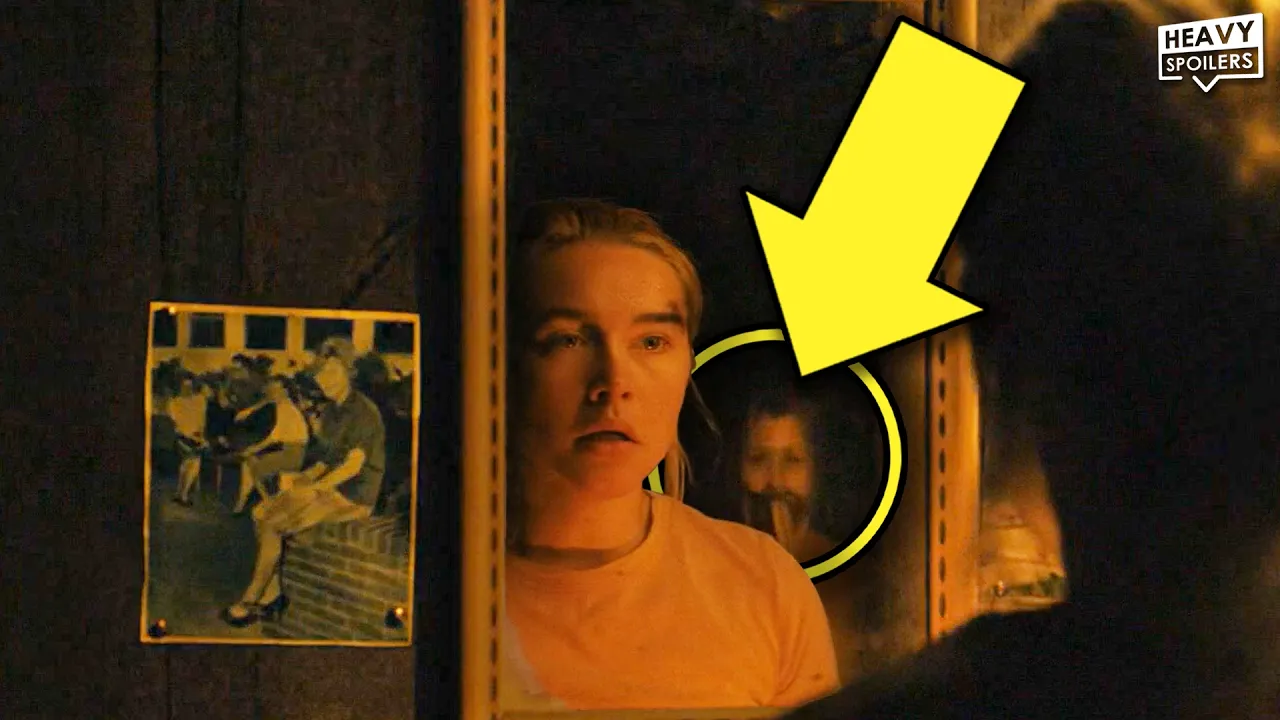
Adapted with AI from Heavy Spoilers' video of 28 March 2026 and checked against the video before publication. Editorial standards · Corrections
More from @heavyspoilers
All →


Make videos? Your next one could be an article here.
We turn your videos into articles under your name, linked back to the original. You keep 60% of what they earn, non-exclusive, and you can leave whenever you like.
Become a SubPlotter →