The Wicker Man ending: does Howie's sacrifice save Summerisle?
How a freezing shoot, a novel called Ritual and a passage from Julius Caesar shaped a 1973 horror classic, and why its final scene still lingers
 Heavy Spoilers (AI-assisted)16 November 2026Editor: Digital Fox Talent Editorial TeamOn YouTube since 2009 · more than 1.6 million subscribers

The Wicker Man (1973), starring Edward Woodward, Christopher Lee and Britt Ekland, is often labeled the Citizen Kane of horror, and I think it more than deserves that reputation. It's a film that stuck with me for a long, long time, and it went on to influence every cult film that followed. You can see it in Midsommar, The Third Day and much more.
Why The Wicker Man works as horror with almost no scares
The film goes beyond the confines of one genre. It was shot almost completely in daylight, and it pulls in plenty of elements from comedies and musicals. Nothing scary happens until the end, and there are no over-the-top shocks to jolt you in your seat. Instead there's a feeling of unease throughout, with most of the horror happening in the background. Only when you see the final scene does your mind start to fill in the blanks. We learn we've been watching a cult, and all those smiling, sweet, slightly sickly faces take on another meaning.
Ryan Hollinger described what we usually see in the genre: horror movies tend to switch to night when something big is about to happen, which he compared to a trigger warning. As soon as night falls, audiences brace for a jump scare. Most of The Wicker Man takes place in the day, even more so in the theatrical cut, which drops an entire night. There's just a constant feeling of dread.
Christopher Lee wanted to escape monster roles
In the early 1970s, Christopher Lee was worried he'd been painted into a corner. For as good an actor as he was, he kept playing monsters, in The Curse of Frankenstein and Dracula, and he felt his career was at an impasse. He met with screenwriter Anthony Shaffer, and the idea was born. Shaffer said horror was seen as a genre where Lee floundered around in fake teeth chasing a damsel in distress, and he wanted to do something more.
To me this felt like the first true elevated horror, pitting Christianity against paganism: devout followers against devout followers. I feel the title also plays on the words weaker man, in a story where Howie is horrifyingly bested by the pagans. In the 1970s, it was estimated that 90 percent of the UK was Christian, so showing the murder of one in the final scene was a big deal, especially as Sergeant Howie stays devout throughout.
How David Pinner's Ritual and Julius Caesar shaped the story
While crafting the idea, Shaffer came across Ritual by David Pinner. It was originally commissioned as a film treatment by Michael Winner, with John Hurt set to star, and followed a Christian policeman investigating a ritualistic murder in a rural village. Pinner was playing Detective Sergeant Trotter in Agatha Christie's The Mousetrap at the time, and that police procedural tone made its way into the material. The ending is completely different: the officer gives in, gets tempted by the villagers' ways and joins them. If you read that book expecting The Wicker Man, I think you'd be sorely disappointed.
That project never got off the ground, and Pinner fleshed it out into a novel. Shaffer paid 15,000 pounds for the rights but couldn't get it to work as a screenplay, so he adapted elements instead. He noticed many religions were built around sacrifice, such as Jesus dying for our sins, while pagans often sacrificed others. Researching human sacrifice, he found Julius Caesar's commentaries on the Gallic War, which described gigantic wicker men filled with people and set ablaze. That image became what the entire film was built around.
A freezing shoot and the lost footage of The Wicker Man
With rumors of a union strike on the way, the production shot in winter rather than waiting for spring, and everyone was freezing. Cast members even sucked ice cubes between scenes so their breath wouldn't show. The studio also wanted a more upbeat movie and even suggested divine intervention at the end. The producers won that battle, but they lost the war when it came to the other cuts. 20 minutes were removed from the film, and having seen all the cuts, I think that severely limits the impact.
StudioCanal's 4K collection contains the theatrical cut, the director's cut and the final cut. The director's cut has the most footage, so that's the one I'm covering. For decades much of the footage was lost. Christopher Lee claimed some canisters were used to build the foundations of a motorway, and negatives stored at Shepperton Studios ended up on the destroy pile. In 2013, StudioCanal ran a Facebook campaign that led to a 92 minute 35mm print at the Harvard Film Archive. It isn't complete, but it's about as complete as you can get, and the 4K restoration is absolutely phenomenal.
Sergeant Howie arrives on Summerisle
The original opening has a text card thanking Lord Summerisle, the film doing the based on a true story trick to make the events feel like they could really happen. The director's cut then shows more of Howie's life as a cop. Woodward plays him as an uptight virgin who follows the rules without question. He's been engaged for two years but believes in no sex before marriage, so fellow officers mock him. He's also a snob, even telling one of them to get a haircut. A letter about a missing girl sends him to the island, and the postcard carries the smiling sun face that appears throughout the film.
The locals aren't helpful, and he has to lambast them into sending a boat out to his plane. On it is an evil eye, a happy accident, as it belonged to a resident of Plockton. It wards off evil by constantly watching it, and here it's clear the islanders see Howie as the evil. The location, Galloway in Scotland, was called the bleakest place on earth by Britt Ekland, which caused a stink, and the producers had to apologize to the locals.
Rowan, the trees and the hare in the grave
Everyone on the island is named after trees and shrubbery: Rowan, Beech Buchanan, his descendant Ash Buchanan, Miss Rose and Ekland's Willow, and wicker is made from willow. Graves have trees planted over them and pictures of fruit, because the islanders believe the dead are reborn in the trees. Lord Summerisle's grandfather introduced a new strain of apples that brought fame and fortune. Hit by famine, the islanders now believe they must kill to get it back.
Rowan's photo shows one twin, while her sister plays the girl we meet later. I'm guessing that was down to child labor laws, but I think it serves the film, because something feels slightly off at the end. I might be reading into that way too much. At the sweet shop, among chocolate skulls, ram heads and a chocolate baby, there are chocolate hares, foreshadowing the hare Howie later finds in Rowan's grave. Hares have been known to symbolize the transmuted soul, and in Celtic lore they were thought to shapeshift. May Morrison's daughter is even drawing a hare, tying into that idea of shapeshifting. I also see similarities to Eye of the Devil from 1966, where a feudal lord holds a pagan sacrifice when the crops perish.
Willow, Britt Ekland and the body double
At the Green Man inn, the locals burst into song about the landlord's daughter while her father laughs along. Willow stands as an opposite to Howie's repressed sexuality and acts as the island's seductress, and in paganism there were priestesses of sexual pleasure who represented fertility. Her father is played by Lindsay Kemp, who was only four years older than Ekland in real life. She's the goddess of love in human form, there to destroy his celibacy.
Ekland has been open about how much she disliked what happened. She was pregnant and refused to shoot scenes from the waist down, and without telling her, the production brought in a body double. According to IMDb trivia, Gary Carpenter said this was the naked woman we later see weeping at a grave. Her voice was also dubbed by jazz singer Annie Ross after she tried a Scottish accent the producers didn't like, the only time she was dubbed, and from what I can gather they didn't tell her. Ekland has disowned the film and claims she's never watched it.
The maypole, the classroom and the rumors from the set
A missing harvest photograph, canned peaches and no apples show the island is struggling. At the school, the children learn the phallic meaning of the maypole. I think you'll always have arguments about sex education, but here it almost steps into the realm of grooming, because everything on the island is built around sex, and with so many children it becomes more sinister. Outside, a ruined church rots while the maypole stands strong. The teacher explains Rowan's status with "You would say so," because death for these people is a state of transformation.
Diane Cilento, who plays Miss Rose, and Shaffer got close and married in 1985. It was said nothing happened during filming, though people have theorized it might have. What caused more issues was reportedly between Ingrid Pitt and producer Peter Snell. It's said Pitt's partner, then head of cinema bookings, didn't want the film to succeed, which is why it struggled for distribution. That's hearsay and rumor, and it's the shortest explanation I can give.
The more I watch, the more convinced I am Lord Summerisle is a con man
Every time I've watched the film, I've become more convinced Summerisle is a con man. Like many cult leaders, he's set up a system where he benefits most, living a lavish lifestyle with access to women. His grandfather, a Victorian scientist, used the volcanic soil and warm Gulf Stream to develop new strains of fruit. The clergy opposed him, so he convinced the starving locals the old gods had come to his aid. Christianity preached resisting temptation, while the pagans let you give in to your vices.
In the novelization, Summerisle is asked whether the lord believed in it all and says no, he believed in science. I think he wants to buy time and doesn't want to give up an island that worships him. Some point to the island's positives, but a cult willing to commit murder is not good at all. He also mocks Howie's faith, calling Jesus "the son of a virgin, impregnated, I believe, by a ghost." I don't know if the filmmakers were picking a side; I think they were pointing out that all beliefs require a leap in logic.
Willow's test and the fool's last day
Howie holding firm through Willow's dance always gets me. There are theories that if he had given in, he would no longer be a virgin and wouldn't have been a suitable offering. Some say they'd have gone ahead anyway, but I feel this was almost a test of whether he was the one. Later he reads about the May Day figures, the hobby horse, the man woman and the fool, and wrongly assumes Rowan is the sacrifice. In disguise, he's poked and mocked by islanders who clearly know it's him.
Rowan leads him through the caves exactly where they want him, then collects praise like an actor at the end of a play. "Welcome, fool," Summerisle says, acting like a hand of God who predicted his every move. Howie warns that if the crops fail, the islanders will come for Summerisle next. Summerisle insists they will not fail, and that choice of words shows how much he believes his own hype. Woodward declined every invitation to see the wicker man before filming, so his reaction was partly real. His final speech is based on Sir Walter Raleigh's dying words.
The Wicker Man ending explained
The sunset could mean the sun god will bless them, but I have a depressing read: Howie isn't likable, the islanders are creepy, and I think it's possible Howie doesn't go to heaven and the pagans don't get their harvest. Religion was forced throughout these kingdoms and pagans were subjugated, so who are the real baddies? That's my interpretation, and you could completely disagree. That 90 percent Christian figure has since dropped to 46, and I think the film tapped into that questioning.
The Wicker Tree, released in 2011, shows an elderly Summerisle, so the crops presumably came back. I prefer the ambiguity: the real horror is not knowing whether it worked. There was talk of rain putting out the fire as a sign God saved Howie, but I think giving this movie a happy ending is the wrong way to go. Lee even paid for the press tour from his own salary and called it his best role. Even today, I think it's one of the best horror films ever, and every cult movie owes a lot to The Wicker Man.
Watch the original
@heavyspoilers · YouTube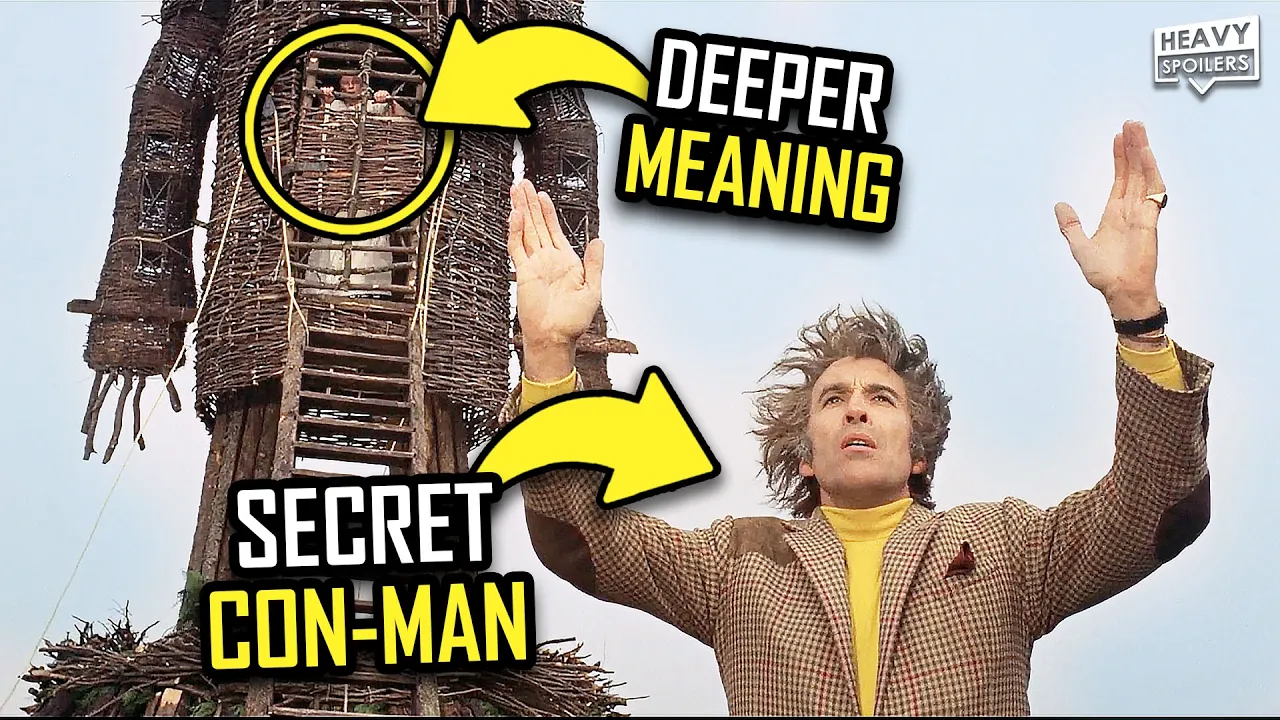
Adapted with AI from Heavy Spoilers' video of 23 March 2026 and checked against the video before publication. Editorial standards · Corrections
More from @heavyspoilers
All →


Make videos? Your next one could be an article here.
We turn your videos into articles under your name, linked back to the original. You keep 60% of what they earn, non-exclusive, and you can leave whenever you like.
Become a SubPlotter →