Thousand Year Old Vampire review: is this solo RPG worth it?
A journaling game where dice, prompts and a five memory limit chart an immortal's slow unraveling across the centuries

I've been playing Thousand Year Old Vampire, the solo roleplaying game designed by Tim Hutchings, for a few weeks. I think it's safe to say it has "completely ruined the bar for any other solo RPGs," which is frankly inconsiderate of it. It's a game about loss. My verdict is that if you're willing to lean into that darkness, it becomes something special.
I already have a soft spot for solo RPGs. One of my goals this year is to go to the UKGE on a quest. Not a noble or heroic one. More the kind where you arrive with a coffee, a backpack and slightly sore knees, intending to buy one more small game, and leave three hours later with a stack of obscure narrative RPGs and no memory of how it happened. This one has set the bar awkwardly high. Other games now need to arrive wearing full Warhammer power armor just to stay competitive.
How dice and numbered prompts move your vampire through Thousand Year Old Vampire
The game runs on a series of numbered narrative prompts. Think of them as story events in a game book or a moody quest log. Each prompt nudges your vampire's story forward, or occasionally drags it backwards, like a dungeon master who has decided you're getting too comfortable.
Movement happens with dice. You roll a ten sided die, subtract the value of a six sided die, and move that number of prompts from wherever you are. In practical terms, the fate of your immortal vampire is decided by math that wouldn't trouble a primary school classroom. Narratively, you wander through the book like a cursed Skyrim character whose fast travel has been permanently disabled: lots of walking, lots of regret, occasional confusion about how you got back here again.
Most of the time the game trends upwards through the prompts, and the last few pages are about endings. Not cheerful ones. Your vampire might exist for centuries before being abruptly erased by history, a brief, miserable blip in the timeline. Think less Dracula and more the stormtrooper who walks into a door in the background of a scene. Or the dice drag you backwards, and certain prompts change when you revisit them, so the same moment can play out differently the second or third time. You never know what lifespan you'll get. The vampire technically could last a thousand years, but the dice are chaotic and time isn't known for its kindness. I've loved every second of it.
There is a lot of story in Thousand Year Old Vampire, and serious content warnings
What surprised me most is how much meat is on the bones. I'm still in my first game, and it keeps producing interesting story moments, like a narrative loot chest that stubbornly refuses to run out.
The book's introduction describes it as "a lonely solo role-playing game in which you chronicle the un- life of a vampire over the many centuries of their existence." It promises that you'll build up a record of memories and then lose them to time, and watch everyone you've loved and hated grow old, die and turn to dust.
I think the warning that follows is important to mention. The book says you will encounter themes of death, selfishness and predation, and that your character will murder and victimize people, possibly including children, animals, loved ones or themselves. Imperialism, colonialism, oppression, self harm, drug abuse, illness and body horror may all come up, and your character will certainly forget important things. It calls itself "a personal, challenging game for mature adults," asks you to stay aware of yourself and your feelings, and points to an appendix with thoughts on safety in solo games.
Memories are the heart of Thousand Year Old Vampire
Your vampire is built from a few simple pieces: memories, skills, resources, characters and marks. The real heart is the memories. A memory is a major event in your vampire's life, and under each one you can record up to three related experiences. You start with space for five memories, which sounds reasonable until you remember your character is trying to recall a thousand years with the storage capacity of a slightly stressed USB stick.
The rules define an experience as a single evocative sentence written in the first person from the vampire's point of view, combining what happened and why it matters. A suggested format is the event, how I feel, and what I did about it. Almost every prompt creates an experience, and experiences are grouped by theme into memories. Memories don't have to be linear or chronological. When all five are full and a new experience fits none of them, you strike out an existing memory and everything in it. The book is blunt: "Forgetting things is a fundamental aspect of the game, so embrace it."
There's one way out. If you're lucky, you might gain a resource like a diary or journal and move memories into it, an external hard drive for your tragic immortal existence. Even then the choices get uncomfortable. Every new memory might mean forgetting a friend, a lover, a city you once lived in, or possibly why you walked into the kitchen in the first place.
Living for a thousand years sounds epic on paper, but the game is both brilliant and quietly devastating. It keeps circling back to one idea: when you live long enough that you can't remember everything, what part of your life is worth keeping? If human identity is the sum of our memories, the vampire's identity becomes the opposite, not collecting memories but losing them. The game doesn't dress this up with dramatic music. It tells you to remove a memory, maybe the love of your life or the one happy century you managed, and you strike a line through it like you're cleaning up a shopping list. You sit there with a pen thinking this feels mildly traumatic.
Skills and resources in Thousand Year Old Vampire are simpler, but still cost you
After all that existential dread, skills and resources are mercifully easier to get your head around. Skills are things your vampire has picked up over the centuries: swordplay, manipulation, forgery, languages, or standing dramatically in the shadows like a low budget Vampire: The Masquerade cutscene. Some prompts tell you to check a skill, which means it has been used. The rules put it this way: if unchecked skills are what your vampire can do, checked skills are what they have done. You can only check a skill once, and sometimes the only one available is something you'd rather not use, like the book's example of a humane vampire helping a friend out of a bureaucratic jam whose only option is rage and kill.
Resources are what your vampire acquires: safe houses, secret tunnels, hidden treasure, loyal servants, crypts and lairs that would make Batman nod approvingly while taking notes. Some are portable. Others are stationary, like a hidden refuge beneath a monastery, and the game enjoys reminding you that immortality doesn't protect you from bad luck when an angry mob arrives with torches and pitchforks.
The rules ask you to leave lost resources legible, because lost things might come back, and to make losses vivid: don't just lose your mansion, burn it to the ground. Losing a resource doesn't hit the same as losing a memory, though. When a resource disappears, your vampire at least remembers it existed. When a memory goes, it's gone.
Character creation, mortals and a sire, and a brutal first prompt
Character creation is relaxed. There aren't many strict rules or rigid sheets. You define who your vampire was before immortality: a background, a few skills, and a couple of resources. These can be wildly different in scale, from an army that can defeat all foes to a Bible someone gave you. They carry little mechanical weight. This isn't about optimizing a build like you're planning a D&D boss fight. They exist to give the prompts something to bounce off.
Then you create characters, the people who matter to your vampire: three mortals and one immortal, your sire, who started this whole inconvenient situation. Mortals die with the passage of time, and the book suggests you'll realize one has died of old age every four or five prompts. Immortals can be anything suitably bizarre, from angels and ghosts to disembodied heads under bell jars.
You spend time thinking about these people, and then the very first prompt asks which of those mortals you killed when your new hunger took over. Loss isn't something that might happen later. It happens immediately. No warm up, no gentle tutorial, just the narrative equivalent of spawning into Dark Souls and being punched in the face by the first enemy.
Marks show your vampire becoming less human every century
Marks are the physical signs you're a vampire. You can go classic with fangs and pale skin, but the game puts no real limits on them: a missing reflection, a shadow that moves differently, eyes that change color. Marks carry no hard mechanical rules, but they affect the narrative. The book asks whether your vampire conceals each one and how, with examples like hypnotic eyes hidden behind smoked glasses.
Personally, I like starting very subtle, but as prompts force new marks, things escalate. Line up your vampire across the centuries and the early one looks like a normal person, while the later one looks like something that wandered out of Warhammer's Chaos Wastes. It's the long form version of character corruption, and I found it appropriate. After a thousand years of drinking people and fleeing mobs, it would be unrealistic to still look like a normal bloke.
Why I chose journaling over the quick game
The game offers two ways to play. In the quick game, you update your sheet, read the prompts and let the story play out in your head, like a strange choose your own adventure book. In journaling, you write down what happens, though the rules make clear these are immediate snapshots; your vampire can only reliably remember the memories and diaries you've preserved.
Naturally, I chose journaling, which is why I was still on my first playthrough several weeks later. The romantic version is gothic prose by candlelight. In reality, handwriting takes forever, and you can spend 20 minutes describing a conversation your vampire will forget in about three prompts. So I've been dictating notes onto my phone, which makes it look like I'm leaving suspicious voice notes while wandering around the house. I did draw my character, though. If I'm following her for a thousand fictional years, I wanted to know what she looked like, and I'm not prepared to use AI.
My vampire, her lost love and the Devourer that made her
In the 13th century, in the lake country of northern Italy, she lived quietly, almost monastically, and loved once, a man who knew the paths between the trees. Bandits attacked them on a forest road at dusk and he was taken. She never knew if he was slain or carried off. Grief drew her into the mountains, where the thing found her. It didn't bite her throat. It split her ribs, tore out her heart, bit it, and pressed it back. She was left with a deep, cold, bruised scar in the center of her chest that must always be hidden, but which pales and warms if she stands near the man she was bound to, should he still walk the earth.
Her sire lives in the high forests where Lombardy meets the Germanic mountains, a creature some villagers call the Devourer, which consumes hearts to quiet its own hunger. It was buried badly, and a landslide split its grave open. It has milk white eyes, and it hunts warmth and grief. It created her because it wanted to remember warmth, and it has never forgiven her for surviving the bite.
I also created her best friend, Rosa, who smelled of lake water and crushed mint and wore her hair half braided, half undone. The first prompt asked me to destroy someone close to me. My brain took that too literally for a moment, and the closest person was a woman checking the bus timetable. Everyone at the bus stop remains safe. Rosa did not make it. That was unfortunate for Rosa, but very effective storytelling, because from then on my vampire is someone who has already done something terrible.
Who Thousand Year Old Vampire is for, and who should skip it
I won't share more prompts, because I don't want to spoil the game. They're cleverly designed, mostly revolving around relationships, conflicts and difficult choices. In my story, one quiet tragedy, watching a character unknowingly forget the person she was trying to honor, was "heartbreaking in the best possible way." The system didn't tell me to write that scene. It created the conditions where the choice became possible, and that's where the game is strongest: a strange little narrative engine that hands you prompts that feel unexpectedly human.
If you enjoy gothic horror, crumbling castles and tragic immortals, you'll feel at home. It's also good for history nerds. I did a surprising amount of searching to stay vaguely accurate, learning about trade routes, plague outbreaks and what people did in Prague in 1642. You expect escapism and instead you're learning.
What you must embrace is the tone. It isn't a power fantasy like Skyrim. You lose memories, people, and safe places, sometimes even the reason you cared. Centuries pass between prompts, and holding on is like keeping sand from slipping through your fingers. If you need your characters to save the day and ride into the sunset, this isn't your game. But if you're happy to sit with a drink, roll dice and watch an immortal life unravel, it's a fantastic experience. Just don't get too attached, because sooner or later your character is going to get it.
Watch the original
@ajm_nerdcore · YouTube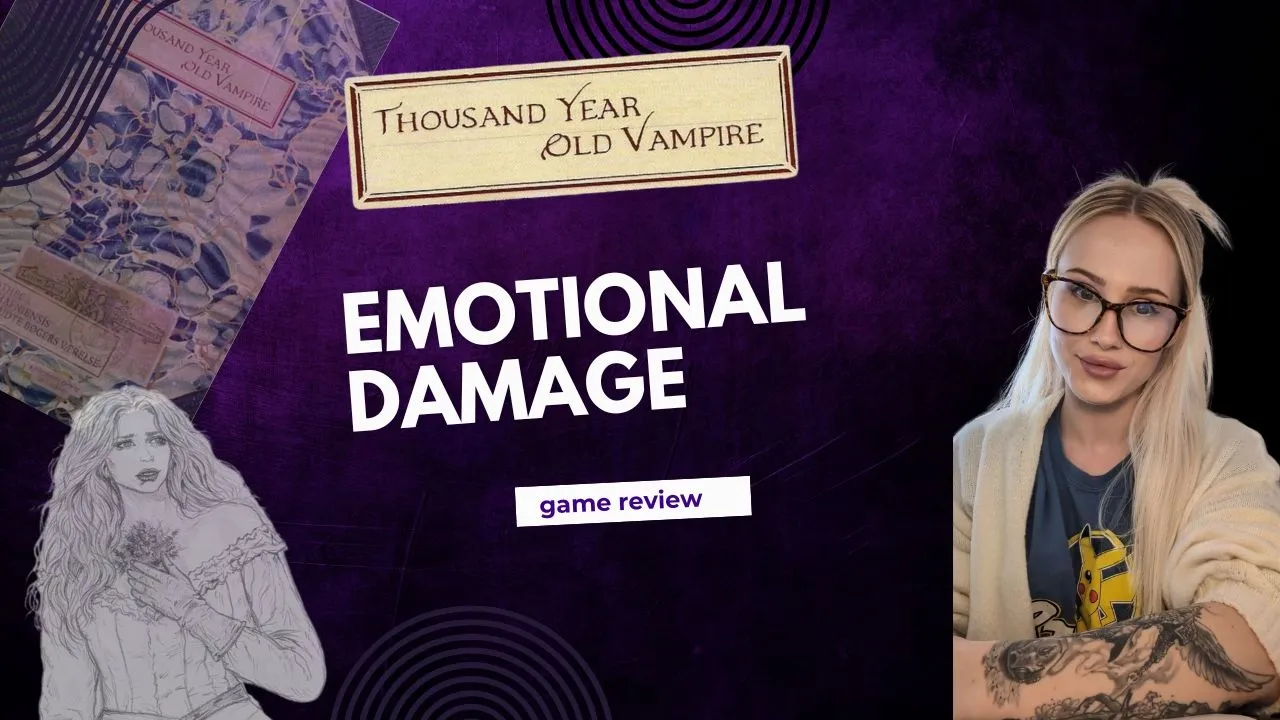
Adapted with AI from Alex's video of 21 March 2026 and checked against the video before publication. Editorial standards · Corrections
More from @ajm_nerdcore
All →


Make videos? Your next one could be an article here.
We turn your videos into articles under your name, linked back to the original. You keep 60% of what they earn, non-exclusive, and you can leave whenever you like.
Become a SubPlotter →