Dial of Destiny ending: why Indy staying in 212 BC feels wrong
Sending Indy to 212 BC with nothing left to live for makes a powerful scene, but it breaks down a hero fans still want to look up to.
 Beyond The Trailer (AI-assisted)26 November 2026Editor: Digital Fox Talent Editorial TeamOn YouTube since 2008 · more than 930,000 subscribers

The ending of Indiana Jones and the Dial of Destiny is shocking and divisive. I've been torn about it, and it haunts me, but I think it's all wrong for Indiana Jones. The 2023 film, starring Harrison Ford, Phoebe Waller-Bridge and Mads Mikkelsen, sends Indy back to 212 BC, and what he tries to do there is what I can't shake. Spoilers follow.
Dial of Destiny drives Indiana Jones to his lowest point
To understand the ending, you need to understand the beginning. The whole film is about getting Indy so low that he makes the decision he does at the end. They put him through the wringer, and I felt so bad for him. I thought it was quite depressing, and it put me in a funk that lasted into the next day.
Archaeology is no longer respected, though I wonder if it ever was. The franchise made it seem like a rock star profession, and museums still need things in them, so it makes no sense to me that it's suddenly uncool. Instead everybody is looking to the stars, meaning space, which I find interesting. Even more ironic, the United States used Nazis to get to space, the very people Indy has been fighting. I wish they'd done more with that. The visual scope is small, with scenes in small rooms, but intellectually the film is broad. All these clever ideas are roaming around, and it won't let us out to explore them.
Dr. Jones is also being forced to retire again. That could have been an interesting statement about forced retirement, but he looks so happy to leave that you can't make that argument. I thought, what a jerk. His students weren't nice to him, though his colleagues seemed kind. Not one student is into archaeology, and nobody seems to know who he is. Wasn't he world famous?
Then it gets bleak. His son was killed in Vietnam, and that loss drove Indy and Marion apart. They married at the end of Kingdom of the Crystal Skull, and now they're divorcing. Indy lives alone in a tiny New York City apartment with rude hippie neighbors. I was on his side there, since they were blasting music at eight in the morning. And what happened to his father's lovely house from Last Crusade? I don't know why he didn't live there after the divorce. Did Marion get the house? That's how much I cared: I wanted to roll up my sleeves and look through his assets, because his life is a mess.
Indy chooses to stay in 212 BC with Archimedes
At the end, they travel back to 212 BC. Set photos of Indy running around with Roman soldiers had somewhat spoiled it, but it was interesting to see. He meets Archimedes, who built the dial, and decides to stay behind. It's his dream to witness history firsthand, like so many people who get lost in history books as they get older.
Helena tells him he can't stay, because he's been shot and there's no medicine there to save him. Indy asks her "what or who do I have left to live for." The look on Harrison Ford's face will haunt me. I think that's a fear everyone has: to end up alone, forgotten and, perhaps worst of all, abandoned.
Why Hollywood keeps breaking down Indiana Jones, Han Solo and James Bond
Hollywood did the same to Han Solo, another Harrison Ford character, who divorced Leia over a problem with their son. It's the exact same plot. Luke Skywalker had this done to him, and so did James Bond in the last Bond movie. Why break these characters down?
I have a few theories. Is it to wrestle the franchises away from them so they can be handed to new actors and characters? Is it a misguided extension of Nolanism, the idea after The Dark Knight that audiences love dark, dramatic blockbusters? Does it reflect older filmmakers and actors? Harrison Ford and Daniel Craig have been very influential on their characters' fates, whereas Tom Cruise is current, modern, forward looking and upbeat. That makes a big difference, and I much prefer it.
Are older filmmakers and actors putting their insecurities and fears into these movies? Is it ageism, because Hollywood can't fathom a senior citizen who isn't depressed? I personally think it's all of these things, and it's a mistake. As a character gets older, the fandom gets older too, and they still want a fun character to look up to and relate to.
Dial of Destiny's time travel has no fantasy to it
We've seen plenty of time travel, from Back to the Future to The Flash, which was inspired by it. I thought it was neat that this film had no fantasy to its time travel. It felt like entering another time, underscoring that humans have always stayed the same and only technology, style and society change. That fascinated me.
When Indy says he'd like to stay, or Mads Mikkelsen's Voller shouts in horror that he can't be stuck there, you feel both emotions intensely. Flying over the battlefield reminded me of the DK picture history books I enjoyed growing up. It was intriguing and horrifying, and it stuck with me. Voller is killed. The Romans weren't messing around, particularly with Archimedes' advanced weaponry, some of which he apparently did invent, and they were up against 1969 technology, not today's.
Helena knocking Indy out is Phoebe Waller-Bridge's best moment
My audience burst into applause when Helena knocked Indy out to get him back on the plane to 1969 before the anomaly closed. Her third act monologue is by far Phoebe Waller-Bridge's best moment in the film. For once she seemed to care about Indy, and about anybody. She won't leave him to die, but she won't let him destroy the timeline by messing with history either. I loved it.
In this one instance, knocking him out was warranted. He was having a nervous breakdown, time was of the essence, and the lives of everyone who lived after 212 BC were in danger. I thought she did it well. But the look on Indy's face, at so low a point that he'd stay even though it meant he'd die, will probably haunt me forever. It was devastating, a horror to behold, and I don't want to see that in an Indiana Jones movie.
The film should have shown how Indy lost his son and Marion
I wish I'd seen the personal moments that got him this low; maybe it would have felt more earned. Clearly they didn't want to bring Shia LaBeouf back, which I understand, but I'd have liked to see Indy and Marion get the notice that their son had died, maybe the funeral, and maybe a montage of them growing apart. I know they wanted to open with the de-aged action sequence, but I think this should have been shown.
I was very pleased Marion returned at the end, reconciling with Indy through a callback to their "where does it hurt" scene from Raiders of the Lost Ark. But the final shot of them old and retired in his small apartment was depressing, almost like they were in a tomb themselves. Indy and Marion were adventurers; that's why they worked so well together. I'd much rather have seen them go on this adventure with Helena and Sallah, the way they were in Raiders, not with the National Lampoon's Vacation vibe of Crystal Skull.
Indy turning his back on Sallah felt cruel
Besides the sadness, I didn't like the negativity. At the airport, Sallah gives a moving speech: he misses the desert and the ocean, has his passport with him, and wants one more adventure with his old friend. The old Indy would have said let's go. Here Indy dismisses Sallah, just as he's being dismissed by others. It would have worked if Indy had pointed out that Sallah has a beautiful family, including grandchildren, to live for, and that the mission was dangerous. Instead he turns his back on a friend who has saved his life countless times. It felt cruel and disrespectful.
Giving his retirement clock to a homeless man wasn't well done either. What is a homeless man going to do with a heavy desk clock? Its value was sentimental, from colleagues who seemed to have put thought into that gift. It was mean to both.
Dial of Destiny's commentary on racism felt sloppy
It was devastating to see Agent Mason shot point blank when she was just trying to do her job. Even more powerful was Voller's conversation with the hotel employee delivering his room service, with a menace and dread that were genuinely scary. But I'm not sure what the point was. Maybe they were showing that Nazis were also horrible racists, or adding dread, but I think they never made it mean anything; it felt inserted and abandoned.
Those were the only characters of color, particularly the Black characters, in a franchise that has always had little diversity, and when it has had some, it has in hindsight been somewhat offensive. I think those scenes make the franchise seem even more like it's not for new audiences. Kudos to the actors, though, particularly the man who played the room service employee.
The de-aged Harrison Ford opening and the train sequence
The opening takes place in 1944 with a de-aged Harrison Ford. Not changing his voice as well as his face breaks the illusion, and his performance is like he is now, not the lighthearted, self-assured fun of his younger days. They smoothed out his face, but he's not fooling anybody. And how many times will Nazis fall for Indy stealing a uniform and sneaking in? Then a U.S. bomb saves him from hanging, which reminded me of Wanda's origin with the Stark bomb, but he's thrown around with the rope still around his neck. I'm pretty sure that would have killed him.
The coolest thing on the train, in my opinion, was the anti-aircraft gun going out of control, its fire streaking across the night sky and taking out the back of the train. The whole sequence felt like the new Mission: Impossible meets Extraction 2, 1940s style.
Helena, the ticker tape parade and Tangier
Helena is a thief who creates chaos for Indy, a setup almost identical to Tom Cruise and Hayley Atwell in the new Mission: Impossible, though Waller-Bridge is far less charming and sympathetic. A Tangier crime boss being madly in love with her is ridiculous. The film's lack of understanding of her appeal is shocking to me, and since she was reportedly involved somewhat behind the scenes, I don't think she understands her sweet spot either. We're told the dial drove her father mad and that she blames Indy for letting him keep it rather than putting it in a museum, but we never see it. She seems spoiled and entitled.
I liked the ticker tape parade a lot: astronauts in a car contrasted with an archaeologist on a horse, the past versus the future. It was the seed of a great idea that wasn't allowed to bloom, but the falling confetti was something fresh. None of Tangier worked for me. The hotel was clearly a sound stage, and the auto rickshaw chase was bland and went on too long.
The deep sea dive and Archimedes' tomb
The deep sea dive wastes Antonio Banderas, who now seems to constantly channel Puss in Boots. I liked the eels, underwater snakes, though I felt bad for a terrified Indy. I also liked Helena decoding the tomb's location while buying time for an escape, and Indy calling her joy cruel since his friend had just been murdered. The bugs callback in the caves made no sense in the story and felt like a Temple of Doom callback for its own sake. Opening the tomb by displacing water to activate levers was elegant in its simplicity.
They got me with the coffin. I didn't realize the watch was Voller's, or that the dragon's propellers came from his plane. Like Indy and Helena, I assumed Archimedes had time traveled himself. Instead the dial was built to bring help during the Roman attack, though Archimedes was killed in that battle. It's a one way ticket to the Battle of Syracuse, which makes no sense and is overly complicated, but I was so caught up that I breezed past it. Wouldn't that leather wristband have degraded over two thousand years, though?
Not the right direction for Indiana Jones
The casting of Archimedes and his era was excellent, and the horror on the Nazis' faces when they realized they were stuck in 212 BC was right up there with opening the Ark in Raiders. That's classic Indiana Jones. But I don't feel this is the right direction. Across many franchises, I feel the people making these movies don't understand why the characters became popular, and they should only hire people who are fans of the material. Nobody wants to see their beloved characters destroyed.
Fans still want a hero they can look up to and relate to. If you show them something bleak, it better be worth it and exceptionally well done. James Mangold, this was an interesting story, but I don't think you needed to hijack Indiana Jones to tell it. You already did it in Logan.
What other creators are saying
More on Harrison Ford →Mostly nobody under 30 saw Dial of Destiny because the franchise never recast an aging Harrison Ford, skipped a reboot like James Bond got, and turned Indy into a broken old man audiences didn't want to watch, leaving younger viewers with no connection to the character.
Indiana Jones: why did nobody under 30 see Dial of Destiny? →
From a hidden C-3PO hieroglyph to a fake Nazi coat hanger gag, here are the production secrets and references behind the first Indiana Jones film
Raiders of the Lost Ark: how Indiana Smith became Indiana Jones →
From River Phoenix's Boy Scout prologue to the invisible bridge and a final shot borrowed from John Ford, Spielberg's most personal Indy film is packed with details that are easy to miss
Last Crusade leap of faith: how does the invisible bridge work? →
Watch the original
@beyondthetrailer · YouTube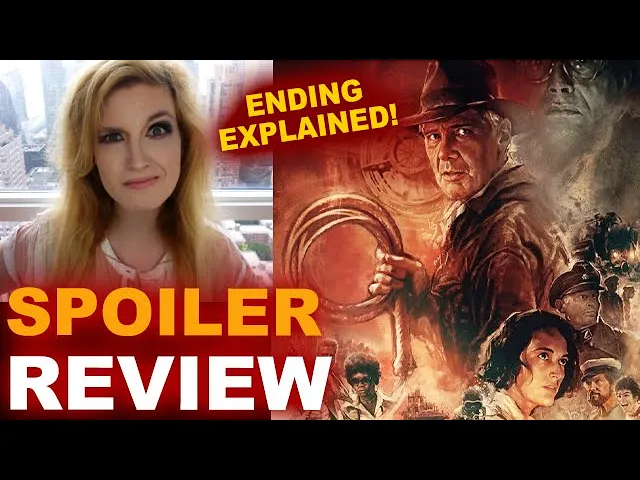
Adapted with AI from Beyond The Trailer's video of 30 June 2023 and checked against the video before publication. Editorial standards · Corrections
More from @beyondthetrailer
All →


Make videos? Your next one could be an article here.
We turn your videos into articles under your name, linked back to the original. You keep 60% of what they earn, non-exclusive, and you can leave whenever you like.
Become a SubPlotter →