Pixar theory: is Boo the witch in Brave's timeline?
How a fan theory links Brave, Toy Story, WALL-E and Monsters, Inc. into one looping timeline, and why its wildest idea centers on Boo
 ChaosTrek (AI-assisted)16 November 2026Editor: Digital Fox Talent Editorial TeamOn YouTube since 2024 · more than 15,000 subscribers
The Pixar universe theory has been around for years. It's the idea that every Pixar movie shares one connected storyline. My question is whether there's any truth to it, or whether we just want it to be real. The theory builds to a twist involving a little girl and a time traveling witch, and that twist could change how you see these films.
In simple terms, think of it as a secret timeline where each film fits into a larger, ongoing narrative. According to the theory, it begins far in the past, ends far in the future, and loops back to the beginning. It's like Pixar made a series of standalone great movies, but "if you squint really hard, you can see this epic saga that hides underneath it."
The Pixar theory says Brave's magic made animals and objects sentient
The key concept is sentience. Nonhumans, meaning animals, toys, cars and monsters, gradually become intelligent and self-aware. Along the way, animals start talking, toys come to life, machines take over, and humans take a bit of a backseat.
What kicked it all off, according to the theory, was magic from Brave, the film with Merida and her mother who becomes a bear. That magic is said to be the spark that eventually gives animals and objects life. It's a pretty cool theory, but getting from medieval magic to space age robots means connecting many dots.
The timeline from The Good Dinosaur and Brave to The Incredibles
According to the theory, the timeline of the Pixar universe spans millions of years, and it's wild in a good way. The first stop in the distant past is The Good Dinosaur, an alternate prehistory where dinosaurs and early humans coexist.
Then the timeline jumps to the 14th century with Brave, where magical wisps and an eccentric witch introduce magic into the world. That magic matters because it's allegedly what makes animals act human and objects come to life later on.
Next comes the mid 20th century and The Incredibles, set in a retro 1960s style period. It shows humans with powers, and it even hints at intelligent AI if you remember the evil robot and the smart Omnidroids in that movie.
Toy Story, Finding Nemo, Ratatouille and Up show nonhumans catching up
By the 1990s and 2000s, we're in familiar territory. These films take place in a world much like ours, except animals and toys are far smarter than they should be.
Is it a coincidence? The theory says no. It's that magic driven evolution of intelligence continuing in the background. We see a rat cooking gourmet meals in Ratatouille, fish plotting escapes in Finding Nemo, and sentient toys dealing with their own society in Toy Story. According to the theory, these are all signs that nonhumans are catching up with humans.
Buy n Large, WALL-E, Cars and Monsters, Inc. close the loop
Meanwhile, an ominous corporation called Buy n Large, or BNL, keeps popping up. It's the big bad in WALL-E that eventually ruins the environment. By the time of WALL-E, humans have left Earth a wasteland, and this is where the machines take over. Cars fits here, with vehicles that have a society of their own, possibly after humans are gone.
Finally, centuries later, comes Monsters, Inc. In the theory, it's set in a future where animals have evolved into monsters and humans are legends of the past. The monsters time travel through magical doors to harvest energy from human laughter in the past. It's wild when you put it on paper. From there, the timeline comes full circle, which leads to the twist.
The Easter eggs fans use as evidence: the Pizza Planet truck, A113 and BNL
It's a cool story, but what evidence is there that these movies are connected? Pixar is famous for sprinkling Easter eggs and nods between its films, and fans have latched onto those clues to build this grand timeline.
The Pizza Planet truck from Toy Story appears in almost every other Pixar movie, even Brave, set centuries ago, where it's a carved wooden truck. The code A113 shows up on license plates, classroom doors and in many films. It's an inside joke among Pixar animators, but in universe it could be a recurring motif tying things together.
Buy n Large is another big one. Its logo and products show up not only in WALL-E but also in Toy Story 3, on Buzz's batteries, and in Up, in the construction company that wanted Carl's house. That suggests one giant company present across multiple storylines, steadily gaining power. There are also cross references to characters, such as the little girl in Monsters, Inc. having a Jessie doll from Toy Story, and Finding Nemo's fish appearing in Monsters, Inc. as toys. These could be fun cameos, but the theory uses them as glue to connect each movie's world.
The WALL-E plant and the tree in A Bug's Life
One of my favorite subtle clues is in WALL-E. The plant that WALL-E finds grows into a big tree, and it looks an awful lot like the tree the bugs live under in A Bug's Life. Is it a coincidence? I don't know. Is it proof that A Bug's Life happens on Earth after humans come back? Maybe.
The evidence is obviously indirect, but it's enough to keep fans looking for more. Pixar has confirmed it loves hiding interconnected Easter eggs, though it stopped short of confirming a single timeline plot. Still, there are plenty of little connections that make you think these movies might share a universe.
The Boo theory: did the girl from Monsters, Inc. become the witch in Brave?
The twist the whole theory builds up to is about Boo, the toddler from Monsters, Inc. According to the theory, Boo isn't a random kid. She might be the key to the entire timeline, by growing up to become the witch from Brave.
The theory speculates that after Sulley leaves Boo at the end of Monsters, Inc., she becomes obsessed with finding her friendly monster again. She remembers that doors can travel to different times or places, since the monsters were time traveling every time they entered a door to the human world. So Boo spends her life figuring out how to use magic to travel through time and dimensions, eventually winding up centuries in the past. There she masters magical abilities and becomes the mysterious witch in Brave.
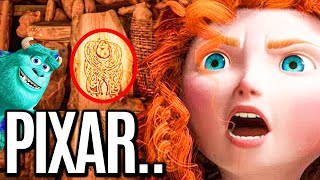
The clues fans point to: the witch in Brave disappears suddenly through a door, just as Boo did. Her cottage is full of carved bears, and Sulley was a big, blue, bearlike monster to Boo. She even carved a figure that looks a lot like Sulley in one scene, an Easter egg eagle eyed fans caught. In the theory, it's a full circle moment. Boo's magic in the past starts the chain of events that gives animals and objects life, which leads to the future where Monsters, Inc. takes place.
Why I think the Boo twist is the coolest part of the Pixar theory
It's definitely the most far-fetched part of the Pixar theory, but I think it's the coolest, too. The twist ties the whole timeline into a giant loop and, to me, gives it a heartfelt motive: "A little girl searching for a friend." Whether you buy it or not, it's an example of fans engaging deeply with the films. I love it because it makes Boo's story bittersweet and epic at the same time. Boo might be the reason the Pixar universe exists.
If the theory were true, how would it continue, and how would it pay off? I don't know. Are all Pixar movies one gigantic timeline puzzle that starts in Brave and ends in Monsters, Inc.? I don't know that either. At the end of the day, the theory is an entertaining way to rewatch these movies from a new angle.
I don't think it ruins any story. If anything, it adds an extra layer of what if when you spot a familiar object or logo in the background, and maybe that's what Pixar was trying to do the whole time. Will there be some culmination event at the end of the Pixar run? Probably not, but "It's always fun to speculate."
Watch the original
@chaostrektv · YouTube
Adapted with AI from ChaosTrek's video of 22 August 2025 and checked against the video before publication. Editorial standards · Corrections
Also on Pixar Theory
2 creators, 2 takes →

More from @chaostrektv
All →


Make videos? Your next one could be an article here.
We turn your videos into articles under your name, linked back to the original. You keep 60% of what they earn, non-exclusive, and you can leave whenever you like.
Become a SubPlotter →