VisionQuest theory: is Ultron based on Doom's father?
Episodes 5 and 6 push Ultron and Vision closer to humanity, reveal Tony Stark bought his AI tech, and leave one big question: who is Ultron's human face?

I think I might know where Tony Stark got the inspiration for Ultron, and it's all connected to Wanda Maximoff, multiversal dreamwalking and, of course, Doctor Doom and Doomsday. Before I get to that theory, I want to share my thoughts on episodes 5 and 6 of VisionQuest, because its further exploration of Ultron keeps delivering. In so many ways, we're seeing Ultron become more and more human.
VisionQuest, the Marvel Studios series starring Paul Bettany and James Spader, is proving to be one of the most thoughtful projects I think Marvel Studios has ever produced. I don't only mean as superhero television. I mean as a piece of science fiction, as a character study, and as a story about artificial intelligence at a time when AI is becoming an increasingly significant part of our everyday lives.
Ultron grows up in VisionQuest and starts finding his humanity
When we first met Ultron, he was essentially a child. He had been exposed to the entirety of human history and, within minutes of being born, decided humanity needed to go. That was his most direct, mechanical, surgical answer to the problem Stark and Banner had tasked him with solving. As he put it back then, "I've come to save the world."
Now, all these years later, we're seeing Ultron all grown up. He's beginning to develop something I don't think he ever expected to experience, and that's humanity. I mean humanity in the sociological sense, not the biological one, and I think we're going to learn it can be found in far more than a human being.
Humanity developing inside an android, a synthezoid as VisionQuest calls them, is something the original Vision already encountered. We saw glimpses of it in Captain America: Civil War and Avengers: Infinity War, and now this new Vision is going through it too. There are some beautiful moments in episode 6 where that humanity begins to bleed through.
What makes this so interesting is that the exact opposite is happening with Jocasta. Vision and Ultron are two artificial beings slowly becoming more human, while Jocasta, who was human, is becoming more and more like a machine in how she understands the world. I think that's the central philosophical conflict the series is tackling: what does it mean to be human, what does it mean to be AI, and what does it mean to be?
James Spader's Ultron is still arrogant, but loneliness is showing through
I've said this before, but James Spader has brought so much emotional depth to a character who on the surface is incredibly arrogant, sarcastic and at times downright cruel. What's remarkable is that none of those traits have gone away. He's still very much Ultron, the same guy who tried to wipe humanity off the face of the earth. But he has evolved, aged and grown up.
He's still capable of being a monster, yet underneath the arrogance we're beginning to see something resembling loneliness, insecurity, affection and maybe even love, and therefore humanity. Episode 5 explores this well through Ultron's conversation with Tommy. Tommy is understandably furious that Vision has been hiding Ultron in his head, and Ultron, being Ultron, takes advantage of that.
He plays on Tommy's insecurities about his father, about whether Vision loves him, and about whether an artificial intelligence can experience love in the first place. What's interesting is that Ultron himself doesn't seem to have a satisfying answer. He can explain love and understand its biological and psychological mechanics, but can he experience it? That's the question.
Take the apple conversation. Ultron explains to Tommy how Vision can identify every component that makes up an apple: the water, the sugars, the acids. That's set against what an apple is in the human mind, the experience of eating and tasting it. That distinction becomes incredibly important a little later.
The taste scene in episode 6 is a standout for Spader
In episode 6, Jocasta allows Ultron to experience the sensation of taste, and I can't overstate how much I loved this scene. For the first time, Ultron isn't simply analyzing the chemical composition of alcohol or taking part in some simulation, as he calls it. Because Jocasta has a real memory of human taste, she can share it with Ultron in ones and zeros, and he experiences what it feels like to taste.
The writers deserve a tremendous amount of credit, but the look on Spader's face here is phenomenal. He sips, takes it in, sits down and sips more. His performance is so subtle and at the same time abundantly clear. Everything going through his mind, you can see right on his face. I thought it was well done, and it's another step in Ultron becoming more human.
Ultron's reaction to Tommy in danger shows he cares about the boy
The most revealing moment for Ultron comes when Tommy is in danger. When Ultron realizes what's happening, his immediate reaction is about the boy, and I love that. It tells us Ultron cares about Tommy. Not because Tommy is strategically important or useful to him, but because somewhere along the way Ultron has developed an emotional attachment to this kid. That was already hinted at earlier in the season, when Ultron tells Vision to tell Tommy he can't come with them.
The same is true for Vision. He has been struggling with his own identity throughout the series, and now he's confronted with Tommy, his son, who desperately wants a father. Vision is trying to figure out whether he's capable of being that father. That's why I found the moment Vision finally sees Tommy again so moving. You can see the emotion on his face and hear it in his voice.
The show keeps asking whether artificial intelligence can be human, but perhaps that's the wrong question. Maybe the more interesting question is whether something needs to be human to experience love, grief, loneliness or happiness. I think VisionQuest is making a pretty compelling argument that the answer is no.
VisionQuest reveals Tony Stark bought the MCU's AI technology
I think Jocasta is one of the most fascinating additions to this story. Unlike Vision and Ultron, she knows what it means to be human. She has lived a human life, experienced loss and grief, and her entire scientific career was motivated by an incredibly noble desire to help people.
These episodes also bring an interesting revelation about the origins of AI in the MCU. Tony Stark wasn't the creator of this tech. He bought it. The original work was being done by a biotech group building on the earlier research of Phineas Horton and the development of Proto One. For years we've assumed Tony was the father of modern AI, with Jarvis, Ultron, Friday and Edith all tied to his genius. Now we learn the foundation existed before he got his hands on it.
Does that undermine Tony's legacy? No. He built an Iron Man suit in a cave with a box of scraps, developed technology that revolutionized the world, figured out time travel and ultimately helped save the universe. Innovation works a lot like evolution, with tiny things building on one another over long periods. Even the iPhone stands on the shoulders of decades, perhaps centuries, of other people's work. There's something interesting about Tony taking existing technology and pushing it further than anyone imagined.
Proto One may explain Vision's voice and face
Still, there's something significant about Tony not being the original creator of these AI minds. If he didn't write the original source code, who or what gave these machines their personalities? That's where Proto One comes in. We're learning that Vision's own artificial intelligence is connected to this original source code, and that his voice and even his human avatar may have their origins in that very first AI.
The repeated line "I am" echoes Vision's first words in Avengers: Age of Ultron, and that was Paul Bettany's voice. Bettany voiced Jarvis in the early days of the MCU, and we've always chalked up Vision sharing Jarvis's voice to the fact that Jarvis was used to create Vision. But it would appear that Jarvis, while based on Tony's childhood butler, was pulling his voice from Proto One. We could also learn that Vision's avatar is based on Proto One. As for who Proto One's appearance was based on, we shall see.
Jocasta's plan to make humanity think as one
Jocasta's big plan to cure humanity is to make us think as one, connecting our minds into a single collective consciousness. On the surface you can understand the appeal: a world where people genuinely understand each other, where misunderstandings are impossible, where hatred, prejudice and violence could be eliminated, and where nobody ever has to feel alone. It sounds almost utopian.
The problem is what happens to the individual, the uniqueness that makes you you. If everyone thinks as one, nobody thinks for themselves, and I think that would rob humanity of a key piece of what humanity is. Philosophically, we're essentially seeing a debate between individualism and collectivism. Jocasta believes our greatest weakness is our individuality, our conflicting desires and competing beliefs, and she wants to remove the conflict entirely.
Vision and Ultron, in their own ways, are discovering that individuality is precisely what makes existence meaningful: your own thoughts, feelings, experiences, privacy and relationships with other people. This reminds me of Pluribus, the Apple TV+ series from Vince Gilligan, who made Breaking Bad and Better Call Saul. I haven't finished it, but it explores humanity connected through a collective consciousness and whether a world without disagreement or suffering is better if the cost is individual freedom. I love that we're getting these stories now, because I think they're asking questions that are going to become increasingly relevant as AI becomes more a part of our daily lives and our information keeps being collected and pulled together into one thing.
Easter eggs: Tommy as Speed, Madripoor and Raza
These two episodes also carry plenty of Easter eggs and references. Tommy calls himself Speed, which is his hero name in the comics. We return to Madripoor. Raza from the first Iron Man film is back. Lots of good stuff.
Who is Ultron based on? My philosophy professor theory
Now to the big question: is Ultron based on Tony and Doom's biological father? And no, I'm not talking about Howard Stark. At some point we have to learn who Ultron is based on, and I don't buy that Ultron picked this design himself. Somewhere deep down, Ultron either knows or has subconsciously chosen this avatar because there's a connection to an actual human being.
As with the other AIs, I've talked before about how I think we could learn this guy was a professor or something, with that classic Stark snark, and he could be the man Tony picked up that sarcasm from at a young age. I'd love to find out Ultron was based on a philosophy professor Tony didn't like at first because he found philosophy a waste of time. Then this man got through to Tony, they became close, and Tony modeled much of his adult self on him. If that's the case, this guy is probably long dead.
The wilder theory: Wanda's vision, Tony Stark and Werner von Doom
But what if it goes deeper? What if Ultron doesn't know who he's based on because Tony didn't know who he based Ultron on, at least not on a surface level? Right before Tony creates Ultron, he sees a vision that we've speculated could retroactively be revealed as a multiversal vision of Doom's threat to the Avengers rather than Thanos's. Tony comes out of it saying, "And I'm the man who killed the Avengers."
We've learned two things in the Multiverse Saga. Dreams are visions into your variants' lives in other realities. And Wanda Maximoff, unknowingly at the time of WandaVision, had access through her hex magic to the code of the multiverse. She created avatars for her children's souls based on what they look and behave like in other universes, even down to their names. Billy and Tommy were unknowingly based on real people out there in the multiverse. So what if Wanda's hex magic on Tony in Age of Ultron, and the vision that led to Ultron's creation, are all connected?
I've said before there's comic precedent for this, and I think Tony Stark is adopted. I think the Starks likely miscarried and adopted a boy from a war torn, impoverished Sokovia. Had the Starks not adopted him, he would have grown up to liberate that country, become its ruler, rename it Latveria and go by his birth name, Victor von Doom. That would also mean Wanda wouldn't have grown up in Sokovia but in Latveria, perhaps as a witch of Doctor Doom.
So what if that vision was a glimpse at Tony's variant life, on a subconscious level, like a dream you can't remember? What if, beyond the vision, Tony saw his biological father, Werner von Doom, the father of Victor von Doom? And what if that's why Tony and Ultron are so alike: not because Ultron is like Tony, but because Tony is like Ultron, like his old man. Could this be a reveal in the final episode of VisionQuest, setting the stage for Robert Downey Jr.'s return as Doctor Doom in Avengers: Doomsday? Could Ultron join the fight against Doom, his son? Probably not. But I had fun with this one, and I'm having fun with this show.
What other creators are saying
More on James Spader →Firewall and Deadlock paid off the face theory, overturned two of my calls, and gave Ultron and Jocasta a story about becoming human from opposite directions
VisionQuest episodes 5 and 6: Ultron's fourth key explained →
In Deadlock, Ultron pursues a synthetic woman whose AI is built on a scientist from the project, but she outsmarts him with a virus, calling their encounter chess rather than a meal. The twist is that Ultron reportedly feels love for the first time through this strange, artificial-trying-to-be-real romance.
James Spader's Ultron keeps winning us over, but the new AI villain may be the more frightening one
VisionQuest episodes 5 and 6: is Ultron heading for redemption? →
Jocasta wants control because she believes human nature, with its greed and chaos, is a flaw that must be reprogrammed rather than cured. Her nanobot hive mind would remove human will and autonomy, overriding people like a remote, which is why she pursues power over genuine healing.
Watch the original
@coltonogburnchannel · YouTube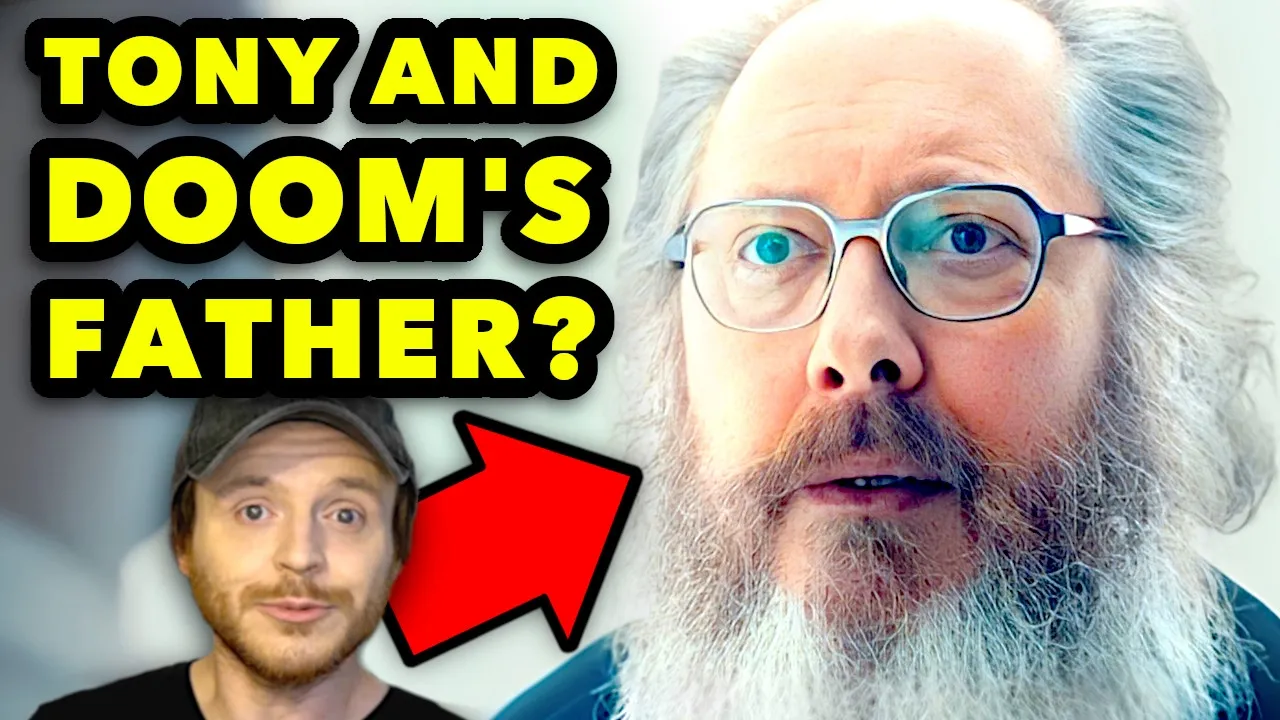
Adapted with AI from Colton Ogburn's video of 31 October 2026 and checked against the video before publication. Editorial standards · Corrections
More from @coltonogburnchannel
All →


Make videos? Your next one could be an article here.
We turn your videos into articles under your name, linked back to the original. You keep 60% of what they earn, non-exclusive, and you can leave whenever you like.
Become a SubPlotter →