The Dark Knight: what does the Joker's makeup reveal?
From melted eye paint to a possible green screen cover up, Heath Ledger's painted face may hint at the Joker's untold story

In The Dark Knight (2008), starring Christian Bale and Heath Ledger, the Joker's makeup is a living painting that hints at an untold story about his supposed madness. I believe the truth of his origin lies hidden in plain sight on his face. I promise there's one specific detail hidden in the Joker's makeup in his most chilling moment that makes this analysis worthwhile. The most chilling moment is when Ledger's Joker alters his scar story, signaling that he's a wild card in the vein of Alan Moore's The Killing Joke.
To this day we don't know who this Joker is or where he came from, and Ledger's makeup is essential to that mystery. The Dark Knight remains the best superhero film adaptation of all time and one of the biggest summer game changers. Every rewatch unearths new details.
The Dark Knight opens with fire and a Gotham built from Chicago
All three of Christopher Nolan's Batman films open with the Batman sigil formed by the elements to frame the hero's coming trials. Batman Begins uses swarming bats for Bruce embracing his fear. The Dark Knight Rises uses cracking ice for Bruce breaking through Bane's frozen Gotham. Here it's fire, the Joker's tool. He burns cars, hospitals and half of Harvey Dent's face, and his whole message is that everything burns. That's why Alfred's solution is to fight fire with fire, a callback to Ra's al Ghul saying a purging fire is inevitable and natural.
Nolan wanted Gotham to be the principal character, using the Chicago skyline, the elevated train and streets like Lower Wacker Drive. It's a microcosm of society, and its pristine facade is marred by a shattering window on a sunny day. That's the point: Gotham is a normal looking American city about to explode. The Joker stands on a street corner in broad daylight and no one bats an eye.
Costume designer Lindy Hemming said the gang would have gotten a box of plain white masks and each decorated their own. The Joker's mask resembles one worn by Cesar Romero's Joker in the 1960s Batman series. But this Joker is a painter who uses his own face as a canvas. His external mask is a sad clown, while his internal mask is always smiling, a walking paradox of tragedy and comedy. Hans Zimmer's Joker theme starts as a single D note on electric cello, and Zimmer experimented with razor blades on piano wire. The same sharp edge that gave the Joker his scars created his music.
Poker, two jokers and game theory in the Joker's bank heist
A thief says "three of a kind," a poker hand, and poker is a recurring motif. The Joker's address for Harvey and Rachel, 250 52nd Street, plays on the numbers two, five, zero, five, two. There are 52 cards in a deck, not counting two jokers, so the Joker's plan is to double the wild card, with Harvey Dent as the second Joker. The evidence bag label for the Joker's calling card from the end of Batman Begins carries a name matching one of the Joker's comic aliases, maybe a clue pointing to this Joker's origin as a police patrolman.
The opening heist, where the Joker plays five thieves against each other, is an example of the pirate game from game theory. The most senior pirate bribes the weakest to conspire against the others so he can take the biggest share. The last pirate standing besides the Joker is the bus driver, who one would argue is probably the weakest. Ra's al Ghul manipulated corruption and infrastructure, and Bane manipulated financial elites, but the Joker manipulates regular scared folk. He comes from broad daylight on the sidewalk. He's a face in the crowd, and that's what makes him so scary.
William Fichtner plays the bank manager, who also appeared in Michael Mann's Heat, a major tonal influence. This robbery is closer to Heat's climactic downtown LA bank robbery, and both films feature midpoint interview scenes where opposing figures pick each other apart. Like Heat, The Dark Knight vastly underestimates the weight of a cash filled duffel bag, which would weigh somewhere around 350 pounds.
The Joker's Glasgow smile and the red detail in his makeup
The Joker's first line, "whatever doesn't kill you simply makes you stranger," seems to indicate past trauma. I think we can read it differently: what doesn't kill in these movies is Batman, so the Joker is joking that Batman made him stranger. The music on his face reveal goes from D to C, a possible DC reference. Overall the film is mostly devoid of Easter eggs, because Nolan uses attention to detail to keep you in the scene.
The Glasgow smile was formed by three pieces of stamped silicone. Prosthetic supervisor Conor O'Sullivan told Empire he thought back to the punk and skinhead era and a delivery man near his workshop with a Glasgow smile, who said he got it in what he called a dog fight. O'Sullivan didn't ask further, so the origin stays a mystery. Nolan chose not to define the backstory, as a nod to The Killing Joke and to avoid humanizing a character meant as a force of chaos.
Nolan was obsessed with Francis Bacon's paintings. Makeup artist John Caglione Jr. had Ledger scrunch his face into a wide smile so the makeup cracked when he relaxed, meaning Ledger held that face for an hour every morning. Ledger smeared the makeup on himself for the first camera test, and the team recreated it daily, though he always applied the red lipstick. Because his bottom lip was prosthetic, he developed a habit of licking it.
I always notice a splotch of red on the far right of the smile, separated by a bit of white, which makes it look like that part of the scar is actively bleeding through. You can also see white paint on his fingers and under his nails in every scene. To me that gives a completely different context to the slight changes in his makeup scene to scene, and to how much preparation he put into each step of his plan.
Heath Ledger's Joker performance and the school bus escape
Ledger's costume was inspired by Iggy Pop and Adam Ant, his vibe a bit of Alex from Stanley Kubrick's A Clockwork Orange, his voice a bit of Tom Waits. But this was a singular psychology he formed by holing up alone in a hotel room for a month. Many believe he paid a price for this role. Ledger died from an accidental overdose in January 2008, and the film arriving after his death gave his performance an eternal, spectral quality.
The Joker guns down the bus driver without looking, echoing a line from the graphic novel The Man Who Laughs: "he didn't even look at them like killing them wasn't even important." That title comes from Victor Hugo's novel and its 1928 film adaptation, whose character has a similarly forced smile. Driving the school bus back into traffic is a bit silly, but the theatricality works, and Nolan mixes in kids' voices from other buses. The production even designed Gotham plates to look like Illinois plates so background cars would blend in.
Gordon, Ramirez and Harvey Dent's White Knight problem
Gordon lights the bat signal so criminals think Batman might be out there, a preventative fear tactic that makes the criminal class more paranoid and desperate. An early line about Ramirez needing to look after her mother establishes her as vulnerable, and the second half hinges on her decision to kidnap Harvey Dent. Cillian Murphy's Scarecrow returns, his drugs driving people to bug out, the damaged souls the Joker will recruit. The copycat Batmen recall the Sons of Batman from Frank Miller's The Dark Knight Returns, and Nolan shoots these early action scenes in daylight and a brightly lit garage, improving on Batman Begins.
Gordon and Batman arrive at the mob scene over 24 hours later, telling us the mob regrouped before reporting it. The Joker's security photo is dated July 18, 2008, the film's release date. In court, a witness pulls a carbon fiber gun on Dent, recalling The Long Halloween's acid attack. Dent's response: "If you want to kill a public servant, Mr. Maroni, I recommend you buy American." It shows an American everyman like the Joker will do far more damage.
I just think we forget Dent starts the film as kind of a manipulative jerk. His double sided coin takes the lead in the Maroni trial ahead of a more prepared Rachel, and he says it won his first date with her. At dinner, Bale channels Patrick Bateman as a test, but Dent doesn't take the bait. "You either die a hero or you live long enough to see yourself become the villain" refers to Julius Caesar and foreshadows Dent's fate. Dent believes only martyrs can redeem Gotham, laying down the film's thematic gauntlet for Bruce. The ballerina covers half his face with white paper, foreshadowing his disfigurement.
Melted eye paint suggests the Joker hid in the kitchen for hours
Ramirez is the last detective into the raided bank, hanging back. At Lau's meeting, the mobsters enter through the metal detectors, but the Joker enters through the kitchen at the back. Yes, he could have bought someone off, but at this point he's still an unknown to all of them, so I just think he was patient. The black paint around his eyes has melted, and I think he was sweating in a cramped oven for over 12 hours.
His pencil trick is a transorbital intracranial penetrating injury. His suit line shows he was eavesdropping. He tilts his head forward so the whites beneath his pupils contrast with the black makeup, a pose from someone who's spent time testing his face in a mirror. When Gamble calls him crazy, he twitches and snaps back. His offer to kill Batman for half fits the shrinking pie game: each seizure of profits shrinks the pie, so 50 percent is actually generous, which is why he thinks he's not crazy.
The rooftop, Hong Kong and the Joker's father story to Gamble
I realized it was Dent who lit the bat signal, and Gordon arrives gun drawn. Dent the idealist, Gordon the realist and Batman are all paranoid that the Joker is taking advantage of the daylight in between them, though Dent is right that Ramirez leaked the raid. Nolan orbits the camera clockwise, reminding me of Spielberg's Brody, Hooper and the mayor in Jaws, with Batman as Hooper. Lucius recommends the CIA's real Skyhook, also seen in Thunderball, and jokes the armor works against cats, recalling Batman Returns and Talia al Ghul in Rises.
Playing a corpse for Gamble, the Joker's white and black makeup has melted, since he wanted to look dead, but his lipstick is bright red and fresh. He uses "crazy" to describe his father, paying back Gamble's earlier word, and pops the T again. At the end he shifts his eye line to Gamble's lieutenant, revealing the story is for the man he wants to recruit. The snapped pool stick dropped among three lieutenants mirrors his plan for Gotham's three heads.
Hong Kong shows the height of Batman's power, since in every other action scene he takes a beating or loses. His time bombs count down from two minutes and 23 seconds and detonate in real time.
Two jokers, the fundraiser and Rachel's warning signs
Dent's RICO case against 549 criminals stuns the gangs with steep bail, the same kind of overwhelming crisis the Joker uses. The judge finds a Joker card in her docket, and since traces of her DNA are later found on a clue, someone close to her may be in his network. Ledger shot the copycat's handheld message himself, set in a butcher shop with hanging pigs, the Joker calling Batman a pig. You can hear him licking his scars behind the camera.
Alfred's "not yet" about Rachel's whole life foreshadows her death. Some say Bruce's three dates reflect CMYK printing colors. I don't know about that; I think Bruce wanted to play the rich jerk. Both he and the Joker toss drinks, playing party goers who probably hate parties. As the judge's car explodes, the crooked cop smiles and says boom. The Joker eats like a dog because of his scars, and Senator Patrick Leahy cameos.
A possible green screen in the Joker's scar story to Rachel
When the Joker grabs Rachel's face, Nolan switches the orbiting camera counterclockwise, which makes this moment especially disorienting, and I maintain it's the most unnerving part of the film. He changes his scar story to scarring himself for a wife, so we can't trust anything he says, and we feel Rachel's discomfort.
I could be wrong, but Ledger and Maggie Gyllenhaal look so sharply in focus that Nolan may have shot the spin on green screen. A bit of moisture beneath the Joker's nose catches the wall's light, and I think that wet spot reflected green screen and was keyed out. When he leans back his makeup is faded and his hair looser, so I think we're back on the penthouse set. That makes me wonder if Ledger did a dozen close ups with a dozen backstories, and his multiple choice origin could be even more multiple choice than we thought.
What other creators are saying
More on The Dark Knight →Audiences may not have been tired of the genre itself, just of films that gave them no reason to buy a ticket
The Real Cause of Superhero Fatigue May Not Be Superheroes at All →
From Rachel Dawes in Gotham to Qui-Gon Jinn in the Phantom Menace, these are the deaths that triggered wars, collapsed kingdoms and released monsters across their universes.
Watch the original
@deepdivenr · YouTube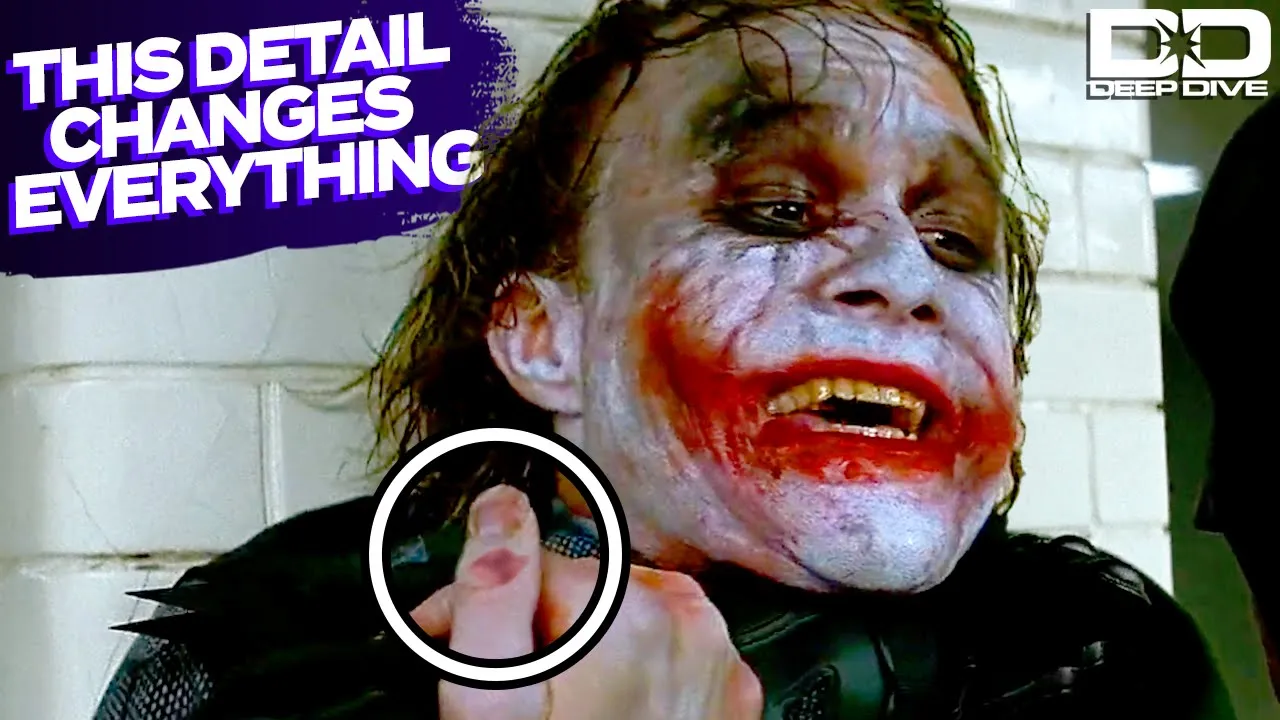
Adapted with AI from The Deep Dive's video of 16 August 2023 and checked against the video before publication. Editorial standards · Corrections
More from @deepdivenr
All →


Make videos? Your next one could be an article here.
We turn your videos into articles under your name, linked back to the original. You keep 60% of what they earn, non-exclusive, and you can leave whenever you like.
Become a SubPlotter →