Silo theory: is Juliette descended from Daniel and Helen?
A pregnancy, a zoom on Juliette's face and a name in Victor's message have fans asking whether Juliette carries Daniel and Helen's bloodline

Silo has me thinking Juliette and Helen could be related, and that Juliette might be a descendant of Daniel and Helen. I find the idea plausible, and the show has given it a meaningful foundation. Even so, I'm more convinced that Helen will shape Daniel's next decision than I am that Juliette inherited their blood.
The series, Silo (2023), stars Rebecca Ferguson as Juliette. Daniel is the man known in Silo 1 as Troy, and the theory asks whether the woman standing against Silo 1 is part of the life he was supposed to live before the project took it from him.
Daniel's zoom on Juliette's face started the Silo family theory
Look at the way Daniel zooms in on Juliette's face. It suggests he is thinking of her as someone who resembles a person he knows, at the same moment the story is also centered on Helen. That is what gave rise to this theory. Even Juliette's rebelliousness hints that Helen's blood runs in her veins.
If she is connected to Helen in some way, Daniel may be about to kill his own family without knowing they are his family. We know Helen was heading to Silo 18 carrying Daniel's child, which gives the theory credibility. That is the unsettling possibility behind the finale's comparison between Troy and Juliette.
A family tree is something Silo hasn't given us, unlike other shows. If the series is about to build one now, reaching back to the before times, that would be a wild move.
Episode 9, Goodbye, puts Helen's potential child in Juliette's silo
In that episode, Daniel and Helen compare their assignments. She asks which one is his, and he answers that he is 1. Her pregnancy has already been confirmed, so the separation places their potential child inside Juliette's silo while Daniel enters the silo he will control. That gives the descendant theory something more substantial than a facial resemblance: a possible path from one generation to the next.
What interests me in that exchange is how ordinary the numbers feel to them. They are simply planning where they will go when the event happens. For us, those assignments divide a family between the people who live under the rules and the people who enforce them.
For Juliette to descend from both of them, their child has to survive, have descendants, and eventually connect to her family. From what we know so far, the show has withheld the evidence we would need. That could change, but for now this is an idea and it remains only an idea. It is a theory, and a good one, because even if it isn't confirmed by the end of this season, the next season could finally give us the evidence we have been looking for.
If the numbers hold, more than 350 years separate Helen from Juliette
Because this is a theory, we can't say Juliette is the granddaughter of Daniel, and we don't know how many generations lie between them. Cryosleep lets Daniel reach a later era without living through every year in between, which makes it feel as though we are talking about something that happened only yesterday.
That isn't possible if we believe the numbers on display. We are talking about more than 350 years. So even if Juliette is related to Daniel, the show has a lot to explain, including a family tree stretching across more than 300 years, although we aren't certain of the timeline. The show would need to tell us how the two connect, and so far nothing tells us how many births link Helen to Juliette.
Daniel's apparent age can't do that job. As funny and strange as it sounds, he is an ancestor who should have died centuries ago.
The Troy and Juliette comparison works as a rivalry
All of this began mainly with that visual comparison. Our attention is drawn to the gazes of Troy and Juliette, and we read that as a sign of shared ancestry. I've seen many people state it outright, but if we rely on that alone, we could be completely wrong. We need something more, such as a record that names Helen's child and shows how it connects to the Nichols family. If that happens, we could say the giant face on the screen and those looks were evidence for the theory.
Still, the two of them work very well as a comparison between adversaries. Juliette and Troy try to anticipate each other's moves. Both understand the other can change tactics when the first plan fails. The visual similarity can stress that they are matched in determination even when their immediate goals are incompatible.
Their conversation at the door deserves to be tested by that standard. Troy moves from a death threat to offering a compromise after Juliette challenges the power behind his warning. Nothing in that exchange identifies her as family. The dialogue gives us a negotiation between two people measuring what the other can really do.
I wouldn't read that concession as Daniel instinctively recognizing his descendant. He has a direct, practical reason to buy time and discourage further investigation. If the show later confirms the connection, the scene would gain a painful irony: they were negotiating without knowing what bound them. But that future meaning is different from claiming Troy already senses the truth. The audience noticing a possible link doesn't mean the character has noticed it too.
Graham Yost and the memory parallel between Juliette and Daniel
There is a more personal similarity that has already been established. Both have had their memories interfered with. Graham Yost explained that Troy's storyline in the book helped steer the writers toward Juliette's memory loss story. He also described the persistence of Daniel's feelings for Helen as central to what they were doing. That gives the memory parallel support from the executive producer himself. It doesn't confirm a blood relationship, at least not yet.
I think this comparison makes the finale more disturbing. We followed Juliette as she tried to recover herself. Now we are looking at a man whose usefulness depends on how much of himself stays out of reach. She shows us it is possible to resist that control. He shows us how damaged a person can become while still functioning brilliantly under it.
The shared experience also gives them a possible basis for understanding each other later. Juliette won't need a family tie to grasp what was done to Daniel. Whether she can trust him once she grasps it is a much harder question. Understanding someone's harm doesn't make standing beside them safe.
For me, the strongest part is what discovering descendants could do to Troy
That brings me to the part I find strongest: what discovering descendants could actually do to Troy. Victor tells him the project is meant to free us from the past. At the end, Victor's message supplies the name he previously withheld. Her name is Helen Drew.
Those moments belong together. At first, the past is treated as something Troy must let go of. Later, Victor gives him a specific person to look for. I see that name as something about to change the kind of problem Daniel faces. He has history with the name that has just been put in front of him. He can ask where she went, what happened to her, and why the people around him made those questions forbidden.
The danger to Silo 1 begins with that inquiry, before he even knows whether she had descendants. If one of them turns out to be Juliette, the reveal would join his public actions to his private loss. He would have been helping preserve an institution that threatens everything left of his future. That would be a cruel outcome of the separation in Goodbye.
But suppose Helen had a child whose descendants are ordinary residents we have never met. Daniel's realization could still be devastating. There could be many descendants, or none still alive. Each possibility would confront him with a life that went on, or ended, while he was being used somewhere else. Juliette doesn't have to be the last of Helen for Helen's story to matter. Calling her that now would add another unproven claim to a family connection that is already unconfirmed.
The candy dispenser isn't proof of Juliette's ancestry
The candy dispenser raises a similar issue. Its link to Helen and its place in the later story make it an attractive symbol of continuity. But the show also ties it to George and Juliette. An object reaching someone doesn't prove its previous owner was their ancestor.
The dispenser can connect people through a history they recover together. It could even point to someone else's family. We need to know its ownership history before treating it as evidence about Juliette specifically.
What Shift says about Donald Keene and Helen
Book readers have their own reason to slow down here. In the novel Shift, Troy is Donald Keene, the counterpart of the show's Daniel. Helen's later life includes another marriage and children with another man. Donald's loss is about discovering the life he missed rather than returning to the family he remembers.
That book history doesn't confirm that the show's Juliette is a descendant of both Daniel and Helen. An adaptation can change that history, and this one has already made choices that reshape these relationships. But we have to be fair. The book offers a precedent for lost love, severed identity, and a future Helen lived without Donald. The pregnancy and the visual comparison in the show provide the basis for the descendant theory. They aren't interchangeable pieces of evidence.
What I take from Howey here is the cruelty of mismatched time. One person is put back to work again and again while the people he loved have to live real lives. You can preserve a body and still rob the person of everything they wanted that body to experience. A descendant reveal would give that loss a living face, but it wouldn't be the only way to express it.
Charlotte's refusal to attack Silo 17 makes me cautious about blood fixing Daniel
There is also a scene in the finale that makes me cautious about expecting a biological bond to fix Daniel. Susan is Charlotte, his sister. When she refuses to attack Silo 17, saying she won't do it, Troy removes her from command and tells her she's fired. The episode puts real relatives together, and their relationship doesn't stop them from making opposing choices. Neither acts from a clear understanding of that relationship.
That refusal matters because Charlotte is responding to the people being targeted. She doesn't need proof they are her family for their deaths to be unacceptable. Compare that with the imagined future scene where Daniel discovers Juliette is his descendant. If the reveal changes him, I want the story to question how far that change goes.
Does he want an exception for his family only? Or does realizing what he nearly did to them force him to reconsider everyone he was prepared to kill? Those outcomes would make him a very different ally. A man who protects one relative might still accept a system that threatens everyone else. A man who understands why that system is wrong has to face his role in it. A family revelation might start that reckoning, but it shouldn't finish it for him.
Juliette's standard of protecting everyone
Juliette herself offers a useful comparison. Her argument for attacking Silo 1 includes the possibility that we can protect everyone. The reach of that statement matters. She is thinking beyond the residents whose faces she knows, and beyond the people who share her immediate danger.
That is the standard I'll hold Daniel to after he recovers. Juliette widens her responsibility to include others. If he becomes her ally, his concern has to extend beyond the one person who gives him a reason to care. Otherwise, their possible family reunion could shrink a story that has just become much bigger.
I also don't want lineage to become the explanation for Juliette's growth. Her skill, stubbornness, grief and loyalty have a history we followed together. We don't need to discover that mechanical ability or resistance to authority runs through some exceptional bloodline. A family reveal should complicate her relationships and decisions. It shouldn't replace the reasons she became the character we see today.
What would convince me Juliette is Helen's descendant
So what would move me from interest to conviction? A surviving record that links Helen's child to Juliette's family. A remembered account backed up by another detail. A discovery that carries more weight than one more meaningful look. It wouldn't take a scene listing every generation, just something that sets Juliette apart from the other possible descendants.
For now, I think the finale draws a deliberate comparison between Troy and Juliette. Lineage is one compelling reading, memory is another, and a standoff between two strong adversaries is a third. These readings can coexist. We don't have to reject the family theory to admit the finale works without it.
What makes the possibility worth discussing is the choice it could force on Daniel. The system kept him alive while cutting him off from the people who may have given that survival meaning. If Juliette belongs to that lost family, he might finally understand the threat from the other side. But the moment I'm waiting for isn't Daniel seeing his own eyes in someone else. It's Daniel looking at the people he was ordered to kill and deciding their lives matter even if he sees nothing of himself in them.
Watch the original
@filmparadise · YouTube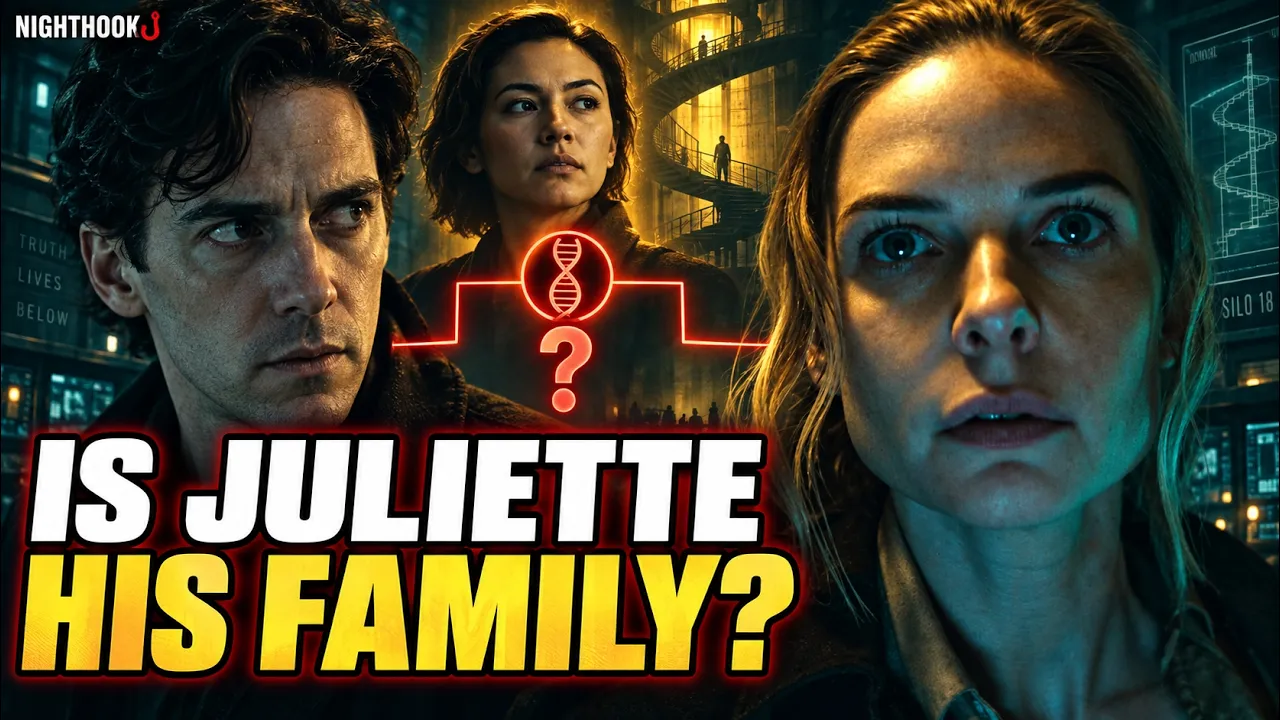
Adapted with AI from Film Paradise's video of 8 September 2026 and checked against the video before publication. Editorial standards · Corrections
More from @filmparadise
All →

Make videos? Your next one could be an article here.
We turn your videos into articles under your name, linked back to the original. You keep 60% of what they earn, non-exclusive, and you can leave whenever you like.
Become a SubPlotter →