House of the Dragon episode 4 shows why Targaryens are the ultimate power players
A masterclass in political intrigue, family drama, and character work that sets up the rest of the season.
 Kristian Harloff (AI-assisted)18 July 2026 · Editor: Digital Fox Talent Editorial Team
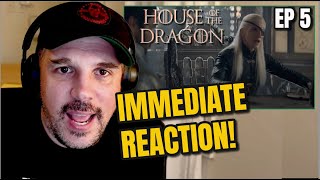
House of the Dragon continues to captivate with its fourth episode, a chess match of politics and personal ambition that deepens every major character's arc while moving the central conflict into dangerous new territory.
Rhaenyra's awakening
The episode opens with Rhaenyra on her suitor tour, bored and detached as potential husbands arrive to win her hand. She's not presented as purely good or noble. Instead, she has an edge, finding amusement in the proceedings and the fights that break out among her suitors. This complexity makes her far more interesting than a simple hero character would be. When a young knight kills another suitor and Rhaenyra essentially shrugs it off before boarding her ship, we see someone shaped by her privilege but also someone chafing against the constraints placed on her.
Daemon returns with a crown
Daemon arrives at King's Landing with a fresh haircut and newfound confidence, having already conquered the Stepstones. He's killed his rival and cut his body in half, taken a crown for himself, and sailed back as though he's just returned from a casual errand. His brother's initial disapproval shifts quickly into approval, with one caveat: stay away from Rhaenyra.
That restriction lasts about as long as it takes for the two to lock eyes. The chemistry between Rhaenyra and Daemon has always been present, and now it ignites. He takes her into the streets of King's Landing in a scene that echoes Aladdin, showing her that the common people already talk about her, already fear her potential rule. He tells her something she needs to hear: if she wants to rule these people, she has to care what they think.
Control and desire
In the brothel, their encounter reveals something crucial about Daemon's psychology. He doesn't stop because he suddenly feels guilt or realizes he's wrong. He stops because Rhaenyra begins to enjoy herself, and once she's no longer under his control, he loses interest. He came to dominate her, and the moment that power dynamic shifts, he withdraws. It's a disturbing detail that speaks volumes about his character.
After Daemon leaves, Rhaenyra seeks out Ser Cristos, the guard, and demands he remove his armor. What follows is a comedic bit about how absurdly complicated medieval armor is, but it also shows Rhaenyra now acting on her own desires rather than those imposed upon her.
The king's judgment
When King Viserys learns what's happened, he doesn't simply punish his daughter. Instead, he takes command with surprising clarity. He confronts Otto Hightower about spying on Rhaenyra, calling out the hand's ambition to place his own grandson on the throne. Viserys has been underrated as a character throughout the season, but his longer scenes reveal a man trying to hold a fractious family and kingdom together. He's not the strongest king, nor the best warrior, but he understands the game.
Alicent, the queen, also confronts Rhaenyra about her actions. Rhaenyra swears that Daemon never laid a hand on her, which is a lie. He did touch her. What's true is that they didn't have sexual intercourse, but the lie reveals Rhaenyra's willingness to bend the truth when necessary.
A dynasty's solution
Viserys ultimately makes his decision: Rhaenyra will marry her cousin Laerys to unite the houses. It's a solution that preserves both his daughter's future and the stability of the realm. As a condition, he removes Otto Hightower as hand, recognizing that the man's judgment is compromised by his ambition. The king tells his former hand exactly why: everything Hightower did, including the spying, pushed Rhaenyra toward rebellion in the first place.
Daemon is banished again, though everyone knows he'll return. The message he wanted to send to the king was clear: let me marry her. The answer is no, but the answer to a different marriage is yes.
The cost of duty
The episode also explores the contrast between Rhaenyra and Alicent through parallel scenes. While Rhaenyra experiences passion and excitement, Alicent lies in bed with the king, performing her duty without passion. As queen, she's locked in a castle, doing exactly what she never wanted to do. The contrast highlights what each woman has become and what they might yet become.
Otto Hightower emerges as the show's true schemer, the Littlefinger of this world. His removal won't stop his ambition. It will only redirect it, setting up conflicts for the rest of the season.
The power of storytelling
What makes this episode work is how deeply it dives into character and consequence. Every line of dialogue, every moment of hesitation or reaction, builds the political landscape. Even when characters aren't on screen, what others say about them deepens understanding. The title House of the Dragon feels earned here, not as a superficial reference but as a thematic anchor. This is about legacy, about conquest, about a family that holds power through dragons and through blood.
Four episodes in, the show has established a foundation of intrigue and character work that promises the remaining episodes will be shaped by what happens here. The personal choices made in this episode will have kingdom-wide consequences.
Watch the original
@thekristianharloff · YouTube
Adapted with AI from Kristian Harloff's video of 12 September 2022 and reviewed by Digital Fox Talent before publication. Editorial standards · Corrections
Also on Entertainment
5 creators, 63 takes →




More from @thekristianharloff
All →

Make videos? Your next one could be an article here.
We turn your videos into articles under your name, linked back to the original. You keep 60% of what they earn, non-exclusive, and you can leave whenever you like.
Become a SubPlotter →