Dragon Ball GT ending explained: Goku doesn't die
Why Goku survives Omega Shenron, feels no pain, and leaves on Shenron's back with the Dragon Balls, traced to a Taoist belief called Ascension to Heaven in Broad Daylight

For more than two decades, Dragon Ball fans have argued over the cryptic ending of Dragon Ball GT, and my answer is that Goku doesn't die at all. What happens to him is a Taoist idea called the Ascension to Heaven in Broad Daylight. To me, GT has the best ending of any of the old Dragon Ball anime.
Dragon Ball GT (1996) ended with episodes 62, 63 and 64. All three were written by Toei writer Atsushi Maekawa and originally aired on November 5, November 12 and November 19, 1997. I'd stress that anyone checking these episodes should see them in the original Japanese, because that's imperative to following what happens.
Episode 62: Goku swallows the Four Star Dragon Ball and Nuova Shenron turns good
At this point in the story, Goku and Vegeta are battling Omega Shenron, their toughest foe in GT and the final boss of the series. Episode 62 lays the groundwork for the last two episodes, and some very interesting events happen in it. First, Goku loses his Super Saiyan 4 power and shrinks back into his kid body. Then the Four Star Dragon Ball appears on Goku's forehead and physically manifests as the fire dragon, known as Nuova Shenron in the English dub.
Because he was born from the Four Star Dragon Ball, the ball most personal to Goku since it represents his grandfather and Goku's love for him, he's what I'd call the most honorable of the evil dragons. Before the ball appeared on his forehead, Goku had swallowed it, and that plays an important role here. It may have seemed at first that the fire dragon would join his brother and torment Goku and Vegeta, but it's a big swerve, and it seems this time the dragon is completely a good guy.
How did that happen? It's not that difficult to figure out. Goku has been described as pure of heart from the very beginning of Dragon Ball. When the Dragon Ball was infused with Omega Shenron, it was consumed with negative minus energy. When Goku swallowed it, his heart was so pure that he cleansed the ball and turned that into positive plus energy. That's why the dragon that came out was benevolent and willing to fight his own brother. He failed, though, and Omega Shenron returned to full power, leaving Goku and Vegeta in serious trouble.
Episode 63: Goku survives Omega Shenron's blast and fires the Super Ultra Spirit Bomb
Episode 63 is probably the most eventful episode when it comes to understanding the ending. Omega Shenron is ruthless and can't be stopped. He fires a blast at Goku, who tries to block it with his hands, not unlike his struggle with pure Majin Buu at the end of the Buu arc in Dragon Ball Z. This time there are no Dragon Balls to restore his energy, so Goku uses his sheer will and every ounce of energy inside him to stop the blast and keep the Earth from being destroyed.
Goku shouldn't be powerful enough to block it, but out of sheer will he does, and we even hear an Oozaru growl in the background. A huge explosion leaves an enormous crater where Goku stood. He saved the Earth but was seemingly killed, and several statements from the characters all but confirm he's dead. Omega Shenron floods the Earth with minus energy, Vegeta and the others fight him, and the destruction continues because he's too powerful.
Then Goku's voice is heard gathering energy for a Spirit Bomb, and he rises from the crater alive, holding a gigantic universal Spirit Bomb. It may not have seemed as big as the one against Kid Buu, which is up for debate, but it's packed with positive energy from the entire universe. One statement Goku makes here is essential: he says he can't die until he wins this fight. Is that sheer will, or is there more?
The Spirit Bomb's positive energy cleans up the negative energy Omega Shenron had spread across the Earth. Omega says Goku should be dead and blasts him, but Goku feels nothing. With help from the four Kais of the four quadrants, his voice carries across the universe, which gives him energy. Genki represents good health and positivity, the opposite of Omega Shenron's negativity and evil. Omega asks who Goku is. The attack, called the Super Ultra Spirit Bomb in the Japanese version, destroys him. Then the Dragon Balls light up and the dragon emerges, although nobody summoned him.
Episode 64: Shenron ends the Dragon Balls and takes Goku away
There's a lot of mystery in the finale of the original run of the Dragon Ball anime. Bulma senses something is wrong because the sky doesn't darken when the dragon appears, as it does every other time. Shenron tells Goku to rise. We learn that this world and the next world becoming one is why the evil dragons appeared. People relied too much on the Dragon Balls, so the dragon won't let them be used anymore. He's very authoritative, and there's no bargaining with him.
As a final request, Goku asks the dragon to revive the people who died in the fight with the evil dragons. Shenron does, then asks Goku to go with him. Goku somehow knows exactly where they're going. He asks the dragon to stop so he can visit his friends and reminisce. Master Roshi and Krillin are puzzled by his state as he vanishes. He doesn't seem like the same Goku, almost like a different person. He even goes to Hell to say farewell to Piccolo, who is also puzzled.
Mysteriously, Goku's clothing is left behind for his granddaughter, yet we see him wearing his clothes, sleeping on the dragon's back as the Dragon Balls appear to absorb into him and the dragon vanishes. Goku isn't seen again for 100 years. After that time skip, an elderly Pan sees Goku, or a vision of him, fully grown, at the tournament as Goku Jr. and Vegeta Jr. fight. He smiles and walks away. He also appears to his descendant Goku Jr. in the Goku Jr. special. The series closes on Goku remembering his adventures, from meeting Bulma to his battles with Frieza, Cell, Majin Buu and Baby. That was the end of Dragon Ball in anime form until Dragon Ball Super in 2015.
Dragon Ball GT borrows from Eastern religion and philosophy
Dragon Ball, and anime as a whole, borrows many concepts from Eastern religion and philosophy, and GT is no different. Knowing this is essential to understanding the ending. Very little of it is on the internet; much of it is only in books at the library, which is probably why this ending confuses so many people.
Start with the Eternal Dragon. When Kamisama recreates Shenron in Dragon Ball, he performs a Shinto ritual, which implies the dragon is made of light, an idea discussed often in Taoism and Asian literature. Dragons are light beings, and the ancient Asians believed multiple dimensions and realms existed on the planet. So the home of Shenron, Porunga and the other dragons is some kind of alternate dimension, and it's implied the Namekians were the first to discover it. That predates the Zalama lore from Dragon Ball Super, so I'm setting that aside here.
Goku isn't dead: the Ascension to Heaven in Broad Daylight
So, did Omega Shenron kill Goku at the end of GT? No. He may seem dead, but he isn't. His closest friends could tell something was different about him, though. In episode 62, his pure heart purged the minus energy from the Four Star Dragon Ball. But what did the Dragon Ball do to Goku? Keep in mind he was the first person pure of heart to swallow one.
What happens to Goku is the Taoist belief called the Ascension to Heaven in Broad Daylight. Taoists believe you die, come back to life and look the same, but you're not really dead. Taoism describes two consciousnesses, the main and the subconscious. The key in meditation and the occult is that your knowing self dies and your true self awakens. In Taoism you must eliminate your physical form for your true self to rise, and you must be virtuous and pure hearted. Not many Dragon Ball characters fit that, but Goku unquestionably does.
So when Goku rises from the crater, this is Goku in his ascended body. He looks young, but he's immortal, perfected in body and mind. You can compare it to Jesus rising from the grave in the New Testament and other texts, but in Dragon Ball it's an Asian idea. That's why Omega Shenron's attacks don't hurt him. Nothing can hurt Goku, especially something made of negativity, when he's flowing with positivity.
Goku's celestial body and his unspoken bond with Shenron
One could say the Dragon Ball infused into Goku gave him this ability, but I think something else happened. This ascended Goku is made of a super matter that produces light, a celestial matter. He fights Omega Shenron with a celestial, immortal body because the dragon and the Dragon Balls became one with him.
That's why, when the dragon returns at the end of episode 63 and in episode 64, there's a kind of mind meld, an unspoken understanding between him and Goku about what had to happen next, given the misuse of the Dragon Balls and the battle it led to. Through the Dragon Ball's synthesis, the dragon realized Goku was pure of heart and worthy of the celestial body.
Why Goku leaves on the dragon's back for 100 years
Remember that dragons are creatures of light. Taoists believed deities descend from heaven and are brought back to heaven by dragons. Dragons connect heaven and Earth, and when you ascend, you ascend on top of a dragon, as Goku does in episode 64. Riding a dragon shows mastery of nature and ascension beyond being mortal.
So Goku, with his new immortal body, left Earth with the dragon for the dragon's version of heaven. That's not the Dragon Ball afterlife with the check in station and King Yemma, but a separate dimension for the dragons. He wasn't to be seen until the time was right, and he chose to return 100 years later to see his descendant fight with his own eyes. Goku knew exactly what he had to do, what it meant, and why he had to leave with the balls so they wouldn't be used again.
Why I think GT has the best ending of the old Dragon Ball anime
Dragon Ball is a Japanese product, and Akira Toriyama isn't solely responsible for its concepts and its grounding in Eastern philosophy and religion. In Japan, this knowledge is probably very common or something people study as children. I assume most people outside Japan have never heard of the Ascension to Heaven in Broad Daylight, and that wouldn't surprise me.
Dragon Ball GT has a beautiful ending. It's very satisfying and very poetic, and it's so rich in philosophy and culture that it took a long time to decode Goku's ascension into an immortal body, how it works and where it comes from. To me, it's the best ending of any of the old Dragon Ball anime.
What other creators are saying
More on Goku →Doom Slayer has killed god-tier beings in his own lore, but Goku's Ultra Instinct speed and scaling put him ahead in this matchup.
Working through the reasoning behind Super Saiyan God, Super Saiyan Blue and the returning red haired form during the Tournament of Power arc.
Dragon Ball Super: why Goku keeps switching Super Saiyan forms →
Watch the original
@geekdom101 · YouTube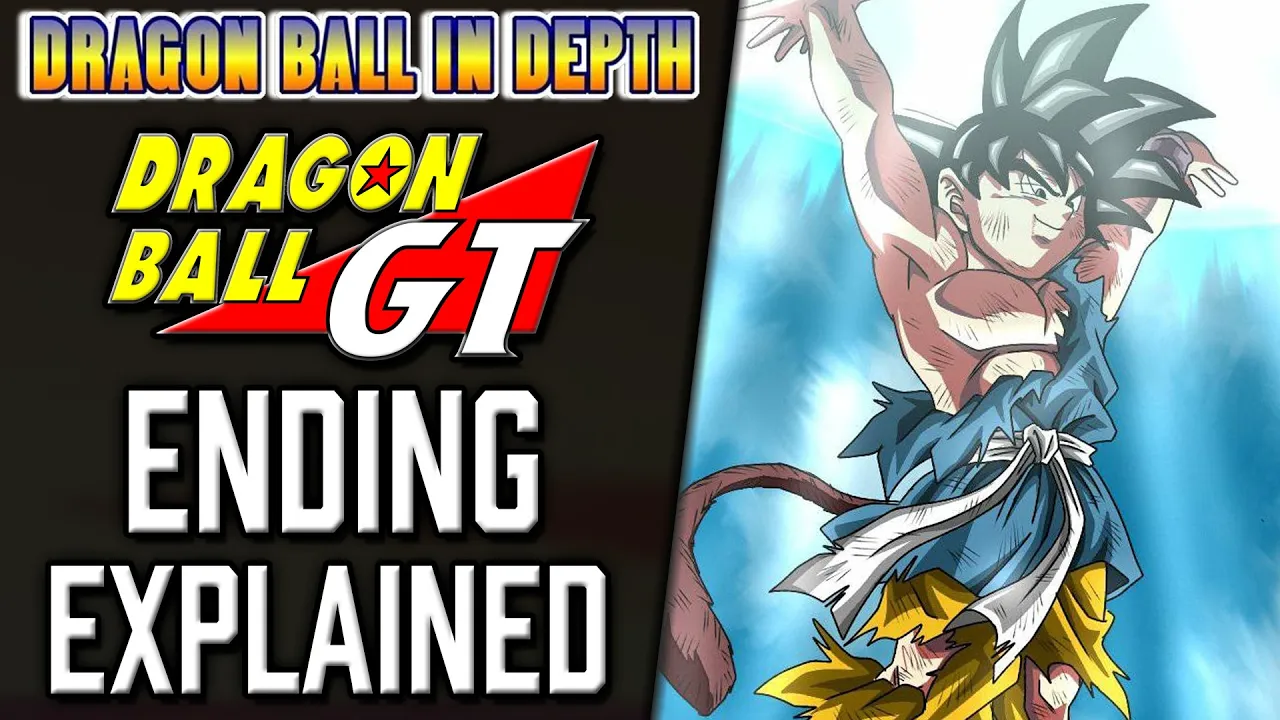
Adapted with AI from Geekdom101's video of 14 November 2020 and checked against the video before publication. Editorial standards · Corrections
More from @geekdom101
All →
Make videos? Your next one could be an article here.
We turn your videos into articles under your name, linked back to the original. You keep 60% of what they earn, non-exclusive, and you can leave whenever you like.
Become a SubPlotter →