E.T. making of: why Spielberg saw the aliens as plants
From a plant-based alien race and a 380 dollar voice performance to Star Wars toys, Reese's Pieces and an ending shot in order, here is how the film came together

This is a breakdown of Steven Spielberg's beloved 1982 film E.T. the Extra-Terrestrial, starring Henry Thomas, Dee Wallace and Drew Barrymore. In this breakdown I go scene by scene through the film's origins, its casting, its creature effects and the symbolism I think Spielberg built into Elliot's world.
The film has its roots in a much darker science fiction film, Spielberg's Close Encounters of the Third Kind. After that film became a huge success, Columbia Pictures wanted a sequel. Spielberg was enthusiastic about the idea at one point but later soured on it, and he also didn't want Columbia to make a Close Encounters sequel without him.
Spielberg saw E.T.'s race as sentient plants from outer space
The film opens in a Los Angeles forest as short, brown aliens gather plants. They appear to be intergalactic space botanists, with a ship full of plants from other planets, including a sentient plant whose face moves as it groans. Spielberg had production designer James D. Bissell make a foam latex recreation of one of the murderous plants from the 1963 film The Day of the Triffids to sit in the background. That would have been a fun crossover if the plant hadn't been cut.
Spielberg viewed E.T.'s entire race as vegetable-type plants that evolved enough to travel between planets and study their flora. That's why E.T.'s insides look more plant-like than mammal-like whenever his chest glows. Those glowing shots were inspired by the transparent xenomorph eggs in 1979's Alien, specifically the scene where John Hurt's Kane inspects the see-through eggs before a facehugger attacks. We first see the aliens' chests glow when they sync up on high alert at the sound of an owl hooting nearby.
Ralph McQuarrie's mothership and its Kelly-Hopkinsville rainbow
Concept artist Ralph McQuarrie, who worked closely with George Lucas on the original Star Wars trilogy, also designed E.T.'s mothership. He shaped it like a diving bell to underscore that E.T.'s race comes from a green and humid planet. He gave it legs that let it squat as it lands, reflecting how E.T.'s people can condense their bodies into a squat. He made it round and mirror-like so nature and the stars would reflect off it, underscoring how much the aliens value life and the cosmos.
The ship's rainbow trail appears to be a nod to the Kelly-Hopkinsville incident. One supposed witness apparently saw a glowing silver object in the sky, "real bright with an exhaust all the colors of the rainbow," before it dropped near their house. Spielberg originally wanted the ship to land in a vacant parking lot, but screenwriter Melissa Mathison convinced him a forest would make for a more appropriate atmosphere.
Peter Coyote's Keys and the Dungeons and Dragons game at Harrison Ford's house
E.T. wanders off to marvel at the city lights and is startled by the men in black, arriving in two 1978 Ford Broncos and a 1975 Chevy Blazer. Among them is the man known only as Keys, played by a 40-year-old Peter Coyote. Spielberg first met Coyote when the actor auditioned for Indiana Jones in Raiders of the Lost Ark, an audition he blew by tripping over the wires powering the lights. Spielberg remembered him when casting E.T. The chase makes E.T. miss his flight and cuts him off from the alien hive mind sustaining his life.
At the family home, Michael, played by Robert MacNaughton, plays Dungeons and Dragons with his friends Tyler, Greg and Steve, though the film never names the game because it didn't have the rights. MacNaughton was a big fan before getting the role. Spielberg and Mathison invited all four boys to Harrison Ford's house, chosen because Mathison was his girlfriend, to see how well they played and how naturally they gelled as teenagers from the '80s. Ford didn't play with them.
Henry Thomas, Dee Wallace and a film shot from a child's height
Spielberg cast 9-year-old Henry Thomas as Elliot after he cried during his audition. Apparently Thomas put himself back into the day his family dog died, and Spielberg himself apparently cried, which pretty much won him the role. That performance mattered because Elliot starts the film suffering a deep sadness over his absent father, much like his mother.
Mary, played by Dee Wallace, is one of the few adults whose upper half we see for most of the film. Spielberg shot much of the movie from the height of the children and the alien, so the audience experiences it alongside them. That meant cutting off the adults' upper bodies, Tom and Jerry style. As Elliot pesters the boys, Jim Carroll's "People Who Died" plays on the radio while Greg requests the 1977 Persuasions version of "Papa Oom Mow Mow," which Mary dances to.
Pat Welsh voiced E.T. for 380 dollars, and M&M's turned down the role Reese's Pieces got
When Elliot meets E.T. at the shed, both let out a loud scream that somehow doesn't wake the family. That scream was made by amplifying recordings of otters screeching. E.T.'s actual voice came from Pat Welsh, who was 67 when she was approached. What's messed up is that she was paid 380 dollars and left out of the credits as the voice of E.T. Smoking two packs a day helped give her the right rasp, and engineers added the heavy breathing of various animals. A year later she went uncredited again in Return of the Jedi as the voice of Princess Leia disguised as the bounty hunter Boushh.
Spielberg originally wanted Elliot to lure E.T. with M&M's, but the company refused because it didn't want its product associated with an alien as ugly as E.T., which is ridiculous. It was almost certainly a decision they'd regret, with Reese's Pieces sales apparently jumping 65 percent after the film's release. At dinner, Elliot insults Michael, and Mary's laugh was Dee Wallace's genuine reaction. Apparently the script wanted a harsher word, but Henry Thomas wasn't comfortable saying it.
Drew Barrymore's Gertie and Spielberg's own absent father
Spielberg met a 6-year-old Drew Barrymore when she auditioned for 1982's Poltergeist and immediately knew she was right for Gertie. She silently battled a bad fever on set, and Spielberg, not knowing, yelled at her one day for forgetting her lines. When he found out she was sick, he apologized profusely and sent her home. Barrymore also believed E.T. was real throughout filming, talking to the puppet between takes, and Spielberg never told her what the puppeteers did, to keep her imagination intact.
Elliot's father has left for Mexico with another woman, and that absence is famously lifted from Spielberg's life. His parents divorced when he was around 19, straining his relationship with his father for years and inspiring him to keep making stories about damaged father-son relationships. After Michael scolds Elliot at dinner, I appreciate how the moon now sits above Elliot, after earlier hovering over E.T. in the shed. Elliot now feels like an alien in his own family, and his initials are also E.T. Elliot is also getting sicker with depression the way E.T. sickens away from his family, which could be why the empathic alien approaches him.
The Hulk, Einstein and the performers inside E.T.
E.T. drops Reese's Pieces on Elliot's Incredible Hulk blanket, and Elliot also has a Hulk light switch and poster. I like this detail because it shows Elliot accepts beings without judging their appearance, something the Hulk knows well. E.T.'s squishing footsteps came from slapping a T-shirt soaked in water and Jell-O on the ground. Working with effects artist Carlo Rambaldi, Spielberg wanted E.T. to read as old but friendly, with a face mixing a pug, Carl Sandburg, Ernest Hemingway and Albert Einstein.
The mechanical hands looked too stiff, so the production hired pantomime Caprice Rothe, later credited as E.T.'s movement coordinator. "I was firstly hired to be E.T.'s hands because of my long fingers and skinny wrists," she said. Three short actors played the body: 34-year-old Pat Bilon, 22-year-old Tamara De Treaux and 12-year-old Matthew DeMeritt, who was born without legs. Bilon, who passed away not long after the film's release, did most of the walking and lost weight from the heat inside the suit. De Treaux wore it for the backyard encounter and the walk to the mothership. DeMeritt walked on his hands for the drunk scene and did the falls, since Bilon and De Treaux had fragile bones.
Star Wars toys and the posters in Elliot's bedroom
Elliot's room is full of Star Wars: a TIE fighter, an X-wing, Darth Vader's TIE fighter, and toys of Greedo, Hammerhead (Momaw Nadon), Walrus Man (Ponda Baba), Snaggletooth (Zutton), Lando Calrissian and Boba Fett. George Lucas returned the favor in 1999's The Phantom Menace, putting E.T.-like aliens called Asogians in the Galactic Senate. Harrison Ford also originally had a surprise cameo lecturing Elliot while E.T. levitates his chair. I love how Spielberg frames E.T. beside a globe and Elliot beside his rainbow blinds, which to me underscores two worlds crossing over.
A poster of a tiny elephant greeting a giant mouse under the words "Think Big" perfectly reflects E.T. and Elliot's dynamic, I feel: a tiny but powerful being emerging into a scary place, and a towering but harmless, curious boy forced to be the bigger thinker. Another poster quotes Aesop's Lion and the Mouse: "No act of kindness, no matter how small, is ever wasted." I feel it shows Elliot was raised to be compassionate to all life, and it mirrors how Elliot spares E.T., who then heals him physically and helps fill the hole his father left.
Drunk E.T., the frog rescue and the communicator that worked
Spielberg added E.T. hiding among Gertie's stuffed animals after Robert Zemeckis pitched it. Home alone, E.T. drinks a beer, and through their bond Elliot gets drunk at school. E.T. watches Tom and Jerry and This Island Earth, then sees a Buck Rogers comic that inspires his communicator. Elliot frees his class's frogs, something Spielberg did as a kid without getting caught, then copies The Quiet Man by kissing a 12-year-old Erika Eleniak. Thomas found that kiss the hardest thing he did on the film. A young Corey Feldman was going to play Lance, a bully turned ally, but Spielberg found the character unnecessary and cut him.
E.T.'s device uses a Speak and Spell, a buzzsaw blade, a record player, an umbrella, a coffee can and more, and the production built it so well it worked as a radio. The Taylors' TV has an Atari 2600 console on top, and the E.T. movie famously got its own Atari 2600 game about six months after the film came out. That game was rushed out with a one-month development period and so poorly received that Atari buried thousands of unsold copies in a landfill in Alamogordo, New Mexico, confirmed by a 2014 excavation. E.T. learns to talk from Sesame Street, and the floors of the bedrooms and hallway closets were built 10 inches higher to hide the puppet's cables.
Elliot's Hunchback costume and E.T. in the Star Wars universe
Elliot dresses as the Hunchback of Notre Dame for Halloween, which I think subtly reflects his protective nature. Like Quasimodo shielding Esmeralda in Victor Hugo's novel, Elliot risks exposure to protect an outcast. Really smart stuff. When E.T. sees a kid dressed as Yoda and says home, I love how it once again strongly implies the film sits in the Star Wars continuity. E.T. moves objects with his mind, senses feelings, heals wounds and reveres life like a Jedi, and at around 10 million years old, he could be old enough to have been affected by the Skywalker saga.
Keys, the unmade sequel and an ending built on real tears
Keys reveals he met an alien as a boy, and I think a prequel about a 10-year-old Keys would be pretty rad. Spielberg and Mathison developed a sequel called Nocturnal Fears, which would have revealed E.T.'s name as Zrek and had him save Elliot from kidnapping aliens. I'm bummed it never got made. The doctors were real emergency room technicians, and the one who declares E.T. dead is James Kahn, who went on to write the novelization. During the escape, Steve, Greg and Tyler embody see no evil, hear no evil, speak no evil, and stunt actor Ted Grossman sits in a pursuing car.
Spielberg shot the film in chronological order so the goodbye would hit the kids hard, meaning their emotions in that final scene were real. He also had John Williams conduct the score separately, then edited the film to match the music, a genius approach that helped make the ending so emotional. Spielberg found the scene so impactful that he ended the film there instead of filming his originally planned ending of Elliot back home playing Dungeons and Dragons.
What other creators are saying
More on Steven Spielberg →The Social Reckoning splits critics, Clayface tracks low on a small budget, and Ben Affleck calls Kevin Feige a genius while questioning DC's approach
The Social Reckoning review: Sorkin's script, a TV-movie feel →
From God light in the Peruvian temple to the melting faces at the Ark, the hidden layers of Raiders of the Lost Ark reward close attention
Raiders of the Lost Ark hidden details: the idol's moving eyes →
George Lucas changed his films and kept the originals off modern formats. Steven Spielberg's handling of E.T. shows a better way.
Star Wars original cuts: why a bad remaster is the real danger →
Watch the original
@heavyspoilers · YouTube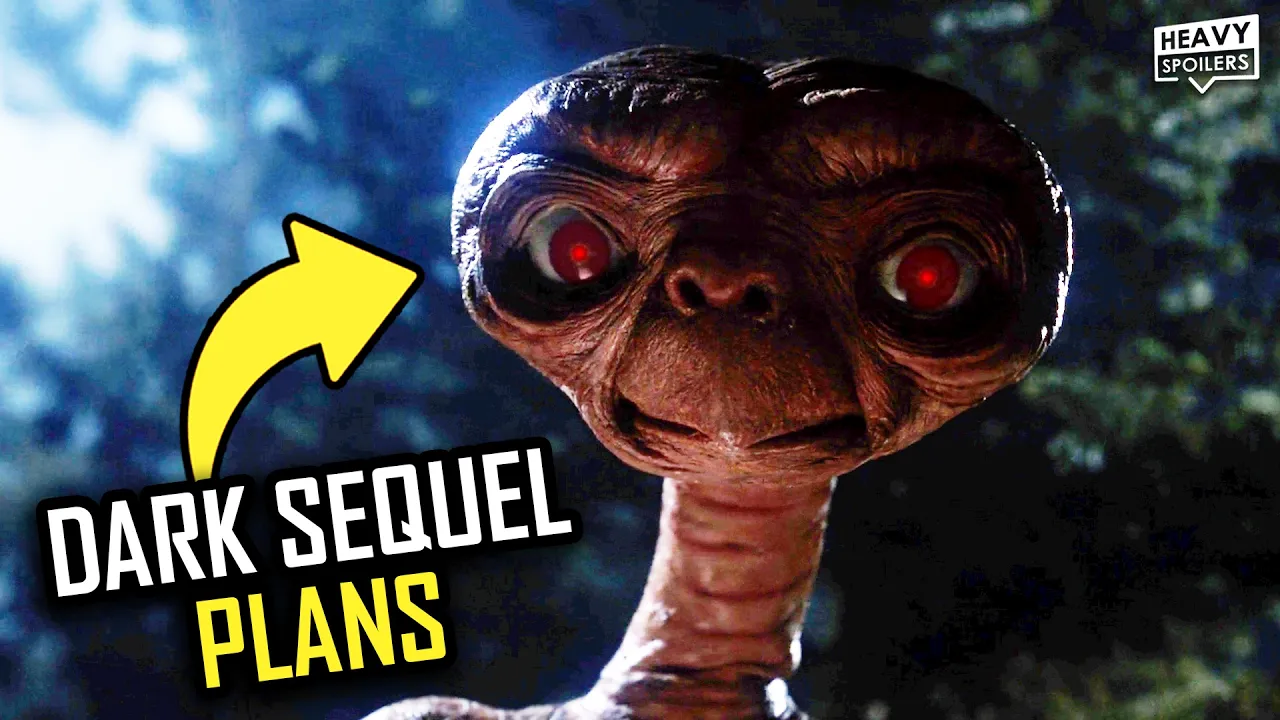
Adapted with AI from Heavy Spoilers' video of 26 April 2026 and checked against the video before publication. Editorial standards · Corrections
More from @heavyspoilers
All →

Make videos? Your next one could be an article here.
We turn your videos into articles under your name, linked back to the original. You keep 60% of what they earn, non-exclusive, and you can leave whenever you like.
Become a SubPlotter →