Alien (1979): How Star Wars, a Failed Dune and a Bomber Gremlin Shaped Ridley Scott's Classic
From Dan O'Bannon's 29 page draft called Memory to the battleship gray Nostromo, the origins, casting choices and opening scenes behind Alien

Alien is one of cinema's best. It may never have been greenlit had George Lucas not changed cinema history with Star Wars. The story runs from Dan O'Bannon's unfinished script to the casting of Sigourney Weaver, along with the hidden details in Ridley Scott's 1979 opening scenes. I also think its look and feel are exactly what Scott himself has failed to recapture since.
Star Wars opened the door for Alien at 20th Century Fox
Before Star Wars, 20th Century Fox had no interest in funding science fiction. Once Star Wars became the biggest movie ever, it made sense for the studio to greenlight other projects in the genre. Luckily, that gave us one of cinema's best, although there were some big duds around the same time as well.
The idea for Alien came about after writer Dan O'Bannon worked on Dark Star with John Carpenter. Both that film and Alien featured a group of blue collar workers on a seemingly mundane mission, along with a murderous alien.
Dan O'Bannon's Memory script had no xenomorph
O'Bannon originally titled the movie Memory, and he only had 29 pages written. Those pages became the film's opening, with the crew waking up and arriving at a mysterious distress beacon. In that original draft, their ship would then be damaged and they would find themselves stranded on the planet. The iconic xenomorph was nowhere to be seen.
The creature only came in after an attempt at a Dune movie. Both O'Bannon and H.R. Giger were hired to work on that project, and during it O'Bannon was horrified and disturbed by Giger's work. He went on to write his antagonist as a Giger style monster. After the Dune movie fell through, he also folded in another of his ideas, a gremlin infiltrating a B-17 bomber, which became the second half of Alien. Memory became Star Beast, and the film was finally titled Alien.
The Thing from Another World, Forbidden Planet and Planet of the Vampires
O'Bannon wasn't shy about his influences. He stated that The Thing from Another World inspired the idea of a creature stalking people in a tight environment. I think Alien and The Thing work perfectly together, almost as accompanying pieces, and the two stand as some of my favorite films ever.
Beyond that, the warning not to land on an alien planet was taken from Forbidden Planet, and the discovery of the engineer was taken from Planet of the Vampires.
Rewrites by David Giler and Walter Hill gave Alien its Ash
Most agree the script was something special, but tensions arose when David Giler and Walter Hill, who were connected to 20th Century Fox, made rewrites that O'Bannon hated. He felt they were trying to attribute the script solely to co-writer Ronald Shusett. In the end, O'Bannon was granted the sole screenwriting credit.
It has to be said, though, that Giler and Hill added a lot to the film, most notably Ash. To me, he's the movie's most interesting character, and I love the curveball of the crew realizing there's someone among their own ranks working against them.
Ash's name beginning with an A, and him being an android, is something the franchise keeps up. Viewed in release order, the main titles all have androids whose initials ascend alphabetically. A is for Ash in Alien, B is for Bishop in Aliens and Alien 3, Call appears in Alien Resurrection, and Prometheus gets the D with David.
Ridley Scott's storyboards pushed the budget to 8.5 million
Things rolled ahead quickly because of Star Wars, and the producers were impressed by Ridley Scott's movie The Duellists. They brought him on board, and although the film originally had a budget of 4.5 million, that was raised to 8.5 million when the studio was impressed by his storyboards.
I can totally buy into that. I think what sets this movie apart from other science fiction horror is the look and feel of the film. Unfortunately, it's something Scott has failed to recapture himself, and I'm looking at you, Prometheus.
The film is very close to my heart. I vividly remember my grandad taping it for me when I was four years old. Apparently he looked at the title and thought it would be cool for a young kid, and here we are over 30 years later. Scott is also from where I live in South Shields, and the area often holds big celebrations of his work, so it feels very close to home.
Alien's theatrical cut versus the 2003 director's cut
There are two versions to cover: the theatrical cut and the director's cut released in 2003. Both can be found on the Alien Anthology set or the Alien Quadrilogy DVD set from around that time, and the later HD release looks slightly better, with essentially every version of the film included.
With Aliens, I think the director's cut improves on the film, but for Alien I don't know. I felt let down a bit. Scott even says the theatrical cut is still his vision and the director's cut was more of an experiment. It's one minute shorter than the theatrical version, and I think it's cut more like a modern movie, rather than having the long feeling of dread I get from the theatrical cut.
The Alien title sequence was once going to be made of flesh and bone
That dread is there from the start, with the slow reveal of the title and the slow, droning, iconic music. The letters gradually appear, and originally they would have been made from flesh and bone, but that was deemed far too gory. I also think it would have taken away from the mystique, and I prefer that they kept the alien hidden until it's revealed later.
Predator and The Thing both open with a ship in space, and I feel that always spoiled the mystery a bit, even though we know what's coming. I have seen those movies several times, but I wish they had held it back.
The titles were created by design company RGA, which was hired after the studio loved its work on the teaser trailer. The title almost feels like an alien language as the letters fade in. On first viewing we don't know what the word will be, and the shapes are almost like hieroglyphics, throwing us off balance until the name is finally revealed. With large gaps of silence and minor drones from the score, this is a slow burn, and there isn't a single piece of dialogue for seven minutes. RGA also created the titles for Superman and Predator, so if you want something in space, these are your people.
The Nostromo is dull and ugly by design
We then see the Nostromo, which at first appears almost like a space rock. Giger's style was known as biomechanical, a horrifying mix of natural and metallic things, and his designs had a sexy quality as well. The ship looking this way plays into the aesthetic. Things in this movie hide in plain sight, with the xenomorph resembling the interior of the Nostromo. Everything feels like it's building off one design, and because of that it all comes together perfectly.
The name Nostromo comes from Joseph Conrad and means shipmate. The Sulaco in Aliens was named after the town featured in that book, so the two ships rhyme. The Nostromo was originally going to be called Snark, and then Leviathan, but those names lived on through two ships Dallas served on before the Nostromo.
The ship is halfway through its trip back to Earth after loading up at Thedus, in the Epsilon Reticuli system, which is a real location in space, much like how Tau Ceti was used in Project Hail Mary. That adds a layer of authenticity. The Nostromo is like a spacefaring battlestation, which makes it one of the most unique looking ships in science fiction, but it's also extremely dull. I think that works perfectly, because it adds to the feeling that this is an ordinary job. Science fiction movies are often selling the fantastical, so things are big, operatic and otherworldly. Having a dull, ugly ship helps Alien feel more realistic. This isn't Star Wars or Star Trek.
The ship was originally going to be yellow, but Scott asked for battleship gray, which adds to the authenticity. Scott also said the ship had to be slow moving and realistic, more like 2001: A Space Odyssey than Star Wars. Yet he did borrow slightly from Star Wars. In the same way that film opens on the Star Destroyer, Alien opens on the Nostromo, and the insides of the ships are also shot in similar ways, which helps add to the scope and scale of the vessels. The ore storage and oil refineries make the ship look far bigger; without them, it looks much smaller. Inside, it departs from the usual science fiction bridge into something much more claustrophobic.
Flying robot mice, drinking birds and eggs aboard the Nostromo
Scott originally planned for flying robots with sensors, referred to as mice, to roam the corridors fixing any problem they came across. They remind me of the skutters from Red Dwarf, although that came out after. Prometheus would later adapt the idea, with David and Mother running things while the crew slept. In Alien, though, everything was stripped back because it was getting far too close to Star Wars.
In the end, this isn't the fancy Starship Enterprise or a Star Destroyer. It's very trashy, with clothes strewn on seats, drinking birds and a little personality. The birds play into the notion of eggs, and we see three eggs vibrating as we move across the ship. Eggs become a big point later on.
The birth and motherhood imagery in Alien's corridors
The long corridors leading to the crew's chambers were originally designed to resemble a vagina. In the original script, the xenomorph would stalk the female crew members and be fixated on their anatomy. That fits with how the facehuggers infect people, forcefully impregnating their victims, something O'Bannon has talked about in depth since. The interspecies sexual assault is intended to unsettle audiences around the idea of male rape.
Beyond that, impregnation ties in with motherhood, and the ship's computer is named Mother, so there are many of these little ties throughout. When the crew awakens, it's almost like they're being born. We also see firefighting outfits and a symbol at the top of the left hallway. This is called the semiotic standard, and it has been used across every Alien franchise film.
A moving camera that feels like something is stalking the crew
At first we believe the camera is simply drifting through the ship, but then paper begins to rustle, which suggests something sinister is on board, a presence moving through the corridors. It gives a feeling of voyeurism, almost as if we're the ones wandering the corridors ourselves. It plays into the idea of stalking, and that someone somewhere is watching over the crew. Speaking with GQ, Ridley Scott said he always wanted the camera moving so it would slightly unsettle the audience.
The Blade Runner connection and Harrison Ford's turned down role
The focus then moves to the emergency helmets as the ship comes to life after receiving the distress call. It's incredibly analog, something Scott later used in 1982's Blade Runner. He reused some graphics from Alien, such as the pitch screen at the end, and Aliens confirms that Dallas was a former employee of the Tyrell Corporation. The connection between the two franchises has only grown stronger over the years, and they've always felt like they exist in the same universe.
What makes this more interesting is that Harrison Ford turned down the role of Dallas. Alien went on to be a smash hit, and he and Scott later worked together on Blade Runner. I'm so glad Alien: Romulus kept this style, as it looks far better in my eyes than what we got in the later prequels.
Meryl Streep, Veronica Cartwright and a Ripley written as a man
Meryl Streep was offered the role of Ripley, which is pretty crazy to think about. Veronica Cartwright, who plays Lambert, thought she was playing Ripley until she arrived in London for her costume fitting.
Ripley was originally written as a man, and the production auditioned many men and women for the role. I think this is what makes the character so strong compared with the usual women in horror films of the time. Scott said he had an epiphany during casting and realized that making Ripley a woman would work much better. Whatever the reason, we got Sigourney Weaver as Ellen Ripley, who for me is on the Mount Rushmore of science fiction characters.
Why Alien focuses on Kane when the crew wakes up
The computer then wakes the crew. This sequence was intended to be much longer, with the crew naked, again tying into the birth metaphors. The film was originally going to open on a close up of Kane's nostrils as he breathes for the first time, before he heads into the galley for coffee and breakfast. Focusing on Kane is a smart way to subvert expectations. When a film does that, you assume he's the main character, yet he's the first to die.
The steady shots of the crew slowly waking were later used by James Cameron in Aliens. Scott also said Ash takes longer to wake because he's almost like a computer starting up, mirroring the ship's systems turning on at the beginning. When we cut to Kane, Ash is visible to the right, and you might notice that Ian Holm isn't breathing; he doesn't start until much later. The cylindrical sleep tubes also look a bit like eggs.
Jonesy, Ash's milk and Mother 6000 at breakfast
At breakfast, Kane says, "I feel dead," which is more foreshadowing. Everyone is referred to by their last name as a way of addressing each other professionally, and that even goes for the cat. Jonesy is seen as a member of the crew and is there to boost morale. Not using first names creates distance and shows they aren't friendly beyond their roles at the company.
Jonesy was portrayed by four different cats: one for holding, one for hissing, and two for running off. That hiss is iconic. The jovial crew disarms the audience, and a relaxing scene like this makes the chestburster scene later on all the better. Pay attention as Ash reaches for a jug of milk. He drinks it throughout the movie, and it is thought this may be replenishing the fluid in his android body.
Scott explained he was inspired by HAL 9000 from Stanley Kubrick's 2001: A Space Odyssey, and AI turning against humans is a timeless message. That influence extends to Mother, whose full name is Mother 6000. Mother was originally going to be the one who let the infected crew member back on the ship, but in the rewrites that role went to Ash. At one point in the script, Ripley would have pleaded with the machine to be saved, and Mother simply replied that her loyalty was to science. From the start, though, Ash is very much a company man. He announces that Mother wants to talk to Dallas, cutting off a very awkward discussion about pay.
What other creators are saying
More on Alien →His serious glances at Kane hint that he expected what was about to happen
Ash always knew the chestburster scene in Alien was coming →
A scene by scene look at Ridley Scott's 1979 classic, from the grimy Nostromo and its Freudian design to the hidden meaning of Ripley's song
Alien ending explained: why Ripley sings You Are My Lucky Star →
Watch the original
@heavyspoilers · YouTube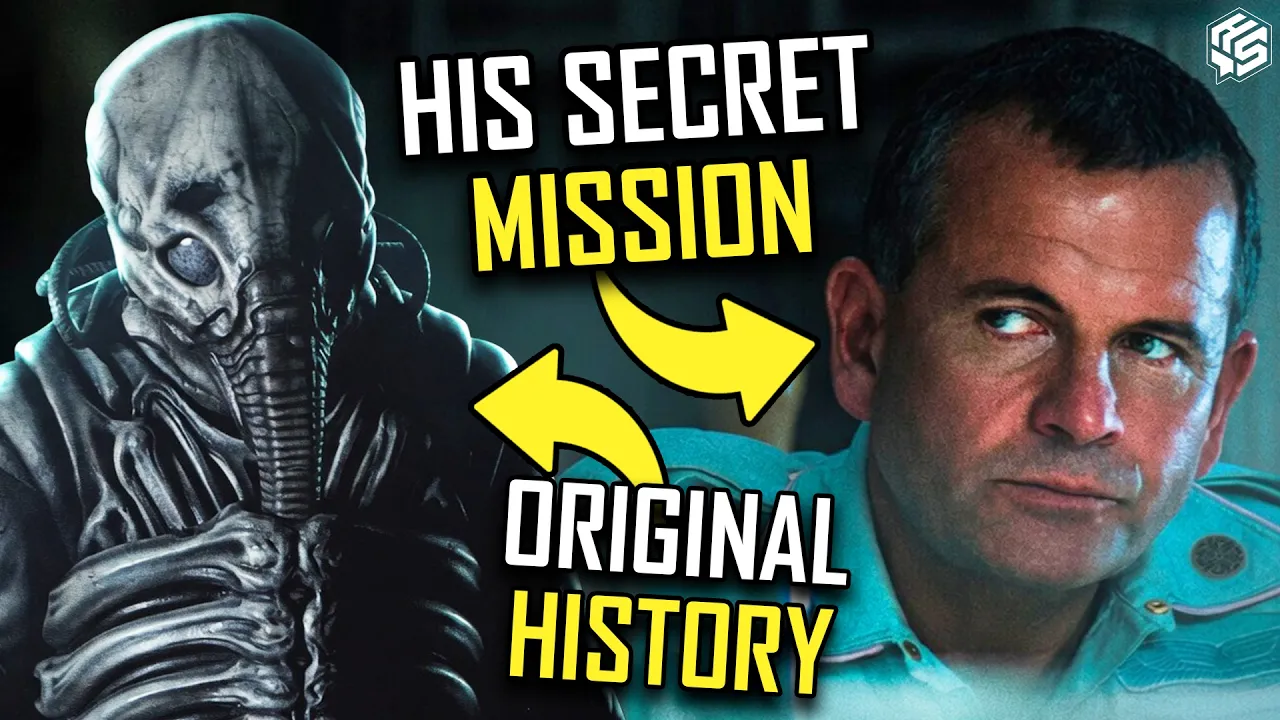
Adapted with AI from Heavy Spoilers' video of 31 May 2026 and checked against the video before publication. Editorial standards · Corrections
More from @heavyspoilers
All →


Make videos? Your next one could be an article here.
We turn your videos into articles under your name, linked back to the original. You keep 60% of what they earn, non-exclusive, and you can leave whenever you like.
Become a SubPlotter →