Full Metal Jacket: how does boot camp erase the recruits?
From the thousand yard stare to the Rifleman's Creed, Stanley Kubrick's Vietnam film charts how men are broken down and rebuilt as killers

Full Metal Jacket (1987), starring Matthew Modine, Vincent D'Onofrio and R. Lee Ermey, is a film about the dehumanizing effects of war and how someone is brainwashed into losing everything they are in order to become a killer. Although it's now regarded as a Kubrick classic, it wasn't so beloved at the time, but I think it's the much stronger film when set against the Vietnam movie that beat it to the punch.
Stanley Kubrick spent so long in development that he missed the boat on Vietnam movies. Oliver Stone was in production on Platoon around the same time and got it out the year before. Stone had served in the war, so his film was seen as the real movie on the conflict. Platoon got Best Picture and Kubrick got overlooked. Full Metal Jacket is a movie of many parts, but they all tell a complex and tragic story in the life of Joker.
Joker's thousand yard stare and the stares across Kubrick's films
We follow Joker, who is the life and soul of the party. He mocks his drill instructor, always has a witty one liner and seems more like he's there for the laughs than anything else. By the end, though, he's forced to kill, and it gives him the thousand yard stare. He looks blankly ahead in total silence, with nothing to say after taking his first life.
Stares appear often in Kubrick's films, and they tend to come when brainwashing has been used on a character. Pyle stares before taking his own life because he's been flushed out mentally by all the abuse. He was trained to associate the enemy with someone who must be killed, so he shoots his oppressor, Sergeant Hartman. In The Shining, Jack stares as the hotel turns him against his family. A Clockwork Orange has a plot built around brainwashing a character, Alex stares there too, and by the end there's definitely the feeling he has lost the person he was.
How Full Metal Jacket links rifles, sex and masculinity
Rob Ager has a full breakdown of how, through repetition, the soldiers lose their identity, whether that's having their heads shaved, chanting and marching in unison, or the things they're made to do. He also pointed out that the recruits associate sex with their weapon. They chant "this is for fighting, this is for fun" while holding their crotches, equating their bodies with their rifles. Kubrick is drawing a line between masculinity and violence, framing the rifle as giving the same satisfaction as sex.
Hartman even tells them to sleep with their rifles and give them a woman's name, because it's the only intimacy they're going to get. He frames it as part of their identity and uses vulgar humor to normalize it. Drill instructors use humor as a foil to their angry outbursts. Too much of one tactic can desensitize recruits, but swinging between the two creates tension so the rage never loses its bite. Pure anger breeds resentment, while mixing in humor reads as charisma and makes recruits more likely to trust that authority.
Sex is a big part of our identity and a fundamental human act. By replacing intimacy with weaponry, Hartman encourages them to kill rather than connect, transforming them from citizens into Marines.
The female sniper, the prostitute and the beating of Pyle
Later, the Marines presumably all take turns with a working girl in Vietnam, and Joker is the last. I don't think it's any coincidence that the final act revolves around a female sniper picking them off, before the soldiers catch her and stand in a circle. Joker is the one who steps forward and pulls the trigger. If you apply the rifle metaphor here, it's metaphorically similar to them all taking turns on the same woman. Hurting a woman is also seen as the least manly thing a soldier can do, so in trying to create ultra alpha males, we see the fallacy when they crowd around and kill her.
The scene also mirrors an earlier one. After Pyle keeps getting them in trouble, the soldiers beat him in his bunk. Joker stands back, unable to stop it, but eventually joins in and is the last to land a hit. In both scenes he stands back while the men surround someone, then comes forward. With Pyle he hurt a friend who was mentally disabled, and that character went on to kill his sergeant and himself. With the sniper, he has again stood by as the group leads toward a woman's death, and he clearly isn't the macho hero he thought he'd be.
The Vietnam War history behind the film
Vietnam was part of French Indochina, alongside Laos and Cambodia, colonized by France in the late 19th century. During World War II, the Nazi occupation of France and the Japanese occupation of the region weakened colonial control, opening the door for Ho Chi Minh's communist movement, which declared independence in 1945. Ironically, he quoted the American Declaration of Independence. France tried to reclaim Vietnam in the First Indochina War, which ended in 1954 with a colossal French defeat at Dien Bien Phu.
At Geneva, Vietnam was temporarily divided into the communist North under Ho Chi Minh and the anticommunist, Western backed South, with elections planned to reunify it. Because of Ho Chi Minh's popularity, the West delayed those elections indefinitely, and the US believed in the domino theory. After the 1956 elections were canceled, communist guerrillas who became the Viet Cong rose in the South, the conflict escalated into civil war in the early 1960s, and South Vietnamese President Ngo Dinh Diem was assassinated in 1963. In the 1964 Gulf of Tonkin incident, US ships reported North Vietnamese attacks, at least one of which never occurred. It was used to justify escalation, and by 1965 American boots were on the ground.
The war's unpopularity led to a wave of films, books and music. World War II movies are often straightforward tales of heroism, while Vietnam movies like The Deer Hunter and Apocalypse Now operate in shades of gray and focus on the human cost of war.
Gustav Hasford's The Short-Timers and nine years of production
Kubrick became interested in the conflict after Barry Lyndon in 1975, but with so many strong films already made, he questioned how to approach it. His lightbulb moment came in 1979 when he read Gustav Hasford's The Short-Timers, a semiautobiographical novel by the Marine veteran about his squad's experience. It doesn't moralize so much as plainly recite events, and its commentary is cynical and darkly comic, with the gallows humor we see in the film. It's the foundation for Matthew Modine's Joker, who narrates in a similar fashion.
Kubrick wanted to use it to discuss how the military erodes the individual identities of those who serve. After The Shining in 1980 he turned his full attention to the project, but it took nine years to complete, with extensive research alongside Hasford and Michael Herr, another writer who knew the conflict. The boot camp is probably the film's most famous part. I've spoken to so many people who love the first hour and don't remember anything about the rest.
Hello Vietnam and the shaved heads that open Full Metal Jacket
We open with Hello Vietnam by Johnny Wright, a song from the early years of the fight centered on duty and pride, evoking public sentiment before the cynicism crept in. It's an apt choice for wide eyed recruits joining up. It plays over their heads being shaved, which in the military is done for hygiene and uniformity, and the actors had their heads shaved weekly. Symbolically it strips away their old identity, and by making it the opening shot, Kubrick presents the film's central thesis.
There was a belief that Kubrick shot this scene, filmed the whole movie, waited for the hair to regrow and shot it again. Vincent D'Onofrio debunked this, saying they shot it first and it wasn't repeated. His character also looks like he's loving it, while the others seem devastated.
R. Lee Ermey's road to playing Sergeant Hartman
R. Lee Ermey had been a drill sergeant during the war and served as an advisor on the film, and this is easily his most iconic role. He asked Kubrick if he could audition, but Kubrick had seen him play a drill sergeant in 1978's The Boys in Company C and thought he lacked the bite for Hartman. Ermey put a tape together hurling insults at the camera, and Kubrick hired him. I don't think I could see anyone else in this role.
In rehearsals, Ermey had to read lines as fast as possible while Kubrick's assistant Leon Vitali threw things at him, which he had to catch and throw back, starting again if he failed. Ermey even described Vitali as being like a drill instructor. He said many times that if Hartman were real he'd be the worst drill instructor in the world, and questioned whether they were doing the right thing. Ermey apparently improvised a lot, with Kubrick estimating he wrote about half his lines, mostly insults. Kubrick also crafted a new lens to keep every recruit in focus, showing that no one was special.
Hartman's tactics mirror how cults break people down
Hartman dehumanizes the soldiers so they can be reborn as killing machines. He says there's no racial discrimination, then hurls slurs you'd normally hear in a Call of Duty lobby. Rather than saying everyone has value, he says everyone is equally worthless. Cults do this too, telling followers they're nothing and that improvement lies with the group. He nicknames Private Brown "Private Snowball" and throws around racist stereotypes, so racism is one of many tools to diminish them. Like a cult cutting you off from family, he mocks where they're from, distancing them from home.
Joker's full name, J.T. Davis, references James T. Davis, recognized as the first US casualty in Vietnam. He undercuts Hartman with a John Wayne impression, a line Cowboy says in The Short-Timers. Joker uses it throughout to undermine images of toughness, and that clinging to identity through irony is a central tension. I think deep down he doesn't believe Hartman will do anything. Hartman dubs him Joker, praises his honesty and punches him in the gut. He also skips one recruit, which fans speculated was an accident, but Ermey said he'd sometimes skip a private to catch the next one off guard.
Vincent D'Onofrio's transformation into Private Pyle
D'Onofrio gained 70 pounds to play Leonard Lawrence, a weight gain record that hasn't been beaten since. The strain, especially on the obstacle course, tore ligaments in his left knee, which needed surgical reconstruction. It took him nine months of training to safely return to his normal weight, and afterward he opted for fat suits in roles like Kingpin.
Hartman dubs him Gomer Pyle, after Jim Nabors' slow character in The Andy Griffith Show. Leonard struggles to drop his grin, setting him up as childlike and at odds with his environment. Hartman makes him choke himself on Hartman's hand, a forced submission that mirrors how soldiers lose bodily autonomy to a higher authority. It's never stated, but many read Leonard as intellectually disabled or perhaps autistic. He reminded me of Lenny from Of Mice and Men, another large, childlike character who meets a tragic fate.
He's later made to march with his pants down, sucking his thumb, apart from the group. The running drills are more about uniformity than fitness. Rob Ager pointed out that brainwashing often only gets through after years of repetition, much like advertising. In the 1990s, a study into subliminal messages saw them played in supermarkets to dissuade shoplifting, and though it wasn't completely successful, it had an effect.
Filming Vietnam and Parris Island in England
The burning orange sunset behind the training soldiers creates an almost hellish image, and that hell imagery returns in the final shots. Joker's narration places the base at Parris Island in South Carolina, a real base, but the whole movie was filmed in the UK because Kubrick didn't fancy flying and could bring Vietnam to the production. Once you know, you can tell in the countryside scenes. They used the power station from the opening of For Your Eyes Only. The sets look authentic to me, though I've never been to Vietnam. Kubrick flew out a prop jungle from the USA, decided it wasn't good enough, and imported 200 palm trees from Spain. Boot camp was shot at Bassingbourn Barracks in Cambridgeshire, used by the RAF until it was decommissioned in 2012.
Joker calls boot camp an eight week college for the phony tough and the crazy brave, pointing out that the toughness is manufactured and performed, and reframing courage as recklessness. The running cadences are like nursery rhymes about domestic and sexual things, and sex jokes are a form of male bonding. Their vulgar chant about Ho Chi Minh reduces him to a sexual deviant without examining his philosophy, making the Viet Cong easier to kill.
The Rifleman's Creed replaces prayer
When Leonard shoulders his rifle wrong, Hartman slaps both cheeks, punishing the individuality of being out of time. I know I'm hard on the military here, but I'm trying to interpret Kubrick's message. I respect the armed services, and I've got pictures of my grandparents who served in the wars.
Instead of praying, the recruits recite the Rifleman's Creed, written by Major General William H. Rupertus during World War II. Memorization is no longer required in recent years. Written in a more black and white era, here it prepares them for a murkier war. The same God referenced in the Creed commanded "Thou shalt not kill," yet they declare their identity dependent on a gun.
Hartman rages at Leonard for not holding his rifle four inches from his chest, which I feel is disproportionate, though I do think he's making an example of the weak link. He punishes everyone collectively and won't let them graduate until they finish an obstacle section in under ten seconds, motivating them by withholding escape. Leonard can't do a pull up and needs Joker's help. He's not even that fat, which reminded me of the 1990s It miniseries, where Ben was called fat while only a little bigger. The constant focus on his weight could point to Hartman being unfair.
Joker becomes squad leader and Leonard's last trace of identity
On Sunday, Hartman orders Joker and Cowboy to clean the head, a navy term for the toilet at the front of a ship. When Joker says he doesn't believe in the Virgin Mary, Hartman slaps him and calls him a communist heathen, since the USSR was officially atheist and Marxism called religion the opium of the people. So Joker can't be a real God fearing American.
Yet Hartman replaces Snowball with Joker as squad leader. By saying any answer would be wrong, Joker shows he understands the system and doesn't crumble. Bringing him into the hierarchy also neutralizes his wit, turning it on the recruits rather than the officers. Hartman tells Joker to teach Leonard everything, even how to pee. Shirtless, bald, in white underwear, Leonard resembles a big baby. The other recruits wear matching white shirts like blank slates ready to be remade. Leonard still exists in his own skin, a visual reminder of the identity he's still holding on to.
Watch the original
@heavyspoilers · YouTube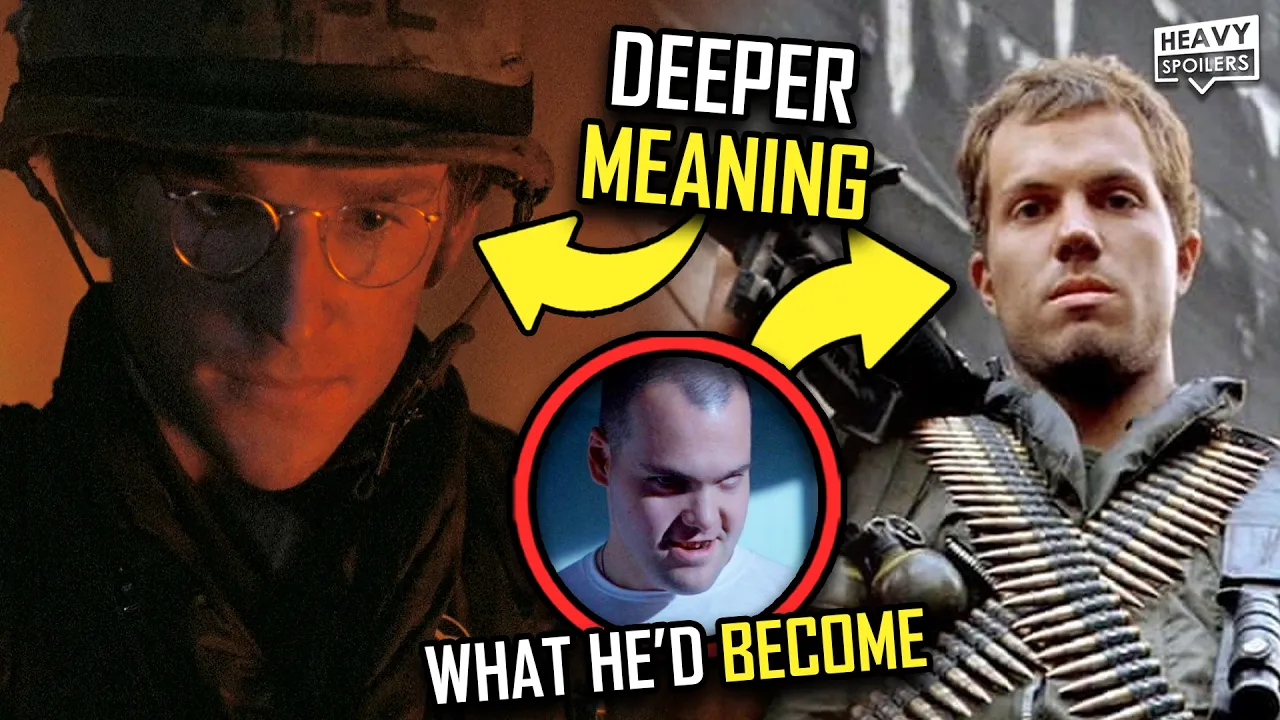
Adapted with AI from Heavy Spoilers' video of 2 May 2026 and checked against the video before publication. Editorial standards · Corrections
More from @heavyspoilers
All →

Make videos? Your next one could be an article here.
We turn your videos into articles under your name, linked back to the original. You keep 60% of what they earn, non-exclusive, and you can leave whenever you like.
Become a SubPlotter →