28 Years Later Bone Temple: is a Rage virus cure possible?
How the fictional pathogen evolved from a lab experiment into fast ones, slows and alphas, and why Dr. Kelson's work with Samson hints a cure may be possible
 Heavy Spoilers (AI-assisted)19 November 2026Editor: Digital Fox Talent Editorial TeamOn YouTube since 2009 · more than 1.6 million subscribers

The Rage virus is one of the most terrifying pathogens in cinema, and what I love about it is that "every time you think you understand it, a curveball's thrown that shakes things up." That's what happens in 28 Years Later: The Bone Temple (2026), starring Ralph Fiennes, Jack O'Connell and Alfie Williams, which continues the franchise's themes of evolution. It also points toward how Rage could possibly be cured.
Here's the history of the disease through all of its stages, from the lab where it was born to the most recent developments.
How Alex Garland and Danny Boyle created the Rage virus for 28 Days Later
The fictional virus was created by Alex Garland and brought to life by Danny Boyle in 28 Days Later. Unlike many zombie films at the time, the Rage virus didn't infect the dead and it didn't reanimate corpses. It didn't come from some ancient curse or an extraterrestrial rock. It was simply born in a lab in England.
During the making of the film, Ebola was garnering headlines in the West, and its red eyed look inspired the infected. Beyond that, the filmmakers also looked at rabies and the rabid state it could send someone into.
The Aftermath comic shows scientists trying to manufacture rage to cure it
Right before the release of 28 Weeks Later came the tie-in comic 28 Days Later: The Aftermath. It followed scientists Clive and Warren, who were trying to isolate rage within the brain. Road rage and blind rages had cost lives. People went into uncontrollable rages every day, usually in situations where lives would have been spared if they had stayed rational. We see it in the news constantly: from outside the situation you can see the right thing to do, but in a state of rage you can't be reasoned with.
So the scientists wanted to control the chemicals in the brain responsible for rage and develop a drug that would cure it forever. To learn what triggered it and where it truly stemmed from, they had to manufacture rage first. They combined an inhibitor with a strain of Ebola to create a contagion. That simply amplified the rage and made it infinitely more contagious. The chimpanzees used to test it became extremely aggressive and would attack anything they could get their hands on.
Boyle and Garland didn't necessarily want to blame the outbreak purely on one side. So they brought in the animal rights activists, who stood morally and ethically opposite the scientists. Both had to come together to unleash the virus. The real cause of Rage is hubris, and people thinking they know what's best and can act without repercussions.
Rage infection takes hold within seconds
The first film begins with the activists releasing the chimps, and within seconds they're infected too. That sparked the original outbreak, which spread like wildfire through the UK. Bites, scratches and even a bit of blood landing in your mouth meant you'd turn within seconds. Even a kiss from a carrier, as 28 Weeks Later showed, could leave a person completely overcome with rage.
One of the most horrifying things about the virus is how quickly it spreads. 28 Weeks Later opens with a small, intimate scene in a kitchen where survivors are huddled together, making the best of it. The second the virus gets in, all hell breaks loose, and within seconds these friends are attacking each other.
Normally in zombie films, someone gets bitten and slowly transforms over the course of the story, insisting they're fine while everyone else notices they're acting strangely. Even in the Dawn of the Dead remake, a character gets to say goodbye to a loved one. With Rage, you don't get that at all. Frank probably gets the longest time to say goodbye to Hannah, after a single drop of infected blood falls into his eye, and even then he gets less than a minute.
What the Rage virus does to the body and the mind
Victims experience immediate spasms and convulsions, and they often begin to vomit, which spreads the virus further. They feel a burning sensation throughout their skin, and blood vessels burst around the brain. That causes their eyes to hemorrhage and their nose to bleed, and sometimes blood bursts from their mouths.
The Bone Temple reveals that the virus also affects perception and memory, completely clouding the mind. In the infected, this state is permanent, and it strips away higher brain functions like reasoning, empathy and self-preservation. The infected see the people around them as monsters and are immediately driven to attack them. That altered perception turns out to be very important when it comes to a cure.
Because the infected aren't reanimated corpses, they're simply humans in an altered state. They don't need to be shot in the head, and a fatal blow anywhere is enough to take them down. The virus is also restricted to primates because it was developed in chimpanzees. Dogs, deer, cows and crows can all encounter it without turning, which is why crows feast on corpses. It's also why Rage couldn't spread as easily as plagues that travel through birds and rodents.
The first outbreak and why the original infected starved
The initial outbreak still spread like a plague from person to person. At first the government suspected it was riots, but it quickly became clear what was going on, and within two weeks the UK had been quarantined. Two weeks after that, Jim wakes up in a hospital in 28 Days Later.
The original outbreak left the infected starving, because with self-preservation stripped away they weren't able to concentrate on eating and drinking. People infected with rabies can have hydrophobia and struggle to drink water, and this first strain worked in a similar way. As a result, the infected all died of starvation.
28 Weeks Later's second strain made the infected smarter
The second strain was where things started to mutate, because it had been incubated inside a carrier. That led to slightly more intelligent infected, which is what we see with Don. He stalked his kids, used strategy to follow them and even avoided attacks by the military.
This outbreak was never contained, and it spread from Britain to Europe. Although it was pushed back to the island, the infected had changed: they could sustain themselves by eating and drinking. Because they now sought nourishment, the virus's lifespan was extended indefinitely, and the option of waiting for them to starve was gone. The infected became a permanent fixture of the UK.
Fast ones, slows and alphas in 28 Years Later
Pack behavior formed and many different variants sprang up. That created the so-called fast ones, the sprinters who made the franchise stand out from the slow zombies of the past. Next came the slows, who crawl along the ground barely burning any calories, getting by on worms and small animals.
Over those 28 years, alphas also rose to the forefront. These were carriers in whom the virus had mutated, and they ruled over their packs and used them to hunt. Alphas were extremely strong and durable, which meant they could withstand several injuries.
Dr. Kelson, Samson and The Bone Temple's makeshift cure
People on the island also found ways to fight the virus. That includes Dr. Kelson, who discovered that iodine could halt its spread. During the events of 28 Years Later, he also came into contact with the alpha Samson. Kelson cared for life, so instead of killing Samson he sedated him.
He then began to notice that Samson was almost seeking the sedation, visiting Kelson to try to get a hit. Kelson studied his behavior and realized that in this state the rage had been quelled. Samson even began to speak, and over time he started to regain his memories.
Kelson eventually concluded that because the virus was similar to a psychosis, it could potentially be treated with drugs. Knowing he could die at the hands of Sir Lord Jimmy Crystal, he quickly tried a makeshift cure on Samson, and it worked, allowing Samson to quiet the infection in his mind. At the time I wrote this, we weren't sure how long the effects would last, but The Bone Temple ends with it seemingly having worked. I expected any sequel to deal with a further evolution of the virus.
Immunity, a lost blood transfusion ending and hope for a Rage cure
It's been a complicated virus across the board. There have been asymptomatic carriers like Alice in 28 Weeks Later, and talk of a widespread vaccine. Her son Andy carries the immunity too, and with the return of Cillian Murphy as Jim, I do wonder if Andy will be back as well.
For now, there's no outright cure that has been written down and manufactured. Kelson's work could even die with him, though I do hope Samson remembers it.
In the original script for 28 Days Later, the virus was cured through a blood transfusion. Jim gave up his blood, and the film would have ended with him strapped to a table watching TV, like the monkey at the start. That didn't make it in, but it could hint that a transfusion might work. More likely, the virus would spread so fast that it would be rendered pointless, and plenty of people would have pointed that out.
Still, if alphas can regain cognition and even go back to how they were, there could be some hope for a cure yet. I can't wait to see where the franchise goes next and what it does to keep the virus interesting. "I love how it's constantly changing and adapting to the world around it," just like a real virus would, and that's what makes this franchise so fascinating.
Watch the original
@heavyspoilers · YouTube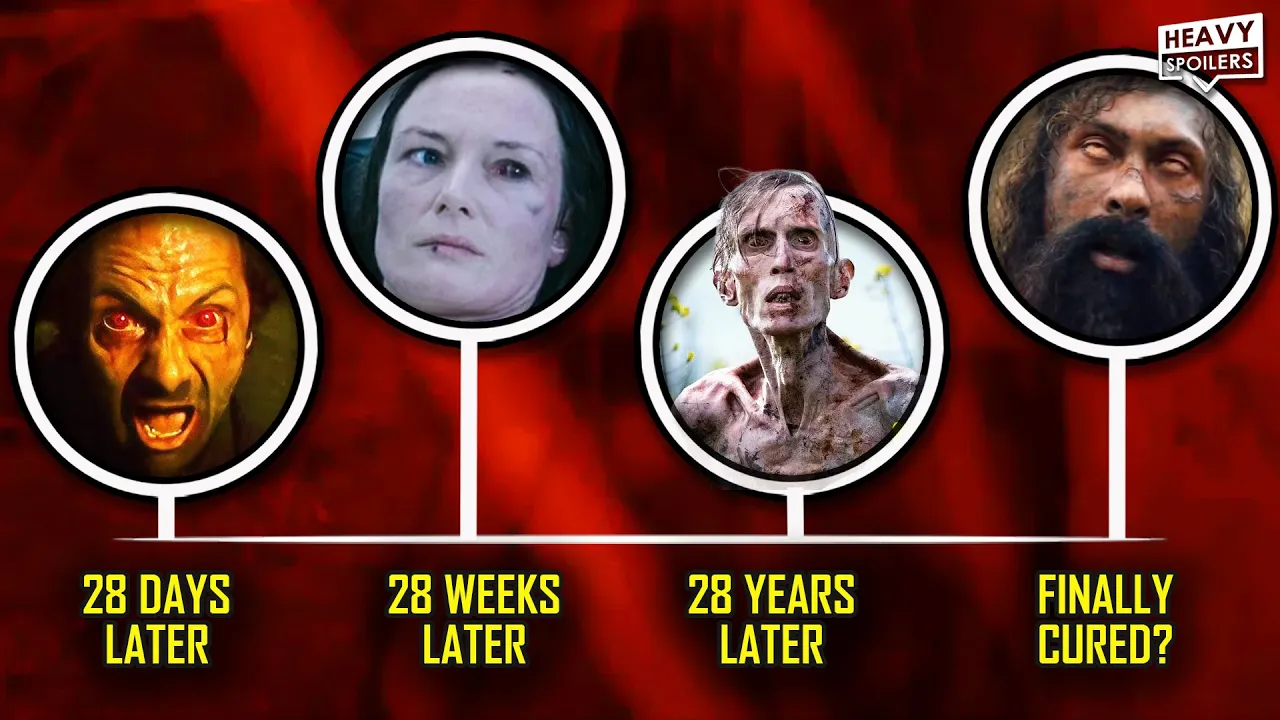
Adapted with AI from Heavy Spoilers' video of 16 January 2026 and checked against the video before publication. Editorial standards · Corrections
More from @heavyspoilers
All →


Make videos? Your next one could be an article here.
We turn your videos into articles under your name, linked back to the original. You keep 60% of what they earn, non-exclusive, and you can leave whenever you like.
Become a SubPlotter →