Star Trek: does the Federation survive on hope, not systems?
From Wolf 359 to the Dominion War and Section 31, the Federation recovers from crises that history suggests should break a civilization. Its real protection may be hope.
 Lore Reloaded (AI-assisted)4 November 2026Editor: Digital Fox Talent Editorial TeamOn YouTube since 2016 · more than 140,000 subscribers

The Federation should be dead. It should not be struggling or weakened, but gone: assimilated by the Borg, shattered by the Dominion War, paralyzed by fear after the Changeling infiltrations, torn apart politically after Mars burned. Any one of those events could have broken an interstellar civilization, and yet the Federation always survives. My argument is that the way Star Trek keeps it alive tells us what the franchise believes about civilization itself.
Yes, Star Trek is a television franchise, and the Federation survives because the story continues. That answer alone misses something important. Starfleet loses entire fleets and recovers in a matter of years. Earth is attacked again and again and still remains the political center. Officers suffer catastrophic trauma, moral collapse, betrayal, infiltration and extinction-level wars, and the system keeps functioning. "The Federation bends, but it rarely breaks." Maybe that's the point. It survives because Star Trek believes civilizations can recover from things history says they usually don't.
So what happens if we remove that protection? What if fear lasted longer, trauma didn't heal cleanly, and one great captain wasn't always there at exactly the right moment? Strip away the narrative protection and something uncomfortable appears: the Federation isn't nearly as stable as it wants to believe.
Wolf 359 shows how fast the Federation returns to normal
The Federation recovers from things that should probably leave permanent damage, and I don't mean military damage. Every civilization loses wars, survives attacks and rebuilds cities. What's strange about the Federation is how quickly everything feels normal again. Take Wolf 359: 39 starships destroyed and over 11,000 people dead, as a single Borg cube cuts through Starfleet like it barely notices it's there. That should have terrified the Federation for decades, not only because Earth was vulnerable, but because the illusion of control shattered in a few hours.
Up to that point, Starfleet still carried the belief that diplomacy, science or sheer optimism would eventually solve most problems. The Borg demonstrated that the Federation is not nearly as advanced or prepared as it thinks it is. To Star Trek's credit, you do see the aftermath for a while. Sisko carries it with him for years. Starship designs change, and the Defiant gets built. Starfleet starts acting more defensive, more paranoid, and for a brief period the Federation seems to realize space is not as safe as it pretended.
Then things stabilize, maybe a little too well. Earth stays the political center despite repeatedly becoming the target of catastrophic events. Starfleet remains mostly unified. You never see major member worlds openly questioning whether the Federation's core systems can still protect them. Real governments don't usually get that kind of grace period.
The Changeling infiltration and the Dominion War should have left deeper scars
It keeps happening. The Changeling infiltration during the Dominion War should have been socially devastating. By the time of Homefront and Paradise Lost, people on Earth are openly afraid their neighbors might not be real. Admirals distrust each other. Blood screenings become routine. Starfleet command structures are compromised badly enough that a military coup almost happens on Earth itself.
That kind of fear tends to leave scars. Historically, societies do not handle paranoia well, especially when the threat is invisible. People become tribal. Governments centralize power. Citizens accept things they normally wouldn't, because fear makes almost any policy sound reasonable if survival is attached to it. Deep Space Nine brushes against that idea harder than most Trek, and then the Federation pulls itself back together again.
The Dominion War itself is even harder to ignore. Entire fleets are wiped out, planets occupied, Cardassia devastated. Officers who once preached Federation ideals discuss biological warfare and deception like unfortunate necessities, which, to be fair, maybe they were. Yet the Federation returns to exploration mode surprisingly fast. Not immediately, and there are scars, but compared to what large-scale wars usually do to civilizations, the recovery is unbelievable.
I don't necessarily think that's bad writing. I think it's intentional. Star Trek wants to believe societies can survive trauma without being consumed by it, and still choose cooperation, diplomacy and optimism afterward. That's probably one of the core ideas holding the franchise together. It also makes the Federation feel almost insulated from consequences at times, even after Mars burns, even after the synth attack, even after trust in Starfleet clearly starts eroding.
Picard, Kirk, Sisko and Janeway save institutions that keep failing
There's another reason the Federation survives, and this one might be even bigger than the recovery issue. Starfleet's institutions fail constantly, and the heroes save them anyway. The Federation presents itself as a massive, stable system: billions of citizens, thousands of ships, centuries of progress, a civilization supposedly designed to outlast any one individual. But when things start collapsing, Star Trek almost always narrows down to a handful of people holding the entire structure together.
Take Picard. One man becomes Locutus and nearly destroys the Federation. Later, that same man becomes one of the primary reasons the Borg are stopped at Earth, again. Kirk repeatedly prevents extinction-level disasters through instinct, luck or sheer refusal to back down: V'ger, Khan, the probe, the Klingon peace process. Half the time it feels like the Federation survives because Kirk is willing to ignore regulations faster than everyone else in the room.
Deep Space Nine pushes the idea harder than any other series. By the later Dominion War, the Federation is losing badly and morale is collapsing in places. Then Sisko makes a morally catastrophic decision, drags the Romulans into the war and changes the balance of the Alpha and Beta Quadrants. Not an institution, not a council vote, not a grand strategy, but one exhausted officer deciding he can live with something awful. Janeway is another example. Voyager survives situations that should have killed the ship dozens of times over, and inside the universe that's largely because she holds the crew together through force of personality.
What happens if Picard dies at Wolf 359, if Sisko refuses to cross the line, if Kirk fails one time, if Janeway loses her crew halfway through the Delta Quadrant? Systems built around extraordinary individuals are usually far less stable than they appear. Real institutions survive by being resilient to failure. The Federation often survives because failure gets intercepted at the last second by someone exceptional. "That's narrative intervention wearing the mask of institutional strength." Star Trek usually knows what it's doing, since these captains are mythic figures. Remove their protection, though, and the Federation may not be designed to survive ordinary leadership.
The Dominion War and Section 31 expose how fragile Federation ideals are
The Federation was not designed for sustained existential conflict. It was designed for expansion, exploration, diplomacy and scientific progress. Many of its most famous ships are flying cities carrying families, laboratories, diplomats and civilians. Psychologically, it behaves like a civilization that believes peace is the natural direction of history, and for a long time that belief mostly worked. Then the Dominion arrived, forcing a grinding industrial war, the kind that changes governments.
Under that pressure, the Federation begins compromising itself almost immediately. Starfleet Intelligence operations become more aggressive. Civil liberties weaken during infiltration scares. Admirals discuss morally questionable actions with increasing comfort. Entire populations are viewed through strategic necessity instead of principle. Even the ships become harsher, more tactical, less exploratory.
Section 31 might be the clearest evidence in all of Trek that Federation ideals are not as stable as they appear. Every time the Federation faces a truly existential threat, it becomes relevant again, almost like a pressure valve. The uncomfortable part is that it's usually not presented as completely irrational. Star Trek's idealism survives partly because someone is willing to violate those ideals in the dark, and the Federation never fully resolves that tension. Fear still works on it, maybe slower and less violently than on modern societies, because people under pressure prioritize survival over philosophy surprisingly fast. That doesn't make the Federation evil, but it does make it fragile, especially in prolonged war, which normalizes emergency powers and creates generations who grow up afraid instead of optimistic.
Hope may be the Federation's real plot armor
It would be easy to dismiss the Federation as unrealistic or naive, a system that only survives because the writers keep pulling it back from the edge. There is some truth to that. Real civilizations usually don't recover this cleanly from repeated existential threats stacked on top of each other. Something usually breaks eventually. But calling it plot armor skips over why Star Trek keeps coming back to the Federation at all.
The Federation was never meant to be a forecast. It's more like a challenge, or maybe a refusal: the idea that societies do not automatically become monsters when survival gets difficult, that fear is dangerous but not unbeatable. That might be the most unrealistic thing in the franchise, more than the technology. History usually goes the other way, with populations trading freedom for security and enemies becoming abstractions. Star Trek shows this too, and DS9 especially understands it, but the franchise treats those compromises as warning signs rather than evolution.
The Federation is not strong because it's flawless. It survives because it keeps trying to pull itself back toward its ideals after failing them. That probably isn't realistic, but I think Star Trek understands that, and I don't think it ignores how fragile civilization is. It keeps making the argument anyway, that maybe some people are capable of rebuilding without being consumed by what hurt them. Maybe that's the Federation's real plot armor: "Not shields, not starships, not legendary captains, hope." That sounds corny until you realize how rare that idea has become in science fiction.
What other creators are saying
More on Starfleet →From Tom Paris to Benjamin Sisko, these officers gave Starfleet good reason to take the uniform back, and some went right back to work
Star Trek officers who deserved to lose the uniform, ranked →
One card plays artifacts from the top of your library, and the other rewards facing a dilemma with free spells
Zefram Cochrane and the Caretaker among Magic: The Gathering Star Trek preview cards →
A Romulan War buildup, a Mirror Universe miniseries, the Borg Queen's origin and a refitted NX-01 were all part of the plans for a season that never got made
Tomorrow's Enterprise plays less like classic Kirk and Spock and more like Next Generation's All Good Things, and the people who made it are calling the future we saw continuity.
Strange New Worlds finale: the original series' lost ending →
Watch the original
@lorereloaded · YouTube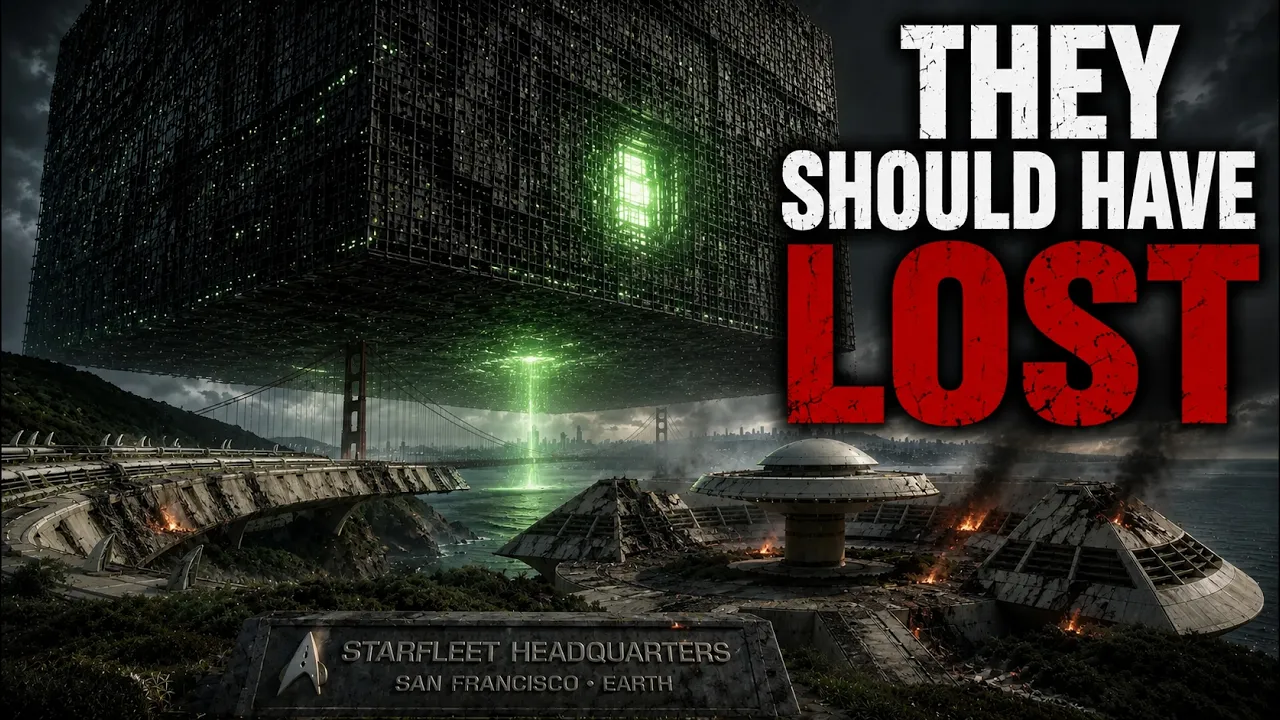
Adapted with AI from Lore Reloaded's video of 29 May 2026 and checked against the video before publication. Editorial standards · Corrections
More from @lorereloaded
All →


Make videos? Your next one could be an article here.
We turn your videos into articles under your name, linked back to the original. You keep 60% of what they earn, non-exclusive, and you can leave whenever you like.
Become a SubPlotter →