Lanterns Episode One Proves Green Lantern Had to Get Grounded Before It Could Get Great
The HBO series builds a real world first and lets the ring earn its place inside it, and the choice pays off in a premiere I'm scoring 8 out of 10.
 Mr. Know-It-All (AI-assisted)4 September 2026 · Editor: Digital Fox Talent Editorial Team
Green Lantern had a production problem before this show ever shot a frame. The last time Hal Jordan led a live-action project, we got a computer-generated suit and an enormous digital world and a character who never felt like he lived in either one. So Lanterns could not just come back brighter, louder, and greener. We already saw that movie. It had to make Green Lantern believable before it made him spectacular, and episode one understands that completely.
I was impressed with this thing, genuinely. By the time the episode ended I was pleasantly optimistic about where the season is going, and I don't say that because it gave me every piece of Green Lantern iconography I wanted. It didn't. I was impressed because it understood what it could hold back and still feel completely like Green Lantern.
Lanterns Borrows True Detective's DNA, Not Just Its Look
A lot of shows borrow the surface of prestige television, the color grade, the pacing, a shot held a little longer than a normal superhero show would hold it, and then call themselves grounded. That is not what is happening here. There was no cleaner way to separate this Green Lantern from the live-action movie everybody already had in their head than to make the world feel real first and then put the ring inside it.
I think of the opening of Agatha All Along, where Agatha is trapped inside her own version of a true crime television show, performing the language of that genre because she is stuck in a leftover television construction from WandaVision. Agatha feels like a show doing an impression of another show. Lanterns feels like True Detective, but superheroes through that lens, a crime drama where one of the detectives can suddenly make a twenty dollar bill out of green light. That difference is going to be everything you need to know about the show.
Florian Hoffmeister shot the episode, and he also photographed True Detective Night Country, so when the landscapes, the practical light, the faces, and the patience of the camera give you that True Detective vibe, there is an actual production connection underneath it. Director James Hawes told the Playlist that the starting point for the whole thing was a real-world buddy cop show, and he also brought up Fargo and No Country for Old Men, which tracks given the dry American humor running under it, with strange people in quiet places that can feel funny and threatening at once.
Chris Mundy told Entertainment Weekly that they shot practically in real places and were not leaning heavily on green screen, describing the effects level as "generally medium to low with some episodes going much bigger." The lack of constant spectacle is not the production failing to deliver Green Lantern. It is the production deciding what normal looks like before anybody turns the ring on.
The Ring Works Because It's Used Like a Tool, Not a Trick
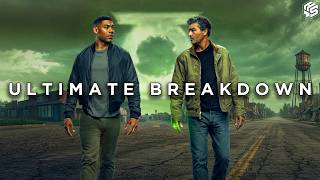
Lanterns is not asking the ring to convince you the world exists. The world is already there. The ring only has to convince you that it belongs there, and I think the way they handled it might be my favorite production decision in the episode. John survives Hal's insane cliff test by wrapping himself in what has been described as a bubble wrap construct, and Hal makes money for a jukebox and uses the ring as a car lighter to light someone's cigarette while a fight happens in the background. The extraordinary thing gets to be part of the environment instead of swallowing the scene, which gave me shades of the Clark and Lois conversation in Superman happening in front of a giant dimensional creature. Life keeps moving in front of it.
Even the interrogation scene builds the rules without turning into an instruction manual. The alien being interrogated asks Hal, "You've been here 48 hours. Did you bring the Lantern to recharge it?" Hal answers, "I have plenty of power." We take that for granted in the comics, but in a more grounded version of the character that detail makes the conservative use of the ring feel practical.
The official Lanterns podcast gives that choice a production logic. Damon Lindelof and Tom King said the writing room treated the ring more like a police officer's service weapon. Having a weapon does not mean an officer fires it in every encounter, because having the ability to end a situation is not the same as having the judgment to use it. So the limit is not the ring, it is the man wearing it. If the ring solved every physical problem the moment it appeared, the detective story would be over, jurisdiction would not matter, a suspect running would not matter, a locked door would not matter. Instead the question is not whether Hal can stop something, it is whether Hal believes using the ring is justified.
Hal Jordan's Mentorship of John Stewart Is Messy on Purpose
Hal begins the episode looking like he is just being a jerk to some new guy, withholding information, putting John in danger, then getting angry when John does not understand a rule Hal never clearly explained. But when John goes after a suspect and screws up the pursuit, the episode lets us see Hal is actually teaching him something, even if the lesson is convoluted, because Hal himself is convoluted. John wants the power because he believes it will let him act. Hal is trying to teach him that the job is partly knowing when not to act.
Mundy described the relationship as a coaching tree: Sinestro trained Hal, Hal is training John. The show is interested in what gets passed down that should be, what gets passed down that absolutely should not, and whether the person doing the teaching can tell the difference. I am not ready to call Hal a good mentor, driving somebody off a cliff is an aggressive onboarding process, but he is trying to prepare John for a job that has consumed his own identity, and he may only know how to teach it through the damage that was used to teach him.
This is where the casting of Hal becomes a smart piece of the puzzle. The age matters. You need to believe that being Earth's Green Lantern has cost this man time, and you need John replacing him to feel credible enough that every piece of advice carries a little resentment with it. Getting authority and exhaustion in the same look means the script does not have to stop and explain every scar.
The Halogram Twist Turns Hal Jordan's Death Into the Premiere's Biggest Reveal
While watching, I predicted Hal was somehow going to die and that the buddy cop story would continue through probably the backup consciousness in the ring. Then they called it the Halogram, spelled H-A-L-O-gram, which is one of the cleverest names I have heard in a long time. Episode one spends almost the entire runtime locked into 2016, teaching us the rhythm between these two men, then jumps ten years and puts Hal back on those same football bleachers with a bullet through his head and no ring on his hand.
James Hawes said on HBO's Inside the Episode that they waited until the audience understood the rules and then detonated the episode, and that is exactly what the cut does. It turns the previous hour into evidence. The question is no longer just what happened at the football game, it is what happened to Hal and John between 2016 and 2026, why John is not wearing the ring, and who took it.
Entertainment Weekly's post-air interview with Chandler, Lindelof, King, and Mundy closes off the cheap version of that mystery: the Hal we see in 2026 is dead, though he stays in the show through the 2016 story and through the Halogram, with a version of his consciousness stored in the ring. The writers said they considered killing Carol as the event that would bring the men back to Rushville but rejected it, because turning her death into motivation for the male characters would have been a disservice to her character. Hal's death was the event with the greatest existing weight, and revealing it in the premiere kept it from being a cheap final button.
Tom King put the governing idea simply on HBO's podcast: "You can't have legacy without loss." Hal's death is not there only to shock people who love the character, it turns every 2016 lesson into something John will eventually have to carry without him. We are not waiting to see whether Hal survives, we are watching a relationship form while knowing it ends unresolved, which puts pressure on every good moment and every bad lesson.
The Makin Ranch Storyline Plays as Allegory Without Spelling It Out
The episode is not being subtle about the fact that something is wrong at the Makin Ranch. These people have automatic weapons, body armor, and organized training, and Hal and John are invited to dinner at what looks more like a compound than a ranch. The character who hosts them there tells them, "I don't know what your interests are. Two of my boys almost got killed last night in a shootout with men no one's ever seen before. How about we both want to protect the planet from anybody not born on it?"
The word alien is doing two jobs at once. I can see the immigration allegory, the fear of outsiders pushed through a literal extraterrestrial story, and it works for me because the show does not stop to put the metaphor in a speech explaining what I am supposed to think. The compound, the weapons, and the language of invasion enter as evidence before the political reading even arrives. Somebody is going to call that woke. I do not think it is woke, I think that is how fiction has always done social commentary, and comic books have been doing it forever. You take something people are already arguing about, change the scale of it, and let an impossible situation expose the ordinary fear underneath, without every person in it becoming a direct substitute for one political side or another.
The Show's Cursing Is the One Place House Style Creeps In
The one place I feel the larger DCU house style pressing on the material is the cursing. I don't know that we needed all of it. Some of it belongs to these men and to this adult procedural world, but the rest feels like the show making sure we understand this is mature HBO storytelling. It is not a huge problem for me, since every filmmaker has tendencies, the way Zack Snyder has that darkness and slow motion, or James Gunn has irreverence and characters who puncture the grandeur around them, while this same universe can still let Superman be earnest.
The test is whether the language keeps belonging to the character or starts belonging to the brand, and episode one mostly keeps it with the characters. Hal is worn down, John is angry and impatient, and the language contributes to the friction. I just do not want every corner of the DCU using the same vocabulary to prove it is made for adults, which is a concern about where the larger universe could go rather than what this premiere actually gives me.
My Score: Lanterns Episode One Earns an 8 Out of 10
What this premiere gives me is a production team that understood the exact problem it had to solve, a procedural that does not feel ashamed of the comic book, a Green Lantern ring that is funny and dangerous without becoming a shortcut, a Hal Jordan teaching John even when he is doing it badly, and a John Stewart already revealing the kind of Lantern he could become. Most importantly, it gives me a foundation strong enough that Hal's death does not feel like a stunt performed on a famous name, it feels like a loss the entire structure was built to carry.
The season still owes us something. It has to prove this grounded form can expand when the story goes cosmic, and it needs to explain the missing ring, the ten-year fracture between Hal and John, and what was really happening in Rushville. Starting small only works if the scale eventually grows without breaking the rules that made small feel important, and episode one has not paid off those promises yet. As a ground floor, though, Lanterns episode one earns an 8 out of 10 from me.
Did the restraint make the ring's power feel more believable to you, or are you still waiting for the show to go bigger and greener, and what do you think happened between Hal and John across those ten years?
Watch the original
@arealknowitall · YouTube
Adapted with AI from Mr. Know-It-All's video of 17 August 2026 and reviewed by Digital Fox Talent before publication. Editorial standards · Corrections
Also on Lanterns
8 creators, 67 takes →


More from @arealknowitall
All →


Make videos? Your next one could be an article here.
We turn your videos into articles under your name, linked back to the original. You keep 60% of what they earn, non-exclusive, and you can leave whenever you like.
Become a SubPlotter →