Psycho (1960) explained: what do the mirrors and paintings mean?
From a low budget gamble to Freud's uncanny double, the making of Psycho and the symbolism hidden in its opening act
 Heavy Spoilers (AI-assisted)23 November 2026Editor: Digital Fox Talent Editorial TeamOn YouTube since 2009 · more than 1.6 million subscribers

Psycho (1960), starring Anthony Perkins and Janet Leigh, is probably Alfred Hitchcock's most famous film, and I'd call it the mother of the slasher genre. It pioneered so many things we still see today. Every shot is deliberate and meticulously planned, building to one of the biggest twists in cinema.
Based on Robert Bloch's 1959 novel, and nodding to the real life story of Ed Gein, Psycho is filled with deeper meaning and symbolism. That symbolism, and the techniques that make the film so terrifying, are what I'm digging into here.
How Hitchcock Got Psycho Made When Nobody Believed in It
The story goes that Hitchcock was strolling through an airport looking for something to read before a flight when he found Bloch's novel. He instantly saw how big a movie it could be. Convincing others was harder. America was going through a wave of censorship, and Paramount, Hitchcock's home, felt it was wrong to relish in the kills. It didn't see a commercial hit and expected complaints. Gein had gained worldwide publicity just three years earlier, so the project felt like it would be in bad taste.
Hitchcock financed it himself and shot it at Universal, the studio known for monster movies like Dracula and Frankenstein, with Paramount only distributing. Nobody thought the film would do well, so everything was done low risk. Hitchcock used his cheaper TV crew and shot in black and white because that stock cost less. He then did what was probably the first form of viral marketing: buying up as many copies of the book as he could to hide the twist, setting up chairs and dressing rooms for Mrs. Bates so people would think someone was playing her, and placing guards at cinemas to keep latecomers out. These days I think it's impossible to watch without thinking about the twist. I had it spoiled before I ever saw it.
Bernard Herrmann's Psycho Theme and the Opening Shot
The film opens with the Psycho theme as names in the credits are sliced in half. It's probably one of the most memorable themes of all time, composed by Bernard Herrmann, and the title sequence was designed to link the music to murder in the audience's mind. Hitchcock attributed 33 percent of the film's effect to the music and doubled Herrmann's salary. Using only strings, the stings stab along with the knife, and the theme signals throughout that something bad is about to happen.
The opening wide shot of Phoenix, Arizona, drifting voyeuristically into an apartment window, was extremely difficult with the technology of the time. The skyline was photographed and dissolves created the panning effect after a helicopter proved too jumpy. A wide tracking shot to a close shot is typically how Hitchcock reveals a hidden secret, here Marion and Sam's relationship. The on screen date, Friday, December 11th, doesn't play into the plot. According to Stephen Rebello on the DVD commentary, it came from a scheduling mistake: the second unit filmed in Arizona at Christmas, decorations were visible, so Hitchcock set the story in December.
Marion Crane, Sam and the Rich Man's Money
In the '60s premarital sex was a major no-no, and that's where the couple's secret lies. This was the first film to show two people half clothed on the same bed, and the first time we saw a major star wearing a bra. Marion wants a respectable relationship, with dinner at her house "with my mother's picture on the mantle." I see that as a desire for safety under the gaze of authority, later darkly paralleled when she eats sandwiches with Norman under his mother's watch. Hitchcock also typically uses sideways shots, like the ones framing this couple, to show guilt.
Back at work, a wealthy client spending $40,000 on a house for his daughter's wedding is condescending and sexual toward Marion. He says he doesn't buy happiness but buys off unhappiness, and flashes cash he can afford to lose. It plants the idea of stealing and makes us sympathetic, since he comes across as someone who deserves to be robbed. Hitchcock believed suspense works when the main character is an everyday person, so we justify her choice, though deep down I think we all know Marion would never get away with it. The same trick later makes us root for Norman.
The McGuffin, the Black Bra and Marion's Uncanny Double
The money on Marion's bed is a classic McGuffin, Hitchcock's term for an object that pushes the plot forward. We don't care about the cash, only whether she's caught with it, and focusing on it lets the audience put their guard down. Marion now wears a black bra and carries a black purse instead of the white ones from earlier. Like the hats in old Westerns, it shows her going from angelic to evil. Her eyes move between the money and her suitcase, a Hitchcock visual sentence that shows her mind at work without dialogue.
She then looks in the mirror, probably the biggest piece of symbolism in the film, since almost every set in Psycho has one. Much of the film centers on Sigmund Freud's uncanny double and the id, ego and superego. Marion gives in to her id, the instinctual drive for pleasure, to be with Sam, creating a dark reflection of her repressed impulses. A photo of her parents hangs behind her as she takes the money, ignored, showing her id is now in control.
The Traffic Cop and Hitchcock's Bomb Under the Table
Woken at the roadside by a police officer, Marion faces questioning that turns out to be nothing. We assume he knows about the money, and because we're in on the secret, we share her fear. Hitchcock explained this with a bomb: blow up people talking and you get 10 seconds of shock, but tell the audience the bomb is under the table and their dull conversation becomes vital. He also warned, "The bomb must never go off because if it does, you've worked your audience into a state, and then they'll get angry because you haven't provided them with any relief."
The cop follows her, seen in the rear view mirror, then parks across from the car lot as she trades in her car plus $700. He's never shown again, so the scene exists to scare people and prepare them, and it makes us complicit. Driving on, she hears the voices of the cop, the salesman and her boss. That's never been cleared up, but I think it's all in her head, since she knew her boss wouldn't check on the money until Monday. I read it as her superego, her conscience, fighting her id, much like Norman later hearing his mother.
Anthony Perkins, Ed Gein and the Paintings in Norman's Parlor
The Bates house, modeled on Edward Hopper's painting House by the Railroad, looms over the motel, one of the best changes from the book. Hitchcock wanted his murderers charming and attractive, and Perkins, a teen heartthrob, was the opposite of the book's overweight, middle-aged, balding alcoholic. His father, Osgood Perkins, died when he was 5, the age Norman says he was when his own father died, and Perkins later said, "I assumed that my wanting him to be dead had actually killed him." Norman himself was based on Ed Gein, who said he'd wanted to make a skin suit so he could become his own mother.
In Norman's parlor, stuffed birds hint at his ability to preserve, which is what kept his mother's corpse from fully rotting away. Titian's Venus with a Mirror shows Cupid holding up a mirror, and I see Norman as Cupid, revealing what kind of person Marion is. When he leans back, he reveals Susanna and the Elders, the Bible story of two elders secretly watching a woman bathe, in a version where they violently pull at her. Venus admiring herself gives way to Susanna's assault, just as Norman's admiration turns violent. Marion even strikes a nearly identical pose in the shower, and that painting hides the peephole Norman uses to spy on her, taking him from onlooker to violent participant, exactly like the elders.
Norman's Parlor Speech Hints at the Twist in Psycho
The conversation turns dark when Marion suggests Norman put his mother in a home. In hindsight, it's clear Norman has been in a place like the one he describes, with everyone staring and examining him, and it's sadly where he ends up. When he says "She needs me," it seems Perkins put extra emphasis on the word me, which could be another way of telling the audience that he and his mother are the same person. Norma needs Norman in order to exist.
Then comes the line "we all go a little mad sometimes." Someone in the '60s could read it as Marion's moment of madness in stealing the money, and it's what makes her realize she has to go back. Knowing the twist, it's a chilling prophecy. Marion also slips and gives her real name, Crane, which is of course another bird. Then comes the peephole shot. Hitchcock used a 50mm lens on a 35mm camera, which apparently gives the closest approximation to human vision and implicates the audience as fellow voyeurs. Afterward, Norman stops himself from going up to his mother and sulks in the kitchen, framed in a doorway that boxes him into his trap. I think this is the best scene in the film, both for the performances from Perkins and Janet Leigh and for its meaning to the plot.
Psycho's Toilet Flush Was a Fight With the Hays Code
Back in her room, Marion flushes her scrap of paper away, and this was reportedly the first movie to feature a toilet flushing. That claim has been contested, since a 1930 film featured a toilet you can hear flush, though it never focused on the flush itself. Under the Hays Code, there was to be no nudity, premarital sex or violence, criminals had to be punished, and toilets were seen as inappropriate.
Screenwriter Joseph Stefano was adamant the audience see the flush to convey realism. Hitchcock agreed, but only if it could be made to happen through the writing, so this entire scene was built just for that flush.
How Hitchcock Made the Psycho Shower Scene
As Marion showers, the score stops, signaling she's safe after disposing of the evidence. It's one of the only scenes with her that doesn't include a mirror, and her smile, I feel, represents her shedding her dark double. Then a wide shot shows the silhouette approaching the curtain, a moment pan and scan hid for years. We can barely see the figure's eyes, which lets your mind fill in the face and points us away from Norman. It wasn't even Perkins, who was in New York doing a play. I think this is probably up there as the most iconic death in a horror movie.
The 45 second scene took a 78 shot setup and a week to film, a third of Janet Leigh's time on the production. Bernard Herrmann had violinists play the same note over and over to match the stabs, though Hitchcock originally wanted no music until he saw a cut with the score. The rapid editing would have shocked people. The knife never penetrates her skin, yet many people walked out saying they'd seen the stabbing. Hitchcock reportedly told the censors, "No, you didn't see this. You thought you did, but you didn't."
For most of it, Leigh was doubled by Marli Renfro, and rumors that Renfro was murdered were debunked when she was found alive in 2017. Chocolate sauce stood in for blood. The close-up of Marion's dead eye took 26 takes, but ophthalmologists wrote to Hitchcock that her pupils should be dilated, and he used belladonna drops in his following films. Apparently you could see Leigh's neck pulsing, which Hitchcock's wife, Alma, pointed out just before distribution, so a quick cut of the shower head covered it.
Psycho Drops the Money and Hands the Story to Norman
When Norman dumps Marion's body in her car along with the money, Hitchcock is telling you straight up that the money plot is over. The film shifts into Norman's perspective and follows the same three-step suspense process used with Marion: plant a secret, add close calls and an investigation, then deliver the final twist. When the car stops sinking in the swamp for a moment, audiences reportedly gasped, then sighed with relief, and Hitchcock later said this was when he knew he had them. Everything has worked to make us sympathize with Norman and become complicit in his crimes.
Arbogast's Death and Where Psycho Starts to Drag
When Arbogast asks if Marion played him for a fool, Norman raises his voice for the first time, and this could be Norma taking over. I personally believe that whenever people hear Norman's mother, they're hearing Norman putting on a voice, and we're seeing things purely from his perspective. On the stairs, I love the quick pace and top-down shot. It hides the twist, and the figure's speed makes clear it isn't an old woman, but we're too shocked to notice. Unlike Marion's rapid cuts, this death lingers.
I think around this point the movie starts to drag a bit, and even Hitchcock admitted they could have trimmed 10 minutes. There was also tension on set. According to the Now Playing podcast, Hitchcock had grown to dislike Vera Miles, who had been groomed as his next star but got pregnant on Vertigo, and he refused to talk to her on set. The movie doesn't feel like it serves her.
The Fruit Cellar and the Bates House Point to Norma
The sheriff reveals Norma has been dead 10 years, supposedly after poisoning her lover and herself. It's basically Romeo and Juliet, the kind of story I feel a kid would make up as a lie. Then Hitchcock begins to show his hand. Perkins swings his hips walking upstairs, intentionally, and Norma screams that she won't go to the fruit cellar before Norman has mentioned it. The overhead shot required taking the roof off the set. I see a great recent example in the final episode of Severance season 1, where a character's wife was in the show all along.
The house's three floors reference Freud: the top floor is the super ego where his mother lives, the main floor his ego, and the basement his id, where he hides his secrets.
The Norma Bates Reveal and Psycho's Final Shot
Norma's bed still holds an impression of a body, and I feel Norman has been lying in her place. When Lila turns the figure in the cellar and finds a corpse, the reveal shocked everyone at the time. Author Robert Bloch made the names similar on purpose: Nor man and Nor ma. Hitchcock even left the corpse dummy in Janet Leigh's dressing room to hear her scream.
The movie should have ended there if you ask me, but Hitchcock believed confusion would take away from the emotional reaction, and I do get why he explained it through the psychiatrist. The real ending is Norman smiling at the camera as his mother says "Why she wouldn't even harm a fly." A skull is superimposed over his face, one of my favorite details, layered over the chain pulling Marion's car from the swamp, right through his heart. Norman, Norma and Marion are forever chained together. In my opinion, this is one of the greatest horrors ever and probably one of the greatest movies ever.
Watch the original
@heavyspoilers · YouTube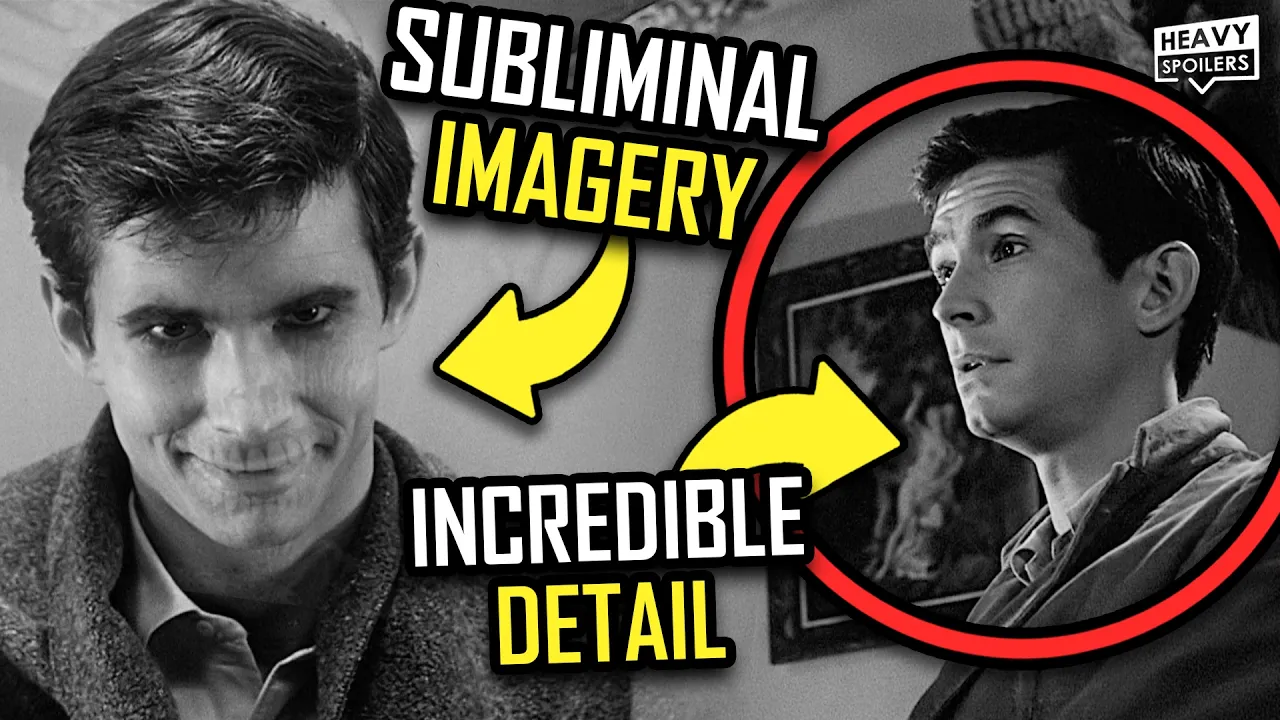
Adapted with AI from Heavy Spoilers' video of 19 October 2025 and checked against the video before publication. Editorial standards · Corrections
More from @heavyspoilers
All →


Make videos? Your next one could be an article here.
We turn your videos into articles under your name, linked back to the original. You keep 60% of what they earn, non-exclusive, and you can leave whenever you like.
Become a SubPlotter →