Tron (1982) Easter eggs: why was it denied an Oscar?
From an Oscar disqualification to Sark's clockwork brain, the stories and secrets inside Steven Lisberger's cyber world
 Heavy Spoilers (AI-assisted)23 November 2026Editor: Digital Fox Talent Editorial TeamOn YouTube since 2009 · more than 1.6 million subscribers

Tron, Disney's 1982 sci-fi classic starring Jeff Bridges, is full of hidden details, from a Pac-Man game playing beside Sark's map to a Mickey Mouse face etched into the digital terrain. Here are the Easter eggs, the stories from the making of the film, and how it ends.
Why Tron's $50 million disappointed Disney
Tron was written and directed by Steven Lisberger and released by Disney on July 9, 1982. It made $50 million globally on a $17 million budget. Those numbers aren't terrible at all, but they still proved disappointing to Disney. The people who did see it loved how it transported them into a backlit cybernetic world they'd never seen before. The 55th Academy Awards nominated it for best costume design and best sound, but it lost to Gandhi and E.T. the Extra-Terrestrial respectively.
It probably would have won for special effects if it hadn't been disqualified. Apparently, back then only practical effects were acknowledged, and using computers to enhance a film's look was considered cheating rather than art. Oh, how times have changed: now Hollywood is trying to replace actors with AI. Many Disney animators even boycotted the film, feeling threatened by the possibility that computer art would become the norm and put them out of work.
The whole franchise exists because of Pong. When it arrived in 1972, everyone went crazy for it, and Lisberger fell in love with games as a whole. Games and Alice in Wonderland led him to imagine someone thrown into a virtual world. His studio later made a test animation of a backlit electronic mascot, described as a "liquid neon character" who smashed two discs of light together. Since he was electronic, they nicknamed him Tron. The unfortunate part is that after Tron underperformed, and after The Black Hole bombed in 1979, Disney gave up on live action films for a full decade and focused on animation.
Flynn's Arcade, Sark and the sound of the light cycles
Disney executives were apprehensive about a film centered on the then confusing world of computers. Apparently, they green lit it because mixing live action with computer animation pushed boundaries, and they felt Walt Disney would have been all about it. The opening fittingly uses the sights and sounds of electricity, since Tron derives from the word electronic. Flynn's Arcade is a building in Culver City, California, originally built as a hospital in the 1920s. Inside are games including Space Invaders, Battlezone, Asteroids Deluxe and Berzerk, plus Space Paranoids and Light Cycle, and you can hear someone losing a life in Pac-Man.
Here we meet Commander Sark, played by David Warner, who also plays Ed Dillinger. Sark is Dillinger's program, which is why he shares his face, voice and personality. The role was first offered to another actor, who turned it down because he found the lack of physical sets too weird. The cast found it new too; one remembered hanging out with fellow cast members: "We were just kids in a candy store." Sound designer Frank Serafine made the light cycle noise by putting microphones on motorbikes and feeding the sound through Prophet-5 and Minimoog synthesizers. Sark appearing inside Flynn's independently built cabinet doesn't make sense, but independent networks were a foreign concept to the production team. Later, when Sark tracks the escaped rebels on his carrier's map, a game of Pac-Man plays on the side.
The MCP began as Walter Gibbs's chess program
Before becoming a cyber tyrant, the Master Control Program was a chess program created by Encom founder Walter Gibbs, played by Barnard Hughes. Dillinger upgraded it to manage Encom's systems, so it shares his voice. When it's destroyed, the original chess program at its core is freed, wearing Gibbs's face. Throughout, the MCP reflects Dillinger: he rose by stealing Flynn's games, and it grows stronger by absorbing programs from companies and government entities. Offering Sark kidnapped strategic air command programs shows it has become a threat to humanity.
Crom, played by Peter Jurasik, was a savings and loan program working under a Mr. Henderson, so it's safe to assume Henderson shares Jurasik's face. His cell neighbor Ram, played by Dan Shor, was an actuarial program designed by Roy Kleinberg, also played by Shor, who later asks Alan for popcorn. Crom's toga marks newly captured gladiators, almost like a cyber Colosseum. Sark and the MCP are rounding up believers in the users, an inquisition akin to the Spanish Inquisition of 1478 to 1834.
Clu, Bit and why programs glow yellow, red or blue
Kevin Flynn, played by Jeff Bridges, was fired from Encom by Dillinger, who stole his games. Flynn's hacking program Clu, short for codified likeness utility, is also played by Bridges with a different voice. A light tank normally holds three programs: a gunner, a driver and a commander. Most cyber world shots are static because glowing backgrounds were easier to animate without camera movement; the simple tank interiors were an exception. Yellow circuitry marks Flynn's programs, red marks Encom programs serving the MCP, and blue marks free programs. Flynn sips from a mug, and so does Clu.
Clu's sidekick Bit, his own personal Jiminy Cricket, can only answer yes or no, and concept art originally imagined him as a floating ball with a face. The recognizers come from Flynn's stolen game Space Paranoids, which is why they adorn his arcade. Their sound is an enhanced helicopter run through a Prophet-5, fitting since they seem to reflect Dillinger's red backlit helicopter. After downing five recognizers, Clu is captured and derezzed.
Dillinger's office, group 7 and the real Alan Kay
Dillinger steps out of his elevator beside what appears to be a dvarapala statue, Sanskrit for door guardian, the demon giants that guarded Buddhist and Hindu temples. That suits Dillinger and Sark as guardians of the MCP, and Sark literally becomes a giant later. Diamond patterns on the ceiling mirror the MCP's core. His assistant Peter is played by the actor who plays Sark's lieutenant. I'm not sure why Dillinger didn't delete Flynn's evidence file instead of storing it in the MCP; I put it down to a chronic case of stupidity.
Dillinger revokes access for group 7, including Alan Bradley, played by Bruce Boxleitner, who also plays Alan's security program Tron. The lockout message is stamped 6:32 p.m. on Wednesday, September 22, 1982; you don't need p.m. with military time. Alan is based on Alan Kay, who helped invent the modern personal computer and object oriented programming, and who consulted on the film. The original script called him Alan Bailey. The cubicles belonged to Disney's IT department, with distant ones added in post, and they evoke Sark's blue maze map. Early plans for white backgrounds were dropped because low light was cheaper and simpler.
Laser Bay 2 and Jeff Bridges's arcade habit
Laser Bay 2 was shot at the Shiva laser facility at Lawrence Livermore National Laboratory, which could apparently generate 28 trillion watts. There, Lora Baines, played by Cindy Morgan, digitizes an orange. Morgan also plays Yori, whose name appears on screen beside the words MCP control, showing why the MCP can later digitize Flynn. Gibbs's program Dumont sends information between programs and users, much as Gibbs sends oranges into the digital realm. The three users wear touches of blue, like their programs, a nice touch by the costume team.
Lora suspects her ex Flynn, so she and Alan visit his arcade as Journey's Only Solutions plays and Lisberger cameos, dressed in black, hugging a woman in blue. The games on set were a blast, especially for Bridges, who became addicted between scenes. When called back, he recalled telling the crew he was "preparing for the scene." Upstairs, Flynn plays a Coleco electronic quarterback and opens his story with a nod to Mr. Peabody and Sherman from Rocky and Bullwinkle.
The MCP blackmails Dillinger, and Flynn is digitized
Gibbs confronts Dillinger for putting an AI's desires over human employees, something I noted we were beginning to see in 2025. Gibbs says a piece of a programmer's spirit lives on in every program, which is why he has two lookalike programs. The MCP then reveals plans to steal Pentagon programs and threatens to send The Times a headline: "Encom senior exec indicted." I love that this comes right after Dillinger threatens Gibbs, giving him a taste of his own medicine.
Alan's cubicle bears the phrase from The Day the Earth Stood Still (1951), Gort Klaatu barada nikto. Flynn quotes John Lennon: "Like the man says, there's no problems, only solutions." When he floods the MCP with unsolvable equations, the laser digitizes him. Cast members recalled the skintight costumes: one asked "Where are the pants?", another vanished to the gym to lose 5 pounds, and lines were drawn on the suits. Flynn's skin looks grayer because these scenes were filmed in black and white, with color added in post.
Identity discs, hyperball and a nod to Spartacus
Flynn's cell sits beside Tron and Ram's, like their creators' cubicles. Sark tells 12 captives they will play games until they die unless they renounce the users. Identity discs, which record every action and thought, are repurposed Frisbees. Their throwing sound is yelling monkeys filtered through a Fairlight CMI, which also processed Lisberger's cat into the MCP's growl. Ram's enthusiasm for helping users is a big reason why he later follows Tron.
Flynn faces Crom at hyperball, a cyber jai alai with energy spheres thrown at the ceiling, added as a tribute to Lisberger's favorite, Spartacus (1960). Flynn refuses Sark's order to "finish the game," mirrored in Tron: Legacy (2010) when a brainwashed Tron refuses Clu. Sark deletes Crom, but the MCP wants Flynn to die fairly to prove technology superior to users.
The light cycle sequence was animated number by number
CG has gotten better, but I still believe the sequence looks good for the time, since the tools animators take for granted didn't exist. That they created it using math is wild and ridiculously impressive. An animator then working on Mickey's Christmas Carol recalled frames sent over a phone line from New York, adding the light cycles "absolutely blew me away."
Another of the film's two animators explained, "There really was no software to make anything move." Each frame needed six numbers, so 100 frames, about four seconds, needed 600, plotted on graph paper and typed in by hand. The computer had a 330 megabyte hard drive, about 103 minutes of songs or 14 minutes of TikTok.
Ram's death and Flynn's user powers
Flynn escapes through a crack in the arena wall. Tron calls the pursuing recognizers demons, apt since Sark and the MCP are red clad enemies of the users. The pursuit force glows green, a late script change that, in my personal head canon, could possibly reflect military programs the MCP may have stolen. A pool of pure power recharges the trio before tanks separate Tron from Flynn and the injured Ram.
In a junkyard, Flynn revives a dead recognizer, likely thanks to that pool. Ram dies smiling after saying "Oh my user," realizing Flynn is a user. Bit returns, mistaking Flynn for Clu, and tire screeches play despite the craft having no wheels. These powers return in Legacy, where older Flynn keeps Bit figures. The programs ignoring his crash are data pushers.
Yori's costume and the deleted love scene
Cindy Morgan later traded her Yori costume for a Lexus; I feel she could have gotten a lot more had she held on to it. Other actresses were turned off by the revealing costume, a big reason she got the job days before filming. A love scene between Tron and Yori was planned, but Lisberger cut it for flow and atmosphere.
Those involved disagreed. One said it might be "a little too sentimental" yet added, "I regret that it was cut." Another recalled arguing with Lisberger in a Technicolor parking lot, feeling "he was making a huge mistake." Another found the idea of these beings being sexual confusing.
The solar sailor, Sark's clockwork brain and the ending
Dumont's pope-like headdress suits his role guarding the sanctum, a bridge between programs and users. Lisberger reportedly insisted on translucent solar sailor sails, one effects crew member recalled, saying "the look of it needs to be ethereal." A hidden Mickey is etched into the terrain, which I love, and green grid bugs appear briefly. Tron kills Sark with a disc to the head, revealing a brain made from clock parts that apparently pushed the rating from G to PG. Tron destroys Sark's brain twice: once through his memory disc and once through his head.
Flynn revives Yori; Lisberger wanted a reshoot briefly turning her human, something we didn't see until Quorra in Legacy. Their kiss is possibly an allusion to feelings Lora may still harbor for Flynn. Flynn jumps into the MCP, turning it blue so Tron can deliver the killing blow, freeing the chess program with Gibbs's face. As the sun rises, Flynn has his evidence, and he ends the film as Encom's new senior executive.
What other creators are saying
More on Easter Eggs →I think the butcher bird is Jocasta targeting tech CEOs to keep AIs like Vision and Ultron from falling into the wrong hands, and I believe the mystery client hunting Vision is most likely a rich tech CEO played by Mary McDonnell, possibly working with or against Jocasta.
VisionQuest episode 1 Easter eggs: Ultron's backup and Tommy →
I rank the blacklight collector's edition map as the best GTA 5 easter egg, with Niko Bellic's social media cameo a close second, because Rockstar packed countless hidden secrets into the game and even extended them into the real world.
From Rio's grave flowers to Wiccan's costume, the last two episodes drew on Young Avengers 2013 and left room for what could come next
Agatha All Along finale: what are the Young Avengers comic nods? →
From a redrawn tour of Goku's history to a nod to a famous Akira Toriyama illustration, the new intro hints at what the recut is bringing
Dragon Ball Super Beerus opening: what are the Easter eggs? →
Watch the original
@heavyspoilers · YouTube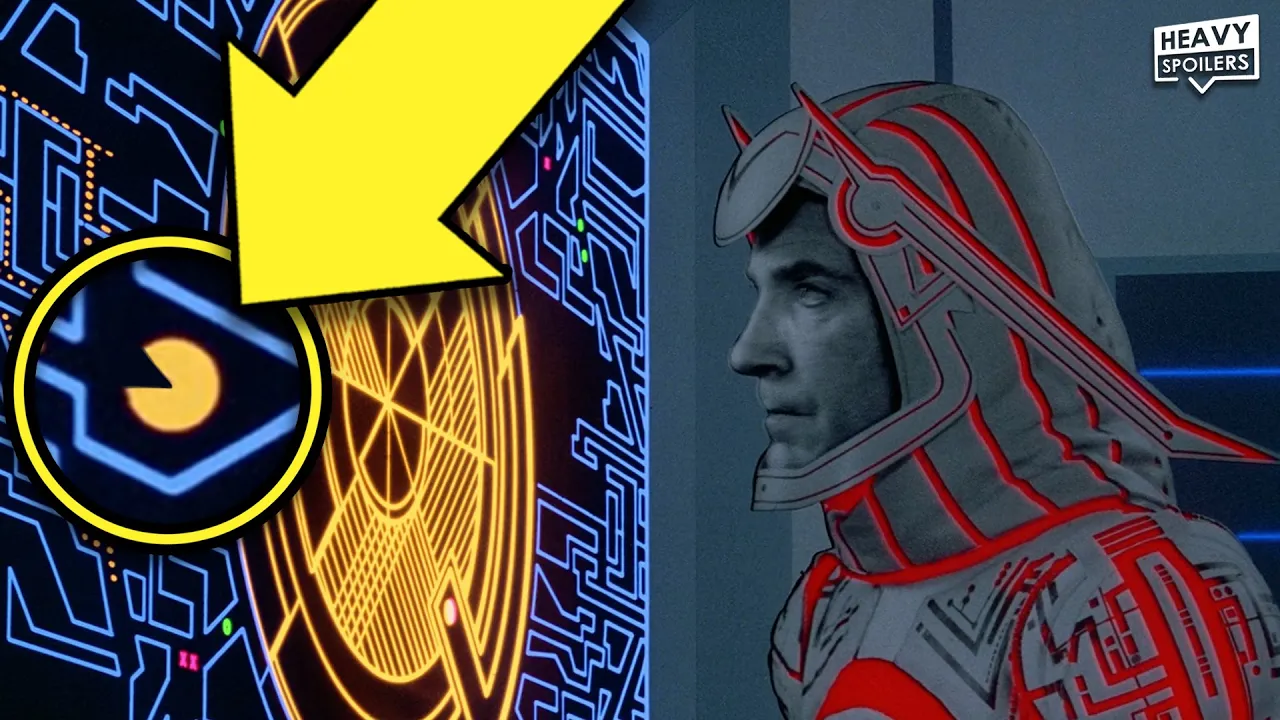
Adapted with AI from Heavy Spoilers' video of 17 October 2025 and checked against the video before publication. Editorial standards · Corrections
More from @heavyspoilers
All →


Make videos? Your next one could be an article here.
We turn your videos into articles under your name, linked back to the original. You keep 60% of what they earn, non-exclusive, and you can leave whenever you like.
Become a SubPlotter →