Tron: Legacy ending explained: why Kevin Flynn merges with Clu
From Sam Flynn's bedroom toys to Clu's origins and a theory about Zuse, a close look at the 2010 Disney sequel
 Heavy Spoilers (AI-assisted)23 November 2026Editor: Digital Fox Talent Editorial TeamOn YouTube since 2009 · more than 1.6 million subscribers

Tron: Legacy is one of my personal favorite Disney sequels ever, with a soundtrack that will send your ears to a higher plane of existence. The 2010 film, starring Garrett Hedlund, Jeff Bridges and Olivia Wilde, is packed with callbacks, and I read its ending as a story about making peace with your own dark side.
Joseph Kosinski's $170 million debut with Tron: Legacy
Joseph Kosinski directed the film, which first released in Tokyo on November 30, 2010, before its U.S. debut on December 17, 2010. Steven Lisberger, creator of Tron and director of the original, served as a producer and consultant, but he wanted to give Kosinski and his team space to make the sequel their way. The original came out in 1982, so a full 28 years passed before Disney tried a sequel.
This was Kosinski's first major motion picture, which is wild given the $170 million Disney trusted him with. That made Tron: Legacy the highest budget film ever made by a first time director. He went on to direct 2022's Top Gun: Maverick and 2025's F1.
Disney approached Kosinski around 2007. He wasn't into the idea at first, but after weeks of talks he convinced Disney to give him a couple thousand dollars for a concept trailer: an older Kevin Flynn looking down from his cliffside house as a yellow glowing Clu kills a blue program. It was shown at San Diego Comic-Con in 2008, and Disney announced the sequel at Comic-Con the following year. The story was crafted with great influence from The Wizard of Oz, with Sam Flynn trying to get home much like Dorothy.
Sam Flynn's bedroom is full of Tron Easter eggs
The film opens with Kevin Flynn telling young Sam how he envisioned the Grid and digitized himself into it. Blue beams assemble into buildings and roads that transition into the real Center City, foreshadowing Clu's goal of breaking the barrier between worlds. It's 1989, seven years after the first film. Kevin had fallen for Jordan, the architect of the ENCOM building, and Sam was born in 1983. Actress Amy Esterle was cast as Sam's mother, but the production had her die in 1985 to focus on the father and son dynamic.
Seven year old Sam is played by Owen Best, Bryce from the Diary of a Wimpy Kid movies. Kevin hums the original Tron theme, a fun fourth wall break, and hands Sam a Tron toy with its arms extended in the famous poster pose. Kevin went on to make a Tron game, and the toy is modeled on the upgraded black and blue Tron from his new Grid. Nearby are a poster for Disney's 1979 film The Black Hole, which Disney intended to remake with Kosinski before dropping it, and Marvel's ROM Spaceknight #26, a 1982 issue where Rom defends his home planet from Galactus, much like Tron defended the Game Grid from the Master Control Program.
The shelf also holds a yellow light cycle, Kevin's color in the Game Grid, plus a star, diamond and polyhedron referencing Bit, who said no as a star and yes as a diamond. A Commander Sark toy is hilarious, because Kevin is now profiting off Ed Dillinger's program as payback. Tron and Yori figures sit near an orange light cycle framed directly under Kevin's Ducati 900 SS as he rides away, a great little symbolic parallel.
Clu, Genesis and the coin of light and dark
Kevin tells Sam he made Clu, the Codified Likeness Utility, in his own image to look after the Grid. That echoes Genesis, where God creates Adam in his image, and like Adam, Clu disobeys his creator. I feel Clu is more akin to the fallen angel Lucifer, with Tron as the Archangel Michael, who is supposedly God's right hand like Tron was Flynn's.
The de-aged Kevin's face is shadowed much of the scene to save on VFX. The team used Bridges in his 30s from 1984's Against All Odds, and spent two years on the look, yet Bridges didn't like it, comparing himself to Bill Maher.
Kevin tosses Sam a coin, promising arcade games together. Beyond opening the hidden lab later, the coin represents the film's theme to me. Tron: Legacy is about the dualistic nature of humanity. Kevin faces his digital dark side, Clu, and chooses to merge with him rather than destroy him, recognizing his foolishness and arrogance as part of who he is. Light and darkness are two sides of the same coin.
Sam's black Ducati and the ENCOM break-in
News broadcasts cover Kevin's disappearance and his rise to the covers of Fortune, Time and Newsweek. In one speech he says, "In there is our future. In there is our destiny." Clu mirrors it at the end: "Out there is our victory. out there is our destiny." Young Sam rides off on his bike, symbolizing his choice to run from his father's legacy, transitioning to adult Sam on a black Ducati Sport Classic 1000, black like the new light cycles. Kevin's white second generation light cycle reflects his white Ducati.
A speed gun clocks Sam at 86 mph but shows the stationary officer going 103, so Sam could probably fight that ticket. The "89" on his helmet honors his father's 1989 disappearance. Casey Affleck almost got the role but had scheduling conflicts; Ryan Gosling, Michael Stahl-David and Chris Pine were also considered. ENCOM Tower is Vancouver's Living Shangri-La, and Sam repeats his father's line, "Now that is a big door."
Richard Mackey's black touchscreen table nods to Dillinger's desk. Cillian Murphy appears uncredited as Edward Dillinger Jr., who renamed Flynn OS to ENCOM OS, stealing Flynn's work like his father. A Blu-ray teaser shows Junior messaging a Master Control and calling it dad. This is just my interpretation, but I believe there's a good chance he's talking to a revived Sark. Disney almost showed us this by greenlighting a follow-up in 2015, but ultimately decided against the idea due to Marvel and Star Wars commitments and Tomorrowland bombing. Then Sam tells security exactly who he is, one of the stupidest things someone committing corporate espionage could do, and gets arrested after his base jump.
Sam's shipping container home and Alan Bradley's role
Sam lives in Dumont Shipping containers, a reference to the program Dumont, played by the late Barnard Hughes, who also played ENCOM founder Walter Gibbs. His dad's rusted Ducati is inside. Sam's hidden home with its city view parallels his father's, and just as Sam rescued his dog Marv, Kevin took in Quorra.
Alan Bradley arrives with news of a page from Flynn's Arcade. Sam changes his shirt, as Kevin did when Alan visited in the original. Alan recalls Kevin talking about genetic algorithms, an early hint at the ISOs, whose triple helix DNA suggests the next step in evolution, and quantum teleportation, pointing to access points that could digitize people and teleport them between real locations.
Bruce Boxleitner wasn't originally meant to appear, but a fan campaign he endorsed got him a small role as Sam's mentor. A similar Yori Lives campaign for Cindy Morgan failed, a bummer since she died in 2023 at 69. Still, Alan married Laura, making her Laura Bradley.
Flynn's Arcade and the hidden lab
The arcade's street nods to Syd Mead, the original's vehicle concept designer, and a Tron ad covers the old Space Paranoids billboard. The original arcade was the Hall Building at 9543 Culver Boulevard, built as a hospital in 1925, but the neighborhood changed so much the production rebuilt it with sets and VFX. Journey's "Separate Ways (Worlds Apart)" plays, reflecting how Sam and Kevin are worlds apart, much as "Only Solutions" pointed to Kevin's solutions focus in the first film.
The office is recreated perfectly. Sam's quarter falls out of the Tron machine, revealing the basement lab, originally planned upstairs, as Eurythmics' "Sweet Dreams (Are Made of This)" plays. Inside are Kevin's electronic quarterback game and a map marked KF89 shaped like the carrier ships. A note to call a Robert makes me think of Robert Abel, whose studio made the original's animation. The timer shows over 20 years and 11 months since Kevin left, and Sam echoes his father: "This isn't happening."
The Grid, hexagons and the ISO markings
Hexagons were chosen as the symbol of Flynn's Grid, from hexagonal Tron City to the streets. The ISOs carry a hexagon and a turnstile symbol, which in theoretical computer science means if this, then that. I read it as showing the Grid itself led to their creation, life coming from the digital world's chaos. Tron City held 16,453,479 programs before Clu's betrayal, with the Outlands between the city and western mountains, and the portal far east across the Sea of Simulation.
Clu sent the page, and his Recognizer scoops Sam up, mirroring Kevin's capture by Sark's soldiers. Programs either play the games or get rectified, rewritten into loyal soldiers, which is how Tron became Rinzler.
Light suits, sirens and the Comic-Con crowd
The original's glow was added in post, but here it was practical. Tiny lithium batteries lasted around 12 minutes, so actors switched them off between takes. The suits were extremely hot, so special air conditioners cooled actors, who couldn't sit without damaging the circuitry and suffered occasional electric shocks. The costume department got $13 million.
The sirens needed three to five hours of makeup, and one repeats Sark's identity disc speech. That scene emerged during rehearsals. The Disc Wars crowd audio came from Comic-Con fans, who are credited. A neon number two on a building, I believe, points to this being Tron 2.
Rinzler, Clu and the new light cycles
Kosinski took the name Rinzler from J.W. Rinzler's The Making of Star Wars. Rinzler's orange look and twin discs come from the original concept animation for Lisberger's studio, and four dots on his chest form a T. His protective nature remains: when Sam bleeds, Rinzler takes him prisoner. This Clu is Clu 2.0, since the first was derezzed in the original.
The light cycles come from Syd Mead's original drawings; the canopy existed only because 1982 technology couldn't place real actors on 3D models. Quorra was heavily based on Joan of Arc, from her hair to her divine nature as an ISO. Her missile escape echoes Kevin and Tron's arena breakout.
Kevin Flynn as a Zen master
Bridges encouraged the writers to make Kevin a student of Buddhism, an aspect I deeply enjoyed; he feels like a Jedi master who knows Clu is the yin to his yang. Bridges brought in Zen master Roshi Bernie Glassman and called the film a modern day myth, comparing Clu to plastic water bottles, made for convenience but a long term threat. Nobody listened, and now AI data centers are cooking the planet.
Kevin plays Go, which computers long struggled with, explaining Quorra's trouble beating him. Time moves slower in the Grid, so Flynn may have been there hundreds of years. His library holds Tolstoy, Dostoevsky, the I Ching and Chögyam Trungpa's Journey Without Goal, the most relevant to me. His line that the only way to win is not to play references WarGames, though Sam argues inaction is why he never got home. Food in the Grid could theoretically end world hunger. Kevin's yellow and white Bit pieces stand for Clu and himself, and Tron's off screen scream turns into Rinzler's growl.
My theory that Zuse is secretly an ISO
The End of Line Club references the MCP's sign off, which Clu quotes. Daft Punk cameo as DJs; deadmau5 was considered, but I can't imagine anyone else scoring it. Michael Sheen wanted the role so badly his agents told him to tone down his enthusiasm, and apparently based Castor on Ziggy Stardust and Mae West. Bartik nods to ENIAC programmer Jean Bartik, and Lisberger plays the bartender.
This isn't confirmed, but I'm willing to bet Zuse is another ISO. The film implies he and Quorra have known each other for a very long time. Beyond Konrad Zuse, whose Z3 in 1941 was the first programmable computer, I believe the name also points to the Greek god Zeus. Kevin compares ISOs to gods, and Quorra's name seems to reference Kore, or Persephone, who moves between two worlds and brings hope. Gem and the sirens could be ISOs too. Zuse says he trusted users and got burnt, and Quorra wakes right after the club explodes, somehow knowing Kevin's disc was taken. That's just my theory. Zuse also says Clu searched 1,000 cycles, roughly 7.3 days per cycle.
Tron's return and Flynn reintegrating with Clu
Sunrises symbolize hope returning in this universe. Quorra sacrifices herself to distract Rinzler, Kevin echoes "It's all in the wrist," and Rinzler remembers Tron shouting "Flynn, go!" He breaks free, yells "I fight for the users," and turns blue as he falls into the sea.
Sam and Quorra escape recreating the Tron and Yori poster pose, while Kevin fully reintegrates with Clu. That's hands down one of my favorite moments in the entire film, a visual metaphor for how powerful you become when you forgive and accept your darker half. Sam makes Alan chairman, and Quorra enjoys her first sunrise, achieving an impossible dream with help from the users.
Watch the original
@heavyspoilers · YouTube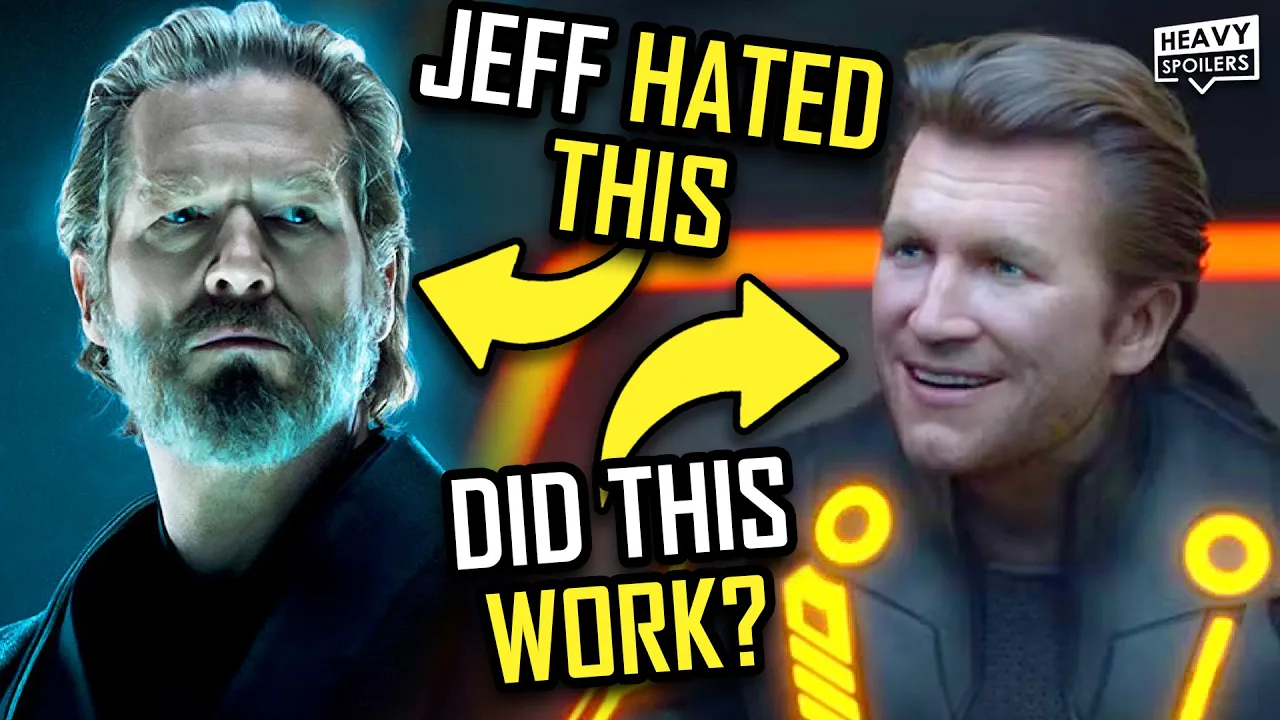
Adapted with AI from Heavy Spoilers' video of 24 October 2025 and checked against the video before publication. Editorial standards · Corrections
More from @heavyspoilers
All →


Make videos? Your next one could be an article here.
We turn your videos into articles under your name, linked back to the original. You keep 60% of what they earn, non-exclusive, and you can leave whenever you like.
Become a SubPlotter →