X-Men: The Last Stand Easter eggs and cut scenes explained
From the first major de-aging effect to Kitty Pryde's cut kiss with Iceman, a scene by scene look at the 2006 film that closed the original Fox trilogy

X-Men: The Last Stand (2006), starring Hugh Jackman, Halle Berry and Ian McKellen, closed out the original Fox X-Men trilogy. It was the first film to take on the Dark Phoenix Saga from Marvel's comics, and it is packed with comic references, casting changes and deleted moments. With the Fox X-Men about to make their return to the big screen in Avengers: Doomsday, it was the perfect time to finish my breakdowns of that original trilogy.
The numbers were big from the start. With a budget of $210 million, The Last Stand became known as the most expensive movie of its time. It went on to gross $460.4 million at the box office, the most lucrative X-Men film up to that point and around $53 million more than the $407.7 million the previous film made. After Bryan Singer directed the first two, Brett Ratner took over. John Powell composed the score, and Ratner chose him because of his work on the Bourne Identity trilogy. John Ottman was originally tapped when Singer was thought to be involved, but he ended up working on Superman with Singer instead.
The opening flashback was the first major movie use of de-aging
The Marvel logo is animated with flipping comic book pages, and this time most of them come from the arcs that inspired the film, mainly Chris Claremont's Dark Phoenix Saga from 1980 and Joss Whedon's Gifted arc from 2004. The story then opens in a New York suburb in 1986, though the scene was shot in Vancouver. The Grey residence is at 1769 Golf Club Drive in Tsawwassen, British Columbia, where the 1995 Jumanji was also filmed.
Arriving in their Mercedes-Benz 600, a young Charles Xavier and Erik Lehnsherr made cinematic history, because this marks the first time de-aging effects were used in a major motion picture. Lola Digital Effects used younger photographs of Sir Patrick Stewart and Sir Ian McKellen to pull it off. For 2006, I think it looks good and holds up very well. The effect is still noticeable by today's standards, but it still looks fantastic to me.
Magneto wears red and purple, the colors of his comic costume, and Xavier is walking. This timeline does not explain his paralysis in this scene, though X-Men: First Class later shows a bullet deflected by Magneto paralyzing him. In Uncanny X-Men #20, the alien villain Lucifer dropped a slab of rock on his legs in Tibet. Jean's parents John and Elaine debuted in Uncanny X-Men #5 in 1964, where Elaine is blonde rather than brunette. Elaine is clearly the more empathetic parent, correcting her husband when he calls Jean's mutation an illness, and I appreciate that the film gives her heart-shaped earrings to show her compassion.
When the 12-year-old Jean lifts every car in the neighborhood, she also lifts a lawnmower belonging to a neighbor played by Dark Phoenix Saga writer Chris Claremont. Stan Lee then cameos as a neighbor whose garden hose water floats upward.
Angel almost appeared in X2 and his wings scene came from Matthew Vaughn
Ten years later, around 1996, we see Worthington Labs, really the Sheraton Wall Centre in Vancouver. Inside, a young Warren Worthington III is played by Cayden Boyd, known as the dreaming hero of The Adventures of Sharkboy and Lavagirl. Angel was one of the original X-Men introduced in X-Men #1 in 1963 alongside Cyclops, Jean Grey, Iceman and Beast.
He nearly appeared in X2: X-Men United as one of William Stryker's prisoners. In a discarded script, Stryker's people would have turned him into Archangel with metallic wings, something Apocalypse first did in X-Factor #23. The scene of his father breaking down the bathroom door to find young Warren cutting at his growing wings was one of Matthew Vaughn's ideas from when he was involved, and Ratner kept it.
Halle Berry's flying demand and the missing Nightcrawler
In the present day, the Danger Room opens with Storm flying into frame. Because Halle Berry barely flew in the earlier films, flying moments were one of her main stipulations for returning. Some of the stunts made her so nauseous that she threw up from spinning, much as Storm does later at the Grey house. Colossus, played by Daniel Cudmore, was done practically this time with a shiny reflective suit to save money on CG after going all CG in X2.
Nightcrawler is completely absent, despite seemingly joining the team at the end of X2. The production planned a small cameo for Alan Cumming but decided the money, time and energy to bring the character to life were not worth it, and wrote him out entirely, which is disappointing.
Shawn Ashmore returned as Iceman for the third time, but this was Elliot Page's first time as Kitty Pryde. After seeing Page in the 2005 thriller Hard Candy, Ratner knew Page was the right choice and even called Page personally after the offer was rejected. Page would come to regret it, having truly hated working with Ratner throughout the production. Eliza Dushku, Summer Glau and Maggie Grace also auditioned, and Grace was briefly cast before the production decided she was too old. Sumela Kay and Katie Stuart had played Kitty in the first two films, but only as background characters.
Wolverine's fastball special with Colossus dates to Uncanny X-Men #100 in 1976, and the simulated enemy is a Sentinel, the mutant hunting machines created by Bolivar Trask in 1965's Uncanny X-Men #14. It's weird that the Sentinels first show up here as a simulation before appearing for real in Days of Future Past, but I still appreciate the reference. Apparently, if Singer had directed, Scott Summers would have built the Danger Room himself after losing Jean, so the X-Men would never suffer a loss like that again.
Cyclops' red painting and Kelsey Grammer's audition for Beast
A grieving Scott has visions of Jean calling from Alkali Lake. The production seems to have placed a painting of a red ocean behind his bed on purpose, foreshadowing his death at the lake at the hands of the red-haired Phoenix.
The Department of Mutant Affairs exterior is an office building at 1075 West Georgia Street in Vancouver, also used for a rooftop fight in the second episode of Arrow. Inside is Kelsey Grammer's Beast. Grammer was so enthusiastic that he went through the audition process, something he rarely did at that point. Vaughn cast him, and Ratner kept him on; Vaughn also cast Vinnie Jones as Juggernaut. Jason Flemyng was heavily considered when his friend Vaughn was attached, and Vaughn later cast him as Azazel in First Class. Sam Neill was apparently cast at one point but dropped out due to other commitments.
Hanging upside down, Beast reads the October 2005 Scientific American, likely focused on an article about tracking mutations. His eyes are green, unlike the yellow eyes of Nicholas Hoult's version. The makeup took about two and a half to three hours to apply and 45 minutes to remove.
Bolivar Trask, Mystique's CG eyes and a pale Leech
Bill Duke plays Bolivar Trask, who in the comics is a Caucasian robotics expert who built the Master Mold that produced the Sentinels. Here he is head of Homeland Security. Rebecca Romijn's Mystique role was reduced because of prior commitments, including the WB sitcom Pepper Dennis, and her growing family. Her yellow eyes were fully computer generated this time, a relief after the irritating contacts of the first two films, though she wasn't comfortable working with Ratner. When she transforms into Magneto, the number 0001 on his chest likely refers to X-Men #1.
Leech, introduced in 1983's Uncanny X-Men #179, can switch off mutant powers, but in the comics he has deformed green skin. For some reason, Ratner made him a bald white boy played by Cameron Bright. Later, Jimmy stands on a green bed, likely a nod to that green skin. A then recent trailer for Insomniac's Wolverine game featured Leech in his green form.
The Morlocks became the Omegas, and Psylocke was named as an afterthought
Back at the mansion, filmed again at Hatley Castle in Colwood, British Columbia, also Lex Luthor's home in Smallville, Xavier tells his class, "When an individual acquires great power, the use or misuse of that power is everything." That feels like a nod to Spider-Man's great power, great responsibility mantra. Siryn, Jubilee, Jones and Artie Maddicks are played by actors reprising their X2 roles. Moira MacTaggart, Scottish in the comics, is played by British actress Olivia Williams. Behind her is Xavier's brain-dead twin, whose name starts with P, foreshadowing the post-credits scene. Hellion and the Stepford Cuckoos appear in the hallway.
The mutant cure is announced at Alcatraz, with Dr. Kavita Rao played by Iranian actress Shohreh Aghdashloo, though the character is of Indian descent in the comics. Vaughn had cast her as Dr. Cecilia Reyes before Ratner recast her as Rao. Anna Paquin wasn't keen on Rogue taking the cure and tried to get the decision reversed, without success. The mutant meeting church is the same Vancouver church from Nightcrawler's X2 scene.
The crowd includes Anole, credited as Lizard Man, who joins the X-Men in the comics, and Phat. The woman with purple highlights is supposed to be Psylocke, yet she can only teleport through shadows, a power comic Psylocke didn't gain until 1996. The character wasn't meant to be Psylocke at all, and someone named her that late in production. I find that random and careless, and since Psylocke is such an important character, I think giving so little thought to her live action debut is disrespectful.
Callisto, played by Dania Ramirez, leads the Omegas as she led the Morlocks, but has super speed and a power sensing ability rather than her heightened senses. Arclight replaced Vaughn's planned Stacy X, a role Ramirez originally read for. As far as I can tell, Ash is an original character. Ken Leung plays Quill and later played Karnak in the Inhumans series, which I thought was terrible.
James Marsden's quick exit and the Phoenix rewrite
Scott rides his Harley-Davidson V-Rod to Alkali Lake, a bike Ratner bought after filming, and is killed by Jean's kiss. Marsden's quick death traces to Singer casting him as Richard White in Superman Returns, so he couldn't do both. Xavier's theory of a telekinetic cocoon echoes Avengers #263 from 1985.
Here the Phoenix is Jean's own walled off power, a split personality Famke Janssen researched, rather than the cosmic entity of Uncanny X-Men #101. Janssen was not a fan of Ratner's take and was let down that it wasn't faithful. One of the main reasons the Dark Phoenix story was presented so poorly is that Fox executives prioritized the cure story, making the Phoenix an afterthought.
Angel's casting, Juggernaut's suit and Pyro's costume
Mike Vogel was cast as Angel but left for Poseidon, and Ben Foster took over despite a fear of heights. The cure's box reads XM89248, a nod to Jim Lee's first Uncanny X-Men pencils in issue #248. Angel's first wings were too heavy, so lighter foam wings were made. Eric Dane plays Multiple Man, though Pyro reads cell 41205 while the door says 41209; a planned solo Multiple Man film never happened.
Juggernaut, Xavier's stepbrother in the comics, is a mutant here like his Ultimate counterpart, and Xavier ignores him at the Grey house, seemingly confirming no shared history. Vinnie Jones hated the uncomfortable costume so much that he declined a cameo in Deadpool and Wolverine. Aaron Stanford was bummed he never got a villain costume, something Marvel Studios fixed in Deadpool and Wolverine.
Kitty and Iceman's deleted kiss, the rebuilt Golden Gate Bridge and other cut moments
Kitty and Iceman shared a kiss on the ice in a deleted scene, but Ratner cut it because he felt Page "looked like a 12-year-old" next to the adult Iceman. Gambit was discussed, with Josh Holloway, Keanu Reeves and Channing Tatum considered. San Francisco barred filming near the Golden Gate Bridge, so a section was rebuilt for $35 million. A deleted moment of Jean empathizing with a crying girl is one I really wish they kept, because it gives Jean more agency over the Phoenix.
Beast's "Oh my stars and garters" is there only because executive producer Kevin Feige felt it should be said at least once. Juggernaut's famous line references a popular 2005 internet clip created by Xavier Nazario and Randy Hayes. Logan believes he is the only one who can stop the Phoenix, which isn't true, because Leech is a few feet away and Colossus could have thrown him at her. Of course, that wouldn't be as dramatic.
Rogue's cure ending and the alternate takes I preferred
Rogue returning cured is wrong for her in my opinion, but I'm glad she's happy. An alternate take where she can't go through with it would have been more fitting for the third act. A cut scene of Pyro returning to the school was apparently filmed, and I'm glad it was removed, because after everything he did, he was a murderer.
After the credits, Xavier wakes in his twin's body on Muir Island, which was referenced in X2 alongside Moira's son Kevin, who can warp reality. It's a shame we never saw Kevin in the trilogy, but I'm sure the MCU will get to him eventually.
Watch the original
@heavyspoilers · YouTube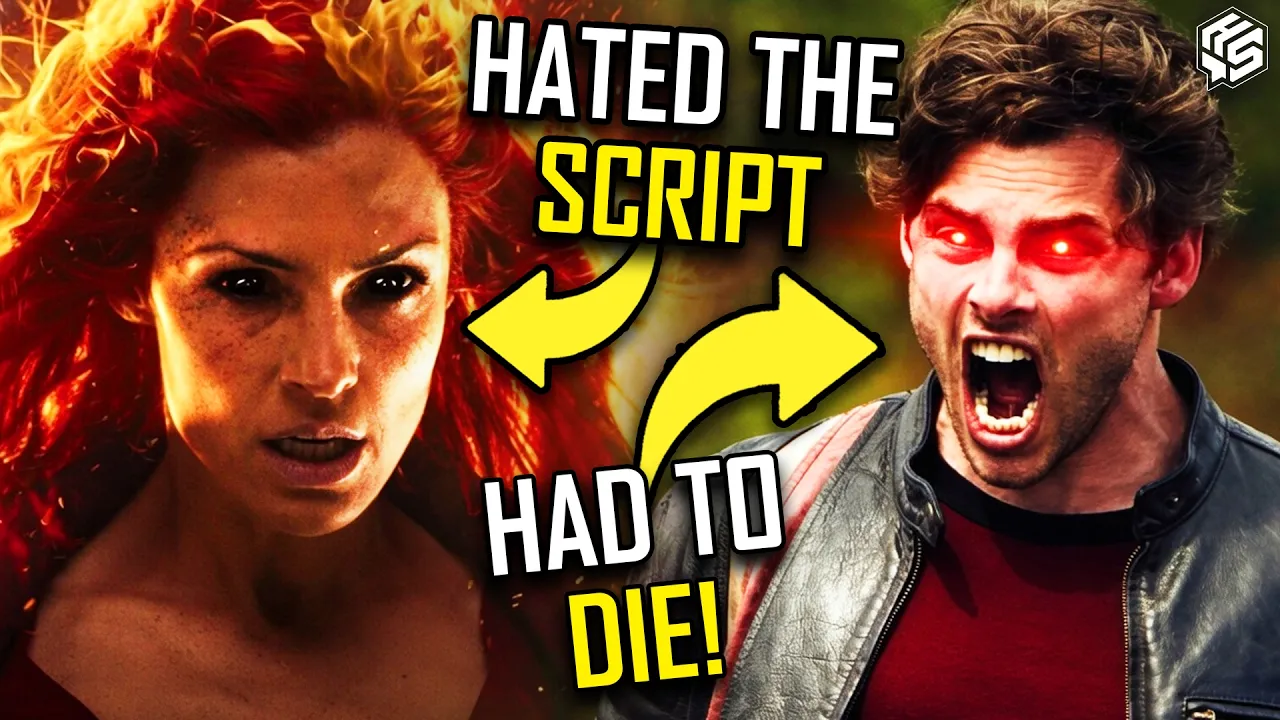
Adapted with AI from Heavy Spoilers' video of 20 June 2026 and checked against the video before publication. Editorial standards · Corrections
More from @heavyspoilers
All →

Make videos? Your next one could be an article here.
We turn your videos into articles under your name, linked back to the original. You keep 60% of what they earn, non-exclusive, and you can leave whenever you like.
Become a SubPlotter →