The Thing game ending explained: Childs, MacReady and more
The survival horror sequel set three months after the film reveals what happened at Outpost 31, introduces a human Thing hybrid, and leaves one big question open
 Heavy Spoilers (AI-assisted)26 October 2026Editor: Digital Fox Talent Editorial Team

The Thing was a film I was absolutely obsessed with growing up. When a video game sequel was announced in 2002, I was eagerly awaiting it. The game, developed by Computer Artworks, is classed as canon to the movie. Beyond it and the comic books, we've never had a real continuation of that story, and I doubt the movie is ever going to get a sequel. So this is the story of the game and how it continues the tale of Outpost 31.
Survival horror is my favorite genre. Whether it's the Resident Evil series, Dead Space, Alien Isolation or The Last of Us, these are the games I constantly go back to. When I'm playing a standard action game, I feel nothing. Survival horror gets me pumped up. For a while it seemed The Thing game could be lost to time, a relic of the past frozen in ice much like the creature itself. Fortunately, it has been remastered for the PlayStation 5.
How Universal Interactive and Computer Artworks built The Thing game
The game was made by Universal Interactive, with the studio combing through its back catalog looking for properties. Realizing The Thing had never had a sequel, they felt a game was a great way to capitalize on the hunger for answers. The ending of the movie had been left ambiguous, so a sequel seemed like an open goal. What attracted them most was that the Thing could appear in a number of forms and take over the team.
While brainstorming, they looked at what had come before. An earlier Computer Artworks game, which involved four scouts exploring an alien planet, caught their eye. Computer Artworks then created a version of a level set at an Antarctic base, and that impressed Universal enough to move ahead with them as the team.
Computer Artworks said Universal were open to their ideas and didn't nail down a list of rules and restrictions. They compared it to the opposite of a game like Harry Potter, where there are strict guidelines on what you can and can't do. That freedom let them branch out. They looked at games like Half-Life as inspiration, which you can definitely feel, and they wanted to play into conspiracy theories around Area 51, so there's a lot of government overreach.
The Thing's trust system means any squadmate could be the creature
The team also created a trust system for your squad, where teammates act differently depending on events. Each has a trust bar that controls their demeanor and how they respond to you. They have classes such as medics and engineers, with engineers opening specific doors. If an engineer doesn't trust you, he won't follow you, which can hamper your progress.
You win trust by giving teammates weapons, ammo and health, and by not constantly shooting them during battles, which is something I may have been guilty of. Sometimes they'll attack you, but you can pick up tasers that stun them, take their weapons and calm them down rather than killing them outright, which I may also have been guilty of.
What makes the game unique is that any of your team could be the Thing. There were parts where I got lost in the snow, then a teammate would catch back up and I'd be thinking "where you been, mate?" You have to build trust while also wondering whether you're handing weapons to the Thing. Although there are scripted turns, some moments play out differently every time. The creative team admitted there were logical inconsistencies, and a couple of times someone got the all clear and moments later turned into a Thing, because that's what the story needed.
The Thing game is set three months after the film at Outpost 31
The game opens with a flashback to the Norwegian camp, showing some of what went down there, and ends the scene with an ominous laugh as someone watches back the CCTV. It doesn't add that much, but considering the game was released before the prequel, at the time it was a nice addition.
The game is set three months after the film. The story truly picks up with the arrival of Captain Blake, part of a US military team. Two teams have been dispatched to investigate the bases, with Alpha Team heading to the Norwegian camp. Bravo Team, led by Blake, is sent to Outpost 31, where they come across the aftermath of the movie.
There are nice touches, like the sign when they first fly in, which comes straight out of the film. There's the pool table in the rec room, and they discover Blair's spaceship. There's also a tape recorder from MacReady that plays lines from the film, including: "I think it rips through your clothes when it takes you over."
Childs's body and Nauls's fate answer questions from the movie
At the base they find the body of Nauls, with his side ripped open. We never discover what happens to the character in the movie, so this clarifies what went down.
They also find Childs. This clears up the ending of the film and does seem to confirm he was human. In the game, Childs died from hypothermia, but I don't know. Maybe the Thing chose to remain frozen. So there is still a level of ambiguity, and I'd never want it confirmed exactly what happened. I'm more than happy to keep wondering. MacReady is nowhere to be seen, but he does come back around at the end.
Blood tests reveal the Thing can now mimic clothes
Blake then gets a call from Colonel Whitley, played by William B. Davis. It's hardly his first run-in with aliens, since he played the Cigarette Smoking Man in The X-Files. Whitley orders Blake to blow the base and return. The rest of his team are airlifted out, but Blake is worried he hasn't heard from the other team, so he heads out and finds survivors who've seen something horrible.
He has to win their trust, and along the way he comes across Easter eggs from the movie, including the axe in the door and the ice coffin the Thing bursts out of. The group are swarmed by Scuttlers throughout, which again plays into the Half-Life inspiration. Eventually Blake finds Pierce, who refuses to go with them until they take a blood test. Blake gets his hands on one and drops a line from the film: "Now, I'm going to show you what I already know."
His other companions turn out to be creatures and spring into action when tested. I remember wondering the first time why they didn't get Blake sooner, since he was completely alone with them at points. The game also explains that the Thing can now mimic clothes, so infected people don't show up looking different. It's a big change from the film, where the Thing can only mimic organic matter, but it's a conceit the system needs to work. I do miss them ripping through clothes, though.
Pierce's slow infection adds to the lore of The Thing
After the fight, Blake's companion gets lost in the snow while they look for a way to contact Whitley. Blake is suddenly hit by grenades from a watchtower, fired by Pace. Pace split from his buddy Williams in the storm, so from this point you set out to find him. Williams is holed up, panicked and suspicious, and the pair have to burn some of the creatures to win his trust.
With his help they reach the comms room, where Blake finds Pierce. He's been infected and can feel the Thing moving through his body. It's a tiny thing, but it adds a lot to the lore and shows that assimilation works slowly but eventually consumes you. It's much like the simulation Blair ran in the movie: if one cell gets inside you, you're done. It slowly infects and mimics every cell around it, but gives you time to make a choice. Pierce takes his own life after Blake refuses to shoot him.
Meanwhile, a mysterious figure has been running about with a radio. Following him, Blake is led to Collins, who turns out to be a Thing, leading to a big boss battle. After Blake comes out on top, he gets the radio.
John Carpenter plays Dr. Faraday of the Pyron facility
Through the radio we learn there's a secret structure below the Norwegian base, known as the Pyron facility, set up by a company called GenInc. I did think this might be an ode to Jurassic Park, as the name sounds similar to InGen. Like InGen, they've been carrying out genetic experiments, in this case to learn all about the Thing.
The research was headed up by Dr. Faraday, who is based on and played by none other than John Carpenter. As with most of the trouble in The Thing, one of the team got infected, and the Thing got out. This is where the lore starts to go a bit wild.
Colonel Whitley is revealed as a human Thing hybrid
While attempting to escape, Blake and Faraday are met by Whitley. He has infected himself with the Thing, but says it's something he can control. He's like Wesker from Resident Evil, and he has his men pull their weapons on the pair. Blake goes to attack him and Whitley shoots him, but it's only a tranquilizer.
Whitley is playing his X-Files character again, working with the aliens once more, or rather becoming a human alien hybrid. "I will be remembered as the first successful test subject," he says. His cells resist the infection, showing it can be controlled. He did this because he had terminal cancer, and considering he played the Cancer Man in The X-Files, he was cast for a reason. I think this will make or break the story for you, but it's extended lore, and everyone's brain selects what is and isn't canon for them.
Blake also discovers his own cells possess a unique resistance, which is why you don't get infected in the game. That's why his companions didn't attack him earlier, and why he wasn't taken over while unconscious. This anomaly makes him both a threat and a potential key to understanding the organism.
GenInc's cloud virus and Whitley's plan to infect the world
Blake and Faraday are taken to a lab where experiments have been running, and the infection has spread across the base. Faraday wants to wipe it out, and Whitley shoots and kills him for it. We discover GenInc developed the cloud virus, which can spread the Thing at a microscopic level. That means it could be used in biological warfare to infect an enemy, so they either join Whitley or die.
They couldn't control it, though, and Blake awakens to find the virus has overrun the base. That leads to a big boss fight in which Blake has to continuously electrocute a gigantic creature to stun it. Further in, he finds everyone turning on each other and is led to another lab, where he learns Whitley wants to use airplanes to disperse the virus around the world. That would be faster than the model Blair came up with in the film and mean the Thing assimilates everything.
Blake stops the planes taking off and comes across Whitley. He shoots explosive barrels that Whitley is conveniently standing beside, but Whitley isn't really affected, so fire is no longer a weakness. Blake follows him back to the buried ship, which has a facility built around it. There the infection takes hold of Whitley and turns him into a gigantic monster.
MacReady's survival in The Thing game remains unexplained
Out of nowhere, a helicopter arrives with a mounted machine gun, which Blake uses to shoot oil barrels around the ship, blowing it and Whitley sky high. The pilot is MacReady, confirming he did survive. How he survived is up in the air, and the game doesn't say outright.
Some believe he was captured after the events at the outpost and kept contained for three months until he escaped during the breakout, then got hold of a helicopter to pick up Blake. The other theory is that the rescue team arrived and found Childs dead, but MacReady had managed to hold on. He was airlifted to safety, then came back a couple of months later to save Blake.
They've never cleared it up, and as we never got a sequel, I don't think we'll find out the answers.
Watch the original
@heavyspoilers · YouTube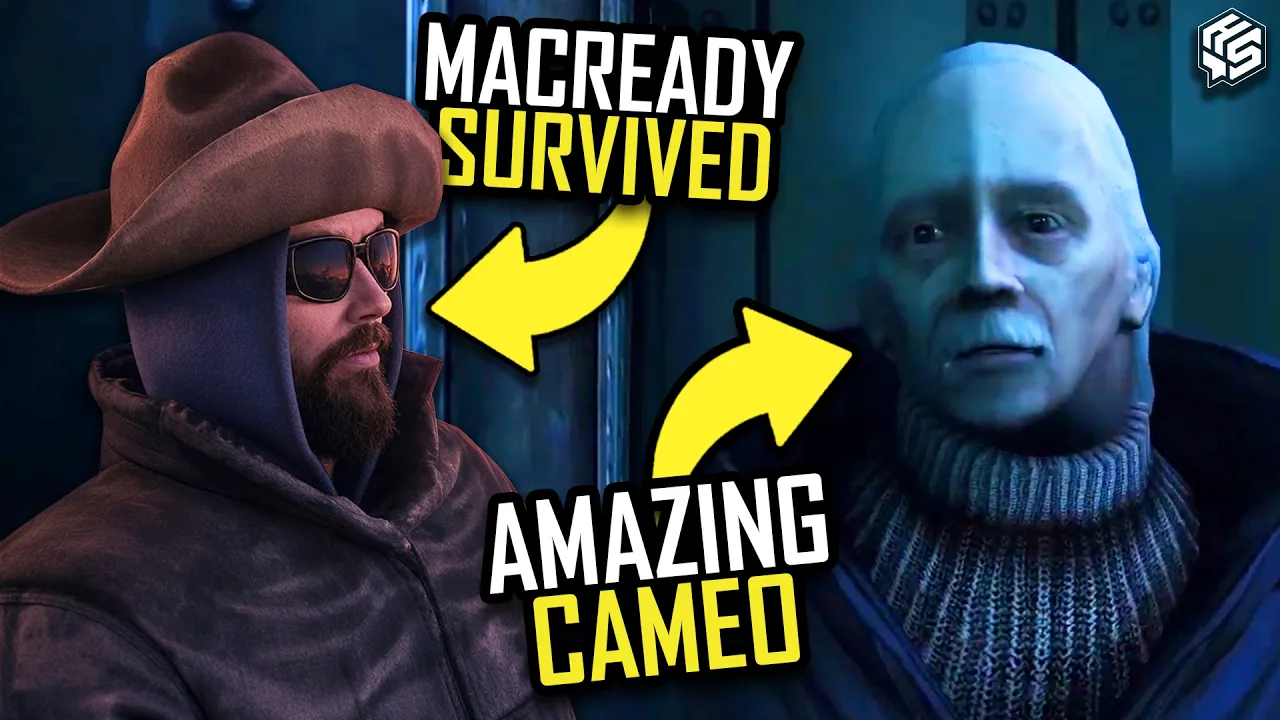
Adapted with AI from Heavy Spoilers' video of 25 October 2026 and checked against the video before publication. Editorial standards · Corrections
Also on The Thing
3 creators, 5 takes →



More from @heavyspoilers
All →


Make videos? Your next one could be an article here.
We turn your videos into articles under your name, linked back to the original. You keep 60% of what they earn, non-exclusive, and you can leave whenever you like.
Become a SubPlotter →