Star Trek: did humans quietly take over the Federation?
Quark compared the Federation to root beer, and that comparison points to how human values became the default across the Star Trek galaxy

In Star Trek, the Federation presents itself as a union of hundreds of worlds. By the late 24th century, though, it feels increasingly human. That didn't happen through conquest. It happened through comfort, as species adapted willingly because life inside the Federation was simply easier.
The best way into this idea comes from an unlikely source: Quark, the Ferengi bartender on Star Trek: Deep Space Nine. "The Federation is a wonderful thing," he once said, and then he compared it to root beer.
Quark's root beer comparison and the Federation's quiet assimilation
At first the comparison sounds ridiculous. A Ferengi bartender on Deep Space Nine describes the Federation as sweet, bubbly and cloying. But the more you listen to him, the less it feels like a joke. Quark wasn't talking about military conquest. He was talking about something quieter. The Federation doesn't usually arrive above your world demanding surrender. It offers membership, trade, security, medicine and opportunity.
Over time, people change. Klingons spend their lives serving in Starfleet. Ferengi begin abandoning traditions that existed for centuries. Vulcans become more emotionally open. Even former enemies start raising their children inside Federation institutions. Nobody forces them to. Adapting to the Federation simply makes life easier.
Obviously there's a real-world reason for some of this. Star Trek is written by humans, performed by humans and made for a human audience. But that explanation only works outside the universe. Inside the universe, something else seems to be happening. I'm not talking about biology here, though there is evidence for it. I'm talking about culture. The Federation's values feel human. Its diplomacy feels human. Even Starfleet increasingly operates according to human emotional instincts and human moral assumptions.
That's where things start becoming uncomfortable, because most species don't resist this shift. They embrace it. To be clear, this isn't cultural extermination. Klingons remain Klingon, Vulcans remain Vulcan and Bajorans remain Bajoran. What changes is subtler. Federation institutions normalize specifically human assumptions about morality, diplomacy, cooperation and ultimately civilization itself, until those assumptions stop feeling human at all and become Federation values. Because membership improves life for many worlds, most species adapt willingly. The Borg assimilate through force. The Federation assimilates through comfort. And over time, the galaxy slowly acquires a taste for root beer.
Before the Federation, Earth looked unstable, not like a future superpower
Before the Federation existed, humanity wasn't viewed as a future galactic superpower. If anything, most major powers saw Earth as unstable. Humans had only recently survived global nuclear war. Entire governments had collapsed and millions were dead. By Vulcan standards, humanity still appeared deeply irrational, emotional, reactive and dangerously ambitious.
Then humans developed warp travel earlier than expected. From the Vulcan perspective, that was probably alarming. Early Starfleet did very little to calm those fears. Human crews ignored protocol constantly. Captains took unnecessary risks. Diplomats improvised first contact situations that more established interstellar powers would have spent years preparing for.
Human adaptability made Earth the center of the early coalition
Over time, something became difficult to ignore: humans adapted unusually fast. Vulcans tended to approach problems through logic and caution. Andorians respected strength and military discipline. Tellarite politics revolved around confrontation and debate. Humans, meanwhile, had a habit of absorbing ideas from almost everyone around them. They negotiated easily across cultures and changed tactics quickly. They were willing to borrow, compromise, improvise and occasionally embarrass themselves if it meant keeping negotiations alive for another hour.
That flexibility mattered more than it first appeared, because the early coalition of planets wasn't held together by military power alone. If anything, it survived because somebody had to keep its founding members from tearing it apart every few months, and more often than not that role fell to Earth. Humanity became the political center partly because humans were good diplomats, and partly because they were uniquely willing to engage with radically different cultures without immediately trying to dominate them. At least directly.
That made Earth increasingly indispensable. Vulcan science remained more advanced in many areas. Andorian military traditions were still respected. Tellarites retained enormous economic influence. But humanity slowly became the connective tissue holding the Federation together, and once that happened, human norms started spreading almost by accident. Starfleet headquarters remained on Earth. Starfleet Academy trained officers on Earth. Federation politics increasingly revolved around Earth as a neutral meeting ground between species. The line between Federation culture and human culture became harder to separate, not because humanity conquered the Federation, but because it became central to nearly all of its institutions.
Starfleet Academy on Earth and a system that rewards human traits
Technically, the Federation's claim to be a union of hundreds of worlds is true. Its ships are crewed by dozens of species, its council chambers hold representatives from across the quadrant, and its founding principles are supposed to apply equally to everyone. But the deeper you look into Starfleet, the harder it becomes to ignore a strange pattern. The institution doesn't simply contain humans. It increasingly operates according to human assumptions.
Consider where Starfleet trains its officers. Starfleet Academy is on Earth. Not Vulcan, not Andoria, not Tellar Prime. For many alien officers, their military and political education takes place immersed almost entirely in human culture: human architecture, human food, human social norms and human history. By the 24th century, many alien officers would spend years immersed in human culture before ever receiving a command of their own.
Even the structure of Starfleet Command reflects this. Human officers thrive because Starfleet rewards traits humans naturally tend to value: emotional intuition, improvisation, collaborative leadership and moral flexibility under pressure. Vulcans can succeed inside that system, but often by loosening the emotional restraint traditional Vulcan culture encourages. Klingon officers who work closely with Starfleet frequently learn to temper aggression with diplomacy and restraint. Even Ferengi who spend enough time in Federation space often begin adapting to values traditional Ferengi culture would once have considered weakness.
Starfleet doesn't force these changes. Institutions inevitably reward some behaviors more than others. Officers who integrate successfully tend to advance, and those who can't adapt often remain isolated. Eventually Federation identity begins replacing older cultural identities, especially among officers who spend decades in Starfleet. Worf is one of the clearest examples of this tension. He spends much of his life trying to preserve Klingon tradition, yet repeatedly finds himself thinking like a Starfleet officer first and a Klingon second. By Deep Space Nine, even Quark quietly notices what's happening. Humans are everywhere because Federation culture mirrors human culture so closely that the distinction becomes harder to separate with every generation.
Starfleet became a culture that teaches officers to think like humans
At some point, Starfleet stopped simply being an alliance fleet and started becoming a culture of its own. Officers from across the quadrant serve aboard the same ships, study at the same academy, follow the same regulations and spend years inside the same institutional structure. On the surface, that looks like multicultural cooperation. Beneath it, Starfleet increasingly teaches its officers to think in specifically human ways.
Officers are expected to improvise during crises, to negotiate peacefully whenever possible, and to balance logic with instinct instead of relying entirely on one or the other. Those ideas aren't uniquely human, but they align very closely with humanity's own political and cultural worldview after first contact. Alien officers often begin adapting themselves to those expectations.
None of this happens because Starfleet openly rejects alien culture. The Federation prides itself on tolerance. But institutions shape behavior whether they intend to or not, and Starfleet's institutions are increasingly centered on human assumptions. That may be the most important shift of all. Once those assumptions are normalized, humanity no longer appears to be one culture among many. It quietly becomes the standard other cultures are expected to integrate around. By the late 24th century, many species in Starfleet aren't simply cooperating with humans. They're increasingly being taught to think like them.
Ferengi and Cardassians see the Federation as human territory
Humanity's influence extends far beyond Starfleet and begins shaping the identity of the Federation itself. The strange part is how rarely anyone inside the Federation seems to question it. Earth becomes the political center of interstellar civilization almost by default, and that creates an unusual perception across the quadrant. The Federation may technically belong to hundreds of species, but many outsiders increasingly experience it as human territory.
Even species openly critical of the Federation describe it in specifically human ways. Ferengi don't complain about Vulcan expansion. Cardassians rarely warn about Andorian influence. They talk about humans: human morality, human idealism, human diplomacy, human arrogance. That distinction is critical to understanding the Federation's broader identity.
In some ways, this was probably inevitable. That doesn't mean humans weren't often trying to understand everyone, and ironically, that may be exactly what made their influence spread so effectively. Humanity rarely imposed its worldview through direct force. It normalized itself through constant presence. Entire generations across the Federation grew up surrounded by human political ideas, educational systems and social expectations until they stopped recognizing them as human at all. That may explain why so many species adapt to Federation life without feeling they're losing anything. The Federation never needed to conquer the quadrant militarily, because by the 24th century much of it was already reorganizing itself around humanity anyway.
Why humanity? Adaptability, transferable culture and optimism
This raises an uncomfortable question: why humanity? The Federation contains species physically stronger, more intelligent, more disciplined and more technologically advanced than humans. Vulcans helped Earth recover after first contact. Andorians possessed centuries of military experience humanity lacked. Tellarites operated enormous trade networks long before Starfleet became a major interstellar power. Yet humans still became the center of the Federation's cultural gravity.
Part of the answer may simply come down to adaptability. Humans change faster than most species around them. Sometimes recklessly, sometimes disastrously, but quickly. They absorbed foreign ideas easily, borrowed technologies freely and integrated cultural practices without seeing them as threats to their identity. In a coalition as large as the Federation, that flexibility became incredibly useful, and it made human behavior easier for other species to integrate around. Not necessarily because humanity was superior, but because human culture proved unusually transferable.
Even humanity's optimism played a role. The Federation's belief in cooperation, exploration and mutual progress aligns closely with Earth's own postwar identity after first contact. For many worlds exhausted by conflict, those ideas were attractive, especially compared to the alternatives around them. Humanity offered stability without complete rigidity, power without constant domination, and a system that encouraged participation rather than simple obedience.
Because of that, species across the quadrant slowly began building themselves around human institutions, almost without realizing it. That may be why the Federation became so successful in the first place. Humanity didn't spread through fear. It spread because eventually much of the galaxy decided life simply worked better around humans than without them.
What other creators are saying
More on Starfleet →I think the Training Day and Crimson Tide influences could make a genuinely compelling, darker Starfleet story with a new crew, and I'm cautiously excited, but I don't trust Paramount's Trek track record and need to see it filmed before believing in it.
Star Trek (2009) and The Force Awakens share a director, a reboot mission and the start of a trilogy
J.J. Abrams Played an Almost Identical Role in Star Trek and Star Wars →
One card plays artifacts from the top of your library, and the other rewards facing a dilemma with free spells
Zefram Cochrane and the Caretaker among Magic: The Gathering Star Trek preview cards →
A Romulan War buildup, a Mirror Universe miniseries, the Borg Queen's origin and a refitted NX-01 were all part of the plans for a season that never got made
Watch the original
@lorereloaded · YouTube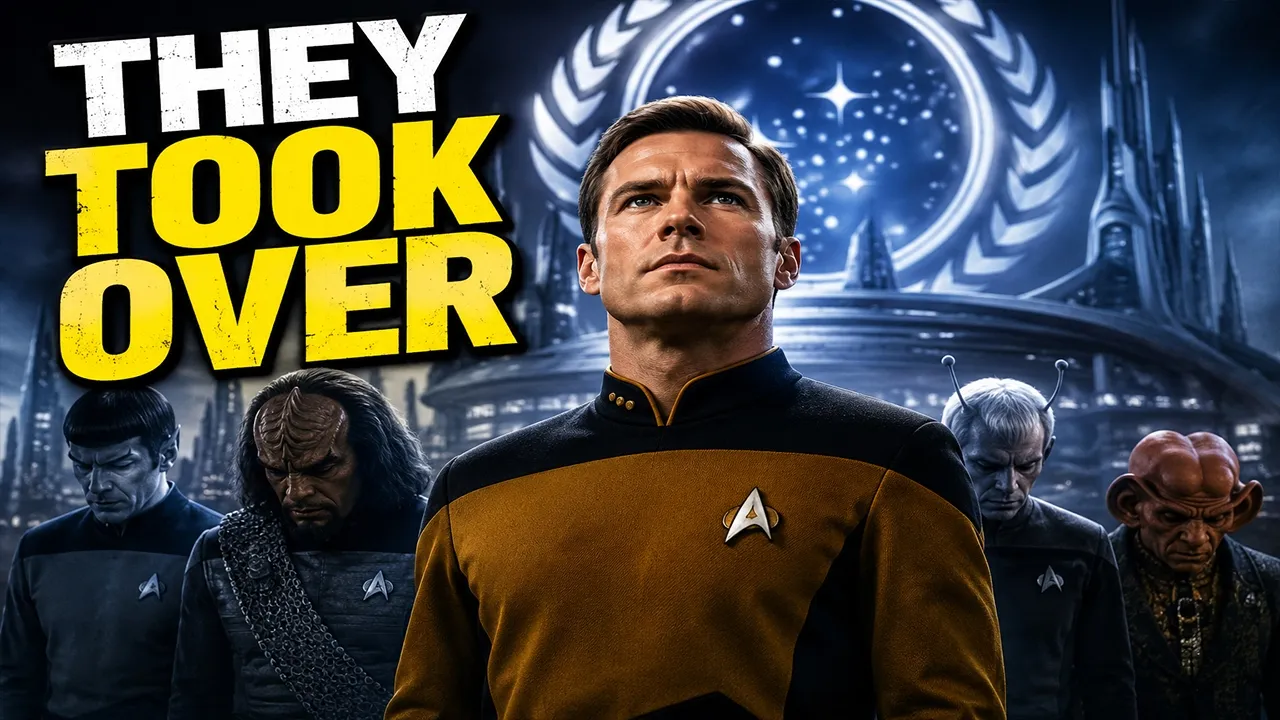
Adapted with AI from Lore Reloaded's video of 17 May 2026 and checked against the video before publication. Editorial standards · Corrections
More from @lorereloaded
All →


Make videos? Your next one could be an article here.
We turn your videos into articles under your name, linked back to the original. You keep 60% of what they earn, non-exclusive, and you can leave whenever you like.
Become a SubPlotter →