How the Federation Was Built Before the Dominion War Tested It
From World War III and first contact to Starfleet's exploration mission, the Federation rose on the belief that cooperation beats domination

By the time the Dominion War began, Star Trek's United Federation of Planets had become something extraordinary. For generations it had expanded across the stars without behaving the way most great powers do. It never conquered planets and didn't rule through fear. Despite what its enemies often claimed, it genuinely believed cooperation worked better than domination, and for a while it was hard to argue with the results.
Then came the Dominion. The war didn't simply threaten Federation territory. It threatened the entire idea the Federation had built itself around. Before the sieges, and before Starfleet started compromising principles it once believed were untouchable, you first have to understand the civilization that entered that war believing history had finally moved past humanity's darker instincts.
The Dominion War battle where 112 Starfleet ships went in and only 14 survived
In 2374, during the Dominion push into Federation space, Starfleet launched one of the largest fleet operations in its modern history. 112 ships entered the battle. Only 14 survived.
The terrifying part wasn't just the losses. It was what the losses revealed. The Dominion War didn't simply threaten Federation territory. It threatened the entire idea the Federation had built itself around. To see what was at stake, you have to go back to before the Romulan Neutral Zone and before the Cardassian Border Wars, to the point where humanity nearly destroyed itself.
World War III and the collapse that came before the Federation
The 21st century was not remembered as an age of progress. It was remembered as a warning. Economic systems collapsed, governments fragmented, and resource shortages and nationalism consumed entire regions of Earth. Eventually it escalated into World War III. It went by other names first, including the Eugenics War, before it was finally just called World War III.
The conflict was so catastrophic that hundreds of millions died, entire cities vanished, and much of the planet was barely functional. What began as an eruption in one nation ended in the eradication of 600,000 species of animals and plants, and 30% of Earth's population.
This is important because the Federation was not born from strength. The peoples of the galaxy were exhausted from war and exhausted from living every day unsure. Humanity had already experienced what happened when fear became the organizing principle of civilization. By the middle of the 21st century, there were legitimate reasons to wonder whether the species was going to survive itself.
Zefram Cochrane's 2063 warp flight and first contact with the Vulcans
Then, in 2063, history changed. The Earth didn't fix itself overnight, but in the middle of the rubble, Zefram Cochrane successfully launched humanity's first ship capable of warp. The flight itself lasted only minutes, but its consequences would reshape everything. For the first time in human history, Earth discovered it was not alone, and suddenly every border, every war and every old political division on Earth started looking very small.
The Vulcans did not arrive as conquerors. They didn't demand territory, and they didn't impose control, at least not in the way we generally think of it. They simply made contact and introduced themselves. That contact gave humanity something it had almost completely lost by that point: perspective.
Earth's problems didn't magically disappear, and the rebuilding took decades. But humanity now understood that the future was bigger than the Earth, bigger than nations and bigger than old rivalries. It was possibly bigger than the instincts that had nearly wiped out the species. Slowly and painfully, humanity began to rebuild itself around that idea. The rebuilding wasn't perfect, and it never could be. It was not clean by any metric. But the one thing you could say about it is that it was deliberate.
Why the Vulcans tried to slow humanity down
Humanity's first contact with the Vulcans is usually remembered as the beginning of change. The reality was more complicated. Humans looked at space and saw possibility. The Vulcans looked at humanity and saw a species that had nearly annihilated itself less than a decade earlier. And they weren't wrong. To Vulcan leadership, humans seemed brilliant, emotional, ambitious and deeply reckless.
For decades, the Vulcans tried to slow humanity down. They tried diplomacy, and sometimes they tried acting paternal. They believed humanity needed time before it started throwing itself into deep space. Humans, unsurprisingly, disagreed. To humanity, warp five engines represented the future. To the Vulcans, they represented a species accelerating faster than its own maturity.
Enterprise NX-01 and a galaxy that was not united
That tension eventually exploded into one of the defining moments of early Federation history: the launch of the Enterprise NX-01. Almost immediately, humanity discovered something uncomfortable. The galaxy was not waiting peacefully to welcome them.
Deep space was fragmented and unstable, filled with territorial disputes, proxy conflicts, piracy, rival powers and civilizations that distrusted each other constantly. Humanity had not entered a united galaxy. It had entered a geopolitical minefield. The Alpha Quadrant was not at peace, and old rivalries still dominated interstellar politics. The Vulcans and Andorians distrusted one another deeply. The Tellarites were argumentative and fiercely independent. Regional powers guarded territory, resources and influence with constant suspicion, and beneath it all, tensions were rising.
In many ways, the quadrant humanity entered resembled Earth's own past. There were competing powers, diplomacy was fragile, and cold wars were waiting to become real ones. But humanity brought something unusual into that environment. Humans didn't have superior technology or overwhelming military power. What they did have was momentum.
Humans moved quickly, too quickly according to many Vulcans. But that same impulsiveness often allowed Earth to bridge political gaps other civilizations had simply learned to live with. Where older powers saw centuries of distrust, humanity often saw a problem that could still be solved. This did not always make humans popular, but over time it made them useful, particularly as the region faced growing instability and outside threats.
How old rivals became the United Federation of Planets
While the major powers of the quadrant distrusted one another, they were increasingly beginning to fear something else more: isolation, division, and the realization that alone none of them were truly secure. Out of that uncertainty, alliances slowly began forming, first through necessity, then through cooperation, and eventually through shared belief.
The coalition of planets was not perfect. Its members disagreed constantly, its politics were complicated and trust remained fragile. But for the first time, former rivals were beginning to build something together instead of simply defending themselves apart. That experiment would eventually become the United Federation of Planets, a civilization founded on an idea almost every major power in the quadrant considered unrealistic. The idea was that cooperation could become stronger than fear, that diplomacy could outlast conflict, and that different species, cultures and governments could choose unity without losing themselves.
The Federation was not inevitable. It did not emerge because history naturally moved towards peace. It emerged because, after generations of conflict, several civilizations made the conscious decision to try something different. And against all expectations, it worked.
Why Starfleet was never designed like a conventional military
The Federation was not built like the empires surrounding it, and because of that, Starfleet was never designed like a conventional military either. To be clear, Starfleet could absolutely fight, and it was a military. But war was never supposed to be its primary purpose. Humans had tried war. Vulcans had too. The Andorians loved it. And it almost destroyed all of them.
Starfleet fundamentally believed exploration created security. This wasn't some random fancy. It was shooting for an end goal that didn't leave billions dead. Starfleet officers were trained as diplomats almost as often as soldiers. Its ships carried laboratories, schools, families and cultural specialists alongside tactical systems. Even the Enterprise D, one of the most advanced ships in Federation history, was designed less like a battleship and more like a flying declaration of values.
For generations, this approach worked remarkably well. The Federation expanded, it created new trade routes that could help everyone, and former enemies became allies. Then something dangerous began happening inside the Federation itself. People started believing the worst parts of history were behind them, and that humanity and its allies had finally evolved past the cycles of fear and conflict that had defined earlier civilizations. The Dominion War would test whether that belief was true.
The Federation's belief that it had escaped history
For much of its early history, the Federation should not have survived. It was surrounded by rival powers, outnumbered in many regions, and frequently challenged by border conflicts, political crises and ideological enemies that viewed its optimism as naive. Yet decade after decade, it endured. That wasn't because conflict disappeared. War still occurred, hostilities still emerged and the galaxy remained dangerous.
Despite that danger, the Federation kept growing, not through fear or occupation but through the simple idea that cooperation could achieve more than domination. Over time, that idea began reshaping entire regions of space. Trade expanded, scientific knowledge spread, and former enemies opened diplomatic channels. The Federation represented something unusual in galactic history: a superpower that genuinely believed its purpose was not to rule the galaxy but to improve it.
To many within Starfleet and the Federation, this was more than policy. It was proof that exploration could matter more than conquest, that diplomacy could matter more than intimidation, and that history itself might finally be moving forward. The Federation entered the 24th century as one of the most powerful civilizations in the Alpha Quadrant. Its fleets protected vast territory, its economy connected hundreds of worlds and its ideals shaped entire regions of space.
Many within the Federation had begun to believe the great crises of history were finally behind them. But history has a habit of returning when civilizations begin believing they have escaped it. And beyond the borders of Federation space, something was already watching.
What other creators are saying
More on Star Trek →I think the Training Day and Crimson Tide influences could make a genuinely compelling, darker Starfleet story with a new crew, and I'm cautiously excited, but I don't trust Paramount's Trek track record and need to see it filmed before believing in it.
Star Trek (2009) and The Force Awakens share a director, a reboot mission and the start of a trilogy
J.J. Abrams Played an Almost Identical Role in Star Trek and Star Wars →
One card plays artifacts from the top of your library, and the other rewards facing a dilemma with free spells
Zefram Cochrane and the Caretaker among Magic: The Gathering Star Trek preview cards →
A Romulan War buildup, a Mirror Universe miniseries, the Borg Queen's origin and a refitted NX-01 were all part of the plans for a season that never got made
Watch the original
@lorereloaded · YouTube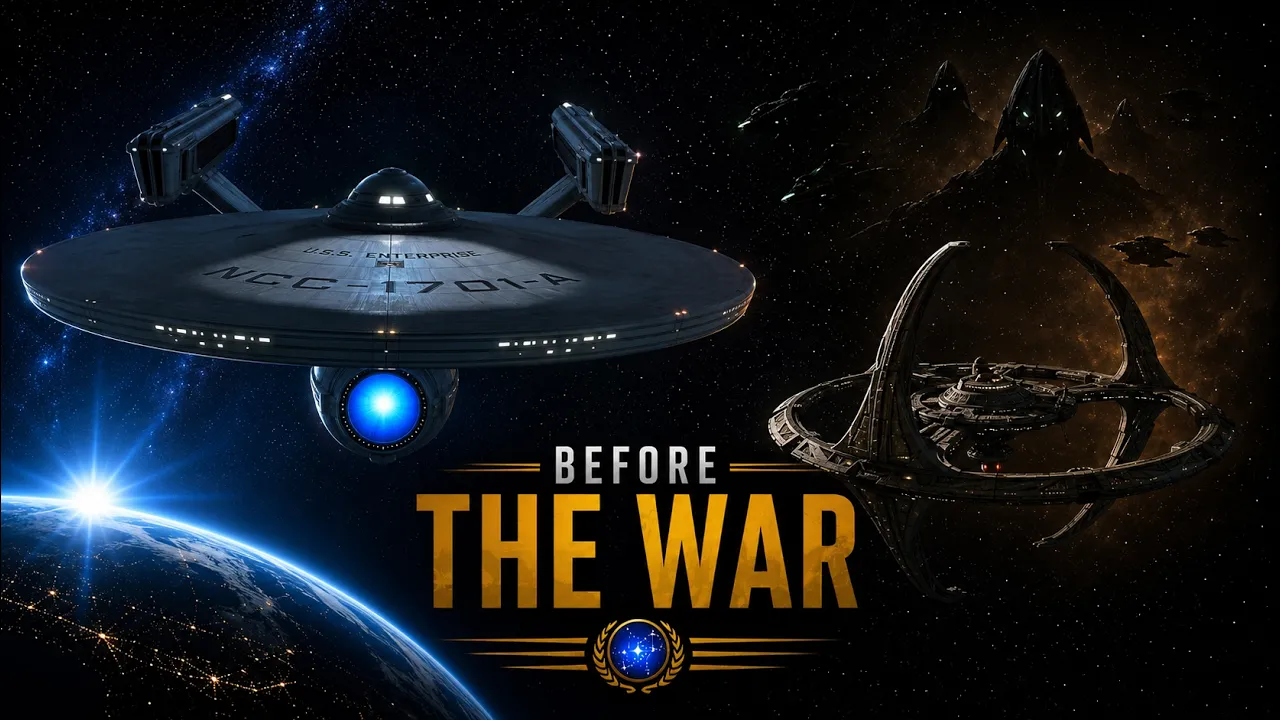
Adapted with AI from Lore Reloaded's video of 11 May 2026 and checked against the video before publication. Editorial standards · Corrections
More from @lorereloaded
All →


Make videos? Your next one could be an article here.
We turn your videos into articles under your name, linked back to the original. You keep 60% of what they earn, non-exclusive, and you can leave whenever you like.
Become a SubPlotter →