Star Trek's Khan problem: why the Federation never solved it
Khan Noonien Singh exposed a contradiction the Federation keeps circling: it condemns genetic superiority while depending on exceptional people to survive.

For nearly 60 years, Star Trek has kept returning to the same fear. It isn't the Borg, the Dominion or even the Q. It's humanity itself. Long before the Federation became a symbol of hope, Star Trek introduced Khan Noonien Singh, a man who believed civilization failed for a simple reason: too many weak people were allowed to shape it. My argument is that the franchise never fully resolved the problem he raised, even though he ultimately loses the philosophical fight.
What makes Khan endure isn't that Star Trek proves him right. It's that the franchise never fully stops wrestling with him. The deeper you look at the Federation, the stranger the contradiction becomes. This is a civilization that condemns genetic superiority while constantly surviving because of extraordinary individuals: Kirk, Spock, Data, Bashir, Seven of Nine.
Khan Noonien Singh was written as a competent authoritarian, not a madman
Khan wasn't written as a cackling madman or a comic book tyrant. He was written as something much harder to dismiss: a competent authoritarian. He was a ruler engineered to be stronger, smarter and more decisive than ordinary people, a man who looked at war, corruption and political paralysis and concluded that democracy itself was the flaw.
Star Trek admires exceptional people. It practically runs on them. At the same time, it warns us over and over not to build society around exceptionalism itself. That tension sits under almost every era of the franchise: the Eugenics Wars, the augments, Section 31, the Borg, artificial intelligence, transhumanism. They're different stories, but usually with the same underlying anxiety. What happens when humanity gains the power to improve itself? And behind that, another question creeps in: what happens if equality starts feeling inefficient?
The Eugenics Wars and Khan as the best of tyrants
By the time Star Trek introduced Khan in 1967, the world had already spent decades wrestling with one of the darkest ideas in modern history, the belief that humanity could be improved. The 20th century saw governments, scientists and political movements across the world become obsessed with human perfection: intelligence, strength, discipline, efficiency. Entire populations were categorized according to who was considered fit to inherit the future. Star Trek understood how dangerous that thinking could become.
What makes Khan fascinating is that the franchise never portrayed the idea as purely irrational. From the perspective of the people who created him, Khan was supposed to solve humanity's problems: war, political instability, economic collapse, weak leadership. The augments were designed to be better than ordinary humans in almost every measurable way, with stronger bodies, faster minds, greater ambition and superior analytical ability. For a time, it worked. According to Federation history, Khan ruled over more than a quarter of Earth's population during the Eugenics Wars.
What's remarkable is how Star Trek describes that rule. It isn't random slaughter or chaos, but order. Later Federation records would describe Khan as "the best of tyrants." That line matters enormously, because Star Trek is acknowledging something deeply uncomfortable. The danger of authoritarianism isn't that it always fails. Sometimes it works frighteningly well. Khan's empire was stable, efficient and organized, and entire regions prospered under centralized control.
Khan believed he was necessary, not evil
The problem with Khan's rule was never incompetence. The problem was freedom. People under Khan had security and order, but they no longer truly controlled their own future. Human equality became secondary to human optimization, and that's the core philosophical wound running through the entire story.
Khan genuinely believed he was helping humanity. When he's confronted aboard the Enterprise years later, he doesn't describe himself as evil. He describes himself as necessary: "We offered the world order." That isn't delivered like the confession of a monster. It's delivered like the frustration of a man who believes history misunderstood him.
In many ways, that's what makes Khan one of Star Trek's most enduring villains. It isn't because he wanted power, but because his argument is terrifyingly familiar. Throughout history, humanity has repeatedly flirted with the same temptation: the belief that freedom is inefficient, that equality creates weakness, and that civilization would function better if superior people simply took control. Star Trek understood something many science fiction stories avoid. The appeal of that idea is real. Khan was extraordinary, and that forced the Federation into a contradiction it would spend centuries trying to escape. How do you reject superiority in a universe where superiority clearly exists?
Why Khan feels uncomfortably human to Kirk, McCoy and the Enterprise crew
Most Star Trek villains feel external: alien empires, godlike entities, invading forces. Khan unsettles people for a different reason. He doesn't feel alien at all. He feels human in a way that's almost uncomfortable. Dr. McCoy notices the physical side first: "Even as he is now, his heart valve action has twice the power of yours and mine."
Khan's real threat is psychological. He carries himself with absolute certainty. It's not arrogance exactly, but certainty, the kind that makes everyone else in the room feel slightly less stable. Even Kirk initially reacts to him less like a criminal and more like a rival, because Kirk recognizes discipline, intelligence and capability in Khan. The crew does too.
Marla McGivers becomes fascinated by him almost immediately, and not simply because she finds him attractive. Khan represents something she feels the Federation no longer produces: intensity. The Federation is peaceful, procedural and civilized. Khan feels dangerous in a way the 23rd century usually tries to smooth over, and he understands that instinct perfectly.
Khan says openly what the Federation leaves unspoken
At dinner aboard the Enterprise, the real philosophical divide slowly emerges. Spock sees oppression; Khan sees efficiency. Then Khan delivers one of the most revealing lines in the episode: "It has been said that social occasions are only warfare concealed." That sentence explains almost everything about how he sees civilization. To Khan, cooperation is mostly performance, and power is always there beneath the surface whether people admit it or not. If that's true, his conclusion becomes brutally simple. The strongest people will dominate history anyway, so why pretend otherwise?
What makes Khan difficult to dismiss is that Star Trek never completely disproves the observation. The Federation is highly hierarchical. Captains routinely shape the fate of worlds, and a handful of officers repeatedly determine galactic history almost on their own. Khan removes the politeness from it. He says openly what the Federation prefers to leave unspoken: capability creates influence.
That's what makes him more unsettling than a traditional conqueror. He represents ambition without restraint, intelligence detached from empathy, and progress stripped of humility. And maybe, most dangerously of all, he represents the possibility that humanity might willingly follow him.
The Federation depends on the exceptional people it warns against
By the 23rd century, the Federation treats the Eugenics Wars as a warning. Genetic engineering becomes taboo and human augmentation becomes politically dangerous. Officially, the lesson is simple: no group of people should ever be engineered to rule over everyone else. But Star Trek introduces a problem almost immediately. The Federation depends on exceptional people constantly.
Kirk succeeds because he sees solutions others miss. Spock processes information beyond normal human limits. Scotty performs engineering miracles under impossible pressure. By the time you reach Picard, Sisko, Janeway and even Pike, the pattern becomes impossible to ignore. History inside Star Trek bends around a relatively small number of extraordinary individuals. Starfleet is technically meritocratic, but in practice, survival often depends on people operating far beyond ordinary capability.
That alone isn't hypocrisy. The contradiction appears when the Federation tries to separate natural exceptionalism from engineered exceptionalism, as though the outcome is fundamentally different. Practically speaking, the Federation already entrusts immense power to superior individuals. Captains command vessels capable of altering planetary history. Admirals influence interstellar policy across entire sectors. Section 31 specifically recruits officers capable of functioning beyond normal ethical boundaries. The Federation insists equality is foundational, yet its survival repeatedly depends on unequal capability. You see that tension in the Borg, in Section 31, in artificial intelligence, and even in Vulcan culture, which is built around the deliberate suppression and restructuring of natural behavior in pursuit of stability.
Julian Bashir breaks the Federation's oldest assumption in Deep Space Nine
For decades, the Federation's position on genetic engineering remained morally uncomplicated. The Eugenics Wars proved the danger, Khan proved the danger, and history itself appeared to prove it. Then Deep Space Nine introduced Julian Bashir, and the certainty began to crack. Bashir wasn't written as a warning. He was written as one of the best people in Starfleet: compassionate, ethical, empathetic and brilliant under pressure. Most importantly, he chose to help people.
Before Bashir, the Federation could argue that genetic enhancement inevitably corrupted human morality, that superior ability would always produce superior complexes, and that Khan wasn't an exception but an inevitability. Bashir's existence weakens that argument immediately. He's genetically enhanced and still fully embraces the Federation's ideals. He risks his life for strangers, rejects authoritarianism, opposes Section 31 and repeatedly chooses morality over efficiency, even when it places him in danger. In many ways he's the exact opposite of Khan, yet both men are products of the same idea: humans can be improved. The problem was never enhancement alone. It was what humanity chose to do with it.
The series itself seems aware of this tension. Bashir's enhancements remain politically dangerous. His career is threatened and his parents are punished. Starfleet tolerates him largely because his modifications occurred illegally during childhood rather than through his own choice. Even so, the Federation repeatedly depends on him. During the Dominion War, his enhanced mind lets him process complex strategic scenarios, identify medical solutions faster than ordinary doctors, detect patterns others miss and operate under enormous psychological pressure. The Federation benefits from the very thing it publicly condemns.
Section 31 specifically targets Bashir because of his enhanced abilities, not despite them. They recognize what the Federation quietly understands: exceptional people are strategically valuable. Once a civilization begins rewarding superior capability, the temptation to create more of it becomes very difficult to resist. Bashir doesn't prove Khan right, but he does prove the issue is more complicated than the Federation wants it to be. A superior human being doesn't automatically become a tyrant, and once that possibility exists, the moral certainty surrounding the Eugenics Wars becomes harder to maintain.
The Borg, Section 31 and Star Trek's fear of perfection
Khan was never a one time villain. He was the beginning of a recurring fear woven through Star Trek: the fear of perfection. The Borg pursue perfection through assimilation, Section 31 through security, and artificial intelligence threatens to surpass humanity entirely. The methods differ, but the temptation is similar: the belief that imperfect people are the problem.
What makes these stories effective is that improvement often does work. The Borg adapt faster than almost any civilization in the galaxy. Section 31 identifies threats the Federation misses, and during the Dominion War its methods are horrifying, but it survives because it's often effective. Even Starfleet grows more powerful with every generation, with faster ships, smarter systems and more advanced weapons. Star Trek doesn't portray progress as evil. What it fears is the moment progress starts overriding humanity itself.
Star Trek repeatedly shows how easily fear pushes civilizations toward those conclusions. In Homefront and Paradise Lost, Earth nearly slides into paranoia and authoritarian control because of fears of Changeling infiltration. The Dominion War pushes the Federation closer and closer to compromising its own ideals in the name of survival. Underneath all the starships and alien species, the question stays the same: can humanity improve itself without eventually deciding some people matter more than others?
The Federation accepts Khan's facts but rejects his conclusion
By the late 24th century, the Federation understands something deeply uncomfortable. Khan's argument isn't completely irrational. Superior individuals do exist, exceptional minds do change history, and capability matters. Spock processes information faster than most humans, Data surpasses organic limitations entirely, and Bashir performs calculations and diagnoses ordinary doctors can't match. What the Federation rejects is the conclusion Khan draws: that human value should rise and fall with ability, that strength is authority and superiority is permission to rule.
Once a civilization accepts that logic, equality becomes temporary and conditional, something people keep only as long as they remain useful enough to deserve it. That's the future the Federation fears: not enhancement itself, but hierarchy. The Eugenics Wars didn't begin because humanity created stronger people. They began because stronger people eventually believed they deserved more power than everyone else. The line the Federation tries to hold is that exceptional people don't deserve greater human worth, and it's an incredibly difficult line to maintain, especially during crisis. Sometimes the Federation compromises and sometimes it fails outright, but it keeps returning to one belief: a society should be judged by how it treats ordinary people, not exceptional ones.
Why Khan loses the argument but still exposes the contradiction
Khan ultimately loses the philosophical argument, even if he exposes contradictions the Federation never fully resolves. The Federation would rather struggle alongside imperfect people than build a future where only the strongest deserve to belong. Khan dies believing weaker people destroyed a better future, and in some ways Star Trek has spent decades arguing with that idea. His logic leads somewhere dangerous: human worth becomes tied to capability, and history suggests societies built around capability eventually stop protecting the people who fall behind.
Star Trek sides with imperfect humanity not because equality is efficient, not because the Federation always succeeds, and not because exceptional people don't exist, but because the alternative slowly turns civilization into something colder, a future where dignity has to be earned instead of protected. Star Trek knows that kind of future can look appealing in moments of crisis. That's part of what makes Khan work so well. He doesn't sound insane. He sounds convinced, and that's much harder to fight. The real Khan problem was never genetics by themselves. It was the temptation to believe some people should matter more than others once humanity gains the power to decide who counts as superior. And maybe that question matters now more than ever.
What other creators are saying
More on Star Trek →I think the Training Day and Crimson Tide influences could make a genuinely compelling, darker Starfleet story with a new crew, and I'm cautiously excited, but I don't trust Paramount's Trek track record and need to see it filmed before believing in it.
Star Trek (2009) and The Force Awakens share a director, a reboot mission and the start of a trilogy
J.J. Abrams Played an Almost Identical Role in Star Trek and Star Wars →
One card plays artifacts from the top of your library, and the other rewards facing a dilemma with free spells
Zefram Cochrane and the Caretaker among Magic: The Gathering Star Trek preview cards →
A Romulan War buildup, a Mirror Universe miniseries, the Borg Queen's origin and a refitted NX-01 were all part of the plans for a season that never got made
Watch the original
@lorereloaded · YouTube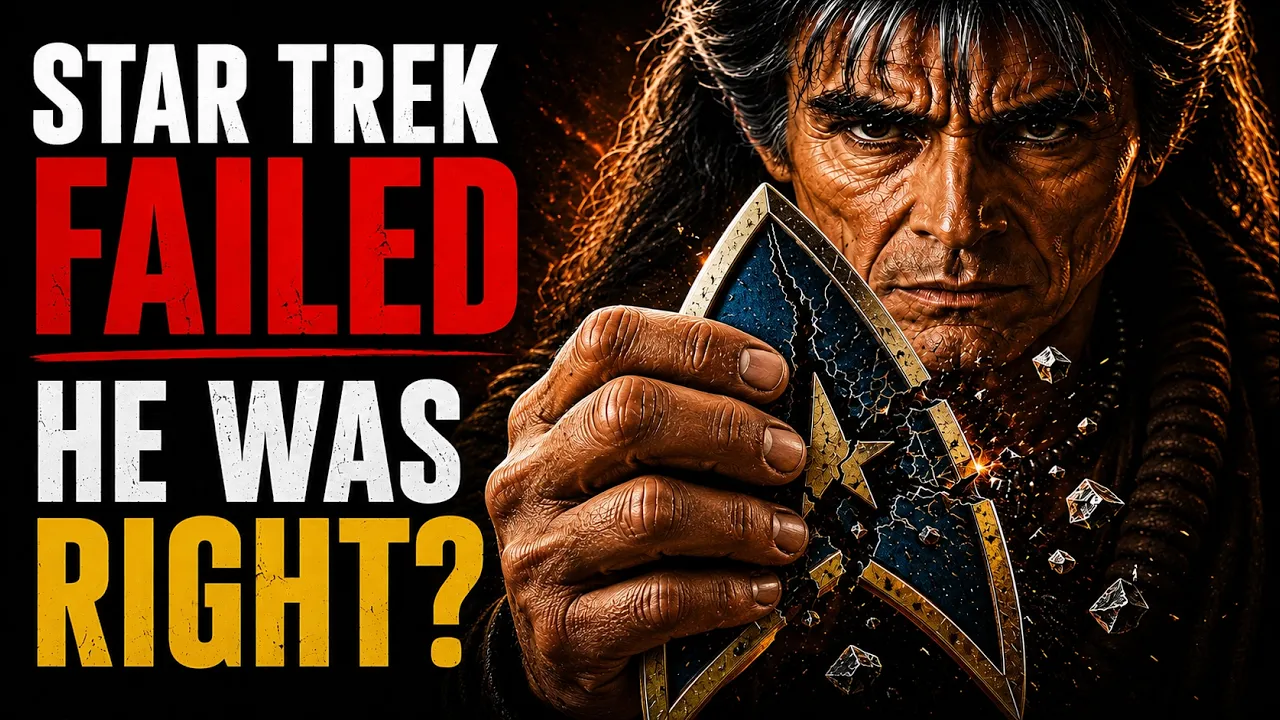
Adapted with AI from Lore Reloaded's video of 15 May 2026 and checked against the video before publication. Editorial standards · Corrections
More from @lorereloaded
All →


Make videos? Your next one could be an article here.
We turn your videos into articles under your name, linked back to the original. You keep 60% of what they earn, non-exclusive, and you can leave whenever you like.
Become a SubPlotter →