Voyager theory: did Q steer the ship to the Borg transwarp hub?
A course change from Q may explain how one lost starship ended up striking one of the Collective's most important structures
 Lore Reloaded (AI-assisted)16 November 2026Editor: Digital Fox Talent Editorial TeamOn YouTube since 2016 · more than 140,000 subscribers

When the USS Voyager finally made it home, it didn't simply finish the long trip back to Earth. It came home through the heart of Borg territory, destroying a Borg transwarp hub on the way. I think there's something deeply unlikely about how Voyager ended up there, and the trail leads back to Q, who quietly changed the ship's course not long before it reached that nebula.
Star Trek: Voyager premiered in 1995, with Kate Mulgrew as Captain Kathryn Janeway. Its final mission did more than bring the crew home. It also crippled one of the Collective's greatest strategic advantages, and that is where my theory begins.
Why the Borg transwarp hub mattered so much
Hidden inside a dense nebula was one of the most important structures the Collective had: a transwarp hub. These hubs formed the backbone of the Borg's huge transportation network. They linked thousands of conduits stretching across the galaxy, letting the Borg move ships between distant regions of space in minutes.
It was the engine of their reach, the silent infrastructure behind countless assimilations. When Voyager destroyed that hub, the consequences were enormous. A weapon meant to bring the crew home also struck one of the most powerful forces in the galaxy, all in a single moment.
The Delta Quadrant is vast and contains billions of stars. A single ship crossing it should never have stumbled on something as rare or as important as a transwarp hub. Yet Voyager arrived at exactly the right place at exactly the right moment, when the chance to destroy it and the chance to get home appeared together. That coincidence raises a question worth asking.
Q gave Janeway a shorter route home
Not long before the end of Voyager's journey, Q returned to the ship. He had crossed paths with Starfleet many times, sometimes as a provocateur, sometimes as a teacher, and sometimes as something far harder to understand. Wherever Q appeared, events had a way of unfolding that nobody aboard a starship could fully predict.
This visit came during a crisis involving his own son. Once that was resolved and the Continuum withdrew, Q stayed behind for a final moment with Janeway and handed her a small device. Inside was something Voyager had spent years searching for: a better way home. It held a revised course through the Delta Quadrant that would shorten the trip by several years.
It wasn't the miracle the crew had hoped for. Voyager would still have to cross a great deal of unfamiliar space. Janeway asked the obvious question: if Q could alter their course so easily, why not send them all the way home? His reply was simple. "What sort of an example would I be setting for my son if I did all the work for you?"
That fit Q's nature perfectly. Time and again he interfered with Starfleet crews, but rarely in ways that solved their problems outright. He nudged events forward and put people in situations that forced them to face challenges on their own. Voyager accepted the new course, and somewhere ahead, hidden inside a nebula, lay one of the Borg's most important structures. The path that led there was the one Q had chosen.
Voyager found a nebula full of Borg ships and turned away
As Voyager pressed on, an unusual signal appeared on long-range sensors. Seven of Nine reported extremely high neutrino emissions, along with an intermittent graviton flux, coming from a nebula several light-years away. Even through the radiation, the readings suggested hundreds of distinct sources.
To Harry Kim, the implication was obvious: wormholes, perhaps dozens, perhaps hundreds. For a ship stranded 70,000 light-years from Earth, that was impossible to ignore, since even one stable wormhole could cut decades off the trip. Janeway ordered a course change, and Voyager entered the nebula. Inside, dense radiation clouded the sensors, leaving the crew to navigate on fragments of information.
Then a Borg cube appeared directly ahead. Voyager passed within meters of its hull before the crew understood what they were seeing. The radiation that blinded Voyager's instruments had blinded the Borg too. Janeway made the only decision she could, and Voyager fled.
Back in clear space, the readings suggested the nebula held not one Borg vessel but dozens, with Seven estimating nearly 50 ships. Kim argued the opportunity was too important to abandon: if the Borg couldn't detect Voyager inside the nebula, the ship might still be able to slip back in and investigate. Janeway refused. Whatever was in there belonged to the Borg, and chasing a possibility that might not even be real would risk the whole crew. So the ship turned away, leaving within reach one of the most important structures in the entire Collective.
Admiral Janeway's return sent Voyager back to the hub
Then something impossible happened. A temporal rift opened in front of Voyager, and a Federation shuttle emerged. Its pilot was an older Admiral Janeway from the future. In her timeline, Voyager reached Earth after 23 years in the Delta Quadrant, but not without loss. Crew members alive in the present wouldn't survive the years ahead, and she had come back to change that.
She also brought technology designed to fight the Borg: ablative armor and transphasic torpedoes capable of destroying their ships in ways Voyager never could before. With those upgrades installed, the balance of power shifted, and so did the decision Voyager had already made. The ship returned to the nebula.
What the crew found was not a cluster of wormholes but the transwarp hub, one of the central nodes of the Collective's transportation network. Destroying it would strike at one of the Borg's greatest advantages, but it would also mean risking everything. Janeway put the choice to her senior officers, and the answer was unanimous: if they had the chance to deliver a blow like this, they couldn't walk away.
Destroying the hub brought Voyager home
The plan became one of the most daring operations in Starfleet history. Admiral Janeway infiltrated the Borg's central complex while Voyager entered the hub itself. As the Collective struggled to adapt to weapons from the future, Voyager launched a spread of torpedoes into the structure, and the Admiral introduced a virus into the Collective.
The hub collapsed, and the Borg began to fracture. Moments later, Voyager emerged from a conduit less than a light-year from Earth. After seven years in the Delta Quadrant, the ship was home.
But the deeper mystery remained. Voyager only destroyed that hub because it found the nebula in the first place. The only reason it was traveling through that region at all was that Q had changed its course.
Q's course change put Voyager in the hub's path
At the time, Q's adjustment looked like one of his typical gestures: helpful but incomplete, just enough help to move the crew forward while leaving the real work to them. Yet that small change carried Voyager through a region it had never intended to cross, a region containing the single nebula where it would find the hub.
If Q hadn't altered the route, the ship would never have passed through that part of the Delta Quadrant. The anomaly would have stayed undiscovered. The hub would have kept operating, quietly linking thousands of transwarp conduits across the galaxy and letting the Borg send their fleets wherever they wished. Instead, a single starship stumbled on it and brought the whole thing down.
Seen this way, Voyager's final mission looks less like coincidence and more like the result of a carefully placed move. Q didn't send the ship home. He did something far more characteristic. "He nudged the board." And Voyager delivered one of the most damaging blows the Borg had ever suffered.
Q's history with the Borg suggests a long game
What makes this even more intriguing is that it wouldn't have been the first time Q intervened where the Borg were concerned. Years earlier, he forced the USS Enterprise to confront the Collective long before the Federation was ready. That encounter set events in motion that led to the Battle of Wolf 359, one of the darkest days in Starfleet history, but also the moment that forced the Federation to start understanding its enemy.
I think that was a variable in the creation of Voyager itself. The ship was designed with the Borg in mind. That's not necessarily the entire reason, but it was definitely something its designers would have focused on. And with Voyager came its mission to find the Maquis, which is ultimately how it ended up in the Delta Quadrant.
If the encounter with the transwarp hub was another of those carefully placed moments, then Q's role in humanity's struggle with the Borg looks less like random interference and more like strategy. It's a series of moves across decades: first he introduces humanity to the Borg, then Starfleet prepares, and finally there's a strike deep inside Borg territory. Perhaps Q never intended to defeat the Borg himself. "Perhaps the game was always about making sure humanity eventually could."
What other creators are saying
More on Star Trek: Voyager →A Ferengi heist plan, three reassimilated drones and the minds still stored in her implants
3 Star Trek Facts About Seven of Nine That Deserve More Attention →
Star Trek (2009) and The Force Awakens share a director, a reboot mission and the start of a trilogy
J.J. Abrams Played an Almost Identical Role in Star Trek and Star Wars →
One card plays artifacts from the top of your library, and the other rewards facing a dilemma with free spells
Zefram Cochrane and the Caretaker among Magic: The Gathering Star Trek preview cards →
A Romulan War buildup, a Mirror Universe miniseries, the Borg Queen's origin and a refitted NX-01 were all part of the plans for a season that never got made
Watch the original
@lorereloaded · YouTube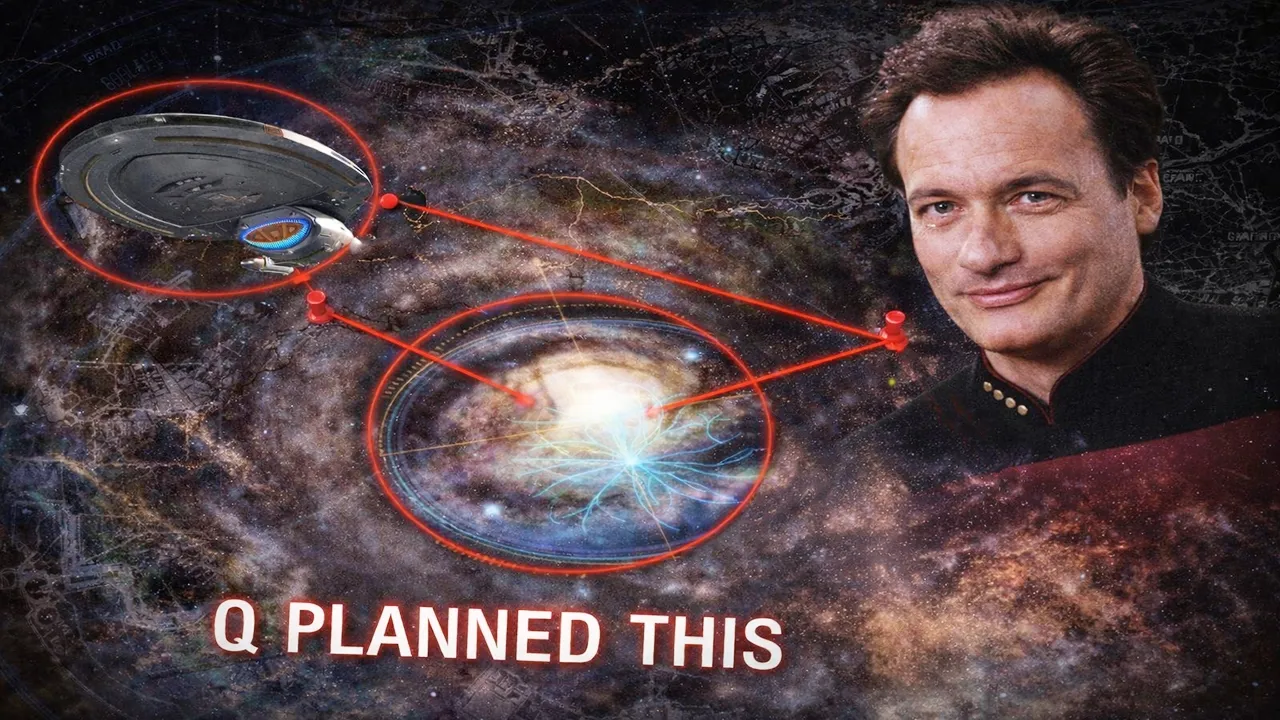
Adapted with AI from Lore Reloaded's video of 6 March 2026 and checked against the video before publication. Editorial standards · Corrections
More from @lorereloaded
All →


Make videos? Your next one could be an article here.
We turn your videos into articles under your name, linked back to the original. You keep 60% of what they earn, non-exclusive, and you can leave whenever you like.
Become a SubPlotter →