Star Wars: how did the Empire create the Rebellion?
From scattered acts of defiance on Kashyyyk, Ryloth and Lothal to a hidden base on Yavin 4, Imperial pressure slowly turned isolated resistance into a movement.
 Lore Reloaded (AI-assisted)18 November 2026Editor: Digital Fox Talent Editorial TeamOn YouTube since 2016 · more than 140,000 subscribers

The Rebellion against the Galactic Empire didn't begin with a declaration or a battle. It grew gradually out of years of pressure, small decisions and connections that formed without anyone seeing the full picture. The Empire's own grip on the galaxy is what pushed scattered people toward each other, until isolated reactions to a new regime became something with direction.
Tracing that path means starting at the moment the Republic ended, then following the resistance as it moved from individuals on single worlds to small cells, quiet networks and, finally, gathering points where people realized how much had already been built.
The Republic Became the Galactic Empire to Applause, Not Shock
"The Republic will be reorganized into the first Galactic Empire for a safe and secure society." The war ended with applause. In the final days of the Republic, fear had already done most of the work. Years of conflict had centralized authority, normalized emergency powers and placed the military at the center of public life. So the announcement didn't arrive as a shock. It arrived as a promise of stability.
In the Senate chamber, the transition was framed as protection, order and security, a way to make sure the chaos of war would never return. Many believed it. After years of loss and uncertainty, permanent control felt safer than the risk of disorder. On distant worlds, the change came through presence rather than speeches. Republic forces didn't go home. Uniforms changed, command structures shifted, and the same ships that had once defended systems now stood watch over them. At first it looked like continuity. Then it began to feel like permanence.
Daily life didn't collapse overnight. Markets still opened, trade still moved and governments still functioned. But authority was no longer negotiated; it flowed in one direction. Some welcomed it, because piracy had been rampant and Separatist attacks had shattered entire regions. Others felt something harder to define as local leaders were overridden and systems that relied on representation adjusted to directives. The galaxy didn't rise up. Most people adapted, some supported the change, and many kept their heads down. Resistance was only a feeling that power had moved farther away and that fewer voices were deciding the fate of entire worlds.
Imperial Emergency Powers Became Standard Procedure
The new government didn't need to prove its authority. It inherited the infrastructure to enforce it. Emergency powers became standard procedure, and military coordination designed for wartime began shaping civilian life. At first the shift felt administrative. Regional decisions moved upward, security became a permanent priority, and garrisons appeared on worlds that had never needed them. Officially they were there to prevent instability and protect the peace. But protection carries weight when it doesn't leave.
Planetary authorities still existed, but under closer oversight. Policies arrived from outside the system, compliance became the expectation, and objections had fewer places to go. The Senate stayed in session, with speeches, committees and debates, so the appearance of representation held even as real influence narrowed behind it. For most citizens, the changes were smaller: new checkpoints, more patrols, more questions. Travel took longer, trade required more approval, and records were kept more carefully.
None of it announced itself as control. Each measure was framed as stability or prevention, and taken individually they felt reasonable. Together they reshaped the relationship between the Empire and its people. A local decision was overruled, a shipment delayed, a community monitored more closely. Most adjusted, some benefited, and others felt the space around them tighten. The distance between a world and the capital began to feel less like representation and more like supervision, and that permanent control created friction in places the system could not always see.
Early Resistance on Kashyyyk, Ryloth and Lothal Was Individual Defiance
Pressure doesn't produce unity right away. It produces decisions. In the Empire's early years, resistance looked like individuals refusing to accept what the galaxy had become. On Kashyyyk, Wookiees who had fought beside the Republic found themselves enslaved under Imperial occupation. Families were separated and communities forced into labor. Some fled into the forests and struck back when they could, freeing prisoners, disrupting work camps and disappearing before retaliation came. It was survival turned into defiance.
On Ryloth, the Empire installed itself under the promise of protection. Cham Syndulla, who had already fought to free his people from Separatist control, recognized the shift for what it was: Imperial forces were there to stay, not to rebuild. On Lothal, a young thief named Ezra Bridger began stealing from Imperial shipments, not for a cause but because the Empire had taken over his world. Elsewhere, clones were replaced by recruits loyal to the Empire, and Captain Rex walked away entirely rather than serve a government he no longer trusted.
None of these moments connected. A Wookiee freeing prisoners had no idea a Twi'lek leader was preparing to push back elsewhere, and a former clone didn't know a teenager was raiding cargo on a distant Outer Rim planet. To the Empire, these were isolated incidents to be contained before they could spread. For a time, that worked. There was no shared leadership and no shared identity.
Small Rebel Cells Took Shape on Lothal and Ryloth
Isolated reactions can be contained, but patterns are harder to manage. Some early individual decisions began drawing people into small groups built around shared experience and local necessity. On Lothal, a small crew raided supply shipments, sabotaged fuel depots and disrupted transport routes, moving resources off world. Those actions required planning, coordination and trust, and over time repeated operations turned a loose group into a functioning resistance cell.
On Ryloth, resistance was more direct. Cham Syndulla and those loyal to him targeted Imperial control points and freed people held under military authority. In one operation, they struck Imperial forces on the planet and pulled captives out before the garrison could react. It wasn't a full uprising, but a focused attempt to protect their own and deny the Empire complete control. Other networks formed around former soldiers, around smuggling routes now restricted and monitored, or simply among people who couldn't rely on anyone outside their circle.
These groups didn't see themselves as part of the same effort. Information stayed close, there was no central leadership, and survival still mattered more than strategy. They were trying to hold ground where they stood, not challenge the Empire as a whole. Still, resistance was no longer one person deciding alone. It had organized into small, durable groups that were fragile but able to act more than once.
Bail Organa, Wavering Clones and Smugglers Added Quiet Pressure
The Empire's fleets were unmatched, but in scattered places, keeping control required more effort. On Alderaan and in the Senate, some leaders who had backed the Empire for stability saw policies move forward with less debate and military priorities override civilian concerns. A handful of senators began asking questions in private they wouldn't raise in public. Bail Organa was among those offering protection and support to people slipping out of the Empire's favor, all behind closed doors.
Inside the military, the replacement of clones created moments of hesitation. On Ryloth, a clone captain refused to keep enforcing orders against civilians who had once been allies. It didn't spark an uprising, but it showed loyalty in the ranks was no longer uniform. In the underworld, tighter inspections and documentation pushed some smugglers out and others to adapt. Ships began carrying people, supplies and information through unofficial channels that no single group controlled.
Imperial commanders responded to what they could see. Senators who asked too many questions were monitored, hesitant units were reassigned or replaced, and disrupted shipping lanes got heavier patrols. Each measure solved a problem in one place before another appeared elsewhere. Nothing here threatened the Empire's hold, but it showed pressure building in places the Empire couldn't fully predict or prevent.
Mon Mothma's Ghorman Speech and Saw Gerrera Connected the Resistance
Then separate efforts began crossing paths. Mon Mothma had spent years in the Senate watching power concentrate. When news spread of an Imperial massacre on Ghorman, she publicly condemned the Empire, naming the Emperor himself. "Their peaceful world is one of countless systems helpless against his oppressive rule," she said, calling him "little more than a lying executioner."
That ended her ability to operate safely. Getting her out required ships, protection and safe passage arranged across multiple worlds, and groups that had never worked together joined the same operation. It was one of the first times political dissent and armed resistance moved in the same direction at once. Meanwhile, messages traveled along smuggling routes, and a name in one system could lead to a contact in another.
Saw Gerrera and his fighters had resisted centralized power since the Clone Wars, and under the Empire they grew more aggressive, often striking without concern for the consequences. Their methods set them apart, but they proved armed resistance could survive in more than one region. None of these people saw the full picture. What changed was the distance between them: help arrived from outside local space, and information no longer stopped at a single border.
Yavin 4 Gave the Rebellion a Place to Gather
Connection changed how resistance understood itself. Success had meant surviving the next sweep or inspection. Now news of a strike in one sector was heard in another, an escape traveled along smuggler routes, and a political speech was repeated in private rooms. The Empire might control the galaxy, but resistance wasn't confined to one world.
On Yavin 4, far from central authority, one of the first lasting gathering points took shape. It was hidden and hard to reach. Pilots, mechanics and couriers arrived in small numbers, with no ceremony, just a growing sense that there was somewhere you could go and not be alone. After leaving Coruscant, Mon Mothma spoke openly against Imperial rule through the same hidden channels. She offered direction rather than battle plans, moving the language from survival to shared cause.
Pilots began flying escort for strangers, and crews took missions outside their home regions. Hope appeared, not belief that the Empire could be defeated, which was still far beyond reach, but understanding that resistance was larger than any one world, cell or voice.
How the Rebellion Built Momentum Even as the Outcome Stayed Uncertain
The difference was scale. A senator forced into hiding could find protection far from the capital, and a pilot who lost everything could arrive at a base where they were already understood. Places like Yavin became repair stations and planning rooms where people from different worlds realized how much had been built without anyone intending to build it. No single person created it. It formed out of necessity and pressure.
The Empire still ruled, its fleets still moved where they wanted, and its authority was still enforced system after system. But resistance was no longer defined by what it lacked. It had places to gather, routes to follow, people to rely on, and momentum. Not the kind that wins wars overnight, but the kind that builds slowly and carries people forward when the outcome is uncertain.
In hidden bases and quiet rooms, the same realization settled in: this could last. What began as scattered reactions had become something that could move, adapt and continue even as the Empire tightened its grip. For those who had spent years pushing back alone, the change was impossible to miss. They were no longer just holding the line. They were part of something that was growing.
Watch the original
@lorereloaded · YouTube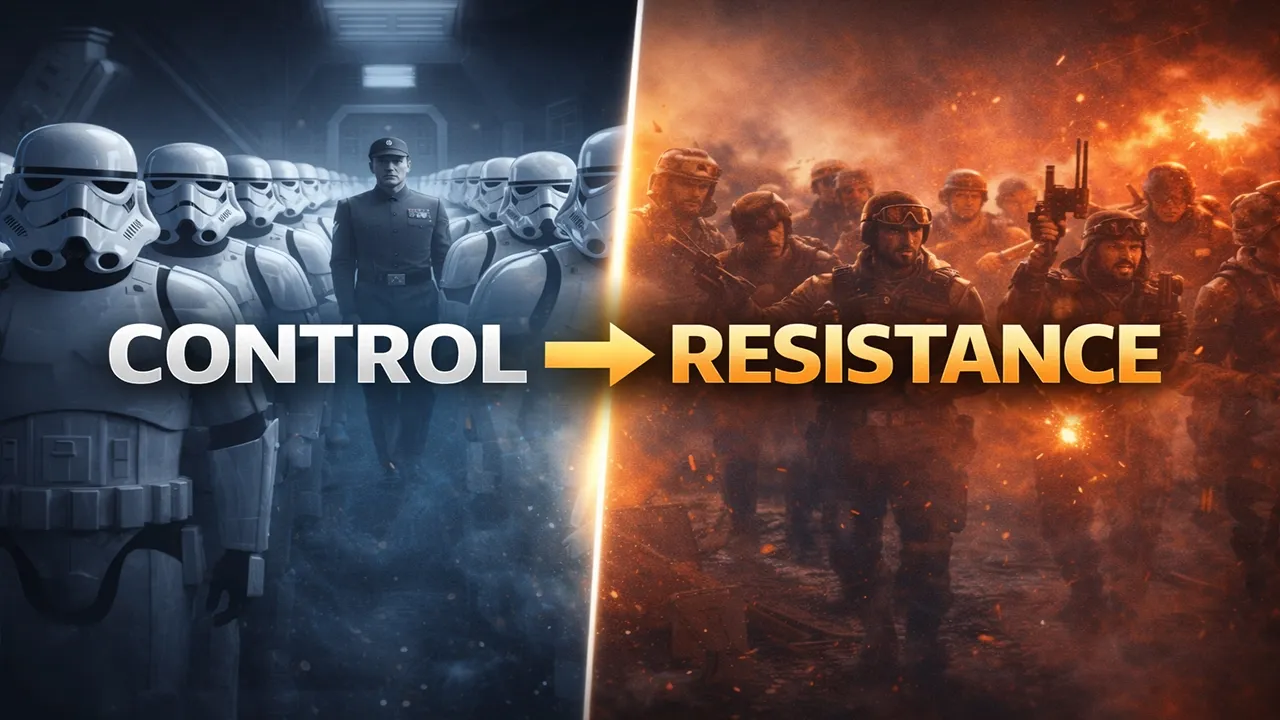
Adapted with AI from Lore Reloaded's video of 11 February 2026 and checked against the video before publication. Editorial standards · Corrections
More from @lorereloaded
All →


Make videos? Your next one could be an article here.
We turn your videos into articles under your name, linked back to the original. You keep 60% of what they earn, non-exclusive, and you can leave whenever you like.
Become a SubPlotter →