Star Trek: did the USS Enterprise make Starfleet a superpower?
The Constitution class shaped the galaxy by arriving, and Starfleet mistook that power for moral progress
 Lore Reloaded (AI-assisted)19 November 2026Editor: Digital Fox Talent Editorial TeamOn YouTube since 2016 · more than 140,000 subscribers

The Constitution class, the class of starship the USS Enterprise belonged to, was the hinge that let Starfleet behave like a superpower long before it accepted the label. It never conquered anything. It shaped outcomes by arriving, and Starfleet never examined what that implied.
It would be easy to treat the Constitution class as an exploration platform, a long range research vessel, a diplomatic courier, or a symbol of peaceful intent. That reading isn't incorrect. It's incomplete.
The Constitution Class Was Built to Explore, but Its Presence Changed Behavior
The Constitution class wasn't designed to conquer territory or impose political control. Its mission emphasized exploration, first contact and scientific inquiry. It was built to travel far beyond Federation space, operate independently, and represent Starfleet values without the support of nearby fleets. But design intent doesn't determine outcome. Behavior does.
When a Constitution class starship entered a system, it didn't arrive as part of a broader mobilization. It didn't announce jurisdiction or claim authority, and often it didn't remain once the immediate situation was resolved. Yet its arrival consistently altered local behavior. Negotiations shifted. Escalation slowed. Actors who had operated without external constraint recalibrated, not because Starfleet imposed consequences, but because the possibility of consequences was suddenly present. What mattered wasn't what the ship said. It was what the ship made possible.
The ship carried enough firepower to resolve most regional conflicts on its own and the endurance to remain on station without support. It could intervene, disengage or wait without reinforcement or permission. That combination produced presence without occupation. Its availability alone compressed distance, response time and uncertainty. From Starfleet's internal perspective, this wasn't power. It was preparedness. Exploration required self sufficiency, diplomacy required credibility, and operating alone required surviving worst case encounters. Each capability was defensible in isolation. Taken together, they produced something else.
The Federation Crossed a Threshold Starfleet Never Acknowledged
To those encountering the Enterprise, intent was irrelevant. They didn't experience the Federation as a distant alliance. They met a single vessel capable of immediate intervention, arriving without warning and leaving without oversight. The Enterprise wasn't symbolic. It was operational. This was the moment the Federation crossed an unacknowledged threshold, not through declaration or expansion, but by normalizing the idea that it could arrive anywhere and alter outcomes without escalation. The galaxy adjusted. Starfleet didn't examine why.
Because the Constitution class didn't conquer, Starfleet concluded it hadn't exercised power. Because it didn't remain, Starfleet assumed it hadn't imposed control. And because its presence often reduced violence, Starfleet treated the effect as evidence of moral progress. What went unexamined was the condition that made that progress possible.
Exploration Became the Framework That Concealed the Enterprise's Power
Having crossed that threshold, Starfleet needed a way to understand what it had built without reframing what it believed itself to be. Exploration provided that explanation. On paper, the class was justified by necessity. The Federation was expanding faster than its infrastructure, new systems lay beyond existing support networks, and survey vessels needed endurance, autonomy and the ability to operate without immediate reinforcement. So Starfleet built one: fast, heavily armed, and capable of long deployments without external support.
Its crew was sized not only to observe, but to respond to scientific anomalies, diplomatic crises, and conflicts that hadn't yet decided what they would become. That wasn't incidental. A ship sent alone must be prepared for outcomes it doesn't control. Internally, firepower was justified as deterrence, endurance as self reliance, flexibility as prudence. None of these choices required Starfleet to acknowledge that the ship had become a stabilizing force capable of altering outcomes simply by being present.
This is where exploration stopped being a mission and became a framework. To those on the receiving end, the distinction between exploration and enforcement was immaterial. Intent couldn't be observed. Only effects could. When the ship appeared, uncertainty collapsed and local calculations stopped being theoretical. That effect depended on credibility, not violence. Exploration didn't produce it. It concealed it. The ship wasn't enforcing order. It was making order unavoidable. And once Starfleet accepted it could shape outcomes this way, the same assumption would reappear in diplomacy, crisis response and eventually war. The Constitution class didn't introduce that belief. It made it feel safe.
Power Projection Through Presence, Not Conquest
Functionally, the Constitution class was a mechanism for power projection, not through conquest or occupation, but through availability. Power is often misunderstood as something that must be exercised to exist. That assumption is convenient. It lets institutions deny power as long as restraint is visible, violence is absent, and outcomes appear voluntary. But power doesn't require action. It requires credible capacity.
When the Enterprise arrived, local actors knew escalation could be met immediately and decisively. No threat was issued. No red line was drawn. The line was implied by proximity. Force resolves conflicts by ending them. Presence reshapes conflicts by narrowing what is possible. Aggression carried risk, delay lost value, and performative defiance became dangerous. Nothing had to happen for this recalibration. It happened because the ship was there.
Starfleet never articulated this. The ship only needed to make enforcement unavoidable if circumstances deteriorated, and that conditionality let Starfleet read outcomes as consensual rather than constrained, and restraint as moral rather than structural. Presence works best when deniable, because deniable power doesn't demand accountability. Violence requires justification and claimed authority must be defended, but when outcomes change without overt action, responsibility becomes diffuse. Once Starfleet learned arrival alone could stabilize situations, it began relying on presence as a substitute for policy.
The Untested Assumption That Presence Would Always Be Enough
That reliance carried hidden assumptions: that presence would always be enough, that credibility would remain permanent, that restraint would be read as strength rather than hesitation, and that adversaries would calculate risk the same way indefinitely. None were tested, because the Constitution class worked. Conflicts cooled, treaties held, crises resolved without war. Starfleet concluded the galaxy had evolved past overt coercion. What it actually demonstrated was narrower and more fragile: coercion had been internalized.
Presence doesn't eliminate violence. It postpones it, and postponement only holds while credibility goes unquestioned. No threshold was defined for failure, and no plan existed for when arrival no longer altered behavior. The Constitution class didn't make Starfleet peaceful. It made peace feel automatic, and then preparation feels unnecessary. Presence based power "is quiet. It is efficient. And it works until it doesn't." When it fails, it fails suddenly. The class didn't teach Starfleet how to avoid war. It taught Starfleet how to delay recognizing when war was becoming unavoidable.
How the Galaxy Learned the Enterprise's Unwritten Rules
The Enterprise's behavior was consistent enough to study. It arrived alone, intervened selectively, could escalate but rarely did, and departed once a situation stabilized. From the outside, that was a pattern. Disputes that relied on delay resolved faster. Provocations were timed more carefully. Actions that might trigger intervention were disguised, displaced or delegated, out of awareness rather than fear of conquest.
The Enterprise didn't enforce borders, but it compressed them. Distance stopped being protection and time stopped being leverage. Treaties gained weight because violations now carried uncertainty, and a single ship could investigate, verify and remain long enough for outcomes to change. Other powers adapted faster than Starfleet expected because adaptation was rational: escalation carried risk without guaranteeing advantage, while accommodation reduced uncertainty. These were strategic judgments, not moral ones. An informal rule set emerged, unwritten and unnegotiated but widely observed. The galaxy didn't interpret this as benevolence. It interpreted it as structure.
Starfleet Mistook Leverage for Virtue
Starfleet saw confirmation of what it wanted to believe: presence paired with restraint was enough. Success was read as validation of values rather than leverage, and the conclusion was that the galaxy was learning to cooperate. What went unexamined was why cooperation suddenly appeared rational. Because compliance wasn't compelled, it was treated as consent, and because force went unused, its role faded from consideration. Power was present, but invisible.
Starfleet didn't conclude the class had introduced a new form of influence. It concluded influence itself had become unnecessary. Presence stopped being understood as leverage and became identity, with ships assumed to embody moral authority by default. Escalation planning appeared pessimistic and readiness became an abstraction. Nothing about this felt irresponsible. It felt enlightened. When an institution mistakes leverage for virtue, it doesn't abandon power. It abandons the habit of thinking about it.
Starfleet's Preparation Atrophied Behind Its Success
Starfleet didn't stop training for conflict or dismantle its fleet. But escalation thresholds remained undefined, contingency planning narrowed, and response timelines assumed cooperation rather than resistance. Preparation didn't vanish. It atrophied. The danger wasn't complacency but substitution. Speed replaced depth, credibility replaced capacity, and the margin for error narrowed without being acknowledged.
Systems built around presence work under familiar conditions but struggle when opponents refuse to deescalate or multiple crises unfold at once. Preparation exists for those moments. Presence doesn't. The absence of crisis was mistaken for resilience. Deterrence erodes through disuse, and adversaries notice hesitation before institutions do. The Constitution class didn't create this vulnerability. It masked it.
Starfleet Acted Like a Superpower Without the Name
By the time the Constitution class ceased to be unique, the transformation was complete. The Federation didn't annex territory or rule by decree. That mattered to Starfleet because conquest requires admission and occupation requires responsibility. Presence didn't. "The ship did not look like Empire. It made Empire unnecessary." Intervention could be framed as assistance, deterrence as reassurance, influence as example. Each framing was sincere. None were complete.
By refusing the language of power, Starfleet also refused its disciplines: planning for escalation, defining thresholds, testing assumptions, rehearsing failure. This wasn't hypocrisy. Starfleet had outgrown the context in which its values were articulated, adjusting behavior without adjusting identity. When power is unnamed, it can't be constrained. Starfleet didn't see itself as a superpower. Others did. The class didn't corrupt Starfleet; it placed it in a position it was philosophically unprepared to inhabit.
The Enterprise's Legacy Is a Precedent
The Enterprise explored farther, stayed longer and acted with greater autonomy than anything before it. That success felt earned, so it was rarely questioned. Later ships would inherit a galaxy already conditioned to Federation presence. The legacy of the Enterprise isn't a myth or a symbol, but a precedent: a ship that proved Starfleet could be everywhere and taught it that being everywhere carried no cost.
Presence isn't inherently good or evil. It is responsibility, and unacknowledged responsibility accumulates until circumstances force recognition. "The Enterprise did not fail Starfleet. It succeeded too well." It left behind a question Starfleet would spend generations avoiding: what does it mean to wield power without ever admitting that you have it?
What other creators are saying
More on USS Enterprise →From the barely built Kelvin Enterprise A to the Galaxy class flagship of The Next Generation, here is how every canon Federation starship to carry the name stacks up
Every USS Enterprise ranked: why is the Enterprise D No. 1? →
Star Trek (2009) and The Force Awakens share a director, a reboot mission and the start of a trilogy
J.J. Abrams Played an Almost Identical Role in Star Trek and Star Wars →
One card plays artifacts from the top of your library, and the other rewards facing a dilemma with free spells
Zefram Cochrane and the Caretaker among Magic: The Gathering Star Trek preview cards →
A Romulan War buildup, a Mirror Universe miniseries, the Borg Queen's origin and a refitted NX-01 were all part of the plans for a season that never got made
Watch the original
@lorereloaded · YouTube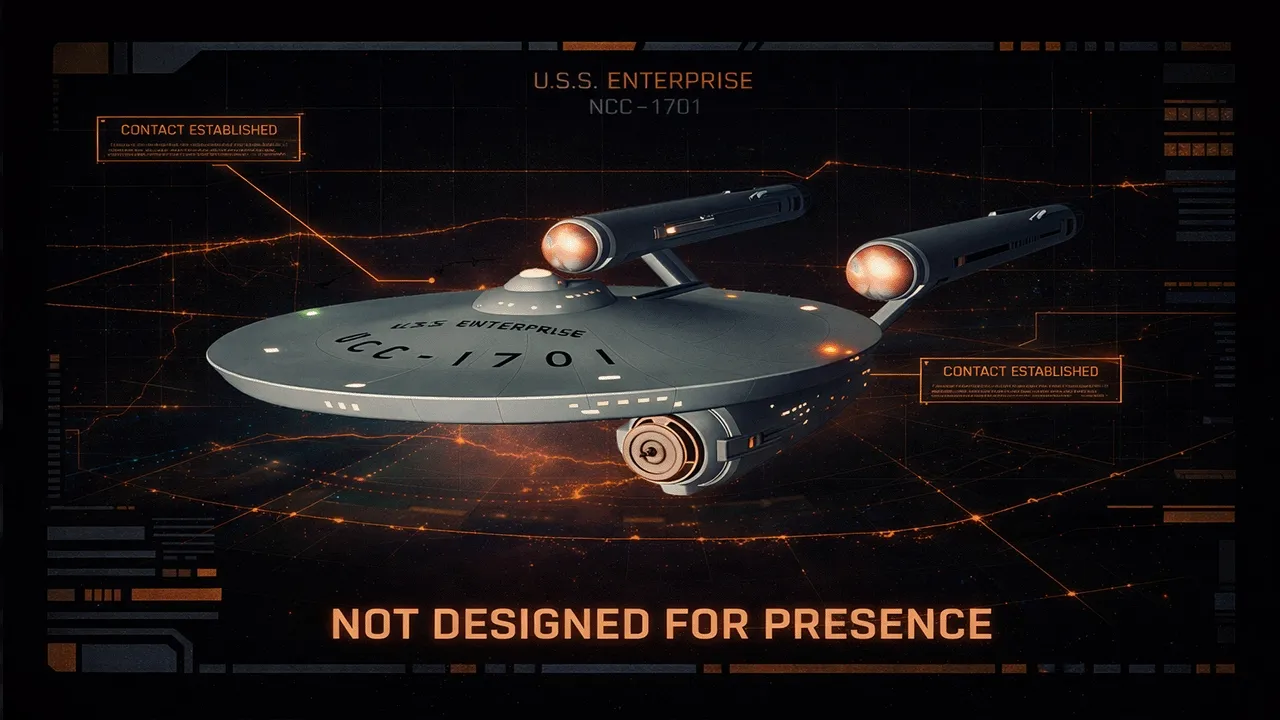
Adapted with AI from Lore Reloaded's video of 6 February 2026 and checked against the video before publication. Editorial standards · Corrections
More from @lorereloaded
All →


Make videos? Your next one could be an article here.
We turn your videos into articles under your name, linked back to the original. You keep 60% of what they earn, non-exclusive, and you can leave whenever you like.
Become a SubPlotter →