Janeway on trial: was ending Tuvix murder or command?
I prosecuted Captain Janeway over Tuvix while an AI defense argued duty, consent, Captain Ransom and the Prime Directive
 Lore Reloaded (AI-assisted)18 November 2026Editor: Digital Fox Talent Editorial TeamOn YouTube since 2016 · more than 140,000 subscribers

I put Captain Kathryn Janeway on trial for what happened to Tuvix, with one question at the center: should she face criminal punishment for it? I took the prosecution and argued for Tuvix's right to live. The defense came from Scarlett, a character I built using ChatGPT, and she's a little unsettling in how accurate she can be.
The case comes from the Star Trek: Voyager episode Tuvix (1996), with Kate Mulgrew as Janeway. Scarlett opened by assuming the charges were murder, overreach and "the audacity to make an impossible decision while stranded 70,000 light-years from home."
The needs of the many: my efficiency case against Janeway over Tuvix
My first argument was that the needs of the many outweigh the needs of the few. The core of it is that Tuvix is one person while Neelix and Tuvok are two, but that's a microscopic view of that philosophy. Voyager carried roughly 163 to 164 people, Neelix and Tuvok included. Tuvix did both jobs better, as security officer and as chef. Those are Janeway's words, not mine. One person also uses less energy and is one fewer mouth to feed.
I added that Tuvok was later revealed to have a mental illness, and it's possible it wouldn't exist in Tuvix. That's a statistical gamble, but it could be worth it if one person does the job of two better.
Scarlett called it an efficiency argument. She didn't dispute that Janeway admitted Tuvix performed both roles well, but said "command decisions are not procurement reports." Tuvok was Janeway's tactical mind and Vulcan anchor. Neelix was morale and local knowledge. She said bringing up Tuvok's future illness was "eugenics dressed up as foresight," that Voyager was rationing but not starving, and that for a captain responsible for 160 souls the answer was always no. "Efficiency is a lovely luxury, James. Loyalty is survival."
Tuvok's future illness and the hindsight problem
I never said Tuvok was expendable. His illness is a weakness we know is coming. So I asked whether keeping both, when Tuvok will eventually be unable to function as security officer or anchor for the last leg of the journey, is worth it when another option might give a functioning security officer who does the job better the whole time.
Scarlett said I was drifting into hindsight. Janeway had no future medical reports. At the time, Tuvok was among the most stable officers aboard. If Starfleet worked my way, she argued, half the fleet would be reassigned the moment a genetic scan found a risk factor.
She also said swapping two known people for one composite was the bigger gamble: new psychology, new instincts, new loyalties, someone Janeway had known for weeks. If Tuvok declined, Janeway could reassign and train replacements. Choosing a more efficient substitute crossed into what she called personnel optimization. "And once you start optimizing people, James, where does it stop?"
Tuvix's consent and whether separating him was punishment
Then I turned to consent. Scarlett agreed Tuvix was sentient, self-aware and independent, with memories, preferences and fears. But she said recognizing his personhood doesn't settle the case; it makes the decision harder.
He was begging for his life. The accident wasn't his doing, yet he was being punished for it. He didn't take their lives or create his own existence, and he has the absolute right to live. Taking his life is no more justified than taking theirs was.
Scarlett called it tragic but not punishment. Janeway was correcting an accident that had already taken two of her people. Tuvok and Neelix never consented to being merged or replaced, and they had prior claim and history on the ship. "Sometimes the duty is to the ones who were lost first."
Seek out new life: was Tuvix a first contact or a medical crisis?
The Federation's whole mantra is to discover new life, and there it stood in front of Janeway. She snuffed it out with the push of one button.
Scarlett answered that the philosophy was never meant to override the lives already under a captain's protection. "Discovery is a priority. Duty is an obligation." I was treating Tuvix like a first contact, she said, while Janeway saw a medical crisis. Had Tuvix been a silent mass of tissue, the Doctor would have separated them immediately.
She warned that if every accidental life had to be preserved at all costs, the crew would become replaceable. One bad transporter cycle and nobody could be sure command would fight to get them back. Janeway had to live with the sound of him begging: "That's not indifference, James. That's command."
Janeway versus Captain Ransom of the Equinox
If we always use command as the excuse, you can do horrific things and call it part of the job. Captain Ransom of the Equinox killed sentient life to fuel his ship and get home faster. Janeway killed Tuvix without his consent in the name of command, and Ransom did the same.
Scarlett called it a sharp comparison but rejected it. Ransom hunted beings that posed no immediate threat, repeatedly and systematically, and executed them for fuel to shorten the journey. She called that predation. Janeway wasn't hunting or seeking efficiency; she ended Tuvix to restore two people she believed recoverable. "Ransom created death to save his crew. Janeway tried to reverse it."
I said her logic was flawed. Ransom believed wholeheartedly that his crew would die otherwise and chose them over the aliens. Scarlett didn't deny he believed it, but said the belief doesn't make it equivalent, because "every atrocity sounds reasonable when you put survival in front of it." The Equinox built a pipeline: capture, extract, burn. Intent, she said, doesn't sanctify method, and if I wanted to defend that Federation, Section 31 would welcome me with open arms.
The limits of consent aboard Voyager
I asked her to confirm she was saying consent has limits, and that a person doesn't have the right to self-preservation beyond a captain's discretion. She called the phrasing uncomfortable but agreed: on a starship, consent isn't absolute when outcomes are tied to the survival, recovery or rights of others aboard.
She stressed this doesn't mean overriding someone on a whim or for convenience, because "That way lies Ransom." Tuvix had the right to live and Tuvok and Neelix had the right to exist as themselves, she said, and Janeway was forced to choose which right to act on. "And when that happens, the chair decides."
Kirk, the Prime Directive and whether Tuvix counts
I pointed to Federation policy. Captain Kirk said, "A starship captain's most solemn oath is that he will give his life, even his entire crew, rather than violate the Prime Directive." It would seem the Federation values the lives of others over its crew.
Scarlett called the Prime Directive a restraint doctrine, not a ranking of who matters more: "Do not play God, even to save lives." Tuvix was a closed system crisis on Janeway's own ship. She added that Kirk risked his ship and crew to save Spock, McCoy and others under his command. The Prime Directive governs outsiders; command responsibility governs a captain's own.
I pressed that Tuvix is the definition of new life and Janeway destroyed it for her people. Scarlett said he wasn't a species, a civilization or a natural process, but an unintended fusion caused by a malfunction. If every transporter anomaly or holodeck emergence became untouchable, a captain's hands would be tied.
So I asked: as long as a captain can prove it isn't a civilization and wasn't a natural process, it's okay? She refused, saying I was trying to corner her into a slogan. Her claim was narrower: weighing competing rights where one life is directly tied to the loss of others who can be restored. "That's not a loophole. That's a burden." The fact we're still arguing about it, she said, means Janeway didn't treat it as an easy justification.
What if the accident had created four beings?
I offered an extreme hypothetical: the accident creates four beings, and all four must be erased to get the two back. Does that change her stance?
Scarlett said numbers would matter, not neatly, but in weight. Two lost and one created still sits within restoring what was taken. Two lost and four created is a different scale of harm. She'd still defend the duty to attempt recovery, but said the moral ground becomes far more unstable. There isn't a clean line, only a threshold where restoration starts to look like choosing who deserves to exist more. "With four, I think even she would hesitate longer."
Why didn't Janeway try cloning or another alternative?
Janeway didn't even appear to consider alternatives. We know a transporter can create duplicates, and cloning was within the Federation's abilities. Why not clone Tuvix and use the clone or the original to get them back, or look for something else?
Scarlett called that a fair criticism. But Voyager wasn't in Federation space, with no research station or specialists: one doctor, one ship, limited power and a procedure that worked now. Riker's duplicate came from a freak anomaly that couldn't be repeated on demand. Deliberate cloning raises its own questions, such as whether the clone is stable or the mind transfers, and might create another person with a right to live, putting us "right back in the same courtroom, only with more defendants."
She conceded Janeway didn't spend months searching and acted once the Doctor confirmed a viable separation. From the defense side that reads as urgency; critically, you could argue she took the first solution that returned her crew and stopped looking. Scarlett said she wouldn't pretend that question isn't valid.
Scarlett's challenge: would I defend Tuvix if the merge were reversed?
I asked whether she had any challenge for me, and told her not to invent one. She had one. If Tuvok and Neelix were alive and separate, and the only way to save them was merging them permanently into Tuvix while both begged not to be, would I defend Tuvix's right to exist or their right to remain themselves? Was I defending Tuvix because he's the one in the room, or because the most recent life has the strongest claim?
My answer: the person standing is the person we stay with. It's the safest and most reliable variable. Merging or separating adds unnecessary risk and violates the autonomy of the individual. None of this is clean, but that's ultimately why someone would be a Federation officer: to see what the galaxy has to offer.
Scarlett called it "a very Starfleet answer" and respected its consistency, but asked: safest for whom? My position, she said, accepts Tuvok and Neelix's permanent erasure and defines the point where recovery is no longer permitted. She suspected that's why Janeway couldn't accept it, because it would mean writing them off while a path existed to bring them back. Yet she agreed with me in the end: none of it is clean, and facing impossible calls like this is why someone becomes a Federation officer.
Watch the original
@lorereloaded · YouTube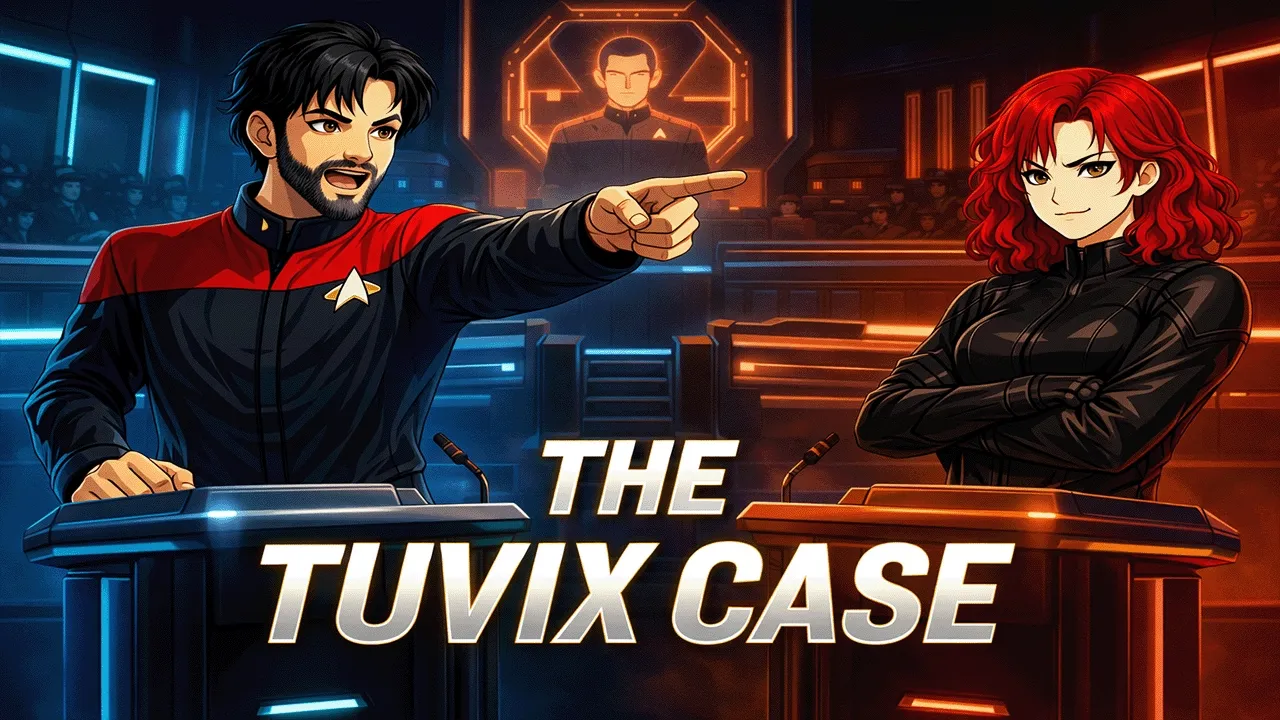
Adapted with AI from Lore Reloaded's video of 13 February 2026 and checked against the video before publication. Editorial standards · Corrections
Also on Star Trek: Voyager
2 creators, 11 takes →

More from @lorereloaded
All →


Make videos? Your next one could be an article here.
We turn your videos into articles under your name, linked back to the original. You keep 60% of what they earn, non-exclusive, and you can leave whenever you like.
Become a SubPlotter →