Star Trek: how the Excelsior class organized Starfleet
Starfleet's transwarp prototype failed at its original goal, then for nearly a century often served as the ship that organized the fleet
 Lore Reloaded (AI-assisted)16 November 2026Editor: Digital Fox Talent Editorial TeamOn YouTube since 2016 · more than 140,000 subscribers

When people think about the ships that define Starfleet, they usually picture the Enterprise, the legendary Constitution class, the massive Galaxy class, or the warships that emerged during the Dominion War. Those ships were symbols. They were icons. But they weren't the ships that organized Starfleet itself. For nearly a century, when Starfleet needed a ship to command a sector, escort a diplomat or lead a fleet into battle, one design appeared again and again: the Excelsior class.
Some will immediately object that the Constitution came first, and that's true. The Constitution class helped define what Starfleet would become. But it was never meant to organize an entire fleet. The Excelsior was. It was introduced in the late 23rd century as part of Starfleet's ambitious transwarp program, and it went on to become one of the most prominent, widely deployed command cruisers in Federation history. Admirals selected it as their flagship. Sector commanders relied on it to maintain Starfleet's presence across the Federation. Decades later, even during the Dominion War, Excelsior class ships could still be found leading fleet formations.
The Miranda class had given Starfleet the numbers it needed to fill the Federation. The Excelsior provided something else entirely: structure. It wasn't just another starship design. It was the moment Starfleet stopped operating as a collection of individual ships and began operating as a true interstellar fleet.
Before the Excelsior, Starfleet Was Built to Explore, Not to Hold Territory
Before the Excelsior class ever launched, Starfleet looked very different from the organization we recognize in the 24th century. It was smaller, less centralized and built around a very different mission. Starfleet wasn't designed to patrol a vast interstellar state. It was designed to explore one. In the middle of the 23rd century, the Federation itself was still expanding. New worlds were joining, borders were uncertain, and much of the surrounding galaxy remained unknown.
Starfleet ships reflected that reality. They were exploration vessels with long range, meant to operate independently for years at a time. Ships like the Constitution class weren't simply patrol cruisers or fleet units. They were deep space explorers tasked with charting new regions of space, establishing first contact and representing the Federation far beyond its borders. These vessels were powerful and capable, but they were also relatively rare. Each Constitution class ship operated almost like its own expedition, carrying hundreds of crew members across vast distances with minimal support from Starfleet Command.
Their missions were ambitious, but they weren't designed to maintain a constant presence across Federation territory. They pushed outward, expanding the Federation's reach rather than holding territory it already possessed. As the Federation grew, that approach began to reveal its limits. More member worlds meant more trade routes to protect, more diplomatic missions to escort and more sectors that required a permanent Starfleet presence. A ship designed to spend years charting the frontier wasn't necessarily the best platform for maintaining order across dozens of inhabited systems.
By the late 23rd century, Starfleet faced a quiet but important shift in its responsibilities. The Federation was no longer just an expanding alliance of worlds. It was becoming a mature interstellar civilization, one that required constant coordination, diplomacy and defense across a vast region of space. That meant Starfleet needed something it had never truly possessed before: command and control.
The USS Excelsior and the Failed Transwarp Great Experiment
Starfleet's answer to this growing problem didn't begin as a fleet cruiser. It began as an experiment. In the early 2280s, Starfleet unveiled a new prototype starship unlike anything it had attempted before. The USS Excelsior, the first vessel of what would become the Excelsior class, was designed around an ambitious propulsion concept known as transwarp drive.
The project was bold, even by Starfleet standards. If successful, it promised to push starship speeds beyond the limits of conventional warp travel and dramatically expand the range of Federation exploration. Starfleet leadership called it the great experiment. The Excelsior was intended to represent the future of Federation propulsion technology.
But the future didn't arrive the way Starfleet expected. The transwarp system ultimately failed to deliver the revolutionary breakthrough Starfleet had hoped for. The technology proved unstable, impractical, or simply too far ahead of its time. Whatever the precise technical reasons, the result was clear: the propulsion system that had defined the Excelsior project wouldn't become the next generation of warp travel. For many programs, that kind of failure would have meant the end.
The ship itself was another matter entirely. Even without its experimental propulsion system, the design revealed something remarkable. The Excelsior had a large and durable space frame, powerful engines, extensive internal volume and the ability to support a wide range of mission profiles. It was fast, versatile and capable of operating independently across vast distances. It was exactly the kind of ship Starfleet needed for a Federation that was no longer just expanding outward but stabilizing inward. The great experiment may have failed, but Starfleet had built a starship capable of doing almost everything. Once Starfleet realized what it had, the Excelsior class stopped being an experiment and became the standard.
How the Excelsior Class Multiplied Alongside the Miranda Class
Once Starfleet committed to the Excelsior design, something unusual began to happen. The class didn't remain a single experimental vessel or a small line of advanced cruisers. It began appearing everywhere. Across the late 23rd and early 24th centuries, Excelsior class ships became a familiar presence throughout Federation space. They escorted diplomats, transported officials, patrolled borders and commanded task forces. Admirals selected them as flagships, and sector commanders relied on them to coordinate Starfleet operations across entire regions of space.
Wherever Starfleet needed a capable and dependable command cruiser, the Excelsior often filled the role. That wasn't simply a matter of building more ships. It reflected a deeper shift in Starfleet's operational doctrine. Earlier vessels like the Constitution class had been designed for exploration, pushing the frontier outward into unknown space. As the Federation matured, Starfleet needed ships capable of managing what had already been discovered. The Excelsior had the command facilities to coordinate multiple ships and the versatility to perform everything from exploration to patrol duty without sacrificing effectiveness in any single role.
At the same time, Starfleet kept producing smaller and more numerous vessels such as the Miranda class, which gave the Federation the numbers needed to maintain a broad presence across its territory. Together, these ships formed the foundation of a new kind of Starfleet. Miranda class vessels filled the fleet with capable patrol ships and mission platforms, while Excelsior class cruisers often served as the ships that organized those fleets, coordinating operations and providing command authority across entire sectors. For the first time in its history, Starfleet was beginning to resemble what its name implied: not a collection of individual starships scattered across space, but a fleet.
Excelsior Class Command Ships at Wolf 359 and in the Dominion War
By the middle of the 24th century, the Excelsior class had become one of the most familiar designs in Starfleet service. Decades after its introduction, it continued to appear across Federation space in roles that reflected its versatility. A single Excelsior vessel could perform the duties of an exploration cruiser, a fleet coordinator and a diplomatic escort without requiring specialized modification. That adaptability let Starfleet deploy the class across an enormous range of missions, so capable command ships were always available wherever they were needed.
Over time, that reliability placed the Excelsior in the middle of some of the Federation's most critical moments. When the Borg launched their first major incursion into Federation space in 2366, Excelsior class ships were among the vessels mobilized to respond, joining the fleet assembled to intercept the Borg cube before it could reach Earth at the Battle of Wolf 359. The engagement ended in disaster for Starfleet, but the presence of Excelsior class vessels in that fleet reflected how deeply the design had become integrated into Starfleet operations.
The class kept appearing in major engagements through the following decade. During the Dominion War, Excelsior class ships served alongside newer designs in some of the conflict's largest fleet actions. They took part in major operations such as Operation Return and later fought in battles that would decide the fate of Cardassia and the war itself, including the Battle of Cardassia. By then the class had been in service for generations, and newer starships had appeared, many of them faster, more advanced or more specialized. Yet the Excelsior held its place, not because it was the most powerful ship Starfleet possessed, but because it was the ship Starfleet had learned to rely on.
Why the Excelsior Class Stayed in Service Through the Galaxy and Defiant Era
By the time the Dominion War began, the Excelsior class was already an old design. It had first appeared in the late 23rd century, and nearly 100 years later it was still present on Starfleet's front lines. On paper, that kind of longevity should have been unlikely. Starfleet technology evolved rapidly, and newer starships were constantly introduced with more advanced systems, faster warp drives and more specialized mission profiles. By the 2360s and 2370s, vessels like the Galaxy class and the Defiant class represented a new generation of starship design.
Yet the Excelsior class didn't disappear when those ships entered service. Starfleet continued to upgrade and refit the design. Systems were modernized, structural components were reinforced, and aging hardware was replaced with newer technologies. Those upgrades kept Excelsior class ships compatible with the evolving needs of Starfleet even as the fleet around them changed.
Part of the reason for this persistence was simple practicality: the Excelsior had proven itself a durable and adaptable platform. But there was another reason the class endured. By the time newer ships began replacing it in some roles, the Excelsior was already deeply embedded in Starfleet's operational structure. Entire sectors were accustomed to operating with Excelsior class command cruisers coordinating local patrols and responding to regional crises. Replacing those ships wouldn't simply mean introducing a new design. It would mean reorganizing the command infrastructure that had grown around them. So Starfleet did what it often does with successful designs and kept using them, decade after decade.
The Excelsior Class as Starfleet's First Real Flagship
By the end of the 24th century, Starfleet had fielded many powerful and sophisticated starship designs. The Galaxy class represented the height of Federation exploration, capable of carrying entire communities across the frontier. Warships such as the Defiant class showed how Starfleet could adapt to the realities of war on a large scale. New cruisers would keep pushing the limits of technology in the decades that followed. Yet long before any of those ships appeared, the Excelsior class had already changed how Starfleet operated.
The Excelsior didn't become famous because of a single legendary mission. It didn't carry the symbolic weight of the Enterprise, nor did it represent a dramatic technological breakthrough after the failure of its original transwarp project. It became something far more practical: dependable. For decades, Excelsior class ships were the vessels Starfleet relied on to manage the daily realities of an interstellar civilization, and when Starfleet needed a ship that could handle almost any mission, the Excelsior often proved to be the right choice.
The Miranda class helped fill the Federation with the numbers to maintain that presence across hundreds of star systems, but numbers alone were never enough. A civilization that spans hundreds of worlds requires coordination and leadership. It requires ships capable of organizing the movements of dozens of vessels across enormous distances, and for nearly a century that responsibility often fell to the Excelsior. It wasn't Starfleet's most famous starship, and it wasn't its most powerful. But it was the design that quietly made possible a Federation where Starfleet was no longer an occasional visitor to distant sectors but a permanent presence. That may be the Excelsior's greatest legacy.
What other creators are saying
More on Starfleet →From Tom Paris to Benjamin Sisko, these officers gave Starfleet good reason to take the uniform back, and some went right back to work
Starfleet officers who deserved to lose the uniform, ranked →
Star Trek (2009) and The Force Awakens share a director, a reboot mission and the start of a trilogy
J.J. Abrams Played an Almost Identical Role in Star Trek and Star Wars →
One card plays artifacts from the top of your library, and the other rewards facing a dilemma with free spells
Zefram Cochrane and the Caretaker among Magic: The Gathering Star Trek preview cards →
A Romulan War buildup, a Mirror Universe miniseries, the Borg Queen's origin and a refitted NX-01 were all part of the plans for a season that never got made
Watch the original
@lorereloaded · YouTube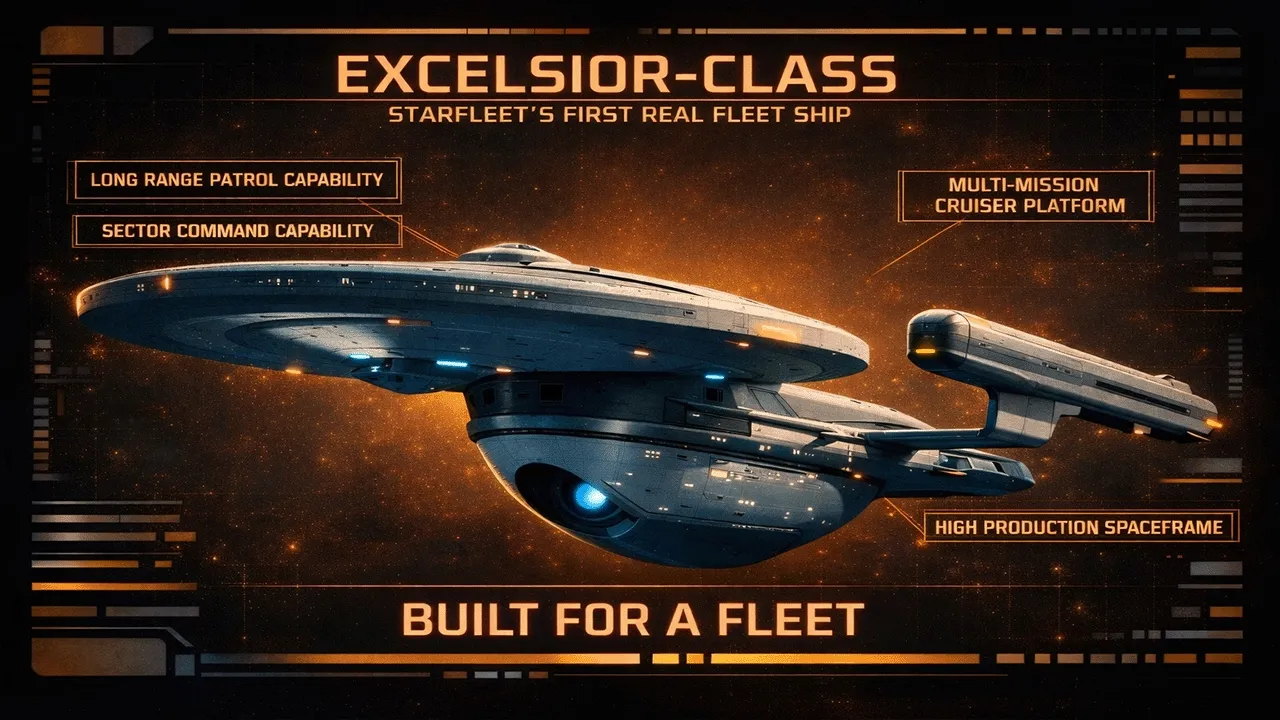
Adapted with AI from Lore Reloaded's video of 8 March 2026 and checked against the video before publication. Editorial standards · Corrections
More from @lorereloaded
All →


Make videos? Your next one could be an article here.
We turn your videos into articles under your name, linked back to the original. You keep 60% of what they earn, non-exclusive, and you can leave whenever you like.
Become a SubPlotter →