Star Trek DS9: what if Admiral Leyton's coup had succeeded?
If the Lakota destroys the Defiant, Star Trek: Deep Space Nine's coup story becomes a Federation civil war that does the Dominion's work for it

In September 2372, Earth is under military lockdown. Starfleet security officers patrol the streets, citizens submit to blood screenings, and the Federation President is losing control of his own government. If Admiral Leyton's coup had succeeded, the story would not end with a military takeover on Earth. It would begin a civil war inside the Federation, and the Dominion might never need to invade, because this time the Federation does the dirty work for them.
The storyline comes from Star Trek: Deep Space Nine (1993), starring Avery Brooks. Somewhere in space, a ship races toward Earth carrying proof that the crisis was a lie. It was not a Dominion attack and not a changeling plot. It was a coup. A Starfleet admiral manufactured a crisis, sabotaged Earth's power grid, and used fear to seize power.
In the original Deep Space Nine story, the Lakota's captain refuses to destroy the Defiant
In the story as it aired, the evidence arrives. The conspiracy collapses, and Admiral Leyton is stopped before he can overthrow the Federation government. But history often turns on a single decision. Before the Defiant reaches Earth, another Starfleet ship, the USS Lakota, moves to intercept it, and its captain receives an order to destroy the Defiant.
In the timeline we know, the captain refuses. But what if Captain Benteen had obeyed? What if the Defiant never reached Earth, and Leyton won? In this version, the Lakota complies and the Defiant is destroyed before its evidence can be delivered.
Leyton brands Benjamin Sisko part of a changeling infiltration
Within hours, Starfleet Command announces that Captain Benjamin Sisko had been aiding a changeling infiltration. Surviving officers who know the truth are killed, detained, or discharged on conspiracy charges. For Leyton, the crisis is over. For the Federation, it is only beginning.
Within days, Leyton's emergency government moves to entrench its power. Starfleet officers loyal to the President are removed from key posts. Communications are monitored and security powers are expanded. Officially, the crisis has been contained. Unofficially, the Federation's constitutional government has been overthrown.
Early reports leaving Earth are confusing. Starfleet Command confirms emergency powers to protect the Federation from Dominion infiltration, official broadcasts claim Sisko was exposed as part of a changeling plot, and extra security measures spread across Federation space. For many citizens the explanation is convincing. The Dominion threat was real, changelings had already infiltrated the Alpha and Beta Quadrants, and Earth had recently suffered a coordinated attack on its power grid.
Vulcan refuses to back Leyton's emergency government
The problem is that Federation member worlds are not colonies. They are sovereign governments, and they start asking questions. Why has the President vanished from view? Why are Starfleet officers issuing political directives? Why is the military making decisions that belong to elected civilian leaders? Above all, why is Earth demanding obedience rather than consultation?
The first major challenge comes from Vulcan. When Starfleet demands public support for the emergency government, the Vulcan High Command refuses. Not because it supports the Dominion, but because it wants proof, and Leyton cannot provide it. For the first time, a founding world openly questions the legitimacy of Earth's government, and that refusal gives other governments the right to ask the same question.
The crisis deepens when several Federation Council members escape Earth, helped either by sympathetic Starfleet officers or local security forces. That leaves two competing claims to legitimacy. Earth insists emergency authority passed lawfully to Starfleet. The escaped councillors insist the government was overthrown. The question is no longer whether Leyton controls Earth, but whether Earth still controls the Federation.
Starfleet splits as officers choose between Earth and the government in exile
For nearly two hundred years, Starfleet worked on a simple principle: the Federation government sets policy and Starfleet carries it out. Admirals might argue behind closed doors, but civilian authority stood above military authority. Leyton's victory shatters that overnight. Orders arrive from Earth to tighten security, reassign patrols and monitor communications. They carry the right authorization codes and follow normal channels. The problem is not the orders but the government issuing them.
The first resignations come within days. Captains turn down promotions, admirals request retirement, and some officers simply drop out of official correspondence rather than declare for either government. One of the first public fractures comes aboard a Galaxy class starship near Betazed. The commanding officer declares for Earth, and the first officer for the government in exile. Neither believes they are breaking their oath.
For about six hours the senior staff argue behind closed doors while the ship drifts in orbit. In the end the first officer requests a transfer, and 37 crew members leave with her. No arrests are made. The commanding officer personally escorts them to the transporter room, and the two officers salute, neither expecting to see the other again. The irony would not be lost on the Founders: for months the Dominion had worked to weaken the Federation with fear, and now the Federation was doing it alone. By the end of the month, without a shot fired, Starfleet has become two fleets sharing one uniform.
Vulcan becomes the seat of a Federation government in exile
Leyton holds Earth, Starfleet Headquarters, and a heavily fortified Sol system. The representatives who escaped him regroup out of reach: council members, ambassadors, ministers and senior officials. Individually they have little power. Together they represent the one thing Leyton cannot manufacture, legitimacy.
Deep Space 9 is proposed as a seat and quickly rejected. It sits on the border, dangerously close to Cardassian territory and the Dominion threat, with great strategic weight but little political weight. Attention turns to Vulcan instead: a founding member, home to some of the Federation's oldest institutions, strong enough to resist Earth, and untouched by the coup.
When the first emergency session convenes on Vulcan, the message is that the Federation government still exists, it has simply moved. Silent ambassadors now have someone to report to, sector governments have an alternative authority, and Starfleet officers opposing Leyton are no longer acting alone. Leyton calls the meeting political theater, and a Starfleet spokesman calls it an illegal gathering of frightened officials. Two governments now claim the same state.
Leyton's ultimatum turns supply lines into a political weapon
For a while the standoff settles into an uneasy stalemate, but time works against Leyton. Neutral worlds drift toward Vulcan and silent officers start choosing sides. He answers with an ultimatum: any member government recognizing the Vulcan assembly will be treated as violating Federation law. Logistical support will be suspended, fleet deployments reassessed, and strategic resources redirected to loyal worlds. It contains no threat of force, but everyone understands it. A colony facing pirates could lose its patrols, and trade routes could lose protection.
The first clash is over supplies. A Vulcan aligned colony requests replacement fusion reactors after a blackout, and the nearest depot is controlled by Earth. The shipment never leaves. Earth calls the delay administrative, while Vulcan accuses Leyton of using civilian infrastructure as a weapon. When the colony suffers repeated blackouts weeks later, neutrality becomes harder to defend.
The first major protests break out on Andor, becoming one of the largest political gatherings in modern Federation history. Millions fill the streets demanding not independence or revolution, but elections, transparency and proof. Starfleet security never intervenes, and ordinary citizens begin taking sides. Medical shipments to frontier colonies get tangled in the dispute, and on paper no one refuses aid, yet patients wait for medicine that never arrives. Meanwhile colonies near the Cardassian border lose contact, merchant ships vanish, and beyond the Bajoran wormhole the Founders realize Leyton has handed them a divided Federation.
The first Starfleet battle of the civil war breaks out near Tellarite space
Neither government wants a battle. Vulcan believes enough pressure will force Leyton to step down, and its supporters see themselves as defenders of the constitution, not rebels. Leyton believes time is on his side. The crisis starts in the Tellar sector, where commanders had stayed deliberately neutral, until Earth orders task forces on the Federation's interior border to redeploy toward the core worlds. Many suspect Leyton is preparing direct pressure on worlds backing the exile government, which orders the fleet to stay put.
A respected Vulcan admiral with decades of service, commanding one of the sector's largest formations, now holds two contradictory orders. She chooses Vulcan. Starfleet Command relieves her, she refuses to recognize it, other commanders follow, and Earth sends another task force. Near the edge of Tellarite space, the two sides exchange messages for nearly 12 hours, searching for a way out. When Earth aligned ships try to pass the blockade, shields go up, warning shots are fired, and someone fires back.
The engagement lasts under 20 minutes. No ships are destroyed, several are damaged, dozens die and hundreds are wounded. The physical losses are small, but the political consequences are catastrophic. A Starfleet officer has fired on another Starfleet officer. Governments mobilize planetary defense forces and starbases close to ships from the opposing faction.
The Dominion spreads uncertainty instead of invading
The civil war creates a problem for the Dominion: the moment Jem'Hadar warships appear in force, the war ends, because even bitter enemies can find common ground facing an open invasion. So the Founders spread uncertainty. Ships vanish, supply depots suffer mysterious incidents, and intelligence reports conflict, with Cardassia preparing for war one week and the Romulans massing forces the next. Both factions must respond, and the result is exhaustion. Intelligence agencies spend more time investigating each other than the Dominion, and the Cardassians are the first to notice.
Then a border colony is emptied, its thousands of citizens gone. Earth blames constitutional loyalists, and Vulcan blames sleeper security forces. Months later, Dominion records recovered after the war reveal that neither side was responsible. The Founders orchestrated it. The colony never mattered; it was an accusation. Cardassian patrols grow aggressive and the Klingons do the same, both watching and learning. The Alpha Quadrant starts to resemble predators circling a wounded animal.
Earth holds the heart of the Federation while Vulcan holds its conscience
Leyton looks stronger at first. Starfleet Headquarters still runs from San Francisco, Utopia Planitia remains one of the largest shipyards in Federation space, and many senior admirals back him. But the Federation is not an Earth empire where controlling the capital means controlling the state. Every shipyard, sector commander and member world can still choose, and many choose differently. Every offensive risks pushing neutral worlds toward Vulcan.
The constitutional faction does not need to conquer Earth; it only needs to survive. If Leyton stays defensive, it slowly gains support. If he attacks, he risks becoming what his opponents call him: a military ruler imposing power by force. Yet the exile government cannot simply invade the Sol system, one of the most heavily fortified places in Federation history. Younger officers serve only one faction, veterans who spoke of reconciliation now speak of victory, and shipyards keep producing ships that never reach the frontier.
Why Leyton's victory makes this timeline a tragedy
The great irony is that both sides are fighting to save the Federation. Leyton believes he is protecting security, and the exile government believes it is protecting democracy. That is exactly why the Dominion wins in the end: it no longer has to face the Federation at full strength.
What makes Leyton compelling is that his fears were justified. The Dominion was coming and the Federation was vulnerable. The tragedy is that in trying to save it from an outside threat, he created one inside, an enemy starships could not defeat. Trust held the Federation together. Leyton may have secured Earth, strengthened Starfleet and delayed some Dominion operations, but he shattered the political foundation that made the Federation worth defending.
When the Dominion War finally comes, the Federation enters it divided, exhausted and doubting itself, exactly as the Founders wanted. In the end, Admiral Leyton may have prevented one catastrophe only to create a far greater one. The worst possibility is not that the Dominion conquers the Federation, but that the Federation destroys itself before the Dominion ever gets the chance.
What other creators are saying
More on Star Trek →There is no official confirmation, but the article speculates that Star Trek may be gradually blurring the Kelvin and Prime timelines, possibly merging them into one unified continuity over time rather than announcing a traditional reboot.
Star Trek reset theory: are Kelvin and Prime timelines merging? →
One card plays artifacts from the top of your library, and the other rewards facing a dilemma with free spells
Zefram Cochrane and the Caretaker among Magic: The Gathering Star Trek preview cards →
A Romulan War buildup, a Mirror Universe miniseries, the Borg Queen's origin and a refitted NX-01 were all part of the plans for a season that never got made
Tomorrow's Enterprise plays less like classic Kirk and Spock and more like Next Generation's All Good Things, and the people who made it are calling the future we saw continuity.
Strange New Worlds finale: the original series' lost ending →
Watch the original
@lorereloaded · YouTube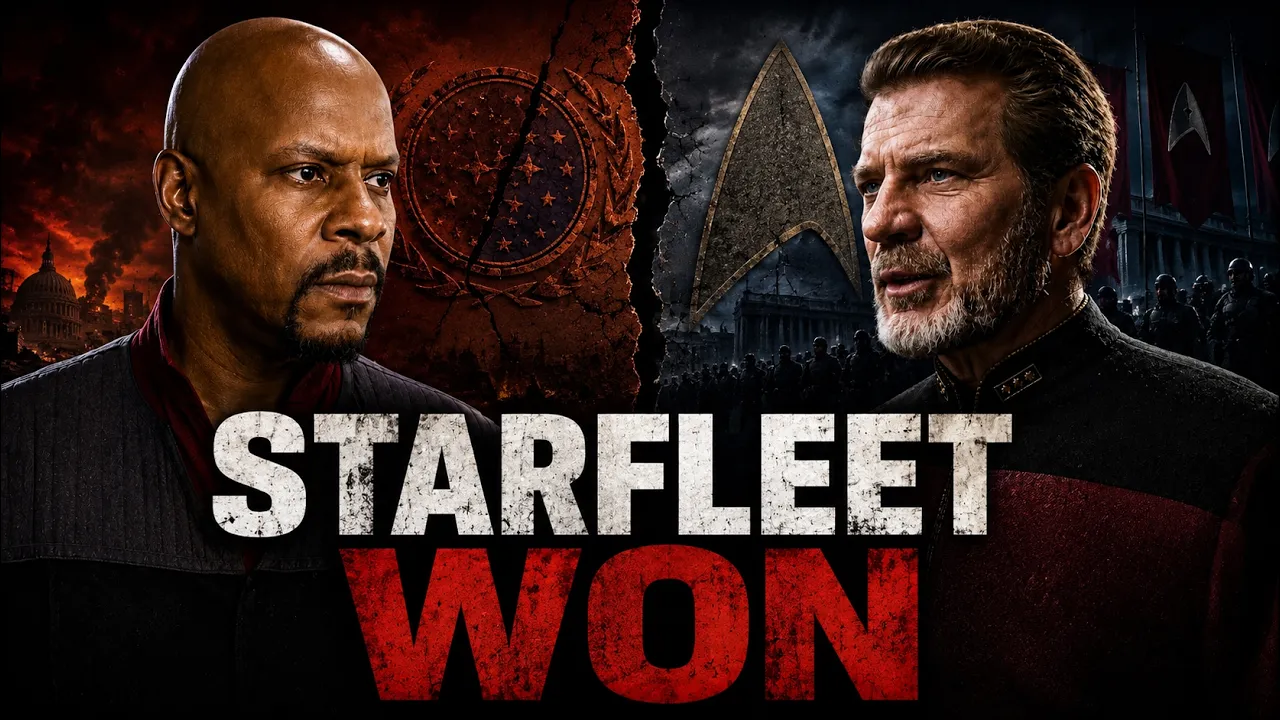
Adapted with AI from Lore Reloaded's video of 26 June 2026 and checked against the video before publication. Editorial standards · Corrections
More from @lorereloaded
All →


Make videos? Your next one could be an article here.
We turn your videos into articles under your name, linked back to the original. You keep 60% of what they earn, non-exclusive, and you can leave whenever you like.
Become a SubPlotter →