Steamrunner class: why Starfleet built it after Wolf 359
Overshadowed by the Defiant, Sovereign and Akira, the Steamrunner kept turning up in Starfleet's biggest battles because it was made for endurance

At the Battle of Wolf 359, the Borg destroyed 39 starships. They also destroyed one of Starfleet's oldest assumptions. My argument is that the Steamrunner class, a ship that never became famous, was a quiet answer to that lesson. It was never meant to steal the spotlight. It was built for the next war.
For generations, the Federation relied on a relatively small number of highly capable ships to extend its influence across known space. Exploration, diplomacy, scientific research and defense all ran through ships expected to do everything. That philosophy worked as long as Starfleet faced isolated crises. Wolf 359 proved it would not survive an industrial war.
How Wolf 359 broke Starfleet's do everything ship philosophy
For most of its history, Starfleet measured success one ship at a time. A single Constitution class ship could explore uncharted space for years. A Galaxy class ship could negotiate treaties, carry out advanced research and respond to humanitarian disasters, while carrying enough firepower to deter almost any regional threat. The idea was not only to build capable ships but ships capable of doing almost anything. The Federation expected its starships to work independently, because they often had to.
Wolf 359 exposed the limits of that approach. The lasting lesson was not that Starfleet needed bigger phasers or thicker shields. It was that the Federation had optimized its fleet for isolated crises, not sustained war. Thirty nine ships were destroyed within hours. Whole command crews vanished. Experienced engineers, tactical officers and captains were lost along with the ships they served on. Replacing a starship was hard. Replacing the institutional experience that disappeared with each one was harder.
That matters because wars are rarely decided by a single engagement. They become contests of endurance. Shipyards have to keep producing new vessels while existing fleets stay in service. Crews have to be trained faster than losses can wipe them out. Supply lines stretch across hundreds of light years. Damaged ships need repair facilities, spare parts and escorts just to return to duty. The side that can absorb losses without collapsing usually gains the advantage long before the decisive battle is fought.
The Borg, the Klingons and the Gamma Quadrant changed what Starfleet needed
In the years that followed, Starfleet Command began to notice the strategic landscape shifting. The Borg remained an existential threat. Tensions with the Klingon Empire were rising. Intelligence reports from the Gamma Quadrant pointed to another great power expanding beyond the Bajoran wormhole. None of these developments guaranteed another war. Taken together, though, they painted a picture of a future in which Starfleet might be forced to fight campaigns measured in months or years rather than days.
That called for a different kind of fleet. Flagships would keep their place, but they could no longer carry the burden alone. The Federation needed ships that could hold contested regions without drawing attention, reinforce sectors quickly, escort convoys through dangerous territory and fight as part of a larger formation rather than on their own. In other words, Starfleet needed ships designed not for prestige, but for staying power. The question was what such a ship would look like.
Defiant, Sovereign and Akira got the attention while the Steamrunner filled the gap
Starfleet's response to Wolf 359 was not slow. Within a few years, entire new classes of starship began entering service, each reflecting a different lesson from the battle. The Defiant class was the most visible change. It was small, heavily armored and designed with one enemy in mind, built to face the Borg head on. It abandoned many of the compromises that had defined earlier Federation designs.
The Sovereign class pushed in the opposite direction. It became the Federation's new flagship, combining exploration with enough combat capability to make sure a Federation flagship would never again find itself completely vulnerable. The Akira class offered a bolder vision of fleet combat, expanding Starfleet's ability to project force across multiple theaters, carrying an impressive weapons load while staying flexible enough to support a wide range of operations. These ships drew most of the attention because they were different in shape and in combat, and they represented clear changes in Starfleet thinking.
While everyone was watching those designs, another class quietly entered service, perhaps to solve a more practical problem. At first glance it lacked the imposing look of the Defiant or the prestige of the Sovereign. It introduced no revolutionary technology and did not redefine Starfleet doctrine on its own. Instead, it filled the space between those two extremes. The Federation was not looking for another Enterprise. It needed a ship commanders could assign to almost any mission without worrying about risking one of Starfleet's most precious assets. The Steamrunner was not built to replace Starfleet's heroes, but to make sure they never had to fight alone.
The Steamrunner's unusual design suggests a ship built for one job
The Steamrunner does not look like a natural extension of Starfleet design. It lacks the sweeping elegance of the Galaxy class and the distinctive lines of the Sovereign. Even next to the Akira or the Nebula, its proportions look unfamiliar. The main hull is low and compact, the nacelle structure extends behind the ship, and the engineering section looks almost separate from the rest of the design. It is easy to recognize, not because it looks powerful, but because it looks practical.
Perhaps that impression is what Starfleet intended. In the late 24th century, Federation ship design came to reflect specialization more than prestige. Earlier generations expected one ship to perform every possible task, while newer classes began to focus on specific operational roles. The Steamrunner appears to continue that approach, not by excelling in one field, but by stripping away everything unnecessary for the work required.
That may also explain its unusual appearance. Unlike ships that projected Federation prestige, the Steamrunner suggests that almost every part of its design exists for a specific purpose. It is not trying to impress diplomats or spend years exploring unknown regions. It is trying to arrive with the fleet, survive the battle and stay ready for the next mission. For a navy preparing for a long conflict, that may have been exactly what Starfleet wanted.
Sector 001 and the Dominion War show how much Starfleet trusted the Steamrunner
Official accounts do not give much technical information about this class, but its appearances tell us something possibly more important. The Steamrunner consistently shows up where Starfleet expects real resistance. It took part in the battle of Sector 001 against the Borg. It appeared again and again during the Dominion War as part of major fleet formations. These were not isolated patrols or ceremonial deployments. They were the largest military operations the Federation carried out in that era.
Whatever role Starfleet gave the Steamrunner, command clearly trusted it to fight alongside the most capable ships in the fleet. That trust may be the most telling evidence we have. Starfleet repeatedly committed Steamrunners to battles where ship losses were expected. If the class had proved hard to maintain, too specialized or unreliable, commanders had plenty of alternatives that entered service in the same period. Even so, the Steamrunner keeps appearing.
In military history, equipment does not stay on the front line by accident. It stays there because commanders keep asking for it. The Steamrunner earned a lasting place on the front line quietly, not by stealing the spotlight. It was not built to dominate a battlefield alone or to carry the Federation's reputation the way the Enterprise did. It was designed to take its place in the line, do its job and be ready to do it again the next day. For a Starfleet preparing for a long conflict, perhaps that reliability was its greatest strength.
Why reliable ships like the Steamrunner rarely become legends
Popular history tends to reduce wars to famous names. We remember the Enterprise because it was at the center of extraordinary events. We remember the Defiant because it represented a fundamental shift in Starfleet philosophy. We remember Voyager because it traveled 70,000 light years to get home. Those ships deserve their place in history, but they blur our understanding of how large fleets actually work.
No military wins a long conflict by relying only on exceptional platforms. The ships that make headlines are usually too few to carry the whole load. While flagships lead the major offensives, dozens of other ships secure supply routes, escort troop transports, answer distress calls, reinforce damaged formations and replace losses faster than the enemy can exploit them. Those jobs rarely become stories, because when they succeed nothing extraordinary happens. The convoy arrives. The colony survives. The fleet stays supplied. The lines hold.
Seen that way, the Steamrunner's greatest strength was not overwhelming firepower or revolutionary technology. It was predictability. Admirals knew what they would get every time they assigned one to a task force. Task force commanders knew exactly where it fit. Engineers knew how to maintain it, and logistics officers knew how to supply it. Those qualities may not sound exciting, but wars are often decided by ships that make planning easier rather than ships that make headlines.
Commanders need ships they understand, crews they can train efficiently and designs that fit smoothly into larger formations. A fleet made entirely of highly specialized ships quickly becomes hard to coordinate, and harder still to replace once losses start mounting. The Steamrunner did not need to be Starfleet's most powerful cruiser, because the fleet already had ships for that role. It occupied a broad middle ground between prestige and specialization: tough enough to survive fierce battles, flexible enough to take on a wide range of missions, and common enough that losing one, however painful, would not cripple an entire sector's operations.
That may also explain why the Steamrunner never gained the fame of the Enterprise or the Defiant. It succeeded because it did exactly what Starfleet asked of it. In that sense, the Steamrunner was not overlooked for failing to stand out. It was overlooked because reliability rarely turns into legend, even though history so often depends on it.
What other creators are saying
More on Starfleet →From Tom Paris to Benjamin Sisko, these officers gave Starfleet good reason to take the uniform back, and some went right back to work
Star Trek officers who deserved to lose the uniform, ranked →
One card plays artifacts from the top of your library, and the other rewards facing a dilemma with free spells
Zefram Cochrane and the Caretaker among Magic: The Gathering Star Trek preview cards →
A Romulan War buildup, a Mirror Universe miniseries, the Borg Queen's origin and a refitted NX-01 were all part of the plans for a season that never got made
Tomorrow's Enterprise plays less like classic Kirk and Spock and more like Next Generation's All Good Things, and the people who made it are calling the future we saw continuity.
Strange New Worlds finale: the original series' lost ending →
Watch the original
@lorereloaded · YouTube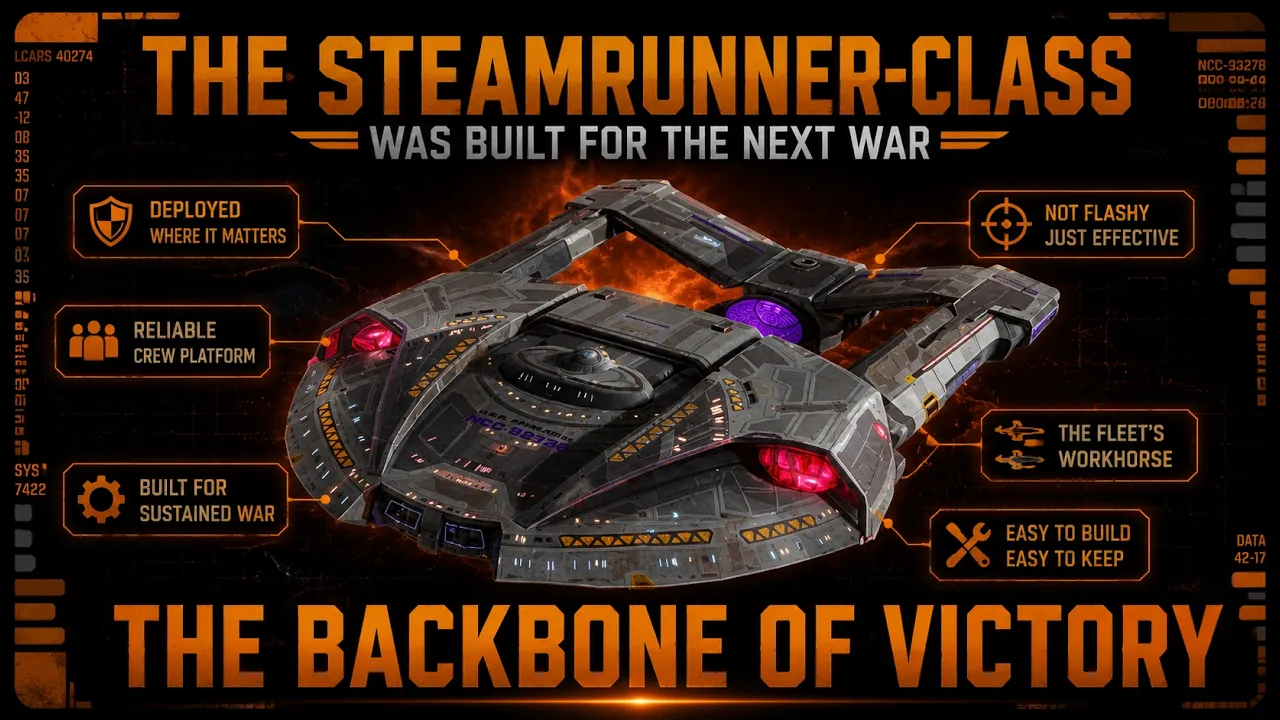
Adapted with AI from Lore Reloaded's video of 1 July 2026 and checked against the video before publication. Editorial standards · Corrections
More from @lorereloaded
All →


Make videos? Your next one could be an article here.
We turn your videos into articles under your name, linked back to the original. You keep 60% of what they earn, non-exclusive, and you can leave whenever you like.
Become a SubPlotter →