Strange New Worlds: why did Pike hold fire in Valles Marineris?
When stolen Enterprise antimatter became the weapon, holding fire stopped being neutral, and Starfleet's ideals ran into the history that made them possible.

The Strange New Worlds episode Valles Marineris puts Captain Pike in one of the most difficult situations any Starfleet captain has ever faced. He orders his crew to hold fire and allows billions to die so that Earth's future, and Starfleet itself, can exist. The episode refuses to offer a perfect answer about whether he was right.
Strange New Worlds (2022), starring Anson Mount, Ethan Peck and Rebecca Romijn, sends the Enterprise 65 million years into Earth's past. There the crew encounters a civilization from Mars locked in a desperate war against another species living on what was then the fifth planet of our solar system.
Why Captain Pike held fire in Valles Marineris
When the Martian commander steals Enterprise technology, she intends to use it to destroy the enemy's home world once and for all. Pike has every reason to stop her. Instead, he gives the order: "Do not fire. Repeat, do not fire." His crew pushes back, arguing that the planet is about to be destroyed by their own technology and that their future is at stake.
By the end of the episode, we learn why he held back. The destruction of that world sets in motion the events that eventually lead to the extinction of the dinosaurs, the cooling of Earth and the rise of humanity itself. Had Pike stopped the attack, the Federation, Starfleet and even Pike himself might never have existed.
At first glance, the decision seems obvious. If stopping the Martians means preventing humanity from ever existing, refusing to fire feels less like choosing genocide and more like preserving history. Without the destruction of that home world, there is no asteroid. Without the asteroid, the dinosaurs don't go extinct. Without that chain of events, there may never be a Federation, a Starfleet or a Captain Christopher Pike. By the time the Enterprise is in firing range, Pike understands exactly what's at stake.
That's what makes the decision so fascinating to me. Pike isn't simply deciding between one civilization and another. He's deciding between the lives in front of him and every life that follows: billions on the enemy home world weighed against the future of Earth, the Federation and every civilization Starfleet will one day encounter.
Stolen Enterprise antimatter turned an ancient war into Starfleet history
That explanation creates another problem, and it's a question I couldn't get out of my head. The moment the Martian commander steals the Enterprise's antimatter, this stops being a war between two alien civilizations. Starfleet technology becomes the deciding factor. Pike is no longer an observer of history. His own ship has become the instrument that makes the destruction of an inhabited world possible.
If the Martians had destroyed their enemy using their own weapons, Pike might simply be preserving history. But they don't. From the moment they take that antimatter, this is no longer an ancient war unfolding the way it always had. Whatever happens next isn't simply history anymore. It's Starfleet history.
Starfleet doesn't exist simply to protect humanity. Its captains swear to protect life, to seek peaceful solutions wherever possible, and to ensure Starfleet technology is never used irresponsibly. In this moment, those principles collide head on with Starfleet's own existence. Whether Pike likes it or not, Starfleet has become part of the chain of events.
That's the paradox. If Pike stops the attack, he may erase humanity and everything Starfleet will one day become. If he allows it, he permits Starfleet technology to become the instrument of a genocide. Either way, something fundamental is sacrificed. And that raises a question I don't think the episode ever truly answers: can Starfleet honestly demand that one of its captains upholds its principles if doing so means ensuring Starfleet never existed?
Pike relied on one Martian commander's account of the enemy
Before deciding whether Starfleet effectively permitted a genocide, there's another question to answer. Did Pike actually know enough to make that decision? Once the Enterprise's antimatter became part of the attack, choosing not to intervene became as significant a choice as choosing to fire.
Everything the Enterprise learns about the enemy species comes from the Martian commander. She's a wartime commander who has seen her people suffer devastating losses. She shows Pike the scar left on Mars by an earlier attack, describing it as "a wound on your planet that will never heal." She says the enemy are creatures that cannot be reasoned with, only stopped through force. From her perspective, there is no diplomacy left to pursue.
The problem is that none of it is independently verified. That's a remarkable amount of uncertainty for a decision involving billions of lives. Pike is weighing the testimony of one wartime commander against the complete silence of the civilization she's asking him to help destroy. The Enterprise never establishes communication with them. The crew never witnesses an attack. They never confirm whether the devastation on Mars was a deliberate act of war, an accident or something else entirely.
The only direct encounter with the enemy species is the wreckage of a crashed ship on Earth, and Scotty even suggests it may have been a colony ship, its passengers still in cryosleep when they died. None of this proves the commander was wrong, but it doesn't prove she was right either. Pike isn't choosing between obvious heroes and obvious villains. He's deciding the fate of entire civilizations while relying almost entirely on one commander fighting for her own people's survival.
Starfleet's principles collide with the timeline that created them
Every Starfleet officer swears an oath to uphold the principles of the Federation. The exact wording has never been established on screen, but the values have: protect life, seek peaceful solutions, use force only when there is no alternative. Those ideals define Starfleet as much as its ships or its uniforms. Valles Marineris creates a situation those ideals were never designed to answer.
By the time Pike gives his order, he understands the paradox. Stopping the commander may preserve the other civilization, but it may also erase Earth's future, the Federation and Starfleet itself. Doing nothing means an inhabited world is destroyed using technology stolen from the Enterprise. Neither obligation exists because Starfleet failed. Both exist because Starfleet succeeded. The same principles designed to preserve life also created the captain now faced with preserving the timeline that allowed those ideals to exist.
The first obligation is immediate. An entire civilization is about to die, and Starfleet technology is part of the weapon. A captain has both the ability and arguably the responsibility to stop that. The second is almost impossible to comprehend. Preventing the attack may mean no Starfleet officer ever exists. Every mission, every alliance, every life the Federation will one day save could disappear with a single photon torpedo.
Neither choice lets Pike walk away with clean hands. Stopping the attack condemns the future. Allowing it condemns the present. Perhaps that's why the episode works so well: there's no clever third option where everyone survives and no last second techno babble solution. And that may be the most unsettling part of all: not that Pike allowed a genocide, but that Starfleet's own principles may have required him to accept one for Starfleet itself to ever exist.
Did Pike permit a genocide? It depends where responsibility begins
If Pike's only obligation was to preserve the timeline, his decision was unavoidable. By letting history unfold, he ensured humanity survived, the Federation was founded and Starfleet would one day exist. From that perspective, preventing the destruction of that home world may have meant erasing countless civilizations the Federation would eventually protect. It's difficult to dismiss the idea that preserving the future ultimately saved far more lives than it cost.
But if Starfleet's first responsibility is to protect life wherever possible, the conclusion becomes much harder to accept. Enterprise technology became the weapon that destroyed an inhabited world. Pike had the authority to intervene and chose not to. Whether or not that was justified, Starfleet was no longer standing outside the conflict. Its technology shaped the outcome, and its captain knowingly allowed it.
Every peaceful first contact and humanitarian mission that followed rests on the uncomfortable reality that humanity's future depended on this moment. The Federation exists because that other civilization did not. Perhaps that's why the episode has generated so much discussion. It doesn't ask whether genocide is ever justified. It asks whether Starfleet's ideals remain absolute when following them means ensuring Starfleet itself never exists. Every ethical system works until following it demands the sacrifice of everything that created it, and this episode forces Starfleet into exactly that corner.
Maybe Pike made the only decision that could ever have preserved humanity. Maybe he crossed the line Starfleet was never meant to cross. If you had been sitting in Pike's chair, knowing that intervening might erase humanity itself, would you have fired?
What other creators are saying
More on Star Trek: Strange New Worlds →Tomorrow's Enterprise plays less like classic Kirk and Spock and more like Next Generation's All Good Things, and the people who made it are calling the future we saw continuity.
Strange New Worlds finale: the original series' lost ending →
Sets are gone, actors are taking other jobs, and the obvious follow up to Strange New Worlds appears to have died without ever being officially greenlit.
Star Trek Year One: is the Kirk series dead before it began? →
Watch the original
@lorereloaded · YouTube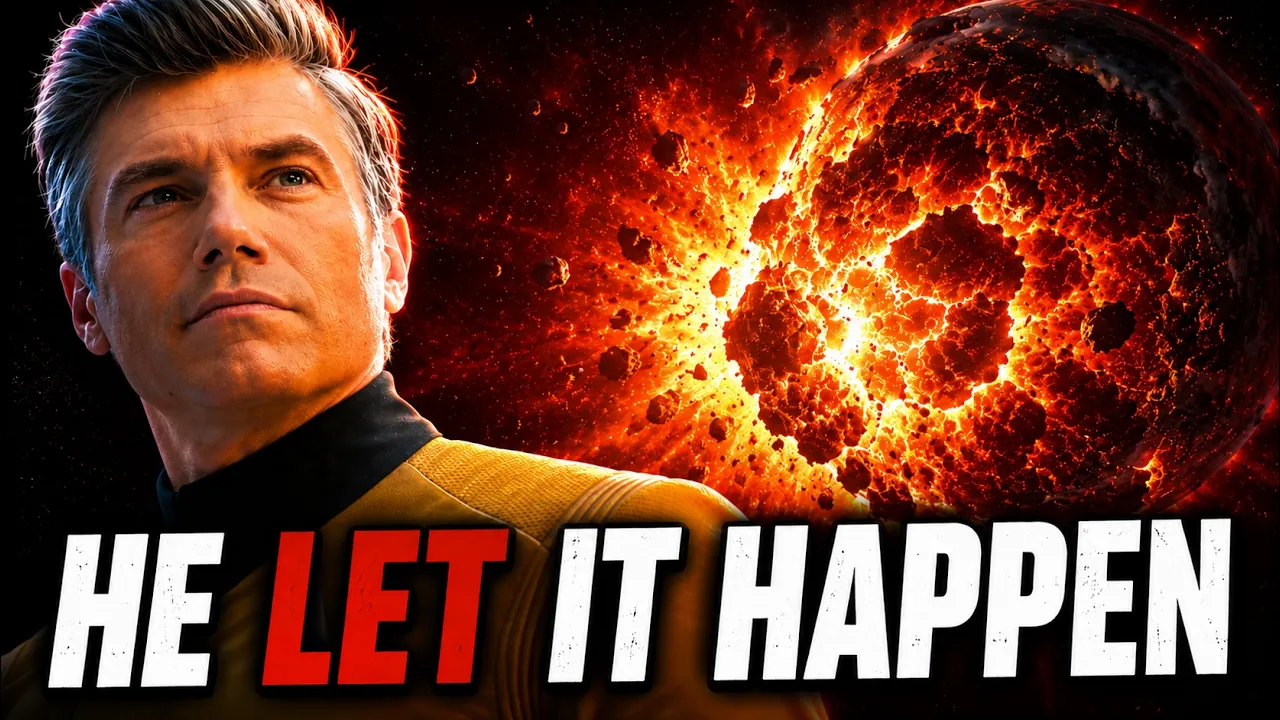
Adapted with AI from Lore Reloaded's video of 23 July 2026 and checked against the video before publication. Editorial standards · Corrections
More from @lorereloaded
All →


Make videos? Your next one could be an article here.
We turn your videos into articles under your name, linked back to the original. You keep 60% of what they earn, non-exclusive, and you can leave whenever you like.
Become a SubPlotter →