Frontier Day: How Starfleet Built the Network the Borg Used Against It
The Borg did not overpower the fleet on Frontier Day. They exploited a centralized command system that Starfleet designed, installed and trusted on its own.

Frontier Day, the celebration at the center of Star Trek: Picard's third season (2023), starring Patrick Stewart, is usually remembered as a Borg victory. I don't think that's quite right. The Borg did infiltrate Starfleet, but that explanation is incomplete. They exploited a weakness Starfleet had already built for itself.
Frontier Day was supposed to be one of Starfleet's greatest celebrations. To honor more than two centuries of exploration, diplomacy and service, the Federation gathered hundreds of its most advanced starships. Within moments, those same ships became the biggest threat Earth had seen since the Borg first arrived in Sector 001. Whole fleets turned their weapons on each other. Starfleet Command was thrown into confusion, and Spacedock came under siege. An event meant to show the Federation's strength instead exposed a deep vulnerability that nearly ended the organization entirely.
The Borg exploited Fleet Formation, a system Starfleet built for itself
The Borg did not arrive with a fleet strong enough to conquer the Federation by force. They did not bring more production, more firepower or more strategic strength across the Alpha Quadrant than Starfleet had. Instead, they took advantage of Fleet Formation, the synchronistic technology that lets every Starfleet ship operate in unison.
Without that system, the Borg plan could never have worked. Frontier Day was not only the story of an enemy exploiting a weakness. It was the story of Starfleet creating that weakness itself. That raises a far more uncomfortable question than how the Borg got into the fleet: why did Starfleet decide every frontline starship should be able to operate as a single interconnected force?
Why Starfleet gave up on independent captains
For hundreds of years, Starfleet relied on independent captains, decentralized command and ships able to make their own decisions across vast distances. That philosophy helped the Federation through wars with the Klingons, clashes with the Romulans, Borg attacks and the Dominion War. So why abandon it?
The answer was not incompetence. On paper, the idea made complete sense. A fully networked fleet promised instant coordination, faster tactical response, seamless resource sharing and a level of battlefield awareness no earlier generation of Starfleet officers could have imagined. Against conventional enemies, it seemed like the next logical step in how fleets are run. Every simulation, every war game and every procurement board probably concluded that a connected fleet would be more effective than one made of independent ships acting alone.
The problem was never Starfleet's desire to be more effective. The problem was the idea hidden inside the solution. Fleet Formation looked like an advanced command system built to help independent starships cooperate better. But the closer Starfleet came to perfect coordination, the more it gave up the independence that had protected the Federation for centuries. To understand how that happened, you have to go back to the moment Starfleet stopped seeing Borg technology only as a threat and started treating it as an opportunity.
From Wolf 359 to Voyager: how Borg technology became an opportunity
When the Borg first appeared, Starfleet had no interest in learning from them. The Battle of Wolf 359 destroyed 39 starships and killed more than 11,000 officers and crew. Years later, the Battle of Sector 001 showed that even the Federation's newer generation of warships could barely stop a single cube before it reached Earth. To Starfleet, Borg technology was not an opportunity. It was the machinery of an enemy unlike anything the Federation had faced.
Each encounter reinforced the same lesson. The Borg were not simply more advanced. They represented an entirely different way of thinking about technology, individuality and even war. Over time, though, necessity began to change that view. Every battle left wreckage that could be recovered and studied. Every encounter produced new sensor logs, engineering data and tactical observations.
Voyager's return accelerated that process dramatically. Seven of Nine brought decades of firsthand knowledge of Borg systems, and Voyager itself came home with years of scientific research gathered on its journey through Borg space. The Stargazer was introduced as the first of a new class of ship, using components derived from research on the Borg cube artifact. Suddenly Starfleet had more information about the Collective than it had gathered in all the decades before.
The results were hard to ignore. Borg research helped Starfleet improve its understanding of adaptive shielding, sensor technology, regenerative systems and countless other engineering fields. None of these developments was inherently reckless. In fact, refusing to study such valuable technology would have been irresponsible. Throughout its history, Starfleet has studied its rivals' strengths. Klingon disruptors, Romulan cloaking devices, Dominion weapons and Cardassian engineering all taught lessons that ultimately made the Federation stronger.
Starfleet's confidence came from success, not arrogance
Each successful advance quietly reinforced a belief that would shape Starfleet's future. Every time Borg technology was safely adapted, confidence grew that the Federation fully understood it. The Borg stopped being an alien existential threat and became a source of advanced engineering that only needed careful study before being folded into Starfleet designs. With each successful project, the line between Federation technology and Borg technology mattered a little less.
At first, those adaptations were limited. They improved the individual systems of each ship. But as Starfleet's confidence grew, the projects could become more ambitious. Eventually engineers stopped asking how Borg research could improve one starship and began asking whether it could improve how the entire fleet was run.
That confidence was not born of arrogance. It was born of success. Years of careful research had brought real improvements with no obvious consequences. From Starfleet's point of view, the evidence suggested Borg technology could be separated from the Collective that created it. Once stripped of its biological components and adapted to Federation standards, it seemed like just another piece of advanced engineering. It was a conclusion backed by years of real experience.
The trouble was that Starfleet spent decades asking whether Borg technology could be made safe. It never stopped to ask whether some technology carries the ideas of the civilization that built it. That would prove far more important than anyone expected, because by the time those ideas became visible, they were no longer confined to a lab or a single experimental ship. They were built into Starfleet's command structure.
Borg technology was built to eliminate the individual
Every civilization builds technology to solve its own problems. That sounds simple, but it has far reaching consequences. Technology is never just a collection of parts assembled in a different shape. It reflects the priorities, fears and ideas of the people who built it.
The Borg were different. They did not build technology to empower the individual. They built it to eliminate the individual. Every major Borg system existed for one purpose: to connect billions of drones into a single intelligence capable of acting in perfect coordination. Their sensors, communications, computer systems and even their biological components were never designed to work independently. Every part of a Borg ship assumed it would always be connected to something larger than itself. Individual decision making was not just unnecessary. It was treated as a flaw.
That is why Borg technology was fundamentally different from almost everything Starfleet had seen before. Starfleet believed it was importing Borg hardware. In reality, it was importing Borg ideas, and the whole point of those ideas was to remove the need for individual judgment through centralized control.
Starfleet never wanted to rebuild the Collective. Quite the opposite. Its engineers believed they could strip out everything that made the Borg dangerous while keeping the benefits of instant coordination, creating a network that boosted cooperation without sacrificing individuality. It was an appealing idea because it matched Federation ideals so neatly. Starfleet had always believed free people working together by choice could achieve more than any of them alone, and a fleetwide command network looked like an extension of that philosophy. The flaw was not in Starfleet's intentions. It was in the assumption that the underlying design philosophy could be separated from the technology. Borg networking was never built to help independent decision makers communicate more efficiently. It was built to replace independent decision making entirely.
The 25th century coordination problem behind Fleet Formation
By the early 25th century, Starfleet faced a problem every successful military eventually confronts. Its fleet was bigger, more technologically advanced and more geographically spread out than ever. Coordinating hundreds of starships across Federation space had become increasingly complex, especially as threats changed faster than traditional command structures could respond. Every recent conflict reinforced the same lesson: information wins wars, and the side that can observe, communicate and react fastest usually gains the advantage.
The danger was not networking the fleet. The danger was making that network so authoritative that a compromised system could override the decisions of the very captains and crews it was supposedly built to help. The proposal probably impressed everyone who evaluated it. The technology reduced confusion, shortened response times and improved combat effectiveness. Everything about it suggested Starfleet had finally found a way to make independent starships cooperate with an efficiency earlier generations could only imagine.
Independent captains were one of Starfleet's best defenses
What disappeared almost unnoticed was the very trait that had defined Starfleet for centuries. Federation captains were never expected to act as extensions of central command. They were expected to use their judgment. A ship on the frontier could go months without contact with Starfleet Command, negotiating treaties, making first contact or responding to military crises entirely on its own authority.
That independence was not an outdated tradition. It was one of Starfleet's best strategic defenses. It let ships keep fighting when communications were cut, ignore compromised orders and survive without central coordination, because every ship could act on its own. At Wolf 359, losing one starship did not hand the Borg control of the others. During the Dominion War, a squadron could be cut off when communications failed, but that could not automatically turn it against the Federation. Even when orders were delayed, distorted or compromised, every captain kept the ability to evaluate them.
Frontier Day was different because Starfleet had built a system that could turn a compromised network into a compromised fleet. Fleet Formation quietly changed that relationship. The more capable the network became, the more valuable centralized coordination appeared, and every improvement encouraged Starfleet to lean on it a little more. Under normal conditions the fleet grew stronger, but it became increasingly dependent on a system whose greatest strength was that every ship acted as part of a single entity. In solving its coordination problem, Starfleet unknowingly created something it had always avoided: a fleet with a single point of failure. Worse, it built that point of failure using a technological philosophy developed by the civilization best able to exploit it.
Why Frontier Day was a failure of institutional memory, not a Borg triumph
The Borg did not defeat Starfleet with overwhelming firepower or numbers. They relied on Starfleet to solve the hardest part of the operation for them. The Federation designed the network. The Federation installed it on its own ships. The Federation linked its entire frontline fleet together. By the time the Borg activated their plan, the infrastructure they needed was already in place. Long before Frontier Day, the Borg didn't need to build an alliance inside the Federation. Starfleet had already done that work for them.
That is what sets Frontier Day apart from Wolf 359 and the Battle of Sector 001. In those earlier attacks, the Borg imposed their will through overwhelming force. On Frontier Day, they imposed it through Starfleet's own systems. The fleet did not fall because its ships were individually weaker than the Borg. It fell because Starfleet gave the shared network enough power that, once compromised, it could override those ships' independence.
The irony is hard to ignore. For centuries, Starfleet's greatest strategic advantage was its captains, each one an independent command able to adapt when communications failed, orders were compromised or events moved faster than Starfleet Command could respond. Fleet Formation didn't abolish that tradition during ordinary operations, but it created a mechanism that could override it everywhere at once.
The Borg deserve credit for recognizing the opportunity, and they exploited it with remarkable precision. But recognizing an opportunity is not the same as creating it. The Collective didn't persuade Starfleet to give up control, and it didn't force Starfleet to build Fleet Formation. Starfleet made those decisions itself, through people who believed they were making the fleet safer, stronger and better prepared for the future. The Borg simply showed what happens when a system built on centralized control meets an adversary that has spent centuries perfecting centralized control. That is why Frontier Day shouldn't be remembered mainly as a Borg victory. It should be remembered as a failure of institutional memory. Starfleet remembered that the Borg had powerful technology, but it forgot why Borg technology had always been dangerous.
What other creators are saying
More on Borg →A countdown of Star Trek: The Next Generation's most memorable antagonists, from recurring Klingon troublemakers to the collective that changed the franchise forever.
One card plays artifacts from the top of your library, and the other rewards facing a dilemma with free spells
Zefram Cochrane and the Caretaker among Magic: The Gathering Star Trek preview cards →
A Romulan War buildup, a Mirror Universe miniseries, the Borg Queen's origin and a refitted NX-01 were all part of the plans for a season that never got made
Tomorrow's Enterprise plays less like classic Kirk and Spock and more like Next Generation's All Good Things, and the people who made it are calling the future we saw continuity.
Strange New Worlds finale: the original series' lost ending →
Watch the original
@lorereloaded · YouTube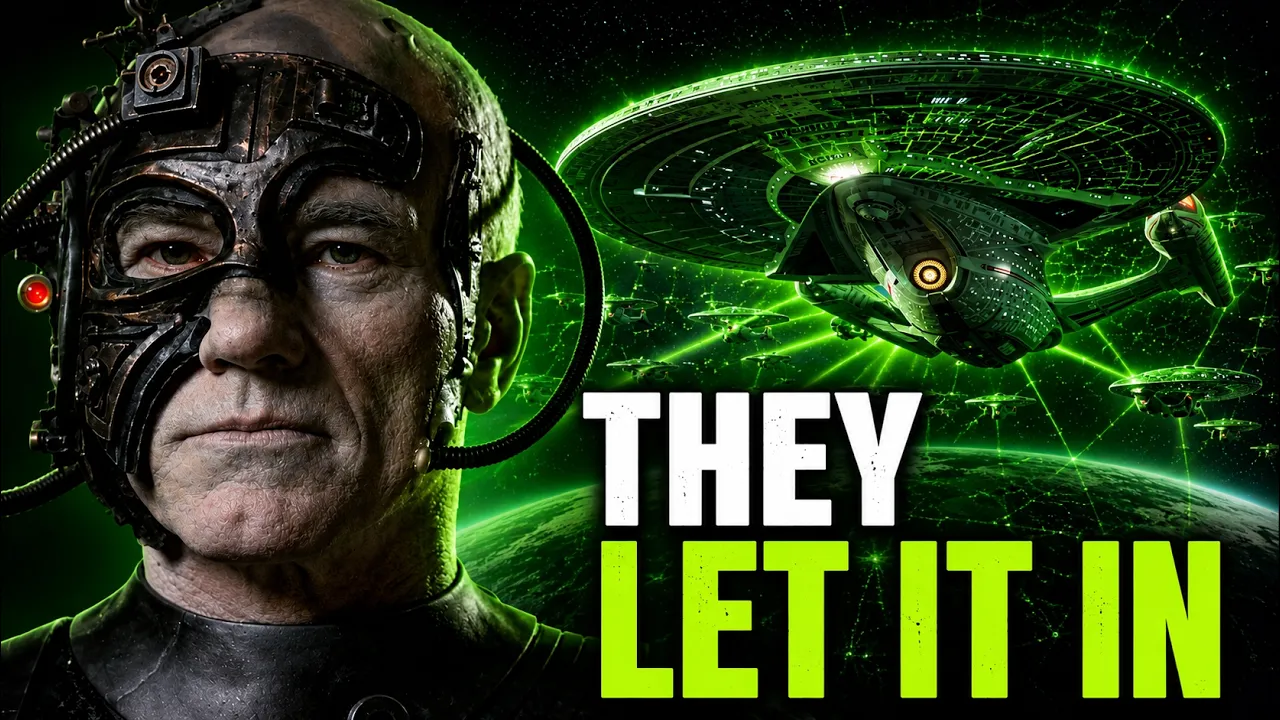
Adapted with AI from Lore Reloaded's video of 15 July 2026 and checked against the video before publication. Editorial standards · Corrections
More from @lorereloaded
All →


Make videos? Your next one could be an article here.
We turn your videos into articles under your name, linked back to the original. You keep 60% of what they earn, non-exclusive, and you can leave whenever you like.
Become a SubPlotter →