Did Lore Replace Data at the End of Datalore? The 'I'm Fine' Theory
A single contraction in the final scene of the Star Trek: The Next Generation episode breaks the rule it set up to tell the androids apart

At the end of the Star Trek: The Next Generation episode "Datalore," everything is supposedly back to normal. Data is safe and Lore is gone. The problem is that the episode already gave us a way to tell the two androids apart, and in its final moments Data says something that breaks that rule. After taking the theory seriously, my answer is no, Lore didn't replace Data. Still, the fact that the theory exists at all is interesting.
"Datalore" (1988), starring Patrick Stewart and Brent Spiner, sets up a simple test. Data can't use contractions. Lore can. Then, right at the end of the episode, Data is asked if he's all right and answers, "Yes, sir. I'm fine." So either the episode breaks its own rule, or the wrong android is still on the Enterprise.
How Wesley Crusher tells Lore and Data apart in Datalore
To understand why that one line matters, you have to look at what "Datalore" is doing. The episode doesn't only introduce Lore. It gives the crew a way to prove he's not Data. It isn't done through strength or through memory. It's done through language.
Early on, everything about Lore feels off. He looks identical and sounds identical, but something isn't lining up. Wesley Crusher is the one who finally notices. The giveaway in that scene comes down to a single phrase: Wesley tells Data that if he'd said "We've been using the sensors" instead of "We have," he "might have suspected" he was Lore. Lore uses contractions. He says things like "I'm," "you're" and "can't." Data doesn't.
This difference isn't just a character quirk. It's treated like a hard rule. Data explains it directly: he's programmed to use formal, precise language, with no shortcuts and no contractions. So when Lore speaks more naturally, in a way that sounds more human, it becomes the tell. It's the flaw in the disguise.
That's important because the episode trains both the crew and the audience to rely on it. If you hear a contraction, it's not Data. It's Lore. That's the test, and that's the line the episode draws. By the time we reach the ending, we already know how to tell them apart.
The Datalore ending skips any test of which android is which
That rule only matters if the moment where it's tested holds up, and in "Datalore" that moment comes fast. By the end of the episode the situation spirals. Lore has taken control, the crew is compromised, and the only thing that stops it is a last-minute reversal. Data is back, Lore is defeated, and it's over.
Look closely at how it's resolved, though. The switch happens under pressure. There's no slow verification, no extended testing and no moment where the crew proves beyond doubt which android is which. They rely on what they think they know. From their perspective this is simple: Data is the one they trust, and Lore is the one they just exposed.
So when the situation stabilizes, they accept the outcome almost immediately. There's no second check and no confirmation beyond assumption. The crisis ends, and the question closes with it. But if the episode already established a clear way to tell them apart, shouldn't that test matter most right here? This is the one moment where getting it wrong would change everything.
Why Data's "I'm fine" line is the problem
The ending is supposed to be clean: threat gone, crew safe, everything back to normal. Data answers that he's fine, and the line is quick and easy to miss. No one reacts. Not Picard, not Wesley, not anyone. To them, the problem is already solved. They've already decided this is Data, so the moment passes without question.
That's the problem. This isn't happening during the deception, with Lore trying to fool them. This is after the switch, and the crew isn't running any more tests. It's the one place where they needed to be careful, and they weren't. Not earlier, when they were confused, but here, when they think they're certain.
Instead, the episode gives you a line that doesn't fit. It isn't loud enough to stop the scene or obvious enough to break the episode. It's small enough to ignore, if you've already decided everything is fine.
What Lore would look like if he had replaced Data
So let's take the theory seriously for a moment, not as canon, but as a possibility. If Lore did make it back onto the Enterprise and successfully replaced Data, what would that look like? It wouldn't look like a villain walking around the ship. Lore isn't reckless. He already proved he can imitate Data well enough to fool the crew once, and if anything he'd be more careful the second time.
He wouldn't push too far or draw attention. He'd do exactly what the crew expects Data to do, only a little better: a little more intuitive, a little more adaptive, maybe even a little more human. That's the uncomfortable part. If Lore is capable of blending in, and the crew is willing to accept that everything is back to normal, the difference between them isn't something you'd notice immediately.
It would be subtle and incremental, the kind of thing you'd only question in hindsight, if you question it at all. Once that possibility is on the table, the real question isn't whether Lore would act differently. It's how long it would take anyone to realize he already had.
Why The Next Generation and Star Trek: Picard rule out the switch
This is where the idea runs into a wall. If Lore really did replace Data here, it wouldn't change only one episode. It would change everything that comes after. Data's entire arc in The Next Generation is built on consistency. His growth is slow and measured. He doesn't suddenly become more emotional, he doesn't start manipulating people, and he doesn't push boundaries in ways that would hint at someone else behind the mask.
More importantly, Lore doesn't disappear. When he comes back later, he's still Lore, with the same goals, the same personality and the same instability. There's no indication he's been living undercover and no suggestion that he's been playing a long game inside Starfleet. By the time you get to Star Trek: Picard, the distinction between them is made explicit. Data is Data and Lore is Lore: separate, defined, resolved.
If you follow the canon all the way through, the conclusion is clear. The switch didn't happen, or if it did, it didn't last. Even so, the contradiction that started the whole theory, that one "I'm fine," never goes away.
Why the Datalore theory still works even though it isn't true
So no, Lore didn't replace Data at the end of "Datalore." The larger story doesn't support it, the characters don't support it, and Star Trek: Picard eventually closes that door completely. But for a brief moment, the episode gives you everything you need to believe it: two identical androids, one established rule, and a single line that breaks it. And the crew never questions it.
That's the part that lingers. Starfleet doesn't verify in that moment. They assume. They trust that the situation is resolved and that Data is Data. Normally that trust is justified, but "Datalore" quietly shows how fragile that certainty is. Identity, at least in this case, is something the crew accepts at face value rather than something they rigorously confirm when it matters most.
The theory doesn't work because it's true. It works because, for a second, the show leaves enough room for doubt. In a story about two identical beings, one trusted and one not, that doubt is exactly where the tension lives.
What other creators are saying
More on Data →Data carries a colony's knowledge, and his family gets even stranger.
Why there are no good guys, who the Emperor really is, what the warp hides, how the Horus Heresy broke the Imperium, and who else is fighting over the galaxy
Warhammer 40K lore for beginners: five lessons for new fans →
The actor behind Jean-Luc Picard and Charles Xavier died at his Los Angeles home following Alzheimer's disease and Lewy body dementia, his longtime spokesperson announced
Star Trek (2009) and The Force Awakens share a director, a reboot mission and the start of a trilogy
J.J. Abrams Played an Almost Identical Role in Star Trek and Star Wars →
Watch the original
@lorereloaded · YouTube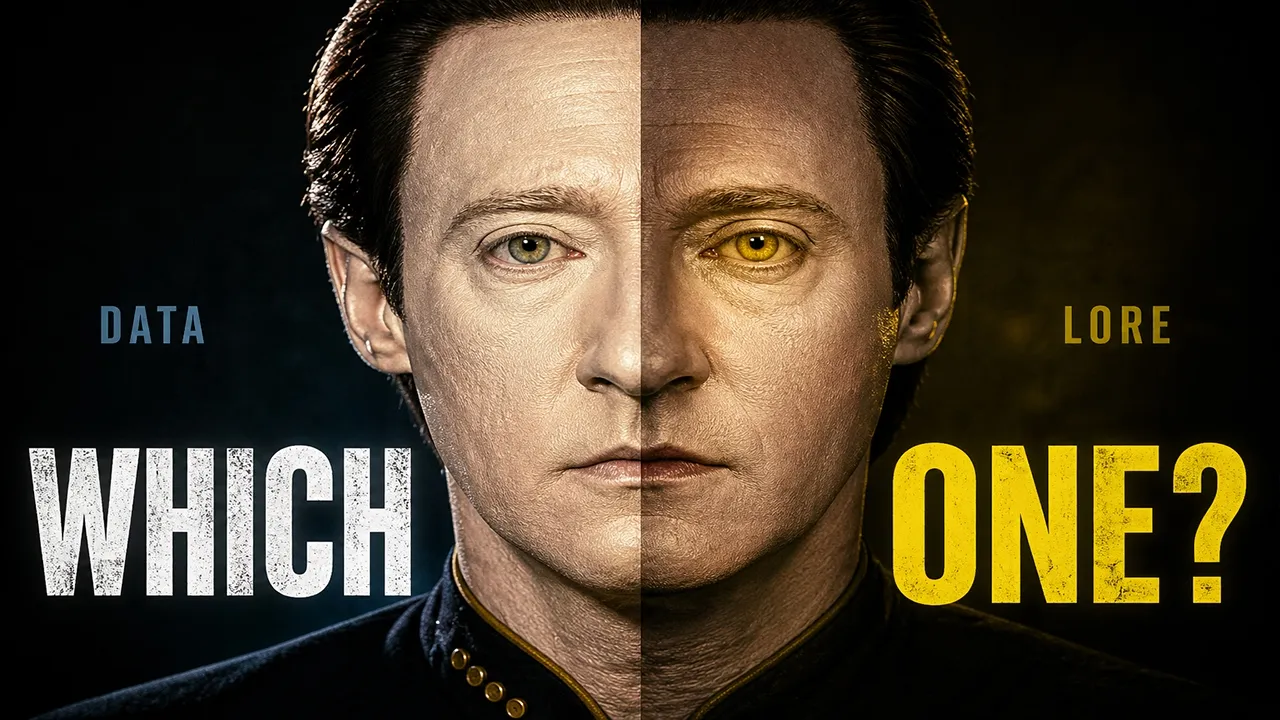
Adapted with AI from Lore Reloaded's video of 30 April 2026 and checked against the video before publication. Editorial standards · Corrections
More from @lorereloaded
All →


Make videos? Your next one could be an article here.
We turn your videos into articles under your name, linked back to the original. You keep 60% of what they earn, non-exclusive, and you can leave whenever you like.
Become a SubPlotter →