Star Trek Luna class: why did Starfleet build an explorer?
After the Borg and the Dominion War, Starfleet built the USS Titan's class not to win the next war but to venture beyond Federation borders again

The USS Titan looked nothing like the war-focused ships Starfleet had spent the previous decade building. When the Luna class entered service shortly after the Dominion War, Starfleet already had some of the most capable warships it had ever fielded. The Luna was a considered statement about the future: after the Federation survived the biggest war in its history, Starfleet chose to put exploration back at the center of its future.
The Defiant had proven itself against the Borg and the Dominion. The Akira had become a cornerstone of fleet operations. The Sovereign represented the Federation's principal heavy exploration ship. If Starfleet's only priority had been building a stronger ship, those classes already existed. Instead, it unveiled something entirely different.
Why building the Luna class after the Dominion War seems illogical at first
At first glance, the decision makes little sense. The Federation had just survived the largest war in its history. Whole fleets had been wiped out. Shipyards were racing to replace catastrophic losses, while the Borg, the Romulans, the Breen and countless unknown threats still posed real dangers. If there was ever a time to keep producing ships optimized for combat, that was it.
Even so, Starfleet Command chose to invest in a ship whose main purpose wasn't to dominate the battlefield. It built another exploration vessel. That doesn't mean the Luna ignored the lessons of the war. Quite the opposite. Armed with photon and quantum torpedoes, modern defensive systems and enough firepower to face serious threats, the Luna was no naive return to the excessive optimism of an earlier era.
It was designed by a Starfleet Command that fully understood how dangerous the galaxy was. But unlike the Defiant or the Akira, every major design decision pointed toward a different mission. This wasn't a ship built to win the next war. It was a ship built to venture beyond Federation borders and start asking questions again.
That's what makes the Luna class so compelling. Starfleet had always built explorers, but the Luna was the first major exploration ship designed after the Federation had fought a total war. It wasn't simply the continuation of an old tradition. It was a considered statement about the future. So the real question isn't why Starfleet built another explorer. It's why, after everything it endured, Starfleet believed exploration deserved to sit at the heart of its future once more.
How Wolf 359 and the Dominion War pushed exploration out of starship design
For almost a decade before the Luna class appeared, Starfleet was working on a completely different problem. Exploration never disappeared, but it stopped driving starship design. The Borg invasion at Wolf 359 shattered the belief that diplomacy and scientific capability alone were enough to keep the Federation safe.
Before Starfleet had fully absorbed that lesson, the Dominion emerged from the Gamma Quadrant, turning what had been a distant strategic concern into an existential threat. Suddenly the question facing Starfleet was no longer how to reach farthest into unexplored space. It was how to survive long enough to secure a future worth exploring.
The ships that followed reflected that reality. The Defiant sacrificed comfort, endurance and even traditional Starfleet aesthetics for pure combat effectiveness. The Akira combined heavy firepower with the ability to coordinate fleet operations. Even the Sovereign class, while still an explorer at heart, looked like a ship designed to fight battles.
This shift wasn't just about adding more weapons. It represented a fundamental change in priorities. During the Dominion War, success was measured by a ship's ability to reinforce the front, escort convoys, survive fleet engagements or respond quickly to emerging threats. Long-range science missions and multiyear exploration assignments became secondary concerns, because the Federation could no longer afford to assume the frontier would stay peaceful. Each new class reflected the pressures of a galaxy that had become faster, more dangerous and less predictable.
The Luna class redefined what a Starfleet explorer could be
What stands out about the Luna class isn't that it ignored those lessons. It's that Starfleet believed it could finally build something for a different purpose without forgetting them. Rather than returning to the assumptions that produced ships like the Galaxy class, Starfleet pursued a more ambitious goal: an exploration ship for a galaxy that had already shown it could turn hostile without warning.
The Luna wasn't meant to erase the Dominion War from Starfleet's thinking. It was meant to answer the question that came after it: what should the Federation build when survival is no longer its only priority? So the Luna class wasn't just Starfleet going back to exploration. It was an attempt to redefine what an exploration ship is. Earlier generations were often forced to choose between endurance and firepower, between scientific capability and tactical effectiveness. The Luna refused that choice, combining the lessons of the Dominion War with the Federation's oldest mission to produce a ship that could venture deep into unexplored space without relying on nearby fleets for protection.
If the Galaxy class represented Starfleet's confidence before Wolf 359, the Luna represents its confidence after everything that followed. That philosophy shows in the design. The Luna is smaller than the Galaxy class, which reduces the personnel and resources needed to run it during long deployments. Yet it's still large enough to carry an extensive science staff, laboratories and the equipment expected of a true deep space explorer.
Its exterior clearly says Starfleet, but there are subtle reminders that we're no longer in the peaceful era of the Enterprise-D. The prominent balance bar isn't just an aesthetic touch: it houses additional torpedo launchers, giving the ship offensive capability that was unusual for many explorers just a generation earlier. Quantum torpedoes sit alongside its conventional photon arsenal, so a ship sent beyond Federation space wouldn't find itself immediately outmatched if diplomacy failed.
Most importantly, the Luna wasn't built to fight wars. It was built to survive them if they came. That's a subtle difference, but a fundamental one. Starfleet already had ships better suited to leading fleet battles, attacking fortified positions or serving as tactical command ships. The Luna had to be able to make first contact, investigate spatial anomalies, support scientific missions and represent the Federation in regions where help might take weeks to arrive. In other words, it had to embody Starfleet's ideals without depending on its fleets.
That may be the Luna class's greatest achievement. It didn't ask Starfleet to choose between optimism and realism. It accepted the danger of the galaxy, then refused to let that danger dictate the Federation's future. Rather than allowing the Dominion War to permanently redefine the Starfleet ship, the Luna showed that exploration itself could evolve. The Federation wasn't returning to the past. It was carrying the lessons of war into a new era, proving a ship could be both explorer and survivor without compromising either mission.
Why Starfleet gave the USS Titan to William T. Riker
Designing the Luna class was only the first step. A new class of starship means little if Starfleet isn't willing to trust it with its most important missions. Throughout its history, the Federation has revealed its priorities not through speeches or technical manuals but through assignments. The ships chosen for the hardest explorations, the most sensitive diplomatic negotiations and the most significant first contacts have always reflected what Starfleet considered most important. If the Luna's real purpose was to lead a new era of exploration, Starfleet would eventually have to prove it.
That proof came in the person of William T. Riker. By the end of the Dominion War, Riker had become one of Starfleet's most capable officers. He spent years as Picard's first officer aboard the Enterprise, led fleets during the Dominion War and helped defeat Shinzon at the Battle of the Bassen Rift. Few commanders had more operational experience, and fewer still had greater standing.
If Starfleet had simply wanted to reward Riker, there were countless commands it could have offered him. Instead, it gave him the Titan. That decision says as much about the Luna class as it does about Riker. The Titan wasn't a veteran ship with a legendary history. It had no famous captain to live up to and no decades of achievements to lean on. Everything the class would become still lay ahead.
By assigning one of its most respected officers to command its newest generation of explorers, Starfleet Command was sending a clear message. It wasn't treating the Luna class as an experimental design or a specialist science vessel. It expected these ships to carry the Federation's ideals into the next century. Perhaps that's the clearest evidence of what the Luna class represented. Before the Titan earned its reputation, Starfleet Command had already decided it was worth believing in.
Why the Luna class deserves more credit than it gets
On paper, the Luna class doesn't look set to become one of Starfleet's defining ships. It never carried the name Enterprise, and it was never the Federation's flagship. It didn't introduce revolutionary propulsion or fight a war that shifted the balance of power in the Alpha Quadrant. Compared with ships like the Constitution, the Galaxy, the Defiant and the Sovereign, its history seems almost quiet.
But that's the point. The Luna class wasn't designed to symbolize an era. It was designed to open a new one. After years of conflict, Starfleet faced a hard choice: keep letting the Borg and the Dominion shape every future starship it built, or decide that those wars would become lessons rather than fixed principles. The Luna class marks the moment Starfleet chose the second path. It accepted that the galaxy had become more dangerous, folded those hard lessons into its design, and then did something remarkable: it went back to exploring the frontier.
That's why the Luna deserves far more appreciation than it usually gets. It wasn't just another explorer joining the fleet. It was proof that exploration had once again become Starfleet's highest ambition. Not because the dangers had gone away, but because the Federation believed the best response to them wasn't retreat, armament or isolation. It was to keep learning, discovering and building relationships with civilizations it had yet to meet.
In many ways, the Luna class represents the most mature version of Starfleet's philosophy. Earlier generations often assumed exploration would inevitably lead to peace, but the Dominion War showed that assumption could be dangerously optimistic. Rather than abandoning its ideals, Starfleet refined them. The Luna class acknowledged that exploration sometimes requires strength, that diplomacy sometimes depends on credible force, and that venturing into the unknown means accepting risks that can't always be negotiated away. Those weren't contradictions of Starfleet's mission. They were the price of carrying it out in a more complicated galaxy.
Perhaps that's the Luna class's greatest legacy. It reminds us that Starfleet's identity was never defined by the wars it fought, but by what it chose to do once those wars ended. When the battlefields fell quiet, the Federation looked beyond its borders again, built a ship designed to explore the unknown, and entrusted its future to exploration rather than fear. In that sense, the Luna class wasn't just Starfleet returning to exploration. It was Starfleet returning to itself.
What other creators are saying
More on Starfleet →From Tom Paris to Benjamin Sisko, these officers gave Starfleet good reason to take the uniform back, and some went right back to work
Star Trek officers who deserved to lose the uniform, ranked →
One card plays artifacts from the top of your library, and the other rewards facing a dilemma with free spells
Zefram Cochrane and the Caretaker among Magic: The Gathering Star Trek preview cards →
A Romulan War buildup, a Mirror Universe miniseries, the Borg Queen's origin and a refitted NX-01 were all part of the plans for a season that never got made
Tomorrow's Enterprise plays less like classic Kirk and Spock and more like Next Generation's All Good Things, and the people who made it are calling the future we saw continuity.
Strange New Worlds finale: the original series' lost ending →
Watch the original
@lorereloaded · YouTube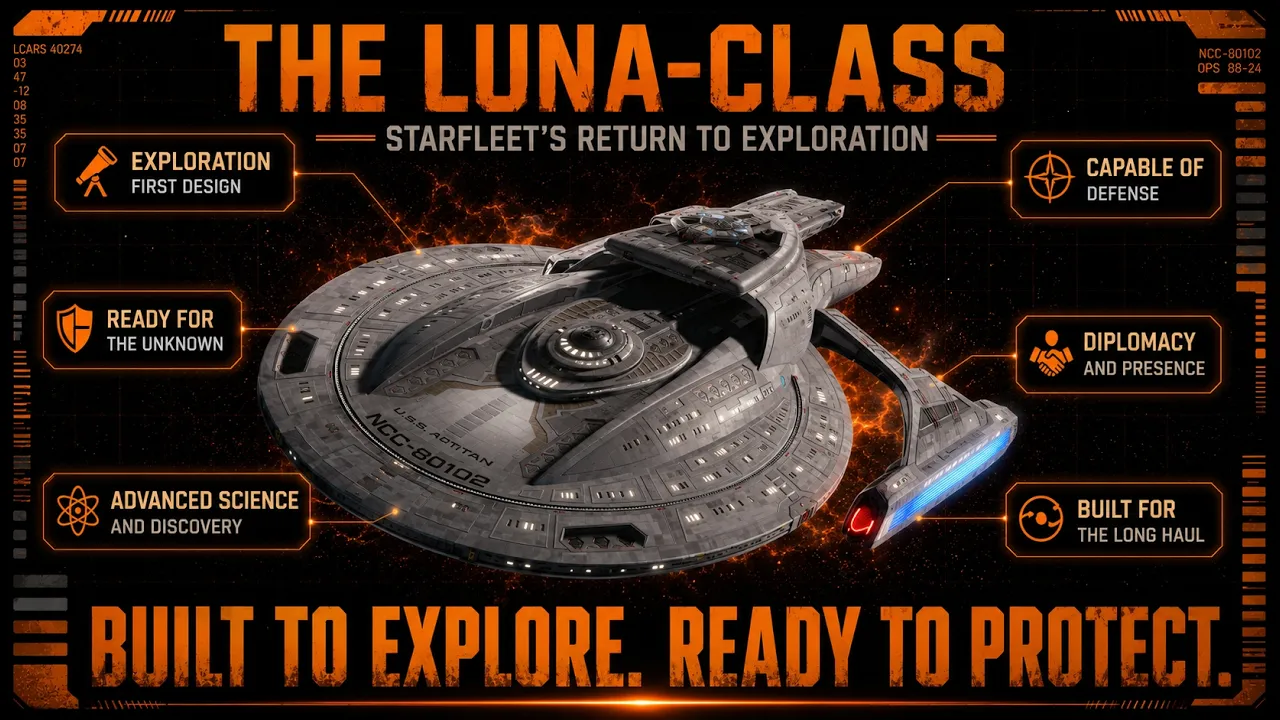
Adapted with AI from Lore Reloaded's video of 12 July 2026 and checked against the video before publication. Editorial standards · Corrections
More from @lorereloaded
All →


Make videos? Your next one could be an article here.
We turn your videos into articles under your name, linked back to the original. You keep 60% of what they earn, non-exclusive, and you can leave whenever you like.
Become a SubPlotter →