Star Trek Deadlock: what happened to the duplicate Voyager?
A security officer's view of the day Voyager was duplicated, and the version of the ship that never made it home

The most terrifying part of Deadlock isn't that Voyager was duplicated. It's that nobody aboard either ship knew which Voyager was supposed to survive. In Deadlock, the 1996 episode of Star Trek: Voyager starring Kate Mulgrew, it was a command crisis from the bridge and a technical disaster from engineering. But for the security officers running through smoke filled corridors, dragging wounded crewmen away from hull breaches and trying to keep the ship together, it was something much simpler. It was the day Voyager died.
The problem is that Voyager died twice. One version of the ship was slowly torn apart from the inside, while the other stayed intact until the Vidiians arrived. Somewhere in the middle of it all were two security officers. Both believed they were the original, both remembered waking up that morning and reporting for duty, and both believed they were standing aboard the real Voyager. Only one of them was going home.
Deadlock begins as an ordinary shift in the Delta Quadrant
This should have been an ordinary shift. The ship was moving through another stretch of the Delta Quadrant. Neelix was busy in the mess hall, with Samantha Wildman helping him troubleshoot equipment problems. Somewhere in engineering, Harry Kim was working through another maintenance issue. Most of the crew were more interested in the upcoming birth of Wildman's child than anything happening outside the hull. It wasn't a peaceful ship. It never was. But it was a normal day.
Then Voyager changed course, and most of the crew never knew why. They weren't on the bridge when long range sensors detected Vidiian activity ahead. They didn't hear the discussion about avoiding Vidiian space or using a plasma drift for cover. They only felt the ship alter course and continue on its way.
For a while, nothing happened. Then the deck shuddered and a few lights flickered overhead. The first report sounded routine: a power failure and a few injuries in engineering, the kind of problem Voyager dealt with every week. Then another report came in, and another. Engineering couldn't explain a growing antimatter loss, systems began dropping offline, and damage reports arrived faster than anyone could process them. Then the explosions started.
Security officers on the damaged Voyager chased emergencies all day
Picture yourself as one of the security personnel aboard Voyager while all of this is happening. Instead of walking patrol routes, you spend the day chasing emergencies from one deck to another. A damaged compartment here, injured crewmen there, engineering teams needing corridors cleared before another section loses power. Every time it feels like the situation might stabilize, another alarm sounds somewhere else.
The strangest part wasn't the damage. It was that nobody could explain where it was coming from. Engineering reported proton bursts, and the ship kept getting hit anyway. Hull breaches, structural failures and whole sections becoming unsafe to enter followed one after another. Emergency teams were sent into damaged Jefferies tubes, and repair crews disappeared into sections that looked one bad impact away from being exposed to space.
Then the reports became impossible. Harry Kim was dead. Kes had disappeared near a hull breach on deck 15, and nobody seemed to know where she had gone. Rumors spread faster than official reports. Some claimed there was a spatial anomaly, others blamed sensor failures, and most people were too busy with the latest emergency to care which explanation was correct. Parts of the ship had been abandoned, casualties continued to mount, and primary systems failed faster than they could be repaired. All the crew knew was that Voyager was losing.
The rumor that Captain Janeway had seen another Voyager
Nobody below decks knew what the bridge was planning, or whether a solution even existed. Then word spread that Captain Janeway had seen something impossible: another Voyager. At first it sounded like the kind of rumor that always appears during a crisis. The ship was damaged, exhausted and running on emergency power, and people see strange things during emergencies.
But this rumor refused to disappear. Another ship, another crew, another Voyager occupying the same point in space. No one knew what was real or what it meant. And somewhere aboard the second Voyager was another security officer who remembered the same childhood, the same academy training and the same morning shift. Neither of you knew it yet, but before the day was over, one of you would be dead.
On the intact Voyager, the crisis brought hope instead of casualties
The first sign that something was different aboard the other ship wasn't another explosion. It was the absence of one. If you had spent the day aboard the damaged Voyager, this ship would have felt almost unreal. The corridors were intact and the lights worked. Nobody was dragging wounded crewmen toward overflowing triage stations, no emergency teams were sealing hull breaches, and there were no reports of entire decks being evacuated. The crisis was still happening, but not in the same way.
While one Voyager was fighting to stay alive, this one was trying to understand what had happened. The first clue came from deck 15, where another Kes had appeared carrying memories that didn't belong there. A damaged piece of conduit was recovered from a section of Voyager that showed no signs of damage. Captain Janeway began connecting the pieces. Something had duplicated Voyager. It hadn't created a copy or moved the crew into another timeline. It had duplicated the ship, and the evidence said both ships were equally real.
News like that doesn't stay on the bridge for long. By the time most of the crew learned the official version, the story had already spread through half the ship: another Janeway, another Tuvok, another Harry Kim, another you. For a security officer, that was hard to process. The person aboard the other ship wasn't an alternate version of you from another lifetime. They had eaten the same breakfast, walked the same corridors and remembered the same academy instructors. A few hours earlier, you had been that person. Now you weren't.
The two Voyagers occupied the same space and shared the same antimatter supply, and the ships couldn't stay that way indefinitely. Still, this crew had something the other lacked: hope. The bridge had answers, engineering had theories, and the two crews established contact. The two Janeways compared notes, and engineers on both ships worked on a plan to merge the Voyagers back into a single vessel. It felt like the breakthrough everyone had been waiting for. Then it failed, pushing the ships even further apart and making the antimatter problem worse. Even so, nobody aboard this Voyager was talking about surrender. You might even have believed the worst was over. What nobody aboard either ship realized was that the anomaly was no longer the only threat in the sector.
The Vidiian boarding action on deck 5
A boarding action changes the way you think about a starship. A few hours earlier, Voyager had felt enormous, with dozens of decks and more corridors than most crewmen would walk in a week. Now the whole ship seemed to shrink. The Vidiians had forced their way in through deck 5. Nobody on your team knew how many had boarded, and the reports contradicted each other. One section claimed security was holding, another reported heavy casualties, and a third had stopped responding entirely. The only thing everyone agreed on was that the Vidiians were spreading.
The wounded appeared before the enemy did: a crewman with a burned shoulder supported by two friends, a medic rushing the other way with a field kit, a security officer carrying a phaser rifle that looked like it had been dropped down a turbolift shaft. Phaser fire echoed ahead. Someone shouted for reinforcements, and someone else shouted that the reinforcements were already dead. When you finally saw the Vidiians, what stood out wasn't how they looked. They moved through the ship like people carrying out a familiar job.
The pattern repeated itself throughout the ship. Security teams delayed the advance where they could, then withdrew to a position that mattered more. Engineering reports became harder to get, internal sensors became less reliable, and entire sections disappeared from tactical maps. Nobody announced that the ship was lost. The fighting simply changed. Earlier, security had been trying to stop the Vidiians. Now they were only trying to slow them down.
The self-destruct order and Voyager's final minutes
Then the rumor started that the captain might destroy the ship. Nobody paid much attention at first, since rumors had been circulating all day and most of them were wrong. Then it came back attached to an order: self-destruct. The corridor went quiet, not because people stopped moving, but because nobody expected to hear it. Somebody asked if the order was real, and it was confirmed. After that, there wasn't much else to say. The Vidiians were still aboard, the wounded still needed help, and the next defensive position still had to be reached. The work stayed the same. Only the outcome had changed.
At some point the comm traffic began to thin out, not because things were improving but because fewer people were left to report. A security officer spends years training for boarding actions, hull breaches, fires and explosive decompression, and the assumption behind every drill is simple: survive, complete the mission, report for duty tomorrow. This time there wasn't going to be a tomorrow. Oddly enough, that made things easier. There was one job left: keep the Vidiians busy long enough for somebody, somewhere, to survive this day. The deck shook violently, the lights flickered, and Voyager ceased to exist.
Harry Kim and the Wildman baby were proof the other Voyager was real
On the surviving ship, the first sign that something had changed was that the explosion never happened there. Then the conversations changed. For the first time since the crisis began, people weren't talking about hull breaches or casualty reports. They were talking about Harry Kim, who on this Voyager had died hours earlier near a breached bulkhead on deck 15. Now people were saying Harry was alive. One person claimed engineering had found him, another insisted he had come through the spatial anomaly, and someone else swore he was carrying Wildman's baby. That last part made the story sound impossible, but impossible had become a fairly common word aboard Voyager.
When you first saw him, he looked exactly like Harry Kim, with the same uniform, the same face and the same awkward expression he had whenever people paid attention to him. For a moment it almost felt like the day had fixed itself. Then you remembered that the Harry Kim who had served aboard your Voyager was still dead. This wasn't the man who had been pulled into space when the hull gave way. That Harry Kim never made it home.
Harry was proof that the other ship had been real, that real people had died there, and that survival had come at someone else's expense. The baby made that even harder to ignore. Crew members stopped to look at her whenever Wildman carried her through the ship, because everyone knew the story of how she had lived on one Voyager and not the other. Nobody talked about it openly. Voyager's crew rarely dwelled on impossible things once they were over. But every time you saw Harry Kim in a corridor, the thought returned: somewhere between the plasma drift and the self-destruct, reality had split in two, and if it happened to him, it probably happened to you.
The version of you that never made it back
Repairs got underway and the ship began to look like Voyager again. Not the Voyager that entered the plasma drift, and not even the one that existed the day before, but a Voyager, the only one left. People returned to their assignments, duty rosters were updated, and security patrols resumed. Life continued because it had to.
Every now and then, usually during the quieter shifts, a security officer's thoughts would drift back to the same question. It wasn't about what happened to Harry Kim. That was known. The question was what happened to the version of you that never made it back.
What other creators are saying
More on Star Trek: Voyager →A Ferengi heist plan, three reassimilated drones and the minds still stored in her implants
3 Star Trek Facts About Seven of Nine That Deserve More Attention →
One card plays artifacts from the top of your library, and the other rewards facing a dilemma with free spells
Zefram Cochrane and the Caretaker among Magic: The Gathering Star Trek preview cards →
A Romulan War buildup, a Mirror Universe miniseries, the Borg Queen's origin and a refitted NX-01 were all part of the plans for a season that never got made
Tomorrow's Enterprise plays less like classic Kirk and Spock and more like Next Generation's All Good Things, and the people who made it are calling the future we saw continuity.
Strange New Worlds finale: the original series' lost ending →
Watch the original
@lorereloaded · YouTube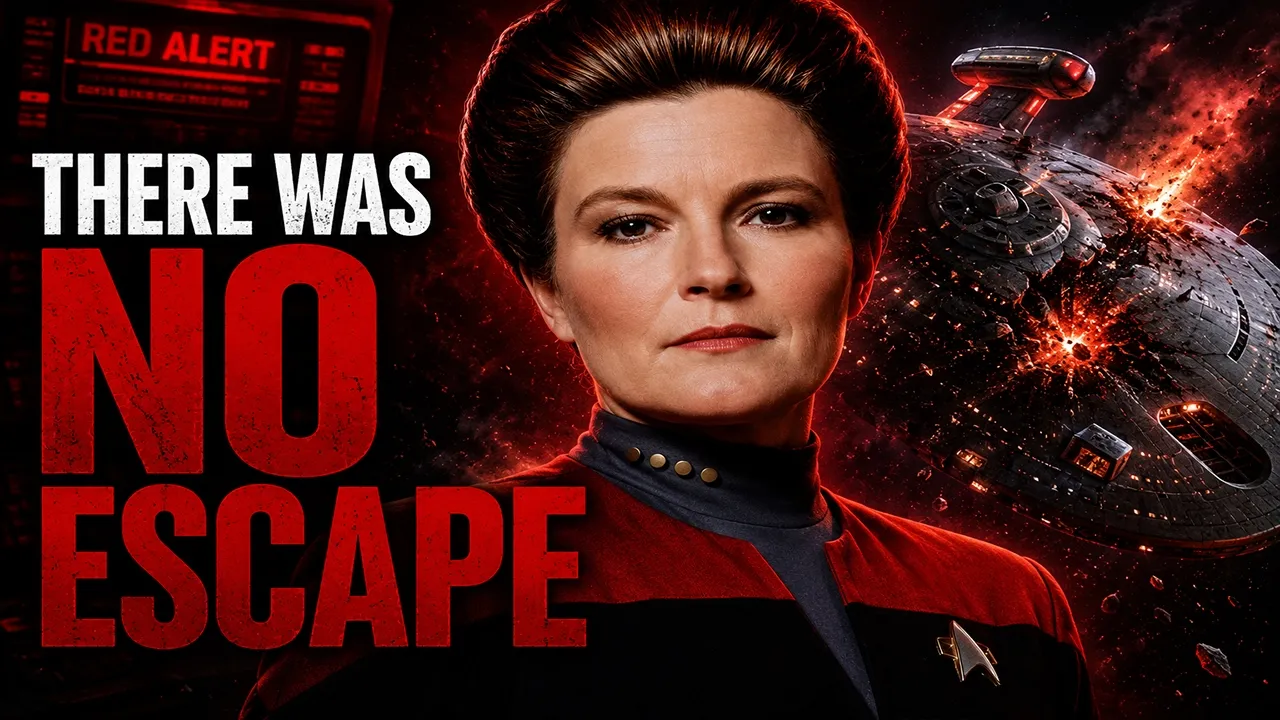
Adapted with AI from Lore Reloaded's video of 12 June 2026 and checked against the video before publication. Editorial standards · Corrections
More from @lorereloaded
All →


Make videos? Your next one could be an article here.
We turn your videos into articles under your name, linked back to the original. You keep 60% of what they earn, non-exclusive, and you can leave whenever you like.
Become a SubPlotter →