Dominion War: how did the Odyssey's loss start the conflict?
From the Odyssey's destruction to the fall and recapture of Deep Space Nine, the Dominion conquered through fear long before its fleets arrived
 Lore Reloaded (AI-assisted)28 November 2026Editor: Digital Fox Talent Editorial TeamOn YouTube since 2016 · more than 140,000 subscribers

The Dominion War almost broke the Federation, and it started without a single declaration. Before the first phaser was fired, there was only an anomaly at the edge of Bajoran space. It became a wormhole, a bridge between two quadrants, two philosophies and two wars waiting to happen. The Alpha Quadrant believed it had found a miracle. What it actually found was a mirror, and staring back was the Dominion.
This is the story at the heart of Star Trek: Deep Space Nine (1993), starring Avery Brooks, Nana Visitor and René Auberjonois. It's a war the Dominion fought as much with fear as with fleets.
The Bajoran wormhole and the Dominion's first warning
In 2369, Commander Benjamin Sisko and Lieutenant Jadzia Dax discovered the Bajoran wormhole, an artificial, stable passage to the distant Gamma Quadrant. For Bajor, it was the Celestial Temple, proof of divine presence. For Starfleet, it was the most important strategic location since the founding of the Federation. Neither saw the enemy waiting on the other side.
In 2370, the Bajoran people established New Bajor, one of the first colonies in the Gamma Quadrant. It was a hopeful gesture, a symbol of peace. Some time later, the Dominion destroyed it without warning. There were no survivors and no demands. Then a Jem'Hadar soldier beamed aboard Deep Space Nine without permission. He didn't negotiate; he threatened. No colonies and no ships would be allowed in the Gamma Quadrant. He also said Sisko and others had been captured and would be held as prisoners of war. When the crew tried to stop him, he simply left.
How the USS Odyssey was lost in retreat
Starfleet answered by sending the USS Odyssey, a Galaxy class vessel retrofitted for long range Gamma Quadrant operations, with enhanced deflectors, upgraded sensors and advanced tactical systems. It was meant as diplomacy with teeth. The Dominion saw it as a test, or possibly a nuisance. Three Jem'Hadar attack ships swarmed the Odyssey in orbit of a moon near Dominion space, and its recently recalibrated shields did nothing to stop the hits. The Jem'Hadar weren't fighting to win. They were fighting to prove a point.
The crew was able to save Sisko, and with everyone recovered, the Odyssey began to withdraw. Then a final, undamaged Jem'Hadar ship broke from the fight and rammed itself into the Odyssey in a suicide run. It wasn't lost in battle. It was lost in retreat, a deliberate, calculated execution. The Dominion didn't just reject diplomacy, at least in the way the Federation was used to. They weaponized finality.
Odo, the Founders and Starfleet's confused response
The Dominion revealed itself as an empire of engineered obedience: the Jem'Hadar bred to fight, the Vorta tailored to deceive, and the Founders, shapeshifting gods ruling from the shadows. They promised order and brought genocide, viewing the Alpha Quadrant's diversity not as richness but as rot. For Odo, a changeling raised outside the Great Link who had made himself a guardian of law and independence, the revelation was existential. Was he bound by biology or by choice?
Starfleet Command responded with urgency but not clarity. Some analysts dismissed the Jem'Hadar as raiders, and some early threat reports framed the Dominion as a regional alliance. One classified memo called the Odyssey's destruction an aberration of protocol. Most, though, saw the truth, Section 31 among them, which began cataloguing Dominion technology, infiltration methods and biogenic weapons.
The USS Defiant and the Enterprise E's covert strike
Starfleet's next move was a warship. The USS Defiant NX-74205 had been built to fight the Borg, but after the Odyssey it became a warning. Compact and stripped of comforts, armed with pulse phaser cannons, quantum torpedoes and a Romulan cloaking device, it was the most heavily armed vessel of its size Starfleet had ever fielded. Its mission was to cross the wormhole, assess the threat and, if necessary, respond with force. The Federation was still speaking of peace, but in some ways it was preparing for war.
Meanwhile, according to classified records later partially released, the USS Enterprise E carried out a covert strike on a Dominion outpost developing an artificial wormhole that would have bypassed Bajoran space entirely. Captain Picard's team, working without support or official sanction, infiltrated the facility and destroyed the core. The operation was unacknowledged, but its meaning was clear: the Dominion was preparing to bypass and invade.
Bajor, changelings and the Tal Shiar disaster
Only a few years free of Cardassian rule, Bajor was suddenly responsible for the one thing that might trigger a quadrant wide war. Bajor was initially willing to back the Federation but, with Sisko's encouragement, called for nonalignment. By the end of 2370, no formal declaration had been made, but the war had, in a way, already begun. Then a changeling replaced a member of Sisko's crew aboard the Defiant on a falsified mission, sabotaging systems and nearly igniting a war. Exposed, it declared: "No matter how far you run, no matter where you hide, we are already among you."
The Romulan Tal Shiar and the Cardassian Obsidian Order, convinced the Dominion could not be negotiated with, struck first. In 2371, their joint fleet attacked the Founders' homeworld. The Dominion had anticipated it: the world was evacuated, a trap was set and the fleet was destroyed. The Obsidian Order ceased to exist, the Tal Shiar retreated into political silence, and Cardassia was left exposed. The Founders won a war before it began.
Klingon invasion, Worf and a quadrant turning on itself
A new civilian government, the Detapa Council, rose on Cardassia. Gowron saw infiltration, declared Cardassia compromised by changelings and ordered an invasion, ignoring Federation objections and undoing the Khitomer Accords. Starfleet reassigned Worf to Deep Space Nine to advise on Klingon affairs, but he no longer fit anywhere: too Federation for Klingons, too Klingon for humans. He arrived as a bridge, and bridges often burn from both ends.
Blood screenings failed and no one knew whom to trust. One Section 31 strike team sent after a suspected changeling in an asteroid colony lost an operative and the target vanished, proving standard detection wouldn't work. Section 31 began developing biogenic scanning and quietly mapping dissidents, allies and admirals. Not every threat came in whispers, though: near Bajoran space, a Federation patrol's tactical officer manually rerouted plasma to the shields long enough to cripple a Dominion warship, and for the first time since the Odyssey, the Dominion blinked. In the Federation, captains with differing philosophies refused to share intelligence, and many outposts became silos. The Founders never raised a weapon.
The minefield and the fall of Deep Space Nine
Sisko and Weyoun exchanged pleasantries like diplomats, but under every word was a simple truth: war was inevitable. Sisko ordered the wormhole mined with self replicating mines to block Dominion reinforcements. Weyoun called it a provocation and issued an ultimatum on behalf of the Founders. Sisko refused, and hundreds of ships, Jem'Hadar strike wings, Cardassian Galor class cruisers and Vorta commanded dreadnoughts, approached in a pincer formation.
The Federation Alliance chose not to reinforce the station, hoping only to buy time for the minefield to be completed. Jem'Hadar fighters strafed the pylons while Cardassian ships degraded the defense matrix. As boarding parties prepared to transport, Sisko ordered an evacuation, and with help from Chief O'Brien and Rom, Kira sabotaged critical systems and erased sensitive intelligence. The minefield was deployed and the station was taken. It was a calculated loss, but still a loss.
The strike on Torros III
The Dominion believed Deep Space Nine was the prize. It was wrong. Under the shadow of the siege, a combined Starfleet and Klingon task force crossed the Cardassian border unnoticed to hit the Dominion shipyards at Torros III, which assembled new Jem'Hadar ships. The USS Centaur under Captain Charles Reynolds operated behind enemy lines, joined by a Klingon bird of prey, the Akira class USS Thunderchild and two Nebula class ships handling signal jamming.
Within 17 minutes, the shipyards were in flames and incomplete Dominion ships were destroyed before they could launch. Sisko told his crew: "Your sacrifices, our sacrifices, made that victory possible. But no victory can make this moment any easier." The capture of Deep Space Nine was the Dominion's first win, but Torros III was the Federation's first strike.
Guerrilla war and Sisko's choice over the Jem'Hadar
Starfleet abandoned traditional doctrine for pure asymmetry: raiding convoys, ambushing patrols and vanishing. Victory wasn't territory; it was slowing the enemy down. On a desolate world behind enemy lines, Sisko crash landed with part of his crew and met a stranded Jem'Hadar unit cut off from Ketracel White. Their Vorta, Keevan, offered to surrender if Sisko let the Jem'Hadar die in a frontal assault.
Sisko tried to talk them out of it and offered to help. They declined. With no other option, he gave the order, and every one of them was gunned down. Afterward Sisko barely spoke. They weren't evil, but the situation left no room for mercy. The Dominion was changing the people fighting the war.
Betazed, the Romulans and the home front
The Dominion then chose Betazed. Using a corridor through Romulan space, sanctioned in silence, over 120 Jem'Hadar attack ships and Cardassian warships arrived without warning while the Tenth Fleet was away on exercises. Dampeners neutralized Betazoid resistance, a resistance leader was executed six hours in, and within 10 hours the world was under Dominion control. Some believe the Romulans always intended to join the Federation but waited; others think they simply studied the battlefield. Either way, the Dominion couldn't have reached Betazed without Romulan corridors.
Ordinary citizens faced a quieter war. Outer colonies lost priority status, replicator restrictions and energy quotas meant rationed food, heat and medical care, and starbases became triage centers. Some local councils declared provisional autonomy, and on Earth, news broadcasts shifted to rolling casualty reports. Hope began to feel like a luxury.
Retaking Deep Space Nine
When the minefield was about to fall, Sisko led over 600 ships. His feint worked too well: Dukat baited the trap and the fleet was surrounded. Then Klingon ships under Martok dropped out of warp behind Dominion lines and the trap unraveled. The Defiant punched through alone but arrived too late to stop the mines being disabled. Whether Sisko meant to fight the fleet himself or speak to the Prophets is still unclear. As the Emissary, he pleaded for Bajor, and the Prophets removed the entire incoming Dominion fleet.
Bajoran and Starfleet teams retook the station corridor by corridor. It came at a cost: Dukat's daughter Ziyal, who had confessed to helping the Federation, was killed by Damar, and Dukat broke and was captured. Still, Quark reopened and laughter echoed through the station. It was proof the Dominion could be stopped.
Deception, loss and the turning point
Desperate to shift the balance, Sisko authorized Elim Garak to create a false holographic record implicating the Dominion in a plot to invade Romulan space. Within days, the Romulans joined the alliance. A man had been assassinated and a war escalated under false pretenses, and Sisko told himself, "I can live with it." Then Dukat, corrupted by the Pah Wraiths, attacked the Bajoran temple. Jadzia Dax was killed, the wormhole collapsed and the Prophets fell silent. Kira, though she could no longer hear them, believed they were still listening.
The Dominion fortified around Ketracel White facilities, and specialized Starfleet teams struck at them. Veteran officers died faster than they could be replaced, and when the USS Valiant's senior officers were killed, the cadets of Red Squad launched a suicide run on a Dominion battleship. Very few survived. Then Sisko, guided by visions, learned his mother Sarah had been chosen by the Prophets and reopened the wormhole. The Dominion was overextended. Scouts reported thin lines, Jem'Hadar patrols were inconsistent, and morale appeared brittle. The Alliance saw its opening.
What other creators are saying
More on Deep Space Nine →An eight episode limited series pitch reopens the station, splits the Dominion into civil war, and lets Jake Sisko search the wormhole for the father he lost.
A Romulan War buildup, a Mirror Universe miniseries, the Borg Queen's origin and a refitted NX-01 were all part of the plans for a season that never got made
Tomorrow's Enterprise plays less like classic Kirk and Spock and more like Next Generation's All Good Things, and the people who made it are calling the future we saw continuity.
Strange New Worlds finale: did it give TOS the ending it lacked? →
Watch the original
@lorereloaded · YouTube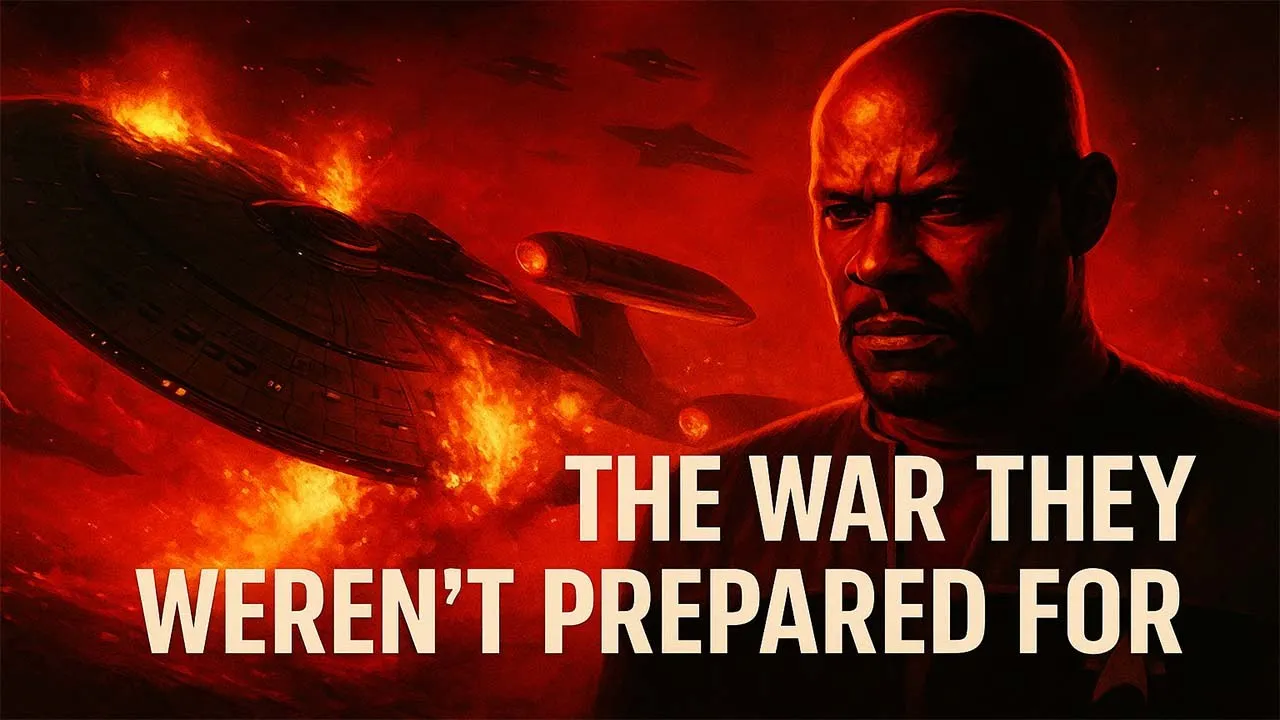
Adapted with AI from Lore Reloaded's video of 21 May 2025 and checked against the video before publication. Editorial standards · Corrections
More from @lorereloaded
All →


Make videos? Your next one could be an article here.
We turn your videos into articles under your name, linked back to the original. You keep 60% of what they earn, non-exclusive, and you can leave whenever you like.
Become a SubPlotter →