Star Trek's Dominion: why was its war machine built on control?
From Changeling infiltrators to cloned Vorta and Jem'Hadar bred for obedience, the Founders' military doctrine was designed to dominate, not just to fight
 Lore Reloaded (AI-assisted)25 November 2026Editor: Digital Fox Talent Editorial TeamOn YouTube since 2016 · more than 140,000 subscribers

The Dominion was a galactic superpower engineered from the ground up with one mission: impose order. Its military doctrine rested on espionage, obedience and absolute loyalty, and it nearly brought the Alpha and Beta Quadrants of the Star Trek universe to their knees.
Created by the shape shifting Founders and enforced through the genetically modified Vorta and Jem'Hadar, the Dominion is a military machine designed not just to fight, but to dominate. This isn't only about fleets and firepower. It's about ideology.
The Founders' doctrine starts from one belief: what cannot be controlled is a threat
Dominion strategy begins and ends with that single belief. The Founders, the immortal shape shifters who lead the Dominion, built their doctrine around a deep rooted paranoia. After centuries of persecution by solids, they concluded that safety could only be achieved through absolute control. Their military doctrine isn't reactive. It's preventative, it's preemptive, and in the end, it's total.
They don't conquer with brute force alone. Their strength lies in patience. The Founders can afford to think in decades or centuries, which makes the Dominion one of the few galactic powers that employs truly long term strategic planning. When the Bajoran wormhole was discovered, connecting the Alpha and Gamma Quadrants, the Dominion didn't immediately invade. It watched, studied and manipulated events behind the scenes, sending in scouts, infiltrators and diplomats. By the time the major Alpha Quadrant powers realized what was happening, the Dominion had already mapped out the chessboard. This isn't opportunism. It's doctrine.
The Dominion has no concept of limited war
The Dominion believes that war, if it must be fought, must be fought to the end. There is no partial victory and no stalemate. The only acceptable outcome is complete domination or the utter destruction of the enemy, because an enemy that survives, even in defeat, might one day rise again. That's not a risk the Founders are willing to take.
In this philosophy, diplomacy is a weapon, and so is espionage. The Dominion doesn't fight until it knows exactly how to win, and even then it prefers its enemy too divided, too weakened or too afraid to fight back effectively. If you've been offered a treaty by a Vorta emissary, you're probably already on their list of conquered worlds. You just don't know it yet.
When war does come, it's swift, methodical and ultimately overwhelming. The Dominion doesn't posture and doesn't bluff. Once the Founders commit, they will sacrifice ships, armies and entire worlds to win, because the end always justifies the means when the end is survival. This is not a doctrine of deterrence. It's a doctrine of inevitability, one that seeks permanence and finality, and that always begins with control.
Subversion opened the Dominion War, from General Martok to Bajor
Dominion doctrine doesn't open with fleets. It opens with fractures: cracks in alliances, uncertainty in leadership, fear among the populace. The Dominion War is the clearest case study, but it represents only one expression of a strategy used across the whole empire. The most effective opening gambit was infiltration. A Changeling replaced General Martok, a trusted Klingon military leader, and sowed discord between the Klingon Empire and the Cardassian Union. The result was a war that devastated both sides and weakened them for what came next.
The Dominion also used diplomacy like a scalpel. Vorta emissaries arrived with smiles, treaties and promises: non aggression pacts, trade agreements, offers of protection. Behind every offer was an agenda to isolate. Key powers such as the Romulans and Tholians were peeled away or neutralized, through manipulation or by being convinced to stand aside. While Starfleet debated its ethics, the Dominion persuaded Bajor to sign a non aggression pact, keeping it neutral and removing a strategic staging ground from Federation use. It offered aid to the embattled Cardassians, who, desperate and proud, ultimately accepted a full alliance. Within days Cardassia became a Dominion client state, giving the Founders their first permanent foothold in the Alpha and Beta Quadrants.
This was warfare by other means. The Founders knew the Alpha and Beta Quadrant powers depended on mutual trust, so they shattered it, letting suspicion take root and fear spread as centuries old alliances cracked. The Federation and the Klingons nearly turned on each other, and the Romulans stood by, calculating. These same methods had been honed in the Gamma Quadrant for centuries, so what happened to the Alpha Quadrant was business as usual. In Dominion doctrine, subversion isn't preparation for war. It's the war itself.
The USS Odyssey showed the Dominion's shock and awe combat doctrine
When the Dominion resorts to force, it doesn't ease into battle. It erupts. Its combat doctrine is defined by overwhelming strength, psychological shock and disregard for conventional military expectations, with the aim of dominating swiftly, breaking morale and demonstrating the futility of resistance. The earliest example the Alpha and Beta Quadrants saw was one of the most brutal. Three Jem'Hadar attack ships confronted the USS Odyssey, a top of the line Galaxy class starship. They studied it and found ways to disable it, and when they weren't going to win conventionally, one of the fighters made a suicide run, ramming the Odyssey at full speed and killing everyone aboard. It was a strategic message: the Dominion's opening handshake.
Their ships were fast, small and highly maneuverable. What they lacked in shielding they made up for in numbers and tactics, with squadrons moving in coordinated formations, striking like precision guided knives rather than battering rams. They also had technological advantages. Polaron beams initially rendered Federation shields ineffective. Long range transporters could move personnel over interstellar distances, making traditional defensive lines meaningless. And perhaps most terrifyingly, Jem'Hadar soldiers could cloak themselves with a personal shroud, so entire outposts were wiped out by soldiers who were never seen until it was too late.
The Dominion did not fight fair, and that was the point. Its doctrine has no room for glory, honor, minimizing casualties or proportional responses. The message is clarity: you're outmatched, outmaneuvered, and can be outlasted. Capitulate or die. The Jem'Hadar, bred for obedience and reinforced through chemical dependency, fought with suicidal precision, and if one wave died breaching a line, another was right behind it. The Dominion believed that if it could crush your spirit in the first hour, it wouldn't need to fight for years.
When those early advantages were countered, as Federation engineers adapted to polaron beams and defenses improved, the Dominion adapted too, bringing in new allies like the Breen and deploying devastating energy dampening weapons. None of this was unique to the Dominion War. The Dominion had a template: diplomacy first, then surprise, overwhelming force and subjugation. It worked in the Gamma Quadrant, and it nearly worked again. For the Dominion, shock and awe isn't a phase of combat. It is combat.
Attrition, not battlefield glory, was how the Dominion planned to win
If shock and awe is how the Dominion begins a war, attrition is how it plans to win. Its machine is built around expendability. Jem'Hadar are grown, not born. They mature in days, need no sleep and no sustenance beyond the drug ketracel white, and exist to fight and die for the Founders. They aren't rotated for rest, they don't suffer morale collapse, and the Dominion doesn't run out of them. The same goes for the Vorta: when one dies, another is cloned and memories are transferred. The Dominion doesn't promote individuals. It manufactures roles, so it can absorb massive losses without destabilizing its command. It doesn't just endure losses. It expects them.
Dominion facilities can mass build both starships and soldiers. Starfleet needs time, training and resources to bring new crews online; the Dominion simply activates another batch. Every skirmish becomes a trade off: can you afford to lose more than they can? The answer is usually no. When early incursions were blunted, the Dominion pressed harder. When the Federation took losses, it had to retrain crews and rebuild the ships that were destroyed, while Dominion losses meant growing more Jem'Hadar. Why negotiate a ceasefire when you can bleed your enemy dry?
Even its allies served that logic. The Breen added technology and the Cardassians offered infrastructure and territory, but they were assets to fuel the war engine. When the Cardassians rebelled, the response was mass civilian executions, scorched earth policies and genocidal bombardments, meant to demonstrate the cost of resistance. To the Dominion, life is a resource, and it had more of it than anyone else.
Changeling infiltration let the Dominion fight before a single shot
Before the Jem'Hadar ever fire, the Dominion is already fighting and often already winning. Changeling operatives are the crown jewel of this strategy, able to infiltrate any organization, mimic any individual and bypass virtually every form of security. They learned to fake blood tests, and background checks are irrelevant. The enemy keeps asking who it can trust, and in Dominion doctrine the answer is no one. Beyond the Martok deception, another Changeling infiltrated Starfleet Command itself, nearly triggering martial law on Earth.
The fear of infiltration alone was often enough to destabilize governments. One operative taunted that there were four of them, but it didn't matter: maybe there were 40, maybe 4,000. It was about perception. The Vorta played their part too, posing as diplomats, scientists, administrators, traders and delegates while gathering intelligence. Vorta like Eris inserted themselves into Federation crews to probe tactical capabilities. The Dominion planted false intelligence, orchestrated diplomatic crises and replaced individuals mid assignment, as with Dr. Bashir on Deep Space 9, whose double nearly triggered the destruction of an entire fleet through sabotage. By the time open conflict begins, allies distrust each other, threats are misidentified and decisions rest on lies planted months earlier. That's how the Dominion wins without fighting, or better yet, makes you fight yourself.
The Jem'Hadar are engineered weapons, kept loyal by ketracel white
The Jem'Hadar aren't soldiers. They're weapons engineered for absolute obedience. They don't eat, don't sleep, don't ask questions and don't live long. They emerge from birthing chambers combat ready and chemically leashed to the system that made them. Ketracel white isn't just a drug; it's a control mechanism. Their biology depends on it, and only Vorta officers may dispense it, so disobedience isn't just treason, it's suicide. On the battlefield they are shock troops who can shroud themselves at will, leaving Starfleet officers to face ambushes and infiltration, and I don't even have to mention the flanking maneuvers. Their mantra is simple: "Victory is life."
What makes them effective also shows how deeply broken they are. They have no families, no ambitions, no past and no future. Their loyalty is engineered, and when they fail they're discarded. Some episodes hint at what happens when that programming fractures, with rare Jem'Hadar questioning orders or defining honor for themselves, but these are exceptions the system deals with quickly. Control through design, loyalty through addiction, obedience through fear: in the Dominion's eyes that isn't a tragedy. It's efficiency.
The Vorta are the Dominion's voice, and Weyoun shows they are replaceable
If the Jem'Hadar are the Dominion's fists, the Vorta are its voice: genetically engineered administrators, diplomats and field commanders who speak with courtesy, negotiate with smiles and carry out orders with unquestioning devotion, even when those orders involve executions or their own deaths. Their loyalty is biological. They are programmed to revere the Founders as gods, with no hesitation and no moral calculus. They control the Jem'Hadar through a monopoly on ketracel white, a fragile but absolute chain: the gods speak to the Vorta, the Vorta hold the vial, the Jem'Hadar obey.
A single Vorta might oversee a planetary occupation, command a fleet or lead a negotiation, and when they die, they're replaced by a clone. Vorta like Weyoun are mass produced, each iteration slightly adjusted, with memory continuity preserved and mistakes deleted. They aren't encouraged to innovate, and even their personalities are tuned for compliance, with dulled curiosity and narrow emotional bandwidth. They're not tyrants or zealots. They're tools: polite, rational, and hollowed out by design.
The Founders rule through absence and see the Dominion as a firewall
At the apex sit the Founders, shape shifters, strategists and self proclaimed gods who whisper from the shadows and rule through fear and awe. Their rarity is a tactic. Most Jem'Hadar will die without meeting a Founder, and most Vorta will interact with only one. But when they act, one infiltrator can destabilize governments and one directive can mobilize fleets or initiate genocidal retaliation. Their perspective is existential. They fear chaos and seek order, and to them the Dominion is a firewall against a universe of unpredictable solids, built to make the galaxy safe for the Great Link.
The Founders don't need loyalty, because they designed it: Vorta devotion is genetic and Jem'Hadar discipline is chemical. What makes them terrifying is their clarity. They don't believe they're evil. They believe they're inevitable, and if control costs lives, freedom or whole civilizations, so be it. Better the galaxy fear them than threaten them. They are architects of obedience, and the Dominion is their blueprint.
Why the Dominion's doctrine worked
The Dominion's doctrine isn't innovative in a tactical sense. It's about structure: a chain of command that cannot break because it was never designed to bend. Founders command, Vorta execute, Jem'Hadar enforce, and those who refuse to submit are made an example of. The Dominion War wasn't a special case. The same strategies had already subdued half the Gamma Quadrant: divide, undermine, strike, grind down, rule.
What makes the Dominion so compelling and terrifying is that its tactics work, because its society rests on one chilling truth: if everything is under control, nothing can hurt you. To the Founders, that's safety. To everyone else, it's the nightmare of peace imposed at phaser point. The Dominion ends questions, choices and chaos, and in their place it offers one thing: order.
What other creators are saying
More on Deep Space Nine →An eight episode limited series pitch reopens the station, splits the Dominion into civil war, and lets Jake Sisko search the wormhole for the father he lost.
A Romulan War buildup, a Mirror Universe miniseries, the Borg Queen's origin and a refitted NX-01 were all part of the plans for a season that never got made
Tomorrow's Enterprise plays less like classic Kirk and Spock and more like Next Generation's All Good Things, and the people who made it are calling the future we saw continuity.
Strange New Worlds finale: did it give TOS the ending it lacked? →
Watch the original
@lorereloaded · YouTube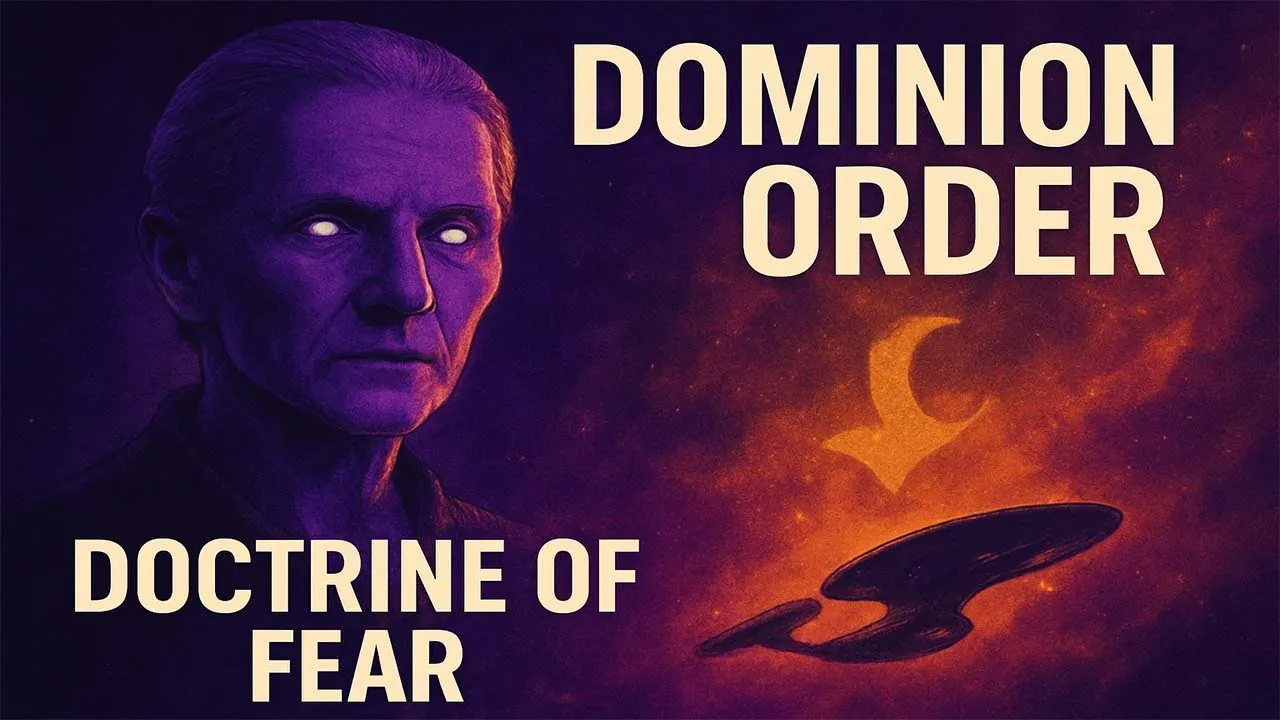
Adapted with AI from Lore Reloaded's video of 11 October 2025 and checked against the video before publication. Editorial standards · Corrections
More from @lorereloaded
All →


Make videos? Your next one could be an article here.
We turn your videos into articles under your name, linked back to the original. You keep 60% of what they earn, non-exclusive, and you can leave whenever you like.
Become a SubPlotter →