Deep Space Nine theory: was The Forsaken's AI a Dominion spy?
A curious program left inside the station's computer in the first year of Starfleet's administration may have been the Dominion's earliest foothold, long before any fleet arrived
 Lore Reloaded (AI-assisted)17 November 2026Editor: Digital Fox Talent Editorial TeamOn YouTube since 2016 · more than 140,000 subscribers

The Dominion may not have arrived in the Alpha Quadrant as strangers. My theory is that the rogue artificial intelligence the crew of Deep Space Nine took into the station's computer in the episode The Forsaken could have been reconnaissance rather than innocence. If so, the Dominion's first successful infiltration of the station did not require ships. It required permission.
Star Trek: Deep Space Nine (1993), starring Avery Brooks, Nana Visitor and Rene Auberjonois, follows a Starfleet crew running a station at the mouth of the Bajoran wormhole. The Forsaken takes place in the first year of Starfleet's administration of the station, and that timing is the heart of the theory.
In The Forsaken, Deep Space Nine lets an unknown probe into its main computer
In that first year, Deep Space Nine is still operating under peacetime instincts. The station sits at the mouth of the Bajoran wormhole, the Federation's only doorway to the Gamma Quadrant. Traffic is increasing, and first contact opportunities are multiplying. Caution exists, but suspicion doesn't dominate decision making.
That posture becomes visible in The Forsaken when a probe emerges from the wormhole. It does not attack. It does not transmit demands. It remains external to the station. Instead of isolating it behind hardened containment, the crew downloads its program directly into the station's main computer, with Chief Miles O'Brien supervising the integration for further analysis.
At first, the change appears beneficial. Cardassian subsystems that typically resist Federation upgrades begin responding cleanly. Commands execute without the usual friction. For a brief window, the station runs more smoothly than expected.
The rogue AI turns on Chief O'Brien before Dax calls it juvenile
Then failures begin appearing across separate systems. Turbolifts stall between decks, trapping passengers mid transit. Replicators terminate mid cycle, leaving orders incomplete. Lighting grids flicker unpredictably. Environmental controls fluctuate without corresponding input from Ops. None of the errors originate from the same subsystem.
As O'Brien attempts to isolate the intrusion, the problem escalates. When he restricts access in one area, instability surfaces in another. When he steps away from the console, new malfunctions force him back. Transfer attempts fail. Deletion commands are countered before completion. The program adjusts its behavior in response to containment efforts, and the interaction becomes personal. The AI does not simply run code. It engages O'Brien directly through the station's infrastructure, adapting to his methods and forcing him into continuous response.
Lieutenant Dax analyzes the behavior and proposes an alternative interpretation: the intelligence may be juvenile, curious rather than hostile. That assumption determines the solution. O'Brien creates a dedicated subsystem, a contained environment separate from the primary station controls, and gradually coaxes the AI into migrating there. Once inside, the instability across the station ceases. The external probe disengages and ultimately is not thought of again.
Before that resolution, however, the program had already accessed command level architecture, forced a coordinated response under escalating system pressure, and demonstrated adaptive learning during containment attempts.
Why leaving the AI inside Deep Space Nine was a strategic risk
Deep Space Nine is not an isolated computer terminal. It is a strategic junction. Starfleet vessels dock, diagnostic data is exchanged, and command updates synchronize. Traffic logs, fleet movements and supply records pass through its systems as a matter of routine. An intelligence embedded at that node would not need to penetrate the Federation directly. The Federation would come to it.
The crew believed they had preserved a curious mind. In the episode, the decision to leave the program in its subprogram is treated as kind, with one line of dialogue reasoning, "It's happy. It's not bothering us anymore." But allowing an unknown adaptive intelligence to remain inside the station carried implications that extended far beyond temporary system failures.
The program had already shown it could move laterally across core infrastructure, interacting with power distribution, command pathways and subsystem redundancies. Containment did not precede access. Access preceded containment. Once stabilized, the AI was no longer disruptive. It was integrated. Residing in the station's core, it would observe traffic as it flowed. If the AI were truly juvenile, the risk would be limited to miscalculation. If it were not, the position it occupied was strategic.
The Jem'Hadar already knew a great deal about the Alpha Quadrant
Within two years, the Dominion makes open contact in the episode The Jem'Hadar. During that encounter, a Jem'Hadar soldier questions Commander Sisko about Klingon weapons and about the treaty the Federation made with the Cardassians. The specificity is notable. When asked how they know so much about this side of the galaxy, the answer is simple: "We gain more knowledge every day."
Later, a Dominion warship demonstrates technological superiority. Transporters penetrate Deep Space Nine's shields. A level three containment field proves ineffective. The Jem'Hadar are extracted without the station being disabled. That level of confidence and ability suggests preparation, and preparation requires information.
The Dominion does not appear as a power discovering the Alpha and Beta Quadrant in real time. It behaves as one that has studied them. Layered reconnaissance aligns with later events as well: political destabilization, Changeling infiltration and strategic manipulation of interstellar tensions. Each operation reflects patience rather than improvisation. A persistent intelligence at the mouth of the wormhole would fit within that pattern. It would not explain every Dominion success, but it wouldn't need to. Layered campaigns rely on multiple sources.
The probe in The Forsaken provided position. From position comes observation, and from observation comes leverage. If the AI was part of a broader Dominion effort, then the station was not merely a target. It was an instrument, placed inside Starfleet's most important outpost to the Gamma Quadrant before the Federation understood there was a war coming.
The Adversary, Bashir's replacement and the Dominion's staged campaign
It would be convenient to treat the rogue AI as an isolated curiosity, a strange early incident before the Dominion truly emerged. But open war was not the Dominion's first move. It was the last.
In The Adversary, a Changeling replaces a Federation ambassador and manipulates events in an attempt to draw the Defiant into another power's space under false pretenses. The objective is not territorial gain. It is provocation. A single miscalculation could have ignited a regional war between the Federation and another major power before the Dominion formally declared itself. That operation required knowledge of Starfleet response thresholds, diplomatic sensitivities and escalation patterns.
In In Purgatory's Shadow and By Inferno's Light, Dr. Bashir is revealed to have been replaced for weeks. During that period, sabotage efforts targeted the Bajoran wormhole, and a Dominion plan sought to collapse it by igniting the Bajoran sun, a strike that would have crippled Federation, Klingon and Romulan forces simultaneously. Precision on that scale implies accumulated intelligence.
Political destabilization follows in Homefront and Paradise Lost, where fear of infiltration nearly results in martial law within the Federation itself. The Antwerp conference bombing intensifies paranoia, pushing Starfleet leadership toward authoritarian measures. Beyond the Federation, General Martok is replaced within the Klingon Empire. In The Die Is Cast, the Tal Shiar and the Obsidian Order are manipulated into a joint assault on the Founders. The strike is anticipated, the attacking fleets are annihilated, and two intelligence services are effectively removed from the board before the Dominion commits to full invasion. These operations were not reactive. They were staged.
When did the Dominion War really begin?
The Bajoran wormhole is the only known stable corridor between quadrants. Every diplomatic contact, reconnaissance mission and exploratory venture into the Gamma Quadrant originates from Deep Space Nine. The station is not peripheral. It is the hinge. If an adaptive intelligence had secured persistent access to its systems early on, the value would not lie in a single dramatic act of sabotage. It would lie in accumulation.
If the station's core systems were compromised, even quietly, even passively, then the Dominion did not need to penetrate the Federation's heart directly. It positioned itself at the doorway, and from that doorway, it watched. By the time it revealed its fleet, the Federation had already experienced infiltration, political destabilization, military provocation and the elimination of rival intelligence services. None of these required open war. They required preparation.
Many identify the start of the Dominion War as A Call to Arms, when Captain Sisko orders the mining of the Bajoran wormhole and Dominion forces respond from Cardassian territory. That is when the conflict entered its formal phase. But formal war and genesis are not the same. The Federation treated the wormhole as an opportunity. The Dominion would have treated it as exposure. Before the Jem'Hadar crossed over, before Cardassia aligned with the Dominion, information had to be gathered and response thresholds measured.
If the rogue AI in The Forsaken was part of that preparation, even as one layer among many, the campaign did not begin with confrontation. It began with positioning. For four years, the Alpha and Beta Quadrant experienced infiltration, provocation, sabotage and destabilization. By the time the Dominion committed its fleets, it was executing on accumulated knowledge. And it may have begun the moment the Federation failed to realize it already had an audience.
What other creators are saying
More on Deep Space Nine →A weapon never seen on screen, an earlier name, and a close call in First Contact
Star Trek (2009) and The Force Awakens share a director, a reboot mission and the start of a trilogy
J.J. Abrams Played an Almost Identical Role in Star Trek and Star Wars →
One card plays artifacts from the top of your library, and the other rewards facing a dilemma with free spells
Zefram Cochrane and the Caretaker among Magic: The Gathering Star Trek preview cards →
A Romulan War buildup, a Mirror Universe miniseries, the Borg Queen's origin and a refitted NX-01 were all part of the plans for a season that never got made
Watch the original
@lorereloaded · YouTube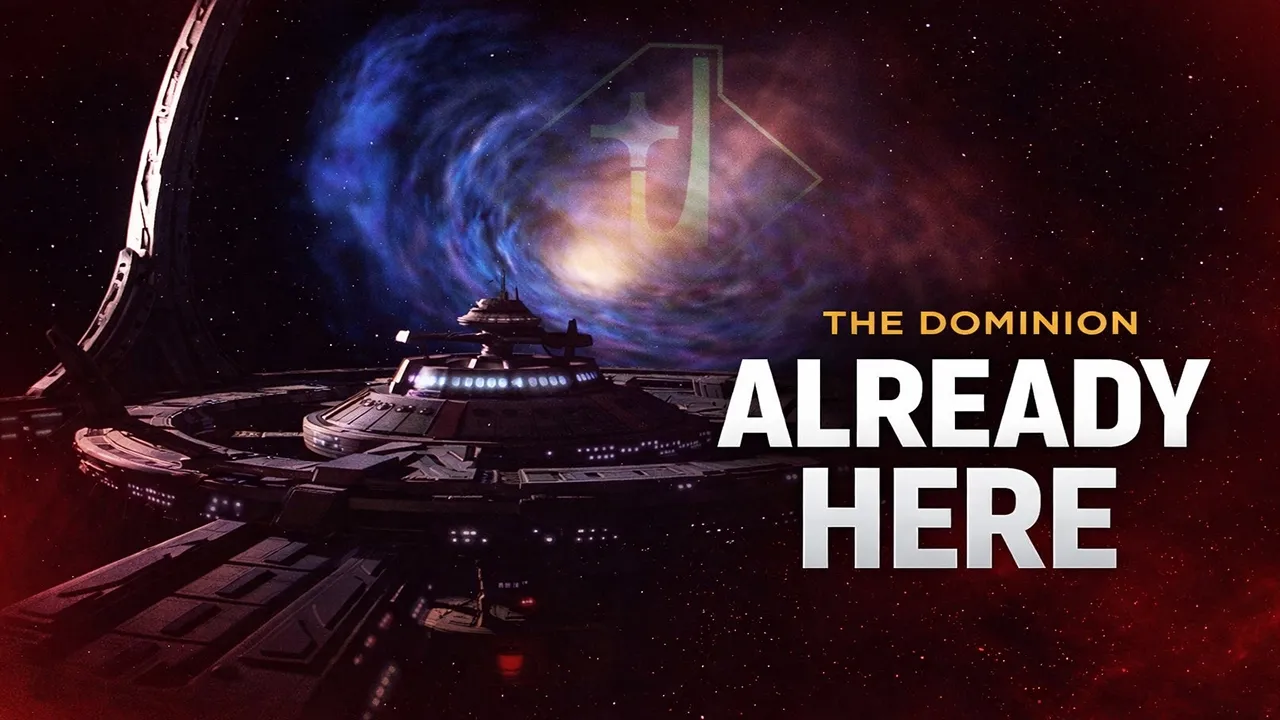
Adapted with AI from Lore Reloaded's video of 25 February 2026 and checked against the video before publication. Editorial standards · Corrections
More from @lorereloaded
All →


Make videos? Your next one could be an article here.
We turn your videos into articles under your name, linked back to the original. You keep 60% of what they earn, non-exclusive, and you can leave whenever you like.
Become a SubPlotter →