Star Trek Oberth class: was the ship built to be expendable?
The small Star Trek science vessel earned a reputation for bad luck, but its record of disaster says more about the missions Starfleet gave it than about its design

The Oberth class has earned a very bad reputation in Starfleet, and at first glance it's easy to see why. Unlike ships such as the Constitution, the Galaxy and even the Miranda, the Oberth rarely appears in Starfleet's finest moments. Its history is tied to disaster instead. My argument is that the class was never badly designed. It was a science ship that Starfleet was willing to risk again and again, and that is what made it expendable.
The Oberth class's Star Trek reputation is built on disaster
The USS Grissom was destroyed while carrying out scientific surveys around the Genesis planet. Other ships of the same class turn up repeatedly in catastrophic situations. Whether they are investigating dangerous phenomena, responding to emergencies or operating near unstable regions, the Oberth can seem cursed.
Its appearance reinforces that impression. The class lacks the imposing look of cruisers or exploration ships. It looks small, lightly built and fragile. The narrow support struts connecting its sections make it look weak in a way that is rare in Starfleet designs. Standing beside Excelsior or Ambassador class ships, it doesn't project confidence. It projects specialization, and that specialization is often mistaken for weakness.
By the late 24th century, Starfleet was associated with large multirole ships capable of exploration, diplomacy, scientific research and combat. The Oberth was entirely different. It was built decades earlier, at a time when Starfleet still relied heavily on ships designed for specific tasks rather than trying to make every ship capable of everything.
That matters because the Oberth is often compared with ships it was never designed to resemble. Expecting an Oberth to survive the same conditions as a Galaxy class ship is like expecting a hospital ship to perform as a battleship. The comparison starts from the assumption that both ships were built for the same job, and that isn't true. The Oberth certainly had limits: relatively modest defensive systems, limited offensive capability and none of the durability of larger Starfleet ships. None of that was accidental. Those traits came from priorities set before the Borg, before the Dominion, and before Starfleet began redesigning its fleet for the possibility of large scale war. So the first question isn't why it was destroyed so often, but why Starfleet built it at all.
Starfleet designed the Oberth class to answer questions
If the Oberth wasn't meant for combat, what was Starfleet building? The answer is surprisingly simple. The Oberth class was designed to answer questions. By the late 23rd century, the Federation had already explored a vast amount of space, but exploration had changed. Simply putting stars on a map had given way to something more demanding. Strange stellar phenomena needed study over months rather than days. New life forms needed specialized science teams. Research stations across Federation territory needed ships able to move people, equipment and specialized labs wherever they were required.
None of those tasks called for a heavy cruiser. A ship designed specifically for science could devote far more interior space to labs, sensor equipment, mission specialists and research facilities than a general purpose exploration ship. Rather than balancing diplomacy, tactical operations, cargo capacity and long range exploration, the Oberth focused on doing one job as well as possible. That wasn't a compromise. It was the whole point.
People in the 24th century often assume every Starfleet ship can explore, negotiate and fight, but that expectation mostly comes from following ships like the Enterprise. Starfleet operated as a more varied force than most people realize. Larger ships such as the Constitution and later the Excelsior kept pushing the frontier outward, while specialized ships like the Oberth followed behind, studying what had been found in greater detail. If a star system needed months of astronomical observation, if an unusual nebula needed constant monitoring, or if scientists needed a dedicated platform for long term research, the Oberth was often a more practical choice than tying up one of Starfleet's biggest ships.
There was a practical fleet management side to this too. The Federation couldn't justify sending its most capable starships on every science mission across thousands of light years of territory. A smaller, purpose built research ship let Starfleet expand its scientific reach without constantly pulling larger ships away from exploration, diplomacy and strategic patrols. Seen that way, the Oberth makes far more sense. Its small size, modest armament and unconventional design weren't oversights. They reflected a philosophy that knowledge, not combat, would be the ship's main job. Every decision in its development put scientific capability ahead of tactical endurance, because that's exactly what Starfleet expected it to spend its career doing.
Being first to reach the unknown made the Oberth dangerous
The problem was that the galaxy rarely respected those expectations. There is nothing especially dangerous about being a science ship in itself. If an Oberth spent its career cataloguing nebulae, mapping star systems or moving research teams between Federation worlds, there wouldn't be much to say. Those jobs are important, but they're also routine. The trouble is that Starfleet rarely used dedicated science ships only for routine work. They were often the first ships sent when something unexplained appeared.
Ironically, that may have made serving on an Oberth more dangerous than serving on many larger cruisers. Not because the ship was weaker, but because it was always the first to find out whether there was real danger. A star starts behaving unpredictably. An unknown spatial anomaly suddenly appears near a trade route. A research station reports sensor readings that make no sense before communications go dark. These aren't military or diplomatic problems. They are scientific mysteries, which means the first response is usually a ship equipped to investigate, not to fight.
Unlike a cruiser arriving after a situation has been assessed, an Oberth often arrived knowing almost nothing about what it faced. Its crew wasn't responding with a tactical plan or an established protocol. They were expected to work out what the phenomenon was, whether it posed a threat, and, if possible, learn something from it before anyone else arrived. Exploration has always meant entering environments whose rules aren't yet understood, and space magnifies that uncertainty on an almost unimaginable scale. Those same missions also produced some of the gravest dangers Starfleet faced, and when the unknown turns hostile, there's rarely time to call for reinforcements. That's why the Oberth appears so often alongside scientific disasters. It wasn't that the class brought bad luck. Starfleet kept sending it to places where nobody could honestly predict how things would end.
Wolf 359 and the Dominion War changed the Oberth's mission, not its design
The Oberth class entered service in a very different period for the Federation. For most of its early career, Starfleet's biggest challenges were scientific, diplomatic and exploratory. There were conflicts, but they were generally limited in scope and separated by long stretches of relative stability. Under those conditions there was room for specialization, because Starfleet could reasonably expect those tasks to stay its main responsibility.
That assumption gradually faded. Tensions with the Romulan Star Empire returned after decades of isolation. Colonial disputes became more common along the Cardassian border. Then came the disaster at Wolf 359, followed only a few years later by the Dominion War. One crisis began overlapping with the next, and Starfleet faced a strategic reality it hadn't anticipated when ships like the Oberth first entered service. The fleet's needs changed almost overnight. This wasn't only a technological shift but a philosophical one. Starfleet had spent generations designing ships for the galaxy it hoped existed. Now it had to operate in the galaxy that actually existed.
Ships originally meant for exploration found themselves escorting convoys. Long range survey ships began supporting border operations. Science platforms were reassigned to move personnel, deliver vital equipment, reinforce remote outposts and fill operational gaps wherever needed. The Oberth was no exception. It was never turned into a warship, and it couldn't have been. Its design still reflected priorities set decades earlier, but in an escalating conflict, commanders rarely have the luxury of using each ship exactly as its designers intended. Available ships get assigned to available jobs, especially when newer ships can't keep up with demand.
That helps explain why the Oberth shows up in so many dangerous situations in the final decades of the 24th century. The ship didn't suddenly become less capable. Its mission changed while its design stayed the same. Almost every military faces this eventually: ships designed for one strategic reality often end up fighting in another, and the environments the Oberth worked in became noticeably more hostile. No commander would have chosen an Oberth over a cruiser built for those missions, but commanders don't fight wars with the fleets they wish they had. They fight with the fleets they actually have.
What expendable meant for the Oberth class
By now a clear pattern should be visible. The Oberth wasn't badly designed. History tends to confuse presence with responsibility. The Oberth appeared in many famous disasters mostly because Starfleet trusted it, over and over, to investigate the unknown before anyone understood what they were dealing with. It wasn't an antique that somehow escaped retirement, and it wasn't even exceptionally unlucky. It was simply a ship Starfleet found itself willing to risk repeatedly.
That is what made the Oberth expendable, and the word itself often carries the wrong meaning. Expendable doesn't mean a ship is expected to be destroyed. It means its loss, while regrettable, is considered acceptable when weighed against the importance of the mission. Every navy in history has made that calculation. Commanders rarely have enough premium assets to answer every crisis, so hard choices had to be made about which missions justified risking which ships, and the Oberth often ended up on the losing side of those choices.
The same principle applied in wartime. As Starfleet expanded to meet growing military demands, every available ship became valuable. Newer cruisers and dedicated combat ships naturally got priority for the fleet's toughest assignments, but that didn't remove the many secondary tasks that still had to be done. The Oberth kept doing them. Ironically, the traits that made the class so useful also made it easier to put in harm's way. It was relatively cheap to run, available in large numbers, and built around specialized science crews able to handle problems larger tactical ships often couldn't. When commanders needed a ship to probe the unknown, the Oberth was often the best option available, even when everyone understood the risks.
We remember the Oberth because it appeared beside some of Starfleet's worst disasters: the Grissom, dangerous anomalies, experimental research, frontier emergencies and wartime losses. Those events dominate the record because they were exceptional, not because they represent the whole of the class's service. The Oberth spent decades quietly doing what it was built for. It is remembered only for the moments Starfleet asked it to do far more.
What other creators are saying
More on Starfleet →From Tom Paris to Benjamin Sisko, these officers gave Starfleet good reason to take the uniform back, and some went right back to work
Star Trek officers who deserved to lose the uniform, ranked →
One card plays artifacts from the top of your library, and the other rewards facing a dilemma with free spells
Zefram Cochrane and the Caretaker among Magic: The Gathering Star Trek preview cards →
A Romulan War buildup, a Mirror Universe miniseries, the Borg Queen's origin and a refitted NX-01 were all part of the plans for a season that never got made
Tomorrow's Enterprise plays less like classic Kirk and Spock and more like Next Generation's All Good Things, and the people who made it are calling the future we saw continuity.
Strange New Worlds finale: the original series' lost ending →
Watch the original
@lorereloaded · YouTube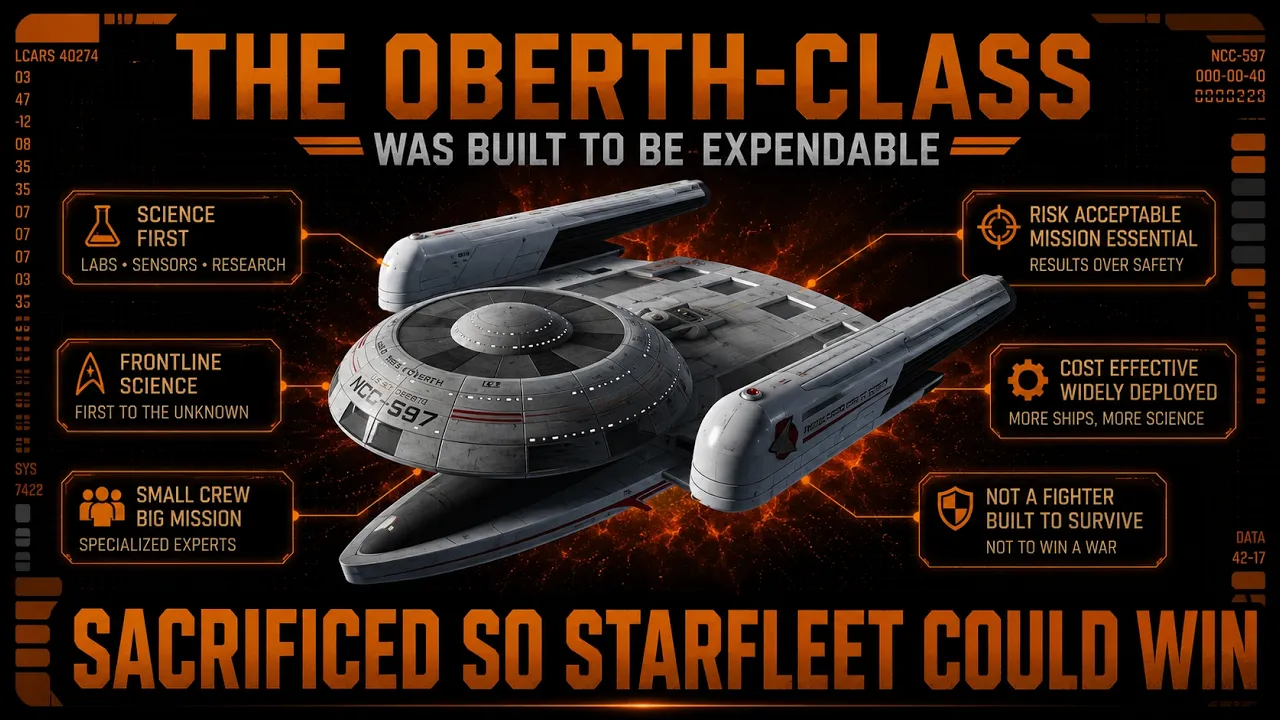
Adapted with AI from Lore Reloaded's video of 5 July 2026 and checked against the video before publication. Editorial standards · Corrections
More from @lorereloaded
All →


Make videos? Your next one could be an article here.
We turn your videos into articles under your name, linked back to the original. You keep 60% of what they earn, non-exclusive, and you can leave whenever you like.
Become a SubPlotter →