The Fatal Flaw of the Borg: How Perfect Unity Made the Collective Fragile
From the Arctic signal and Wolf 359 to Species 8472, Janeway's pathogen and Frontier Day, the traits that made the Borg unstoppable were the ones that broke them
 Lore Reloaded (AI-assisted)17 November 2026Editor: Digital Fox Talent Editorial TeamOn YouTube since 2016 · more than 140,000 subscribers

The Borg were not destroyed in a single battle. They were eroded by the very principles that once made them formidable: total unity, seamless interconnection and the elimination of every internal contradiction. To see how that happened, you have to follow the Collective from its origins in the Delta Quadrant, through its first encounters with the Federation, to its height and its slow contraction.
The Borg emerged as a solution to conflict, not as raiders
Before the Federation existed, something else in the Delta Quadrant had already resolved its internal divisions. Civilizations there were evaluated not as rivals but as resources. Distinctiveness was identified, cataloged and integrated, and expansion followed calculation rather than emotion. At some point in their distant past, conflict was judged inefficient. Individual will slowed consensus, emotions complicated decisions, and biological limitation restricted advancement. Those variables were removed one by one.
What remained was a networked intelligence that processed without hesitation and adapted without debate. Dissent vanished and decisions came faster. Each assimilated species contributed new biological traits and technological innovations, so innovation stopped being unpredictable and became cumulative. Evolution shifted from chance to design. Transwarp corridors collapsed distance into infrastructure, and regions adjusted their borders around the known edge of Borg space. Some civilizations fortified, others fled, and a few endured by remaining unnoticed.
There was no throne world at the center. Governance ran through distributed processing across billions of linked minds, and orders were unnecessary because purpose was universal. Internally, assimilation was framed as improvement, and the Collective did not question growth. Resistance only delayed integration. For a civilization that had eliminated internal chaos, the galaxy was the only remaining variable.
The Arctic crash sent a signal toward the Delta Quadrant
In the Alpha Quadrant, none of this was visible yet. Cooperation between imperfect species was treated as strength, and on Earth, warp travel symbolized optimism more than strategic necessity. Then, two centuries before formal contact, a fragment of Borg ambition fell into the Arctic ice. A sphere damaged during a temporal incursion crashed on Earth in the 21st century, carrying drones cut off from the wider Collective.
Isolation did not change their function. Assimilation resumed immediately, and the researchers investigating the wreckage became the first humans transformed. Nanoprobes rewrote their biology and overwrote their neural pathways. Using salvaged human technology, the drones built a vessel capable of transmission, and before it was destroyed, a signal went out toward the Delta Quadrant. Captain Archer of the Enterprise interpreted it as spatial coordinates. Its full contents remain unspecified. What matters is that it was sent, and that it needed roughly two centuries to arrive.
Meanwhile the Collective kept refining itself. Resistance patterns were studied and countered, and with each addition, internal friction decreased. Adaptive shielding reduced the effectiveness of conventional weapons, and a single cube could outperform entire fleets built around traditional hierarchy. Expansion was methodical, not reckless. When the signal reached its origin, the Collective would learn of a developing interstellar alliance. From its perspective, that was not an anomaly. It was the next integration.
First contact with the Federation looked like data acquisition
Two centuries after the Arctic transmission, Federation outposts along the Romulan Neutral Zone began disappearing. No distress calls were recorded, and debris patterns did not match a conventional attack. Initial reports blamed anomalies, equipment failures, unknown hostile action and border instability. The Federation understood how adversaries behaved, with political motives and signaled intent. This was erasure.
Contact came beyond mapped Federation territory, when a Starfleet vessel was placed directly in the path of a cube. It did not posture or issue territorial claims. It advanced at a constant velocity. Weapons fire registered, then lost effectiveness as shield frequencies adapted during the engagement. The fight did not resemble a battle so much as data acquisition. The voice that answered neither threatened nor negotiated. It described function: biological and technological distinctiveness would be added to their own, and resistance would not change the outcome.
Starfleet doctrine relied on deterrence, leverage and psychological pressure, all of which assume the other side values something that can be influenced. The cube valued integration. Drones boarded without urgency, experience was distributed instantly, and correction happened without debate. Retreat was the only option, and survival required intervention from Q, the same entity that had engineered the encounter. His warning was direct: the Federation was not prepared for what lay beyond its frontier.
The Neutral Zone incidents took on new context. The stations had not been destroyed as acts of aggression. They had been sampled. A signal sent two centuries earlier would have reached the Delta Quadrant around the time this cube entered Federation territory, and coincidence becomes harder to defend. Whether the Collective came because of that message or would have arrived eventually matters less than the pattern itself. Contact did not feel spontaneous. It was scheduled.
Wolf 359 and Locutus: 39 Starfleet ships against one Borg cube
When the Borg returned, there was no ambiguity. A single cube entered Federation territory on a direct course for the core worlds, with no diplomatic overtures or territorial declarations. The USS Lalo was destroyed almost immediately, and the Enterprise engaged next. Coordinated volleys, rerouted phaser frequencies and adjusted shield harmonics were each incorporated and neutralized. The adaptive shielding did not simply resist attack. It learned from it.
Then the conflict turned psychological. Jean-Luc Picard was taken and altered, his identity subsumed, and the Collective returned him as Locutus of Borg, not as a prisoner but as an interface. Through him, Starfleet defensive protocols, fleet formations and strategic assumptions became accessible.
At Wolf 359, 39 Starfleet vessels engaged that single cube. Excelsiors, Mirandas and Nebulas, crewed from every member world, formed a wall between Earth and annihilation. Tactical projections estimated resistance in hours. It lasted less. Saturation fire and rotating phaser frequencies failed, hull breaches widened across multiple vessels, warp cores destabilized, and the formation collapsed. There was no tactical turning point and no rally. The cube simply continued toward Earth.
For the Federation, Wolf 359 was structural trauma. The assumption that cooperation, technological progress and coordinated defense were enough deterrence collapsed with those ships. Even after Locutus was severed from the Collective, ship design hardened, doctrine shifted toward asymmetrical countermeasures, and research into adaptive defenses accelerated. To the Borg, the Federation had been measured and found insufficient: capable of response, but not prevention.
At their height, the Borg were stable at scale
Wolf 359 was not the height of Borg power. It was the Federation's introduction to it. The Collective kept expanding across the Delta Quadrant with the same procedural certainty, absorbing whole civilizations and turning biological variation into system upgrades. They behaved less like an empire consolidating victory and more like a process continuing uninterrupted. When a cube entered a region, it did not need reinforcement. It was reinforcement.
The temporal incursion into Earth's past showed capacity, not desperation, because time itself became a navigable vector. Even defeat did not look like defeat as we understand it. A cube destroyed in orbit of Earth was registered as a loss, not a failure, and the infrastructure remained intact. With no visible center, there was nothing obvious to decapitate.
By the late 24th century, the Borg were the only power in the galaxy that needed no alliances or treaties. Other empires balanced expansion against resource strain, dissent or overreach. The Collective faced none of those constraints. No succession crisis could divide it and no ideological fracture could split it. It did not accelerate in anger or retreat in fear. It expanded, and nothing in known space had shown the capacity to destabilize it.
Species 8472 exposed the limits of Borg adaptation
The decline did not begin because the Federation defeated the Borg. It began when they met something they could not immediately assimilate. A cube entered fluidic space pursuing Species 8472 and followed doctrine: contact, analysis, integration. It did not work. Nanoprobes failed to penetrate their cells, and shield adaptations proved useless against organic technology whose weapons destabilized matter at a fundamental level. Entire incursions into fluidic space were overwhelmed.
It's important to frame this precisely. Species 8472 did not collapse the Collective or dismantle its infrastructure, and assimilation continued elsewhere. But the appearance of invincibility fractured. The Borg were forced into a sustained reactive posture, expansion slowed as resources went to containment, and momentum became conditional. The war revealed a limitation inside perfection itself: adaptation needs data, data needs survivable encounters, and when survivability narrows, the adaptation cycle compresses.
So the Collective sought advantage through alignment, and Voyager became a temporary instrument. This was not an ideological shift but a strategic acquisition, and once the objective was met, assimilation resumed. Species 8472 were pushed back into fluidic space and the Collective endured. But endurance is not the same as immunity, and once that boundary was revealed, it could not be unseen.
The Borg Queen made the Collective look centralized
In early encounters, the Collective spoke through drones or an ambient unified voice, and Picard as Locutus was a communication node, not an individual directing it. By the Battle of Sector 001, the architecture appeared more concentrated. The Queen selected interlocutors, framed arguments and showed strategic preference. She insists she was always embedded in the system as its embodiment rather than its ruler, and that interpretation preserves continuity. Yet the way she acts increasingly resembles central mediation.
Her repeated destruction and reemergence complicates the model, because repetition creates concentration. Voyager's encounters deepen the impression: Seven of Nine is pursued with sustained interest rather than simple reclamation, Janeway becomes a recurring adversary, and dialogue replaces silent efficiency. Unimatrix Zero adds internal complexity, with drones experiencing individuality in a shared mental space that the Queen actively suppresses. That suggests uniformity is not absolute and must be managed.
None of this immediately reduced Borg capability. The shift was architectural, not numerical. Whether the Queen was always part of the design or emerged in response to growing complexity, the practical effect is the same: decisions appear filtered, and the Collective looks less like pure distributed perfection and more like a system negotiating its own scale.
Janeway's pathogen and the transwarp hub turned interconnection into collapse
For centuries the Borg engineered internal conflict out of existence, which let them expand without schism. "But perfection is brittle when it leaves no room for deviation." A system meant to spread cognition across billions of minds was expressing itself through a singular presence more often, and that presence could be targeted, disrupted and infected. When Admiral Janeway introduced the neurolytic pathogen, it exploited the very neural interconnectivity that let drones act as one. Signals that once carried coordination now carried degradation.
The destruction of the transwarp hub compounded the damage. Transwarp was strategic compression, letting cubes reinforce distant incursions within hours rather than months. When the network fractured, synchronized regions became isolated pockets, and scale turned into fragmentation. Cut off cubes kept operating, but with less adaptive integration. The Borg were still dangerous. They were no longer omnipresent.
Every drone linked and every experience shared eliminated inefficiency, but it also eliminated insulation. "There were no firebreaks because there had never been a need for them." The Borg absorbed difference only after erasing its independence, so the network either functioned collectively or degraded collectively.
Frontier Day shows how far the Borg had contracted
Later appearances reveal the extent of that contraction. Cubes drift without clear reinforcement, and a Queen orchestrates strategy from the wreckage of a diminished infrastructure. Assimilation shifts from overwhelming force to infiltration: genetic subversion at Frontier Day rather than a fleet scale invasion. That contrast is structural. The Frontier Day attempt relies on stealth and biological manipulation because the infrastructure for overt dominance no longer exists at its former scale.
The rise of the Borg was built on the belief that evolution could be engineered into flawless convergence, and their fall reveals the cost. By eliminating contradiction, they lost the ability to compartmentalize failure. By centralizing unity, they introduced fragility at scale. The Collective survives in fragments, and the Borg remain one of the most consequential forces the galaxy has encountered, but they are no longer inevitable.
What other creators are saying
More on Borg →A countdown of Star Trek: The Next Generation's most memorable antagonists, from recurring Klingon troublemakers to the collective that changed the franchise forever.
Star Trek (2009) and The Force Awakens share a director, a reboot mission and the start of a trilogy
J.J. Abrams Played an Almost Identical Role in Star Trek and Star Wars →
One card plays artifacts from the top of your library, and the other rewards facing a dilemma with free spells
Zefram Cochrane and the Caretaker among Magic: The Gathering Star Trek preview cards →
A Romulan War buildup, a Mirror Universe miniseries, the Borg Queen's origin and a refitted NX-01 were all part of the plans for a season that never got made
Watch the original
@lorereloaded · YouTube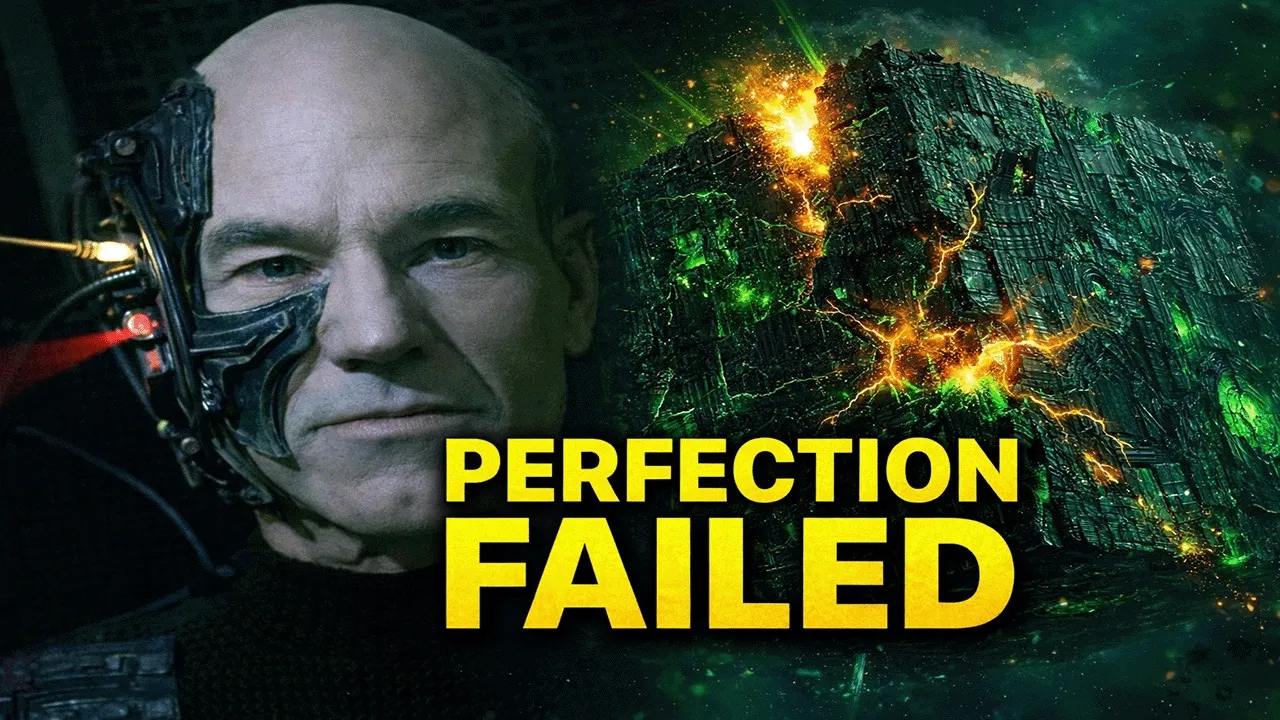
Adapted with AI from Lore Reloaded's video of 4 March 2026 and checked against the video before publication. Editorial standards · Corrections
More from @lorereloaded
All →


Make videos? Your next one could be an article here.
We turn your videos into articles under your name, linked back to the original. You keep 60% of what they earn, non-exclusive, and you can leave whenever you like.
Become a SubPlotter →