D'deridex warbird: why did the Romulans build it for fear?
After decades of silence following the Tomed Incident, the Romulan Star Empire returned with one enormous warbird designed to make the Federation hesitate before choosing to fight at all.
 Lore Reloaded (AI-assisted)16 November 2026Editor: Digital Fox Talent Editorial TeamOn YouTube since 2016 · more than 140,000 subscribers

The D'deridex class warbird was never meant to be just another starship. Its purpose was not merely to fight the Federation. It was to make the Federation stop and think before choosing to fight at all.
The ship's size, its presence, and even the way it revealed itself from cloak were all part of a message the Romulan Star Empire had spent decades preparing to deliver. The D'deridex was the clearest expression of how the Romulans understood power: not as something proven through battle, but as something demonstrated through fear.
After the Tomed Incident, the Romulan Star Empire went silent
The Romulan Star Empire has always been one of the most dangerous powers in the Alpha Quadrant. That isn't because of its fleets or its weapons. It's because of its patience. While the Federation expanded outward through diplomacy and exploration, the Romulans built their power differently. They watched, they waited, and when they chose to act, it was rarely without purpose.
In the early 24th century, the Romulans vanished. After the Tomed Incident, relations between the Federation and the Romulan Empire collapsed completely. The neutral zone was reinforced, diplomatic channels went silent, and the Romulan fleet withdrew behind its borders. For decades, Starfleet saw almost nothing of them. Patrols along the neutral zone reported the same thing year after year: no crossings, no communications, no signs of activity.
To many in the Federation, that silence wasn't comforting. Some believed the Romulans had turned inward, consumed by their own politics. Others suspected their power had been weakened. Whatever the reason, the neutral zone slowly changed from a flashpoint of Cold War tension into something closer to a forgotten border.
But the Romulans hadn't disappeared. They had only stepped back. Romulan strategy has never relied on constant confrontation. Where other powers show strength through visible fleets and open patrols, the Romulans prefer uncertainty, and silence itself becomes a weapon. The longer their enemies hear nothing, the more dangerous the eventual return becomes. By withdrawing entirely, the Empire let the rest of the quadrant wonder what it might be building in the dark. Its silence had not been surrender. It had been preparation.
Why every Romulan warship has to represent the empire
The Romulans have never enjoyed the advantages that define their rivals. The Federation has enormous industrial capacity, a network of member worlds, and the ability to mobilize fleets across a vast alliance. The Klingon Empire builds its power around a culture that embraces constant warfare. Its fleets are designed for aggression, and its commanders are raised to seek victory through battle.
The Romulans operate under very different constraints. Their empire is powerful, but not limitless. It doesn't command the Federation's industrial scale, and it doesn't rely on the raw military culture that drives the Klingons. Instead, Romulan strategy has always focused on a smaller number of carefully positioned assets: ships and operations designed to exert influence far beyond their actual numbers.
In a system like that, every vessel has to matter. A Romulan warship can't be one more hull in a larger fleet. It has to carry weight and represent the empire itself. When a Romulan ship appears on the frontier, it isn't just a patrol. It's a calculated political signal.
By the time the Romulans emerged from their long silence, the strategic balance had shifted. The Federation had kept growing, Starfleet's exploration programs had pushed deeper into the galaxy, and its fleet had become larger and more capable. If the Empire wanted to reassert itself, it needed something that could command attention instantly. Not simply a faster ship, and not merely a stronger one, but something unmistakable. The D'deridex answered that need.
The D'deridex design: built for control, not utility
Starfleet builds ships to function. Federation starships have efficient structures, smooth lines and carefully used internal volume. Exploration vessels carry laboratories, diplomats, families and entire scientific departments. Even Federation warships tend to prioritize versatility over spectacle. A Federation ship is meant to work.
Romulan warships follow a different logic. Where Starfleet designs for utility, the Romulans design for control. A Romulan commander doesn't simply want the stronger position in battle. They want the psychological advantage before the battle begins, and that means the ship has to send a message the moment it appears.
At over a kilometer in length, the D'deridex is larger than the Galaxy class explorers that would soon become the pride of Starfleet. What makes it unusual isn't only its size, but how that size is used. Sweeping wings stretch outward from a narrow central hull, leaving a vast hollow space between them. From a purely engineering perspective, that's a strange choice. Starships normally maximize internal volume, filling their frames with systems, equipment and crew compartments. The D'deridex spreads its structure across space instead, creating a huge silhouette where a more compact ship could have filled the same technical role.
So why build it that way? The answer may lie in how the Romulans expect their ships to be seen. When a D'deridex decloaks, its wings unfold across the viewscreen like a predator revealing itself from darkness, and the open frame makes it look even larger than it is. The D'deridex isn't just large. It's visually large, and those two things aren't always the same. If an enemy commander hesitates and starts wondering whether escalation is worth the risk, the Romulans have already gained an advantage. The cloak lets them choose the moment, and the warbird ensures that moment can't be ignored. In that sense, the D'deridex is a piece of stagecraft as much as a warship.
How the Romulans returned to face the Enterprise-D with a single warbird
For nearly 50 years, the neutral zone had been quiet. Not peaceful, but quiet. Starfleet patrols still watched the border, and it remained one of the most sensitive frontiers in the quadrant, yet year after year passed without a single confirmed sighting of a Romulan vessel.
Then outposts along the neutral zone were destroyed without warning, and entire colonies vanished. No ships crossed the border and no enemy claimed responsibility. When the USS Enterprise arrived to investigate, a huge shape decloaked from empty space onto the viewscreen. The Romulans had returned, but with no invasion fleet and no declaration of war. They came with one vessel.
What made the moment unsettling was not only the ship's size but the confidence behind it. The Romulans had crossed half a century of silence to confront the Federation's flagship with a single warbird, and they clearly believed that was enough. Every Starfleet officer present was forced to consider the same question: if one warbird looked this powerful, how many more were waiting beyond the border?
The Romulan commander made no attempt to open fire and didn't immediately escalate. The warbird simply held position across from the Enterprise as both sides measured each other for the first time in half a century. This wasn't a battle. It was a statement that the Empire had not grown weaker in isolation. If anything, it had become far more dangerous, and the D'deridex was the first glimpse of a power designed to reshape the strategic conversation before a single shot was fired.
D'deridex deterrence and the long standoff in the neutral zone
The appearance of the D'deridex didn't start a war, and that was never the point. The Romulans returned to remind the Federation that the balance of power hadn't shifted in their absence. In that sense, the ship did exactly what it was designed to do: Starfleet, for all its power, hesitated.
For decades after the Romulans reappeared, the neutral zone was again defined by caution. Encounters rarely escalated into open battle. They unfolded as tense standoffs, with ships holding position and commanders calculating how far they were willing to push. Starfleet had faced powerful vessels before. The difference was that the warbird made the consequences of escalation feel immediate, as though whatever happened next could spiral into something far larger than either side intended.
That's exactly the environment Romulan strategy prefers. The Klingons seek decisive engagements and the Federation relies on diplomacy backed by fleets, but the Romulans thrive where uncertainty dominates. A tense frontier, a line neither side wants to cross, and commanders weighing the political consequences of every decision all reward patience and intimidation over raw firepower. The D'deridex became the physical symbol of Romulan deterrence.
The Federation couldn't ignore the ship, but it couldn't easily challenge it either. Engaging a warbird risked a conflict neither government wanted, while leaving it unopposed meant accepting that the Empire could still project power whenever it chose. So Starfleet strengthened patrols, developed new starship classes, reorganized its fleets and prepared contingency plans in case the fragile peace collapsed. But neither side pulled the trigger. The Romulans didn't need the D'deridex to destroy Federation ships. They only needed every Starfleet captain to understand what escalation might cost.
The Romulan way of war: the victory that never needs a shot
To understand the D'deridex is to understand how the Romulan Empire thinks about power. Many civilizations measure strength through victory in battle. The Klingons seek honor through combat, and even the Federation, despite its ideals, ultimately proves its resolve when diplomacy fails and its fleets must defend its borders. The Romulans see war differently. For them, the greatest victory is often the one that never requires a shot to be fired.
Romulan strategy is built on patience, deception and the careful control of information. They prefer to shape the battlefield long before weapons come into play, gathering intelligence, manipulating perception and forcing their enemies to confront uncertainty. When confrontation finally arrives, they want the outcome to feel inevitable. The D'deridex appears suddenly from cloak, already positioned where it needs to be, with the moment, the location and the conditions of the encounter chosen in advance. It turns what might have been a simple border incident into something far more dangerous, and that transformation is the real weapon.
The moment a Starfleet captain sees the warbird, the questions begin. How many more are nearby? What happens if this escalates? Is this the moment a cold frontier becomes open war? Those questions are the heart of Romulan strategy, because fear doesn't paralyze an enemy through brute force. It works by making every possible decision feel dangerous, and a commander who second-guesses their options is already fighting on unfavorable terms.
The D'deridex was never meant to conquer the galaxy. It was meant to make sure no one forgot the power of the empire that built it. In Romulan strategy, the most effective weapon isn't always the one that fires the first shot. Sometimes it's the one that convinces the enemy not to fire at all.
Watch the original
@lorereloaded · YouTube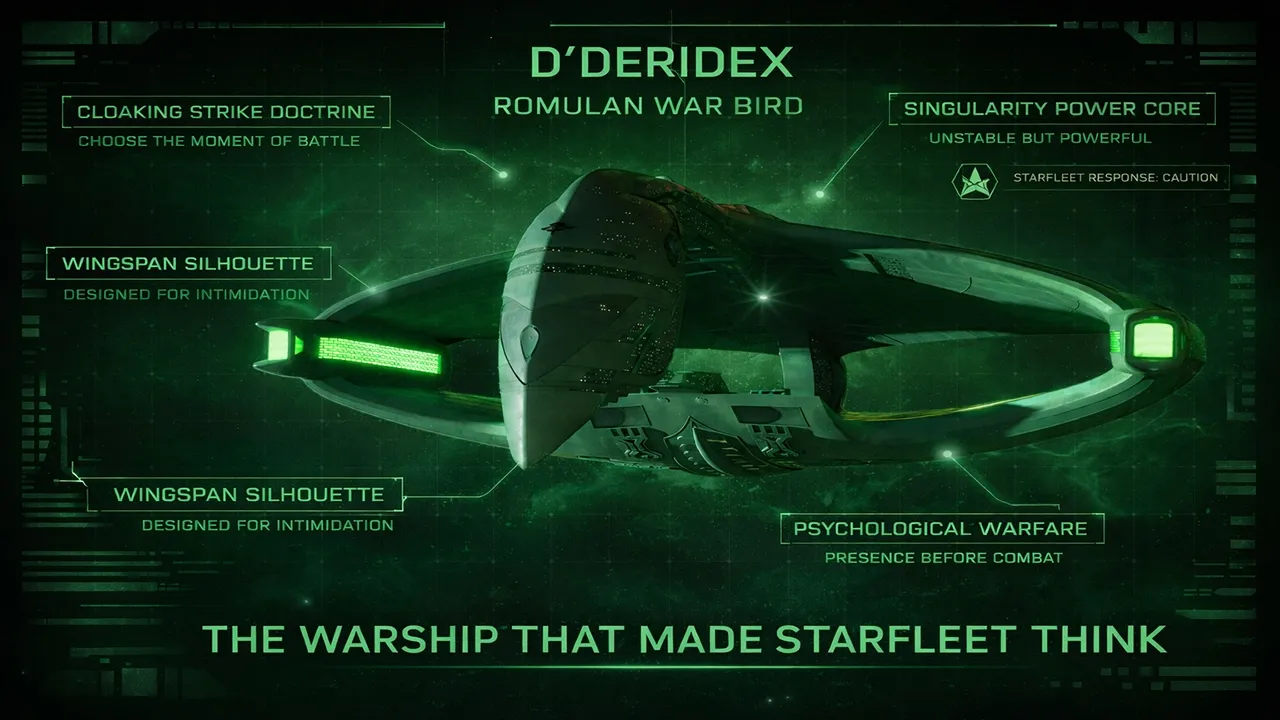
Adapted with AI from Lore Reloaded's video of 12 March 2026 and checked against the video before publication. Editorial standards · Corrections
More from @lorereloaded
All →


Make videos? Your next one could be an article here.
We turn your videos into articles under your name, linked back to the original. You keep 60% of what they earn, non-exclusive, and you can leave whenever you like.
Become a SubPlotter →