Deep Space Nine: why did Bajor keep Terok Nor?
Built to enforce the occupation of Bajor, the station kept its walls and its scars but ended up standing for almost everything its builders hoped to prevent.

Deep Space Nine is remembered as one of Starfleet's greatest outposts: the gateway to the Gamma Quadrant, the center of diplomacy during the Dominion War, and the station where Bajor finally began charting its own future. None of that is what the station was built for. Cardassia built it as Terok Nor, an instrument of occupation, and without meaning to, it built one of the Federation's greatest assets.
The station is the setting of Star Trek: Deep Space Nine (1993), starring Avery Brooks, Nana Visitor and René Auberjonois. Its story is one of a monument to oppression being transformed into a symbol of freedom without anyone changing its walls.
Terok Nor was built to run the Cardassian occupation of Bajor
Long before Starfleet crews walked its Promenade, before Quark's bar filled with merchants and travelers, and before families called its habitat ring home, the station was Terok Nor. To the Cardassian Union, it was a masterpiece of colonial administration. To the Bajoran people, it was a prison hanging in orbit over their world.
Everything about the station reflected that purpose. The ore processing facilities that would later become forgotten relics were once the heart of a massive extraction operation. Raw materials stripped from Bajor by forced labor flowed through its systems day and night, enriching Cardassia while Bajor was left impoverished. Every docking port existed to receive cargo or military vessels. Every security office enforced the occupation. Every corridor was designed to support an empire that viewed an entire civilization as a resource to be exploited.
"Terok Nor was never intended to inspire hope." It was designed to make resistance feel impossible. From orbit, it reminded Bajorans that Cardassians controlled their skies, their economy and, for decades, their lives. Every Bajoran who looked up saw the physical embodiment of the occupation watching over their world.
That symbolism mattered because occupations are sustained by more than soldiers and weapons. They rely on institutions, logistics and permanence. A military can conquer a planet, but a station like Terok Nor tells everyone that the conqueror intends to stay. It turned the occupation from a temporary military campaign into an established system of control, where exploitation became routine and oppression became ordinary. Most stations are remembered for the missions they launched or the discoveries they enabled. Terok Nor was remembered for the suffering it oversaw.
Why Bajor kept Terok Nor instead of destroying it in 2369
When the Cardassians abandoned Bajor in 2369, they left behind more than an empty station. They left a difficult decision. Terok Nor had been built with Bajoran labor, used to exploit their world, and served as the command center for a regime that ruled them through fear. If any structure deserved demolition, this was it. Yet Bajor never seriously attempted to destroy it.
At first glance that seems almost impossible to understand. Throughout history, newly liberated nations have often torn down the monuments of their former oppressors, and removing those symbols becomes part of reclaiming a nation's identity. The reality was far more complicated. The occupation had devastated Bajor's economy and infrastructure. The provisional government inherited a world struggling to feed its people, rebuild its cities and establish a functioning government.
Building a new orbital station, or doing without one, wasn't a realistic option. Terok Nor remained the only major facility capable of coordinating trade, receiving starships, supporting relief efforts and connecting Bajor to the rest of the Alpha Quadrant. Destroying it might have satisfied an emotional need, but it would also have crippled the planet's recovery. So Bajor made a harder choice: it chose to reclaim what had once been used against it.
That reflects a broader truth about recovering from occupation. Freedom rarely begins with a clean slate. Nations emerging from decades of foreign rule inherit damaged economies, compromised systems and buildings constructed for purposes they never chose. Bajor understood something the Cardassians never had. A building has no ideology of its own. Terok Nor wasn't evil because of its bulkheads or docking pylons, but because of the people who controlled it and the purpose they forced on it. Rather than erase the station, Bajor would overwrite its past, and the provisional government asked Starfleet to take command.
Benjamin Sisko inherited Terok Nor, but its purpose changed
When Commander Benjamin Sisko arrived, he didn't inherit a blank canvas. He inherited Terok Nor. The hull and the Promenade remained the same, and Operations still overlooked the docking ring. On paper, very little had changed. What had changed was the purpose behind every room.
During the occupation, the Promenade existed to support Cardassian administrators, military personnel and the machinery of exploitation. Bajorans walked those corridors because they were ordered to, and merchants operated under Cardassian authority. Under Starfleet and the Bajoran Provisional Government, civilians wandered freely, traders came from across the Alpha and Beta Quadrants to open businesses, and diplomats negotiated treaties instead of occupation policies. Families made the station their home. Traffic no longer measured how effectively Bajor was being exploited, but how quickly it was reconnecting with the galaxy.
Even Operations reflected the change. Gul Dukat had looked out from it as the unquestioned representative of Cardassian authority. Sisko looked out over the same station with a mission not to extract wealth or suppress resistance, but to help stabilize a fragile peace and support Bajor's recovery. None of this erased the past; the scars remained visible in the station and its people. Deep Space Nine did not become a symbol of freedom because everyone forgot what Terok Nor had been. "It became one because they remembered." Every merchant, every child raised aboard and every Bajoran officer in Operations represented another victory over the station's original purpose.
The Bajoran wormhole made Deep Space Nine the crossroads of the galaxy
Even after those first days under Starfleet, the station sat on the edge of Federation space. It was essential to Bajor's reconstruction, but few would have predicted that an aging Cardassian station would become one of the most strategically significant locations in the Alpha or Beta Quadrants. The discovery of the Bajoran wormhole changed that almost overnight.
For the first time, stable and reliable travel between the Alpha and Gamma Quadrants became possible. Worlds separated by nearly 70,000 light years were suddenly connected by a journey lasting only moments. Ships no longer came simply because they had business with Bajor. They came because every voyage into the Gamma Quadrant began there.
The wormhole meant different things to different people. To Starfleet, it was one of the greatest scientific discoveries in history, home to nonlinear life forms unlike anything the Federation had encountered. To Bajorans, it was the Celestial Temple, home of the Prophets, a sacred place that had shaped their faith for millennia. The station now stood at the intersection of science and religion, diplomacy and exploration, local politics and galactic affairs, and every decision made aboard it carried consequences across two quadrants.
Ironically, the Cardassians had unknowingly built the perfect platform for this role. They chose Bajor for its resources, never realizing they were building beside one of the greatest discoveries in galactic history. They built the station to dominate a single world; the wormhole made it the crossroads of the galaxy.
Gul Dukat restored the name Terok Nor during the Dominion War
By late 2373, Deep Space Nine had become a living demonstration that the legacy of the occupation could be overcome. Then the Dominion arrived. Facing an overwhelming invasion fleet, Captain Benjamin Sisko evacuated the station rather than sacrifice his crew in a battle they couldn't win. As Starfleet withdrew, Gul Dukat returned, not as prefect of an occupied Bajor, but as the representative of a Cardassian Union aligned with the Dominion.
One of his first acts was deceptively simple: he restored the name Terok Nor. To an outside observer it may have seemed ceremonial, since the architecture was unchanged. But Dukat understood that names carry meaning. Calling it Terok Nor wasn't nostalgia. It was a declaration that Cardassian authority had returned and that the Federation years had been nothing more than an interruption. The same corridors that had welcomed explorers now carried soldiers, and the command center that had coordinated scientific expeditions now planned military campaigns. Buildings become symbols because of the values imposed on them, not their design.
This time, though, the people aboard knew what freedom looked like. Kira Nerys, Odo, Rom, Jake Sisko, Leeta and countless others had lived through the station's transformation, and that memory made accepting Terok Nor impossible. Resistance was driven by the certainty that they had already experienced freedom and refused to surrender it. That is what Dukat never truly understood. Once people have seen what a place can become, it's far harder to convince them to accept what it used to be.
Why Deep Space Nine, not Terok Nor, is the name history remembers
When the Dominion War ended and Starfleet returned for the final time, the Cardassian banners and the Jem'Hadar soldiers were gone, and the Promenade filled again with merchants, travelers, officers and Bajoran militia. Terok Nor never returned. History rarely remembers a place solely for the purpose it was built to serve. Fortresses have become museums, battlefields memorials, and palaces built for kings public institutions. Deep Space Nine followed the same path.
Within a single decade, the station became known for almost everything its creators hoped to prevent: a place where Bajorans governed themselves, where former enemies negotiated peace, where new civilizations were welcomed instead of conquered, and where faith, science, commerce, diplomacy and exploration existed side by side. Perhaps that is why its harsh, industrial Cardassian architecture never stopped feeling appropriate. Unlike a new Federation starbase, it never let its past disappear beneath polished hull plating. The station did not hide its origins. It overcame them.
Starfleet never transformed Deep Space Nine by rebuilding it, and Bajor never erased the occupation by pretending it didn't happen. Both let the station keep its scars while giving it a completely different purpose, showing that even the strongest symbols of oppression are not beyond redemption if the people who inherit them refuse to let the past define their future. Almost no one calls it Terok Nor now; its legacy is tied to the name Sisko gave it, not the one Dukat tried to restore. In the end, that may be the Cardassians' greatest failure. They built one of the most formidable stations in the quadrant. "They simply failed to decide what history would remember it for."
What other creators are saying
More on Deep Space Nine →A weapon never seen on screen, an earlier name, and a close call in First Contact
One card plays artifacts from the top of your library, and the other rewards facing a dilemma with free spells
Zefram Cochrane and the Caretaker among Magic: The Gathering Star Trek preview cards →
A Romulan War buildup, a Mirror Universe miniseries, the Borg Queen's origin and a refitted NX-01 were all part of the plans for a season that never got made
Tomorrow's Enterprise plays less like classic Kirk and Spock and more like Next Generation's All Good Things, and the people who made it are calling the future we saw continuity.
Strange New Worlds finale: the original series' lost ending →
Watch the original
@lorereloaded · YouTube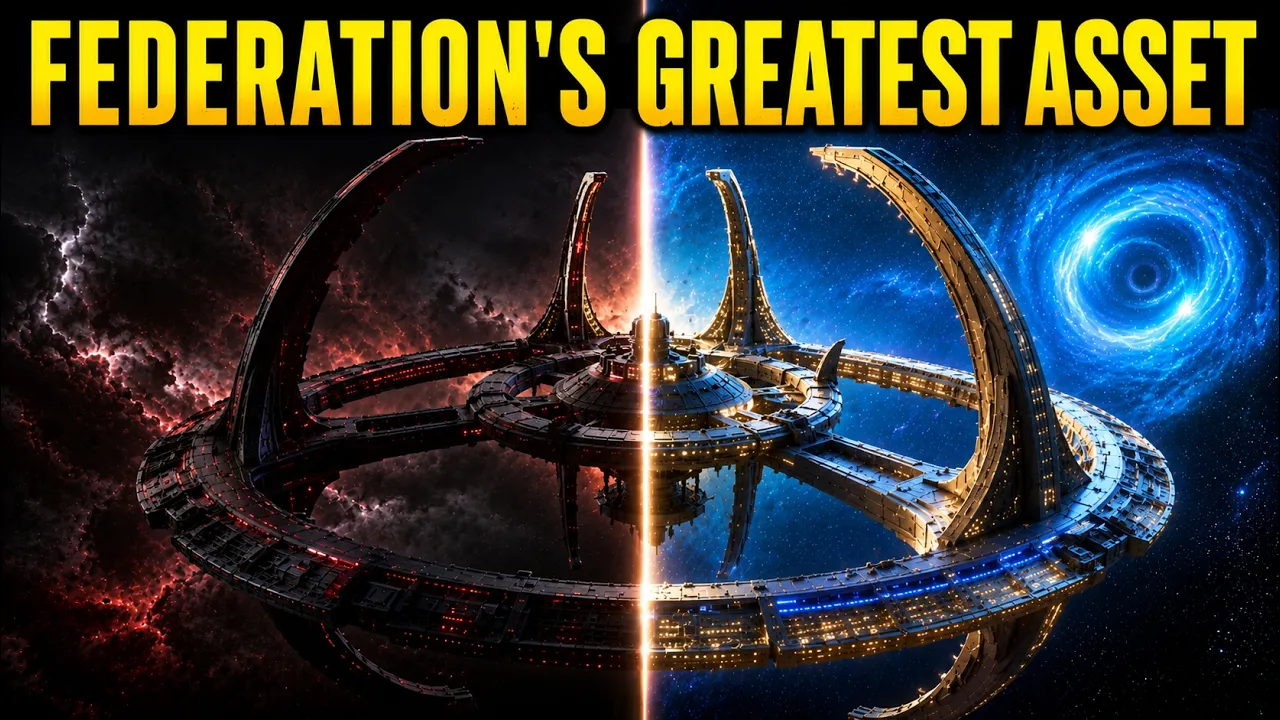
Adapted with AI from Lore Reloaded's video of 17 July 2026 and checked against the video before publication. Editorial standards · Corrections
More from @lorereloaded
All →


Make videos? Your next one could be an article here.
We turn your videos into articles under your name, linked back to the original. You keep 60% of what they earn, non-exclusive, and you can leave whenever you like.
Become a SubPlotter →