Into the Spider-Verse's Post-Credits Scene Explained: Who Is Spider-Man 2099 and What Does That Meme Mean?
I'm breaking down the Stan Lee tribute, the Miguel O'Hara reveal, and that 1967 Spider-Man pointing meme so you don't have to fake laugh through it anymore.
Into the Spider-Verse ends with a post-credits scene that had most of the theater laughing without actually understanding what they were laughing at. I'm going to break it down properly so you know exactly what just happened, because from what I saw, there was maybe one guy in your screening who actually caught every reference.
This matters because the scene sets up a very specific corner of Spider-Man comics history that most casual moviegoers have never encountered, and it may be hinting at where a sequel could go next.
Before the real scene, the movie pauses to honor Stan Lee
As the credits begin, a card appears on screen showing an image of Stan Lee's signature sunglasses, similar to an image producer Chris Miller had tweeted not long before the film's release. Underneath it is one of Stan Lee's well known quotes: "a person who helps others simply because it should or must be done and because it is the right thing to do is indeed without a doubt a real superhero." The card follows that with a thank you to Stan Lee and Steve Ditko for "showing us we're not the only ones." Ditko co-created Spider-Man with Lee along with other Marvel characters like Doctor Strange, and he also passed away this past June.
The real in-credits scene opens on Miguel O'Hara in Nueva York
After the tribute, a caption reads "meanwhile in Nueva York," and a female hologram blips in and out of a futuristic setting, shown from the point of view of an unseen figure voiced by Oscar Isaac, who plays Poe Dameron in the Star Wars movies. Isaac's name actually rolls by in the credits as "interesting person number one." This unseen figure asks the hologram if she's finished assembling his "goober," the name Peter Parker and Miles Morales gave the thumb drive device used earlier in the film to destroy Kingpin's collider. The hologram corrects him, telling him it's actually called a "gizmo," some kind of watch device, and she addresses him as Miguel.
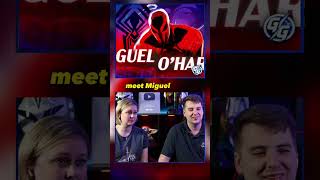
This Spider-Man is Miguel O'Hara, better known as Spider-Man 2099
Miguel O'Hara is Spider-Man 2099, an alternate universe version of the character from the 1990s relaunch that reimagined Spider-Man in a futuristic New York. Miguel was really the first new and different Spider-Man released in the comics. In the comics, he's a rebellious but super smart prodigy who ends up leading the genetics division of the Alchemix Corporation, and his storyline takes place over 100 years after what's known as the Heroic Age of Marvel, when the classic Peter Parker stories took place. Miguel tries to recreate the original Spider-Man's abilities, which results in an accident that alters 50 percent of his DNA to that of a spider. His costume was actually made for a Day of the Dead celebration, using material he called unstable molecule fabric so that it wouldn't rip.
The Spider-Man 2099 comics run pretty wild territory. They're noticeably more violent than a lot of other Spider-Man books, since early 90s comics in general were weirdly lashing out a lot in those days. Miguel at one point accidentally kills a guy, and he also fights Vulture 2099, who is a cannibal. That 2099 run was popular but existed largely in its own bubble because it was so futuristic and out there, though Miguel did cross over with the main Spider-Man from Earth-616, swapping places with him at one point. That crossover history is likely why the movie brings him into the post-credits scene while keeping him out of the main narrative.
The hologram is Lila, and she just gave Miguel a way to travel between dimensions
The hologram Miguel is talking to is an artificial intelligence assistant named Lila, described as really the only person Miguel trusts. In the scene, Lila hands over a special watch that lets him travel between dimensions, and Miguel says the first place he wants to go is "the beginning, one last time: Earth-67."
Earth-67 sends Miguel straight into the famous Spider-Man pointing meme
Earth-67 is a reference to 1967, the year Spider-Man's retro 60s animated show aired, the source of all those great 60s Spider-Man memes, specifically the Spider-Man pointing at Spider-Man meme. That's exactly where Miguel ends up, bickering with the 60s Spider-Man over who's pointing at who: "who the heck are you, i just told you, listen i'm from the future, how dare you point at me, you were pointing first, it's rude to point, you're being very rude." J. Jonah Jameson even shows up telling a cop to shoot Spider-Man. The meme actually originates from an episode called "Double Identity," where a villain named Charles Cameo dresses up as both Peter Parker and Spider-Man to steal a book. As with most memes, this one has taken on a life of its own online, used whenever two similar people need to be called out for essentially being the same, which makes it the perfect reference point for a movie built entirely around Spider-Man doppelgangers confronting each other over and over without ever getting old, thanks to how well the different versions of Spider-Man are mixed together.
My hope: a sequel teaming Miles Morales with Spider-Man 2099 and the 60s Spider-Man
If Into the Spider-Verse leads to a sequel with Miles Morales joining Spider-Man 2099 on a team that also includes the retro 60s Spider-Man, I am game. Just imagine getting the splashy living comic book animation of Miles and Gwen Stacy, plus the looney tune style movement of Spider-Ham, plus the anime look of Penni Parker, with the occasional cutaway to a static letterbox Spider-Man who speaks in big white letters.
Which Spider-Man from Into the Spider-Verse was your favorite? I'm partial to Spider-Ham, but I'll admit I might be biased by John Mulaney's voice work in that fight scene.
Watch the original
@newrockstars · YouTube
Adapted with AI from New Rockstars' video of 14 December 2018 and reviewed by Digital Fox Talent before publication. Editorial standards · Corrections
Also on Miguel O'Hara
4 creators, 9 takes → Lore
Across the Spider-Verse: The Hidden Easter Eggs, Canon Event Secrets and Spider-Punk's Dangerous Endgame
HE
 Review
Across the Spider-Verse Review: We Left the Theater Emotionally Drained and Ready to Give It a 4.5 Out of 5
GA
 Reaction
Reactor Calls Miguel O'Hara a 'Ninja Vampire Spider-Man' in Spider Society Scene Reaction
GA
More from @newrockstars
All →


Make videos? Your next one could be an article here.
We turn your videos into articles under your name, linked back to the original. You keep 60% of what they earn, non-exclusive, and you can leave whenever you like.
Become a SubPlotter →