The Russo Brothers Say a Sergio Leone Western Is Shaping Avengers Doomsday
A new Associated Press interview reveals how Once Upon a Time in the West, a back to back shoot with Secret Wars, and an unfinished script are all feeding into Avengers Doomsday.
 New Rockstars (AI-assisted)4 September 2026 · Editor: Digital Fox Talent Editorial Team
The Russo brothers just told the Associated Press that Sergio Leone's 1968 Western Once Upon a Time in the West has been a major inspiration for Avengers Doomsday, and I think there are three or four ways to read that comparison. All of them have me even more excited for the film.
This week Jake Coyle of the AP shared an interview with the Russo brothers from the set of Doomsday. Included in the piece was a new photo of the directors on the X-Mansion set talking to someone in the foreground with a bit of yellow on the shoulder strap and brown hair that I think could be James Marsden's Cyclops. If he is laying on the ground, I am a little worried that he could be mortally wounded. But it was really the quotes in this article that I found most fascinating.
Doomsday and Secret Wars are now shooting back to back, not with a gap
The article says the Russos spoke separately with the AP while knee deep in work on Doomsday and its 2027 follow up Secret Wars. They were finishing Doomsday, scoring and editing, while, in their words, soft prepping production on Secret Wars. "When you're doing one of these movies, it's the hardest thing you've ever done," Joe says. "When you're doing two of them, it's almost inconceivable. But it's the second time around we're doing two back-to-back."
This confirms something I shared before, because when I got to talk to Anthony Russo face to face last December at Agbo, he indicated to me that at the time they planned on a bit of a gap between Doomsday production and Secret Wars production, more than the gap they had between Infinity War and Endgame. Now it sounds like things are back to back and maybe overlapping a little. I think they might be shooting scenes on the Battleworld sets that could serve as reshoots for the final sequence of Doomsday and preshoots for the full Secret Wars film.
"Our job isn't to answer for the entirety of the MCU"
The article also raises Marvel's box office struggles and the oversaturation of recent years, framing Doomsday as an attempt to get the band back together, a movie expected to be among the highest grossing ever. Asked if they feel the film will restore order in the Marvel Universe after some stumbles, Anthony says, "It's a great question. It's part of the unique challenge. The thing that Joe and I have always appreciated about our collaboration with Marvel is our job isn't to answer for the entirety of the MCU. We intersected in a very specific way. It's that intersection which is where we can make sense of things."
I think this is the Russos signaling that not all of the MCU's characters and storylines, particularly from the Marvel television shows and movies like Eternals, will be represented in the plot of Doomsday.
Why the Russos call Doomsday "back to zero"
The article then discusses the Russos' optimism at the success of Spider-Man: Brand New Day, which they called "a wonderful challenge." It goes on to say the Russos promise something special in Doomsday, referring to it as "back to zero," starting from scratch, and a profound shift in the MCU. The piece notes that even in the ever expanding MCU, the Russos have been animated by stories with defined beginnings, Doomsday, and legitimate endings, Endgame, even if Endgame was not really the end.
This is interesting to me because I hear Doomsday and Endgame as somewhat synonymous, the ending of something, a climax, a send off to other storylines. This is really the first time I have heard Doomsday described as the beginning of anything. But with the Battleworld of it all, I think we can guess what they are hinting at.
Stephen McFeely's early phone call and an unfinished script
The article states that it took something extra to bring the Russos back to Marvel, and that they were coaxed back by a foundational narrative concept suggested by co-writer Stephen McFeely. This is the big idea I have talked about in past pieces, that McFeely called them about something early one morning, and that idea convinced them to come back. The answer to what that idea actually is has been my white whale through all these months leading up to Doomsday.
The article then covers how the fifth Avengers movie was originally meant to center on Jonathan Majors' Kang the Conqueror, which Marvel shifted away from after the actor was dropped from the franchise. The Russos stepped in, but the revamped production meant going into shooting with an unfinished script. "We always view the script as a living organism," says Joe. "We are improvisation based, rehearsal based directors. We like to see what the actors bring to the characters and sometimes you don't get the actors until a few days or a few weeks before you shoot them and a lot of time that's when the magic happens."
I find the timeline here a little confusing. The Russo brothers were announced in July 2022, when the movie had a release date of May 2026, which was plenty of time. The following April it was pushed back further to December 2026, meaning this fifth Avengers movie was delayed several times over several years, giving the studio, the new filmmakers, and writers including McFeely, Michael Waldron, and now reportedly Chris McKenna and Erik Sommers, plenty of time to write and rewrite. So I do not think it is the revamped production that explains why the Russos like to start shooting with an unfinished script. I think that is just how they prefer to approach all of their projects, regardless of how much prep time they have.
Marvel's find it in the edit method, for better or worse
Some cinephiles on Film Twitter hate hearing this kind of thing, because they believe every film should have a perfectly polished screenplay before cameras roll, with directors working through a shot list that never changes all the way to wrap. As a type A creative, I feel similarly, and I join every AD and line producer out there in agreement with that instinct. But much to my chagrin, finding these movies in the edit, using extensive reshoots and intense visual effects crunch periods, has been Marvel Studios and Kevin Feige's method since the first Iron Man film, and for most of the studio's history it has worked really well.
It really only became an issue between 2021 and 2025, during a period of oversaturation and overextension with interconnected streaming shows. But if a studio scales back to releasing one or two movies a year, and does not force its television shows to connect everything, Marvel's method of building the plane while flying it can still very much work, both for the studio and for the Russo brothers.
Once Upon a Time in the West is the Russos' guiding template
This brings us to the final revelatory part of the article. If there is a guiding template for the Russos for the kind of movie they want to make, one with grand scale and moments of emotional intimacy, it is the Western, and Sergio Leone's Once Upon a Time in the West was a particular inspiration for Doomsday. "Joe and I grew up fans of all types of cinema, but Westerns have always been very special to us," Anthony says. "Throughout cinema history, the Western has been declared dead for decades and then you can still make one of the greatest examples of the genre."
Leone's 1968 film is considered one of the all time best Westerns, arguably the last of the great spaghetti Westerns, shot in Italy and Spain by an Italian crew led by Leone with composer Ennio Morricone. After directing the Man with No Name trilogy with Clint Eastwood, Leone was reportedly done with the Western genre, but was convinced by Paramount to return with the stunt casting of Henry Fonda and a budget he liked.
The film follows Frank, played by Fonda, who murders Brett McBain and his three children on their ranch, leaving behind McBain's new bride, Jill. We learn railway tycoon Morton had hired Frank only to intimidate McBain, because McBain owned land needed for a watering station, land that would revert to Morton's company if the station was not finished by the time the railroad arrived. The killings get blamed on an outlaw named Cheyenne, and the mysterious gunslinger Harmonica arrives in the town of Sweetwater and ends up working with Cheyenne and Jill to save the ranch and build the station.
The conflict builds to a train shootout and a final showdown between Frank and Harmonica, where we learn in flashback that Frank once forced a boy to hold his older brother up on his shoulders during a hanging with a harmonica stuffed in his mouth, and that boy grew up to become Harmonica. He beats Frank to the draw, pushes the harmonica into his mouth as he dies, and rides off with the dying Cheyenne's body as Jill serves water to the railroad workers at the finished station. The film is remembered for Leone's directing, for how Morricone's score works diegetically with Harmonica's theme, and for the way it deconstructs the myths of the Western as the frontier gives way to the railroad. It arguably ended that era of Westerns as audiences knew them in the 1960s, paving the way for the New Hollywood directors of the 1970s, and it later influenced Clint Eastwood's Unforgiven, which in turn influenced Logan, as well as Quentin Tarantino, who used Morricone to score several of his own films and named 2019's Once Upon a Time in Hollywood after that era.
Four ways to read the comparison, and who Doom, Cheyenne, and Jill might be
One way to read the Russos' reference, and how the AP article itself interprets it, is that they are comparing the superhero genre to the Western, something critics have written off as dying but which really just keeps transforming into a genre that always has a place in Hollywood. Another possibility I see is that these Italian brothers liken themselves to Leone, thinking they were done with Marvel after their earlier run but lured back with iconic stunt casting, Henry Fonda in Leone's case and Robert Downey Jr. in theirs, plus a pile of cash. That would make Doomsday and Secret Wars their own Once Upon a Time in the West after the popular run of Winter Soldier, Civil War, Infinity War, and Endgame.
A third reading is about Leone's visual style itself, the patient editing, the extreme close ups on small details, the focus on eyes as the full expression of a character's soul, and the use of musical leitmotifs, which we know Alan Silvestri has composed for Doctor Doom in this film. I think that could be a big part of how the Russos are shooting Doom in Doomsday, in tight close ups building to tense standoffs.
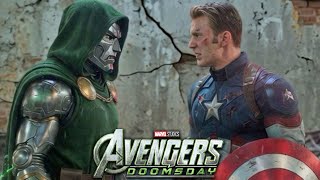
A fourth, deeper reading is structural: Once Upon a Time in the West is about the death of one era and the birth of a new world through the arrival of the railroad, which could mirror the X-Men, Fantastic Four, Avengers, and Wakandans working together to prepare for the incursion of colliding Earths. That raises the question of whether the Russos see Doom as Frank, the unambiguous villain who is properly punished and left dead by the end, or as Harmonica, Charles Bronson's mysterious man who aligns with the heroes, helps them build what they are building, and is revealed to have a sympathetic revenge motive before surviving as one of the last men standing. I think Doomsday will show Victor victorious and portray him as more of a complex antihero, which makes me lean toward the Harmonica read and toward Doomsday as the beginning the Russos describe. That leaves the question of who plays Cheyenne and Jill: could Steve Rogers be the Cheyenne, an outlaw blamed for crimes he did not commit, and could Sue Storm be the Jill who has to make sense of the new world on the other side of the conflict?
What do you think the Russo brothers really mean by comparing Avengers Doomsday to Once Upon a Time in the West?
Watch the original
@newrockstars · YouTube
Adapted with AI from New Rockstars' video of 3 September 2026 and reviewed by Digital Fox Talent before publication. Editorial standards · Corrections
Also on Russo Brothers
3 creators, 13 takes →

More from @newrockstars
All →


Make videos? Your next one could be an article here.
We turn your videos into articles under your name, linked back to the original. You keep 60% of what they earn, non-exclusive, and you can leave whenever you like.
Become a SubPlotter →