VisionQuest episode 2 Theseus Easter eggs: Paladin's secret history, Jim Hammond and Ultron's long game
Tommy's split memories, a Paladin order that may be tied to real assassinations, a Madripoor clue, Jarvis's sacrifice and the details hidden in Theseus
 New Rockstars (AI-assisted)15 October 2026 · Editor: Digital Fox Talent Editorial Team
VisionQuest episode 2, Theseus, is packed with secrets. It hides a Paladin order that may be tied to real historical assassinations, a Madripoor clue, a Jim Hammond warning and plenty of signs that Ultron is playing his own game inside Vision's mind. I'm loving this series so far, and I came out of this episode with a lot of questions about what exactly is going on at the sanitarium where Tommy ends up.
Thomas Shepherd's psych eval suggests he holds two consciousnesses at once
We open on Thomas Shepherd's criminal psych eval, recorded one year earlier at the Tottenham police station. He describes roughhousing with the boys in the pool, not being bullied, which is what Billy thought was happening to him during the seance in Agatha All Along episode 8. This is the moment the soul of Tommy Maximoff from the Hex inhabited the body. He describes it like a bolt of lightning. I assume that's the kind of speedster shock that might have zapped the other kids in the water but didn't kill them, thankfully.
This is different from William Kaplan's experience. In Agatha All Along episode 6, William died in the car accident and his consciousness was fully gone, so it was 100% Billy's consciousness and memories, and Joe Locke played Billy as kind of suffering in silence. Thomas, by contrast, possesses the memories and consciousnesses of both Thomas Shepherd and Tommy Maximoff, so his reaction is far more explosive and panicked. It seems Thomas did not fully die in the pool. Or maybe the transference just wasn't as clean because the seance happened three years after the Hex collapsed.
With Tommy's origin moment in the water, it might also be another thematic example of him being a ship of Theseus himself. Like his father, he contains multitudes. The eval happens six months after Tommy entered the body, and if that's a year before the main events, we're about 18 months after Agatha All Along, or four and a half years after WandaVision, suggesting we're sometime in 2028.
The prison bus scene layers in Hannibal Lecter, Norman Bates and Lisa's advice
A year later, on Christmas, Thomas gets loaded into a juvenile prisoner transport by London's Tower Bridge. The transport officer, Clancy, is played by Ben Crompton, Dolorous Edd from Game of Thrones. Clancy doesn't care if you're Oliver Twist, Hannibal Lecter, or the one who wouldn't harm a fly, referencing Norman Bates in Psycho. Norman Bates had a split personality, so that might resonate with Tommy. Tommy flashes back to scary Vision in the pool, including the moment Vision tried to push through the Hex wall in WandaVision episode 6.
Lisa tells him that who we are is less important than who we pretend to be, and it was Lisa who gave Tommy the advice he mentioned in episode one: "I get to wake up every morning and be whoever I want to be." She jokes that she killed a man and wore his face, identifying with Clancy's Hannibal Lecter. In reality she's a pickpocket who brags about lifting six wallets off five men, meaning one guy had two. Another offender screams about not wanting to go back to the sanitarium, and Lisa says no one ever gets out.
When Clancy prods Thomas, Tommy's speedster abilities redirect the current back into him, scarring his neck and chin. Lisa grabs the keys, Tommy vibrates the hinges off the doors while the others sing Jingle Bells to cover Clancy's shouting, and the two slide out the back, kind of like Keanu Reeves and Sandra Bullock in Speed.
Vision's Paladin briefing seems to tie the order to real assassinations
Ultron again claims no involvement in the Paladin voice booming from the sky, but encourages Vision to investigate and make some connections. Ultron certainly seems to be working his own angle to get Vision out of stasis into a place where Ultron can more easily break free. In the briefing, the Paladin sigil appears on an armored chest plate, suggesting the order goes back to at least the Middle Ages. One photo looks late 19th century, with that Paladin's own pull down goggled mask. There are at least 10 past Paladins in a grid with identity unconfirmed banners and digital blurring, spanning ages, races and, I think, even genders, each with what seems to be a signature from their contracts.
The crest shows three bloody swords over a bloody shield with a Latin motto, though its first word isn't Latin. I assume it's the ancient family, order or clan name from which the modern name Paladin derives. Then come the historical killings. A real Le Petit Journal front page shows the failed assassination attempt on Fernand Labori, a prominent French attorney. The assailant was never identified, so in the MCU it was a Paladin, and maybe Labori actually died there, since we see a signed Paladin contract beside it.
A mug shot with prisoner number 7129 looks 20th century to me, so maybe go with me on this: the failed 1933 attempt on Franklin D. Roosevelt that killed Chicago mayor Anton Cermak. Historically the shooter was Giuseppe Zangara, but maybe Cermak was the real target and it was a Paladin. A paid receipt from May 1884 has no famous assassination to match, so here's a theory: maybe a Paladin was the real killer of the infamous bandit Jesse James in 1882, and the coward Robert Ford was just credited, with the Paladin collecting two years later. There's also a photo dated June 96, which I assume is 1996 because it looks way more recent than 1896; in June 1996, the wife of a detained Nigerian political leader was assassinated in her car in Lagos by unknown attackers, and in the same month in the Philippines, a controversial colonel was shot in an attack claimed by a communist group.
Some bounties weren't killings. One receipt reads target delivered alive, for $25,400, which looks like a low sum before inflation, so I'm assuming early to mid 20th century. Another figure collected a $1.5 million bounty. No clue who or when, but he knows how to strike a pose for a mug shot. Friday explains Paladins have the sharpest minds and are trained in all kinds of weapons, and the knight chest piece logo also appears on crates in a trailer shot of a character with robotic arms, which tells us she'll be in the Paladin base at some point.
A Madripoor headline raises Sharon Carter as a possible client
News headlines include a partial one about a bomber captured, which could be Berlin or Dublin, and Dublin would link to IRA bombings maybe during the Troubles. Another reads that a bounty hunter bypasses federal efforts, a Paladin editors had no name for. There's a headline about bodies in Madripoor and a magazine profile titled Man or Myth. Friday says Paladins consider their contract sacred and unbreakable. What keeps it unbreakable, I wonder? Honor, or some kind of blood magic? Is that why Paladin seems so open minded about magic?
Then comes the headline that a bounty hunter finds asylum in Madripoor. My read is that Western media knew of an anonymous bounty hunter tangled up with American or European authorities who found legal asylum there. Madripoor is the fictional Southeast Asian haven for thieves and black market dealers from The Falcon and the Winter Soldier, with no extradition treaty. Seeing it at all brings up Power Broker Sharon Carter as a possibility for the client. Stranger things have happened on these Disney Plus shows.
The sanitarium subplot feels reworked to me
After kidnapping Thomas from Borough Market in episode 1, Paladin takes him to the same sanitarium his prisoner bus was headed to a year earlier. I wonder if something was reworked or removed in postproduction, because it feels like a lot of extra work for Paladin's mercenaries to take over an entire British corrections facility and retrofit it with an EMP cage. Are there other guards or staff? Is more going on there than we know?
I just think something was reconfigured, because it all kind of abruptly ends with poor Clancy getting zapped and shot in the head, followed, hilariously, by the mercenaries getting in costume as patients and staff.
Tommy's Westview memories make Vision a kind eyed demon
More of the eval plays. Thomas recalls a house that felt haunted, "like an audience that wasn't there." So the Thomas side of him is objectively processing Tommy's memory of the sitcom laugh track as ghosts. His mention of pixelated green lawns sounds more like what Vision is creating with the mind space estate. He describes a man with a demon's face, red like a purple bruise, but with kind eyes. I kind of feel Thomas might have seen the WandaVision episode 5 opening credits imagery. But does this mean Thomas had never heard of Vision, who would have been all over the news after Captain America: Civil War? Maybe the magical merging just makes these hazy, invasive memories.
Thomas says this figure called him son. Vision stops the playback and denies paternity, saying no magical entity could have survived the Hex falling and that this is a deception by Paladin. They assume the client is SWORD reclaiming its hardware. The real answer is probably more complicated.
Thomas remembers Wanda singing to them, like the Sokovian lullaby in WandaVision episode 3, and says her eyes had too much love and too much pain. He adds, "Our dog died," meaning poor Sparky, killed by Agatha. Then he shares what Wanda told them: "Grief is just love persevering." That paraphrases Vision's line to Wanda in episode 8. But we saw what Wanda told the boys after Sparky died, and it was nothing like that: some things are forever, family is forever. So maybe she said it later. Either way, Vision is now kind of confronted with evidence this kid must be telling the truth.
Paladin's pub meeting echoes Jonathan Hickman's Time Runs Out
Vision meets Paladin in the ruins of an old pub, and the drink on offer is a problem for Vision's synthetic digestive system. In Civil War he couldn't taste the paprikash he made, and in WandaVision episode 5 he threw away a sandwich, so it might be any food. The food in the mind mansion stands in for processing power and redistributed energy. Paladin says "Everybody bleeds underneath," and he'll be right later, when adamantium bullets make Vision's vibranium body bleed.
Vision quotes along with Paladin's next words, having run every simulation of what he might say. "Everything dies" is also the opening of Jonathan Hickman's Time Runs Out storyline leading into 2015's Secret Wars, where Reed Richards lectures the Illuminati that everything dies, including the universe itself. Vision runs Thomas's stats: born to Irene Shepherd, deceased, which is why he said he was orphaned twice. Vision doesn't reveal that the grief quote is his own line, so he's kind of bluffing to seem like he has nothing to lose.
Paladin drops a Wizard of Oz reference about monsters, wizards and witches, and his theory is that the magic that was Tommy went into this kid. He's only partly right, since he doesn't know Billy and Agatha did it, but he's overestimating that Vision cares about him frying Tommy's brain into a "nightmare omelette." Vision quotes his own defense of humanity to Ultron from 2015, takes a sip of whiskey anyway, and essentially says the kids don't matter to him. "I'm not Vision." I love the rapid transition to his machine form because it comes off like a jump scare. The client's voice then threatens to end Paladin's contract. I don't know, this just kind of sounds like Joe Locke to me.
Ultron recasts the ship of Theseus as a story about the king
Ultron takes in another report on the Butcher Bird killings of tech CEOs. I assume the victim was rich from the luxury car. The fact that Ultron is just observing it fuels my theory that he's somehow using Jocasta or someone else for these slayings. In the attic, I love the staging, dialogue and lighting. Vision pounds the window shaped like his forehead opening, saying he has the other Vision's memories but not his feelings, his face but not his virtue, and that he feels the weight of legacy, worthiness and name. Worthiness means worthiness to lift Mjolnir.
Ultron counters that humans change constantly, sometimes 10 different people in a day. I think he's alluding to Shakespeare's As You Like It: one man in his time plays many parts. That would contextualize his interest in hats, like a solo show where each hat is a character. He calls the ship of Theseus "a busy work thought exercise for college freshmen." He's really insulting Vision for letting the paradox trail off, and refocuses on King Theseus, who sailed to Crete to kill the Minotaur to save the children.
Vision reasons that the kids Theseus saved grew up to restore his ship generation after generation. Sometimes we need to take a cue from Don Draper: "If you don't like what's being said, change the conversation." I think the season finale of Widow's Bay did something similar with the trolley problem. So where Hex Vision disrupted White Vision, Ultron now kind of cures him by disrupting it again, telling him that when a monster has your son, don't be the ship, be the king.
Jim Hammond is framed as a cautionary tale
Jarvis warns Vision about the danger of being controlled by emotion, and they turn to a Jim Hammond painting, described as the first of them and a cautionary tale. Jim Hammond is the original Human Torch synthezoid created by Phineas T. Horton in 1943, an Easter egg at the Stark Expo in Captain America: The First Avenger. In the Timely Comics era he was a golden age hero alongside Captain America and Namor, and in the 1960s Avengers comics, Ultron used a copy of his body with his own technology and Simon Williams's brain waves to create Vision.
The MCU process was different, and this show suggests Jim Hammond was the first synthezoid, who glitched out when overwhelmed by emotion. We know from promo art that the name will be an acronym tied to joule, a unit of energy, and we will meet him in a future episode.
The trap plays out to John Denver's Calypso
Edith quite unnecessarily goes Tom Cruise in Mission Impossible over the blueprints, which I also see as an early Tony Stark reference, since Marvel considered Cruise for the part. In the lobby we hear John Denver's Calypso, another Greek mythology nod, as Calypso is the nymph Odysseus stayed with for seven years, played by Charlize Theron in Christopher Nolan's The Odyssey. Denver wrote it in 1975 for Jacques Cousteau's research ship, damaged in 1996 and never refurbished, another ship of Theseus reference. I think Terry Matalas might have also chosen it for its importance to Star Trek fandom, through a filk song in the novel The Wounded Sky.
"Hello, my name's Vision and I'm here for the trap." He freezes time, kind of like Sherlock Holmes, and Edith peers through View Master slides, evoking Peter Parker's glasses, spotting tactical boots, military time watches, earpieces and a patient pointing a gun. Then Vision starts killing: a body slam, a grenade phased through him, a vaporized thrower, blood spraying a window. This is the most violence we've seen from an Avenger against a human since Clint Barton took out the Yakuza in Endgame.
The open door should have been an obvious tell. Under red lights Tommy sees the demon face, and Vision tilting his head like Michael Myers doesn't help. The EMP cage disrupts his vibranium body, and Jarvis deletes RAM, including Ultron's Butcher Bird coverage, and his security protocols, opening the elevator to Ultron. Paladin, in his comic accurate form, fires adamantium rounds. Again, I think the source is Madripoor. Vision bleeds the same blue digital fluid we saw in episode 1, Paladin runs out after six rounds, and Vision throws him but still doesn't kill him, then begs his son to get far away.
Jarvis's sacrifice and Ultron's long live the king
Believing he's dying, Vision sees Ultron outside his body in a top hat, the kind a magician wears. I think Ultron hopes Vision dies so he, via an external operative, can reclaim the body and complete his Age of Ultron mission. That's why I think he says "long live the king," which is what Scar says in The Lion King. Ultron is totally a Disney adult: he's referenced Flotsam and Jetsam, and he loves Pinocchio.
In the mind house, every AI is weakened except Ultron. Why, if he's part of the system? This supports my theory that he might have a real world operative like Jocasta. Ultron doesn't make the sacrifice himself but urges Jarvis to redirect his power. "Family is forever," what Wanda told her boys in WandaVision episode 5. Jarvis reverts to the orange hologram from Age of Ultron, the last time he died like this, interestingly also at Ultron's hands. The bleeding stops, but security, housekeeping and encryption are gone.
Ultron says Jarvis "certainly wasn't my first choice or my second." I'm guessing he means Friday and Edith, who bring personality and game theory, and Edith guards the weapons. I don't think he'd sacrifice Dummy and U, the baseline repair architecture. When Tommy pulls up in a car, Vision mutters that he didn't listen, and Ultron says like father, like son. Vision did step up as the king, but I think Ultron is boasting that Vision hasn't noticed what Ultron is secretly planning.
The closing credits show the mind house in chaos
The credits show the mind space in chaos: a fire in the foyer, smoke past Ultron's hat bust, a Vision branded fan blowing smoke from the controls. The table with the lamp, orange paperweight and sunflowers is disheveled, though pulling back reveals an optical illusion.
There's more smoke by the mushroom furniture, the figurine blueprint table is tilted, and where the house was stable in episode one, parts of it now glitch chaotically.
Who do you think hired Paladin?
Watch the original
@newrockstars · YouTube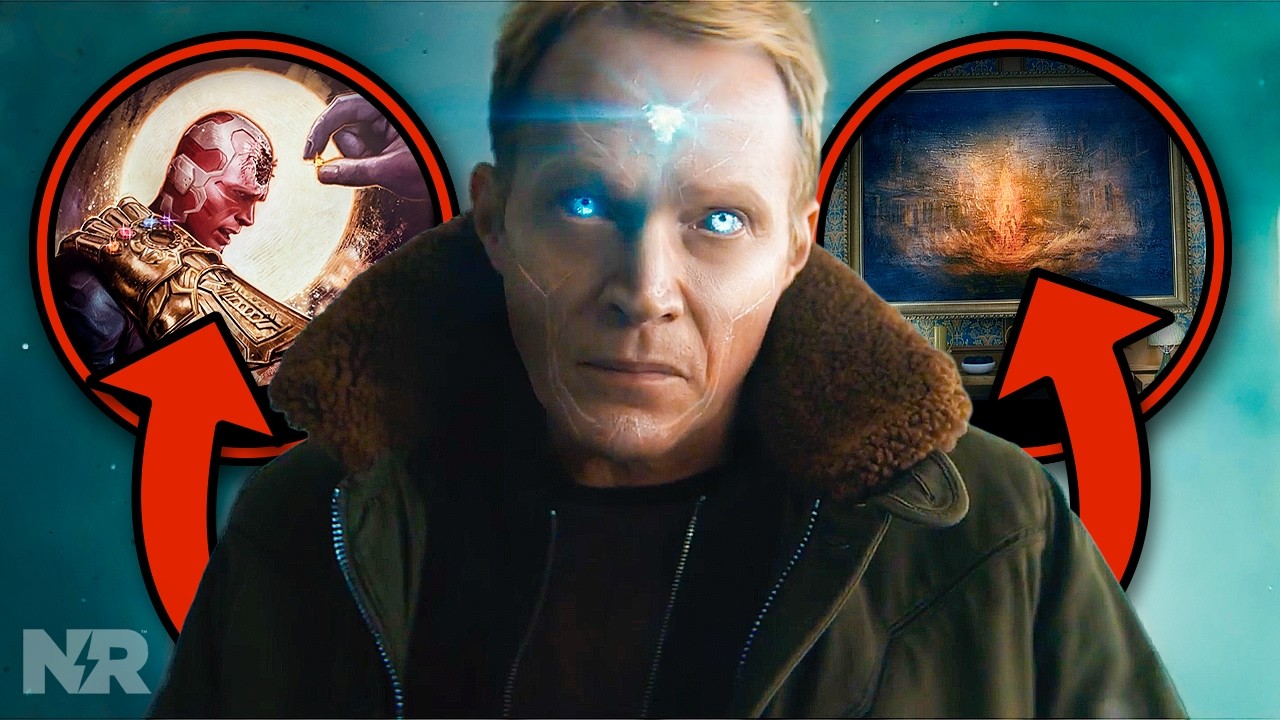
Adapted with AI from New Rockstars' video of 15 October 2026 and reviewed by Digital Fox Talent before publication. Editorial standards · Corrections
Also on Vision
13 creators, 40 takes →



More from @newrockstars
All →


Make videos? Your next one could be an article here.
We turn your videos into articles under your name, linked back to the original. You keep 60% of what they earn, non-exclusive, and you can leave whenever you like.
Become a SubPlotter →