VisionQuest's Terry Matalas on Why a Guessable Ending Can Still Satisfy
Terry Matalas says endings are really hard but can be done, and he likes to know a show's ending well before writing it
Terry Matalas doesn't buy the idea that popular TV shows can never land a satisfying ending because fans won't accept any conclusion. When I put that question to him, his answer was simple: "No, I don't think that that's true." He also said he doesn't know that writers should shy away from a satisfying ending just because it could be guessed.
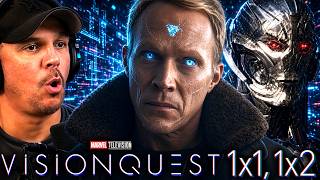
VisionQuest is the new Marvel series on Disney Plus that "has perplexed us with mystery and delighted us with commentary and humor about what AI is doing and how the history of AI has affected the MCU" over the past 16, 18 years or so.
Matalas steps in to stick the landing of the WandaVision trilogy
I opened with the way people talk about the 12 Monkeys finale as one of the rare examples of a multi-season, high-concept show that stuck the landing in a way people found satisfying. Picard gets talked about the same way. Now Matalas is being brought in to kind of stick the landing of the WandaVision trilogy.
His reaction: "Wow. No pressure there." I told him that, from the episodes I've seen so far, he's already doing good things, and that I think people understand he's not Jac Schaeffer. He's telling his own story, and that's understandable.
Then I asked the bigger question, setting Marvel aside. Why does it seem so hard for TV showrunners to stick the landing once their shows become so popular? Is it that these shows now belong to the fans, and the fans are not going to be satisfied with any ending?
Terry Matalas says great endings can be done, citing Breaking Bad and Battlestar
Matalas rejected that idea. He said he didn't really know why some endings fail, because he didn't want to throw rocks at any other players on the field. In his view, endings are really, really hard.
Still, he pointed out that there are some really great ones. He said Breaking Bad was really good and that The Shield on FX had a great one. Better Call Saul came up in the conversation too, and he agreed. He also said he really enjoyed Battlestar and kind of really respects it for not answering all the questions at the end. His conclusion was that it certainly can be done, even though it is hard.
Matalas likes to have the answer to the ending well before writing
When it comes to his own process, Matalas said he actually likes to have the answer for the ending well before writing. That ending can change along the way, and he acknowledged that his team would pivot certain things. But he said he thinks you have to have the main idea of what the satisfying ending is.
He was clear that this isn't the only way to work. He said not everyone can get there, and some people prefer a linear approach, finding the ending as they go. In his words, there's nothing wrong with that either.
Terry Matalas is okay if you guess the ending and like the answer
Matalas then turned to predictability. He said there is sometimes an instinct for writers or showrunners maybe to think that if the audience can guess it, then they can't do it. "And I don't know that that's right. For me it isn't," he said.
He explained that he's okay if you guess the ending and you like that answer. If you think something cool is going to happen and then it happens, you're probably going to say you were right. Then you watch it and maybe discover it was done in a way you didn't expect, and he thinks that's okay. What he questions is not doing something satisfying just because it could be guessed. He said he doesn't know that you should shy away from that.
Why I think the element of surprise is overrated, and Matalas on learning from fans
That lined up with something I've noticed. I told Matalas I'm really grateful he came on, and that I think doing interviews is kind of a double-edged sword for creators like him. Not in this interview, but in other interviews, I sometimes hear things where I want to tell the showrunner not to say them. Don't say you just wanted to be unpredictable, or that you wanted to zag where the audience expected you to zig. To me, the element of surprise is overrated.
Matalas answered that you're always learning. He said that before we started, he told me he'd rather be the one interviewing me, asking things like, "So, what did you think of this? What do you think of that? Did you like the way we played this?"
He said he thinks that by watching these and engaging with the fans, you do learn what you thought was going to work and didn't, or what ended up really working that you only thought might work. He described it as a continuing learning process, so that the next time, if you're lucky enough to do something like this again, you're a little bit better for it. I noted that we didn't talk a whole lot about his experience on Picard, 12 Monkeys, Terra Nova and the other projects he's worked on.
Do you think a TV finale can still satisfy if you guessed the ending before it aired?
Watch the original
@newrockstars · YouTube
Adapted with AI from New Rockstars' video of 17 October 2026 and reviewed by Digital Fox Talent before publication. Editorial standards · Corrections
Also on VisionQuest
9 creators, 21 takes →

More from @newrockstars
All →


Make videos? Your next one could be an article here.
We turn your videos into articles under your name, linked back to the original. You keep 60% of what they earn, non-exclusive, and you can leave whenever you like.
Become a SubPlotter →