Why '90s superhero movies recreated the 1930s after Batman
From Tim Burton's Gotham to The Shadow and The Phantom, Hollywood spent much of the decade rebuilding a world of fedoras, gangsters and art deco skyscrapers, and only Batman became a lasting franchise.

After Batman became one of the biggest movies of 1989, Hollywood was eager to find the next big superhero franchise. What followed was a surprisingly old-fashioned trend: Dick Tracy was based on a newspaper comic strip from 1931, The Shadow and The Phantom were characters from the 1930s, and The Rocketeer was an adventure set in 1938, complete with gangsters, Nazis and a hero flying around with a jetpack.
These films didn't only feature old characters. They were filled with art deco skyscrapers, vintage cars, fedoras, trench coats and elaborate sets that looked like something out of a 1930s gangster movie. Even Tim Burton's Batman, which was supposed to take place in the present day, looked like it belonged decades in the past. At a time when comic books were filled with modern superheroes, Hollywood seemed determined to resurrect characters and a world from half a century earlier.
Lucas and Spielberg's serial nostalgia set the stage before Batman
Hollywood's fascination with old superheroes started long before Batman. During the 1970s and 1980s, George Lucas and Steven Spielberg were making enormously successful movies inspired by the adventure serials they'd grown up watching. Star Wars was heavily influenced by science fiction serials like Flash Gordon and Buck Rogers, which had been popular during the 1930s. Those serials were relatively cheap, episodic adventures with larger than life heroes, elaborate villains and cliffhanger endings designed to bring audiences back to the theater the following week.
Lucas updated the formula with modern special effects and an enormous budget, but the basic inspiration was the same. Then in 1981, he teamed up with Spielberg on Raiders of the Lost Ark, which took that nostalgia further by setting the movie in 1936. Rather than simply borrowing from old serials, Raiders was essentially a modern recreation of them, with ancient treasures, exotic locations, Nazi villains and a hero in a fedora and leather jacket.
It was an enormous success, spawning an entire franchise and proving audiences were happy to embrace an old-fashioned adventure, provided it had the production values and spectacle of a modern Hollywood blockbuster. By the end of the '80s, Hollywood had spent more than a decade rediscovering the movies and characters of its past and figuring out how to repackage them for contemporary audiences.
Tim Burton's Batman built a 1930s Gotham in the present day
When Tim Burton was hired to direct Batman, one of the biggest challenges was bringing the character to the big screen without making it look like the campy 1960s television series. So the filmmakers went back to the original comics, staying true to how co-creators Bob Kane and Bill Finger first conceived Batman in 1939. They also drew heavily on Andreas Feininger's black and white photographs of New York City from the 1940s.
Rather than a recognizable modern American city, Burton and production designer Anton Furst came up with a Gotham that was a bizarre combination of Gothic architecture, art deco skyscrapers, German expressionism and old gangster movies. The streets were filled with men in suits and fedoras, enormous buildings towered over everything, and much of the city looked like a nightmarish version of 1930s New York. Yet Batman drove a futuristic Batmobile, used advanced technology and operated in what was supposedly the present day.
That was a huge part of what made Burton's Batman so distinctive. Instead of making the character fit into the real world, he created an entirely fictional one that looked and felt like a 1930s comic book brought to life. When Batman became one of the biggest movies of 1989, it showed how successful that approach could be.
Warren Beatty's Dick Tracy recreated Chester Gould's comic strip itself
A year later, Disney attempted something remarkably similar with a character who had first appeared in newspapers nearly 60 years earlier. Dick Tracy might look like an attempt to copy Batman, but it was filming before Batman even hit theaters. Warren Beatty had been trying to get it made since the 1970s, and one of the biggest obstacles was deciding what it should look like. The director who was at one point attached to the project wanted a relatively realistic crime drama, while Beatty envisioned something stylized that recreated Chester Gould's original 1931 strip. They couldn't agree, the project fell apart, and Beatty eventually acquired the rights and directed it himself.
Beatty wanted to recreate the strips he grew up reading as a kid. Rather than simply setting the film in the '30s, he wanted it to look like the actual illustrations, which was an enormous undertaking because they weren't realistic to begin with. Dick Tracy wore a bright yellow trench coat and fedora, and the villains had grotesquely exaggerated faces. As production designer Richard Sylbert explained, these characters would look ridiculous in a realistic Chicago, so they had to create what he described as a "parallel world."
The whole movie was limited to seven colors, the same bold, saturated shades used in the original illustrations. Instead of real streets, they built enormous sets full of art deco architecture, vintage automobiles and exaggerated skyscrapers, with dozens of elaborate matte paintings making the city look more like a drawing than a real place. Extensive prosthetic makeup turned actors like Al Pacino and Dustin Hoffman into Gould's bizarre caricatures.
Dick Tracy wasn't conceived as a Batman imitation, but the similarities were striking. They even shared a composer, Danny Elfman, who had just scored Batman. According to Elfman, Beatty was initially apprehensive about hiring someone so closely associated with Batman, while Elfman himself worried about repeating what he'd already done. That's what makes this film so interesting: like Burton, Beatty wanted an entirely artificial world. But where Burton borrowed the aesthetics of the past to reinvent Batman, Beatty was deliberately recreating the comic strip itself.
The Rocketeer kept its 1938 setting after a disagreement with Disney
One year later came The Rocketeer, which, unlike Dick Tracy, wasn't even created in the 1930s. Comic book artist Dave Stevens created it in 1982. He had grown up watching adventure serials from the '40s and '50s, particularly King of the Rocket Men, which featured a hero flying with a rocket strapped to his back. Fascinated with that era, he deliberately set The Rocketeer in 1938, with a young stunt pilot discovering an experimental jetpack that lets him fly.
Stevens almost immediately tried to turn the comic into a movie, originally imagining a black and white film on a low budget that would resemble the serials that inspired it. When it was shopped around Hollywood, virtually every studio turned it down. Disney eventually agreed to develop it, seeing the potential for toy sales, but there was a significant disagreement over the setting. Disney wanted to update the story to the present day, presumably believing a contemporary superhero would have broader appeal, and to replace the Rocketeer's streamlined helmet with something more like a modern NASA helmet.
The filmmakers argued that Indiana Jones had already shown audiences would embrace an old-fashioned adventure set in the 1930s, while the success of Batman and Dick Tracy proved they would embrace highly stylized comic book movies that recreated an earlier era rather than modernizing it. Disney ultimately kept the period setting. The Indiana Jones connection went further: director Joe Johnston had worked on Raiders of the Lost Ark at Industrial Light & Magic, helping design some of its action and visual effects sequences, and he later admitted he was consciously trying to capture the same spirit that made Raiders work.
The Shadow and The Phantom brought back heroes who helped inspire Batman
Over the next five years, Hollywood resurrected two more costumed heroes who originated in the 1930s. The Shadow first appeared on radio in 1930 before starring in his own pulp magazine in 1931, fighting criminals with disguises, intimidation and an almost supernatural ability to seemingly disappear. If that sounds like Batman, it's because The Shadow was one of Batman's original inspirations. Bill Finger later admitted the very first Batman story was essentially a rewrite of an existing Shadow story. In a strange way, Hollywood was now adapting a character who had helped inspire the very superhero whose success revived the genre.
Like Dick Tracy and The Rocketeer, The Shadow had been in development long before Batman was a hit. Producer Martin Bregman acquired the rights in 1982, and several filmmakers tried to bring it to the screen, including Sam Raimi, who eventually created his own superhero, Darkman, after being unable to make The Shadow. When Universal finally moved forward, the filmmakers again chose to recreate the period when the character had been popular, with vintage cars, gangsters in fedoras and art deco inspired production design.
Two years later, Paramount released The Phantom, starring Billy Zane as a masked crimefighter who first appeared in newspaper comics in 1936. The Phantom helped establish many superhero conventions: his skintight costume, wide eyed mask, secret identity and mysterious underground headquarters all predated Batman and Superman. Once again, the film was set in 1938, with director Simon Wincer, a huge fan of the character as a kid in Australia, deliberately recreating the adventure stories he grew up reading. He believed much of the appeal came from the exotic locations, mysterious civilizations and sense of adventure of that period. Screenwriter Jeffrey Boam had written Indiana Jones and the Last Crusade, making the link to Spielberg's adventures even more apparent.
Why none of the 1930s revival films launched a franchise
That's what makes this period so unusual. Hollywood repeatedly went out of its way to recreate the same bygone era, even though comics had spent decades introducing new generations of superheroes. But while Batman launched a franchise, the others didn't. Dick Tracy was a substantial box office success, but a sequel never materialized because of a rights dispute. The Rocketeer was envisioned as the start of a trilogy, with Billy Campbell and Jennifer Connelly signing for potential sequels, but Disney abandoned those plans when it underperformed.
Universal hoped to turn The Shadow into a major franchise, but it was a box office disappointment. The Phantom performed even worse, failing to earn back its budget, and Billy Zane's two planned sequels were quickly abandoned. Despite all the money spent recreating these elaborate 1930s worlds, the films weren't consistently drawing the audiences needed to justify ongoing franchises.
Perhaps part of the problem was that Hollywood became so fascinated with recreating the past that it overlooked what made Batman work. Batman might have looked like something out of the 1930s, but Burton wasn't trying to recreate the Batman of 1939. He used elements of the character's past to make something that felt new and exciting for contemporary audiences, and at its core it was still a modern superhero blockbuster. Dick Tracy, The Rocketeer, The Shadow and The Phantom were deliberately recreating a bygone era, and apart from Dick Tracy, audiences weren't responding.
The Crow, Spawn and Blade moved superhero movies into the present
At the same time, Hollywood was experimenting with a completely different approach. In 1994, The Crow brought a darker, more contemporary comic book character to the screen, with a gothic aesthetic, industrial soundtrack and violent revenge story. In '97, Spawn adapted a character created only five years earlier, embracing the exaggerated violence, elaborate costumes and supernatural horror popular in comics that decade. In '98, Blade turned a relatively obscure character into the star of a modern vampire action movie, with black leather, martial arts, techno music and a very specific late '90s aesthetic.
These films were about as far from the 1930s serials as you could get, and that marked the end of Hollywood's fascination with reviving old superheroes. The industry had spent much of the decade recreating the look of 1930s comic strips and serials, but the movies that eventually transformed the genre were based on characters who felt connected to the present. Blade, X-Men and Spider-Man traded fedoras and vintage cars for contemporary settings, modern sensibilities and a style of filmmaking that reflected the era they were made in.
Watch the original
@breakdownsandblockbusters · YouTube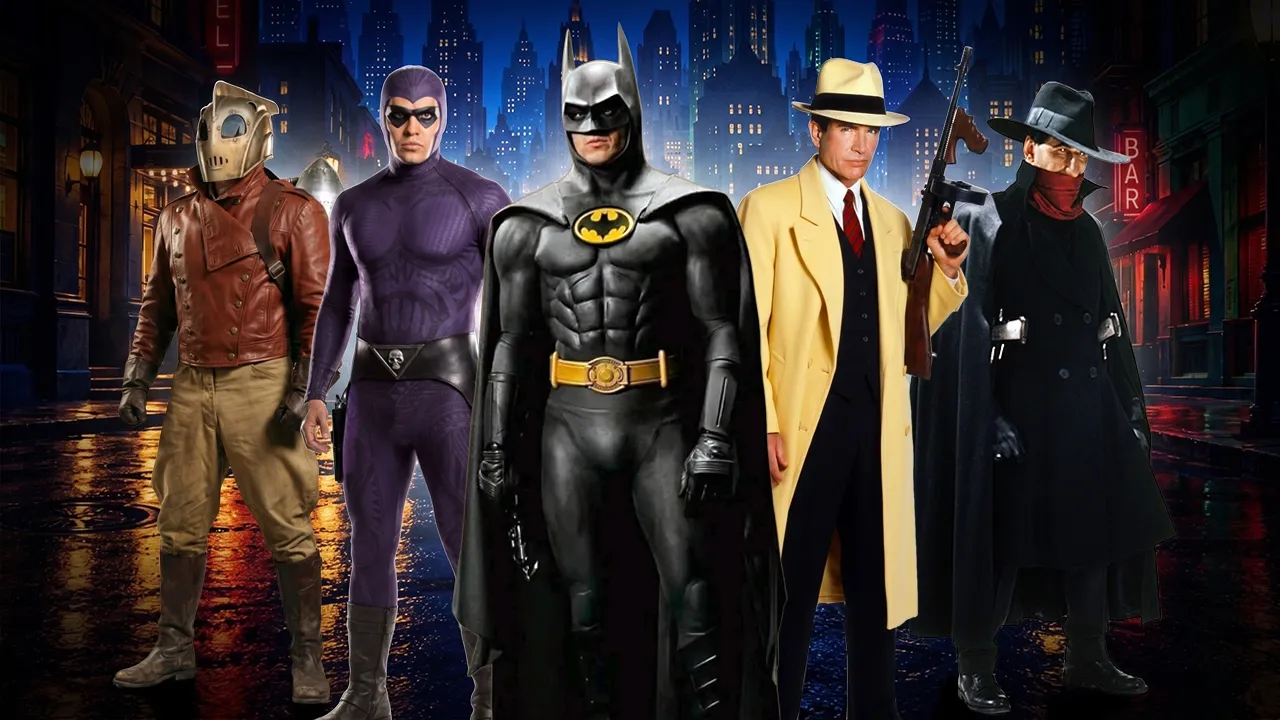
Adapted with AI from Breakdowns & Blockbusters' video of 31 October 2026 and checked against the video before publication. Editorial standards · Corrections
More from @breakdownsandblockbusters
All →


Make videos? Your next one could be an article here.
We turn your videos into articles under your name, linked back to the original. You keep 60% of what they earn, non-exclusive, and you can leave whenever you like.
Become a SubPlotter →