James Gunn fired from DC: why did his DCU fail?
Three movies into his rebooted DC Universe, Gunn and Peter Safran were replaced after Skydance took over Warner Bros.
 Breakdowns & Blockbusters (AI-assisted)15 November 2026Editor: Digital Fox Talent Editorial TeamOn YouTube since 2023 · more than 240,000 subscribers

James Gunn was supposed to save DC. Instead, three movies into his new cinematic universe, he was fired. Four years earlier, Warner Bros. had handed Gunn and Peter Safran control of its entire superhero division, tasking them with doing for DC what Kevin Feige had done for Marvel.
Gunn scrapped much of the existing cinematic universe, rebooted it, cast a new Superman and announced an ambitious slate of movies and TV shows meant to give DC a unified direction. Superman (2025), starring David Corenswet, was a hit. But Supergirl became an enormous box office bomb, and Clayface failed to make much of an impact. Then Skydance acquired Warner Bros. and, with an agenda of its own, fired Gunn and Safran. Their replacement is an executive whose recent work has focused on faith-based entertainment, and whose barometer for a good superhero movie is whether his grandmother would want to see it. Before Gunn had even gotten his cinematic universe off the ground, he'd lost control of it. So what went wrong?
DC's revolving door of leadership before James Gunn and Peter Safran
From 2009 until Gunn took over in 2022, DC had five different executives and filmmakers steering its cinematic universe. Diane Nelson oversaw DC Entertainment from 2009 to 2018. Zack Snyder was the creative architect of its films from 2013 to 2017. Geoff Johns and Jon Berg ran DC Films together from 2016 to 2017, and Walter Hamada took over from 2018 to 2022.
Even Dwayne Johnson tried to take control of the franchise with Black Adam. Each had their own vision, constantly pulling DC in different directions until the whole thing had become an absolute mess. Meanwhile, Kevin Feige had been running Marvel Studios since 2007, building the most successful cinematic universe in Hollywood history.
So after years of inconsistent results and changing direction, Warner Bros. realized it needed its own Kevin Feige. In 2022 it hired Gunn and Safran to take control of DC and right the ship, with Gunn overseeing the creative direction and Safran handling the business and producing side of things.
Gunn's DCU reboot made DC's continuity even more confusing
Their first order of business was to wipe the slate clean and reboot the entire DC universe. Except it wasn't exactly a clean reboot. John Cena's Peacemaker survived, Viola Davis returned as Amanda Waller, and Xolo Maridueña was still playing Blue Beetle. Meanwhile, Gunn's The Suicide Squad was apparently canon, despite taking place in the old universe.
In fact, Gunn recently confirmed that The Suicide Squad was officially the first movie in his new DCU, while clarifying on Threads that Blue Beetle the character was canon but the movie wasn't. And if that wasn't confusing enough, the first season of Peacemaker was also mostly canon, except for the appearance of the old Justice League, which Gunn retroactively changed. So while Gunn was supposed to simplify DC's convoluted continuity, he somehow managed to make it even more confusing.
Then there was his actual plan. After being hired, Gunn announced an enormous slate of films and TV shows. That was an overwhelming amount of content to announce before a single movie had been released. Many of those projects never materialized during his tenure, while others that weren't part of the original announcement ended up getting made instead.
Why Superman was never the DCU's Iron Man
Compare that to how Marvel launched its cinematic universe. In 2008, Iron Man became an enormous hit, turning Robert Downey Jr. into a superstar and giving audiences a character they loved. That was essential, because the entire MCU was built off the back of Downey's enormous popularity.
He was so white hot that it didn't matter that The Incredible Hulk was mediocre, or that Thor and Captain America were good but hardly extraordinary movies. Iron Man was so popular that audiences were willing to invest in a larger universe just to see Stark team up with everyone else. When The Avengers finally brought everyone together, it became one of the biggest movies of all time. But none of that would have happened if Iron Man hadn't been such a phenomenon in the first place.
That was arguably Gunn's biggest problem. While Superman was a hit, it didn't have anywhere near the same cultural impact as Iron Man.
Supergirl, Lanterns and Clayface: a questionable release strategy
Rather than following Superman with standalone movies establishing DC's most iconic superheroes, as Marvel did, Gunn took a completely different approach. His second movie was Supergirl, which felt like a retread to casual audiences who had seen Superman the summer before, and most people largely stayed home. Green Lantern, one of DC's most recognizable characters, was relegated to a TV series instead of getting a major theatrical release.
Then came Clayface, a standalone horror movie about a Batman villain. Sony had spent years demonstrating how difficult it is to build successful movies around superhero villains, with the likes of Morbius and Kraven the Hunter. Gunn's lineup would be the equivalent of Marvel launching the MCU with Iron Man, following it with an Ironheart movie, relegating Captain America to a TV series, and then releasing a standalone body horror movie about the Abomination. As a result, rather than building momentum with each release, the DCU seemed to be losing it.
The DCU's mixed box office and TV results
Financially, the results were mixed. Superman was a hit, but it also cost an enormous amount to produce and market, making it a relatively modest success considering how much Warner Bros. had invested in relaunching the character. Supergirl, meanwhile, was an outright disaster and bombed at the box office.
Clayface actually performed reasonably well. On television, Lanterns was a genuine hit, averaging over 19 million worldwide and becoming one of HBO's five biggest series launches. Peacemaker and Creature Commandos were also both well received.
So apart from Supergirl, nothing here was an outright failure, but nothing was setting the world on fire either. When you're trying to establish an enormously expensive cinematic universe, you need more than a collection of modest successes. You need something that gets audiences genuinely excited about what comes next.
Skydance's takeover of Warner Bros. and its political element
But Gunn's biggest problem might not have been his movies at all. It was the company that bought Warner Bros. In December 2025, Netflix reached an agreement to acquire Warner Bros. But Skydance, which had already acquired Paramount earlier that year, launched a hostile takeover bid and eventually acquired Warner Bros. instead.
There was also a political element to the acquisition. Skydance CEO David Ellison is the son of billionaire Larry Ellison, a close ally of Donald Trump. According to the LA Times, Skydance had been leveraging those political connections to help it acquire Warner Bros. out from under Netflix. There has also been growing speculation that the Ellisons wanted to push Hollywood in a more conservative direction, away from what is frequently called woke entertainment.
Why Skydance reportedly turned on Gunn and Safran
Following the takeover, Gunn and Safran had every reason to believe their jobs were safe. David Ellison visited the set of Man of Tomorrow in Atlanta, where the pair presented their long-term plans for the DC Universe. Apparently he was impressed and encouraged them to continue with their plans.
However, rumors have emerged that Skydance wasn't particularly happy with Man of Tomorrow, Gunn's upcoming Superman sequel. According to an anonymous Warner Bros. insider, Skydance felt the film was overstuffed with characters and cameos and wanted Gunn removed so it could take greater control of the editing process. None of this has been independently confirmed, but it would suggest Skydance wasn't simply unhappy with Gunn's leadership of DC. It was unhappy with the creative direction of his movies as well.
Skydance was also reportedly unhappy with DC's financial performance under Gunn, considering Supergirl a disaster and believing that even Superman hadn't delivered the cultural impact expected of such an iconic character. On top of that, Gunn and Safran began clashing with Skydance over who would ultimately control DC. Under their original arrangement, they reported directly to Warner Bros. CEO David Zaslav, and they expected that to continue under Ellison. That didn't seem to be the case, with Skydance film chiefs Dana Goldberg and Josh Greenstein wanting greater oversight of the studio's entire movie operation.
This was also part of the job Gunn hated. He had apparently been growing increasingly frustrated with corporate politics, admitting that his four years running DC had been trying, to say the least. Then, on Friday, November 6, Ellison arrived at Gunn and Safran's offices and informed them that plans had changed. Just weeks after apparently assuring the pair their jobs were safe, they were being replaced.
Jeremy Latcham and the grandmother test
On paper, their replacement, Jeremy Latcham, seems like the perfect choice. A protégé of Kevin Feige, Latcham served as his right-hand man at Marvel Studios and, ironically, even helped champion Gunn's hiring at Marvel back on Guardians of the Galaxy.
More recently, however, Latcham has been producing faith-based entertainment and has spoken openly about wanting to make uplifting movies that restore people's faith. He has explained that one of his guiding principles when making Marvel movies was asking himself whether his grandmother would enjoy them. He even admitted that while making those early Marvel movies, he'd sometimes hear jokes or dialogue and worry that his grandparents wouldn't approve.
Latcham's desire to make movies the whole family can enjoy is admirable. The problem is that making movies for the entire family risks sanding off the rough edges that make these characters interesting in the first place. If every DC project has to pass the grandmother test, you could end up sanitizing the entire universe until everything feels the same. Not every movie needs to appeal to everybody. Superman can be a family-friendly adventure, Batman can be a dark crime thriller, and Peacemaker can be an incredibly violent, foul-mouthed comedy.
What the shakeup could mean for Gunn's Superman and Matt Reeves' Batman
This shakeup could have enormous consequences for DC's future. Allegedly, Gunn was already writing a third Superman movie, with plans to release a new installment every two years before potentially building toward a Justice League film. But Skydance is already planning to dismantle much of what Gunn and Safran had been developing, meaning Gunn's Superman trilogy may never be completed.
Then there's Matt Reeves' Batman trilogy. The Batman Part II is already in production, and Reeves has always intended to make a third film. Gunn had been happy to let that version of Batman exist separately from the larger DCU. With new leadership taking over, there's no guarantee that arrangement will continue, especially when DC is planning to introduce another Batman into its cinematic universe. So not only could Gunn's plans for Superman be abandoned, but Reeves might never get to finish his Batman trilogy either.
DC seems destined to repeat the same mistakes
Perhaps the most frustrating thing about all of this is that DC seems destined to repeat the same mistakes it's been making for over a decade. Gunn's approach certainly had its problems. His release strategy was questionable, the box office results were underwhelming, and his cinematic universe never generated the kind of excitement that made the early MCU so successful.
But building an interconnected universe takes time, and Gunn was barely four years into what was supposed to be a long-term plan. Instead, Warner Bros. has once again changed leadership, potentially abandoning years of development and putting even its most successful franchises at risk. That's been DC's biggest problem all along. Every few years, somebody comes along promising to finally get things right, only for the studio to change direction when the results don't meet expectations. James Gunn was hired to put an end to that cycle. Instead, he became its latest casualty.
What other creators are saying
More on Peter Safran →I think Gunn and Safran were effectively pushed out rather than stepping down, that this report reads like a Paramount-orchestrated hit piece, and that it signals the current DCU is finished, likely headed for another hard reboot within a couple of years.
James Gunn and Peter Safran demoted at DC Studios? Variety report →
I think the culture war framing is probably overstated, and the real reason Gunn and Safran were ousted was likely the new Skydance reporting structure under Goldberg and Greenstein, who wanted Latcham to push Justice League and bigger, more mainstream DC films faster.
I predicted for six months that Gunn would leave once the Skydance merger closed, and I think this shakeup is bad for the DCU and superhero cinema. I fear the actors may exit, any reboot is a nonstarter, and the DCU could fail completely, leaving us worse off without it as an alternative to the MCU.
DC Studios shake-up: what Jeremy Latcham means for the DCU →
I think this shakeup will impact DC Studios in a big way, and much of the Gods and Monsters slate could change under Latcham. My speculation is Skydance wanted bigger characters like Batman and Wonder Woman sooner, clashing with Gunn's slower-build vision, though this isn't confirmed.
DC Studios shake-up: will Marvel's Latcham change Gunn's slate? →
Watch the original
@breakdownsandblockbusters · YouTube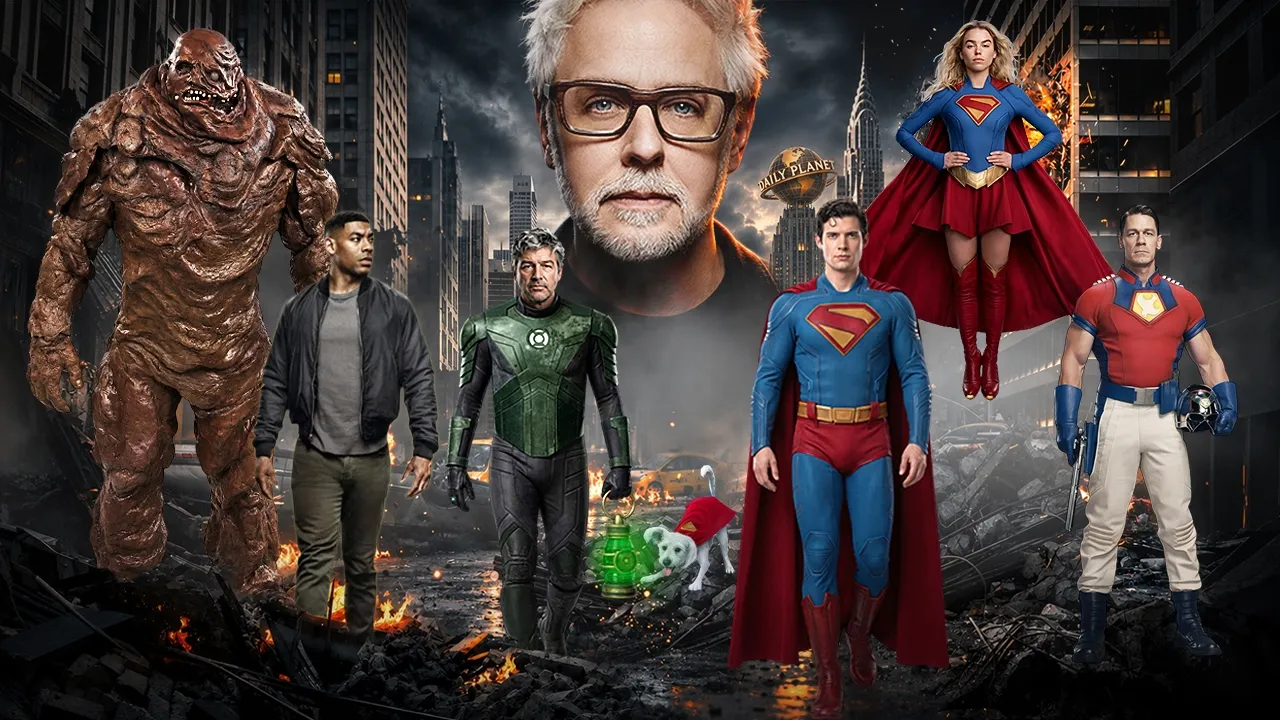
Adapted with AI from Breakdowns & Blockbusters' video of 14 November 2026 and checked against the video before publication. Editorial standards · Corrections
More from @breakdownsandblockbusters
All →

Make videos? Your next one could be an article here.
We turn your videos into articles under your name, linked back to the original. You keep 60% of what they earn, non-exclusive, and you can leave whenever you like.
Become a SubPlotter →