Super Mario Bros. (1993) rated 7.7/10: how bad was the chaos?
Daily rewrites, a three hour Dennis Hopper meltdown and whiskey between takes push a 5.6 movie to a 7.7 overall score
 Breakdowns & Blockbusters (AI-assisted)15 November 2026Editor: Digital Fox Talent Editorial TeamOn YouTube since 2023 · more than 240,000 subscribers

Super Mario Bros. didn't just fail as a game adaptation. It accidentally taught Hollywood how not to make them for the next decade. All things considered, I score it a 7.7 out of 10: a textbook Hollywood dumpster fire.
The 1993 film starred Bob Hoskins as Mario, John Leguizamo as Luigi and Dennis Hopper as King Koopa. All Things Considered rates a movie not just on how it turned out, but on how it got there. Each film gets a score out of 10 in three categories: the quality of the movie itself, the behind the scenes drama among the cast and crew, and the production woes, from studio meddling to on set disasters. Those scores are then averaged into a final number that captures both the film and the chaos behind its creation. This one had daily script rewrites, a husband and wife directing team who weren't on the same page, and actors doing shots of whiskey between takes just to cope.
Roland Joffé went from The Killing Fields to producing Super Mario Bros.
This movie started losing lives at the loading screen. After directing the acclaimed films The Killing Fields and The Mission, Roland Joffé had an identity crisis. He feared repeating himself and felt the pressure to keep delivering the same kind of prestige pictures again and again.
Looking to surprise everyone and do something totally different, Joffé took a hard right turn off a cliff. He went from directing Oscar winners to producing Super Mario Bros. Against all odds, he acquired the rights from Nintendo, beating out other studios. His pitch was simple: do it in live action rather than as a cartoon, and do for Mario what Tim Burton had done for Batman by making it cool and aimed at young adults, not kids. Nintendo allegedly awarded him the deal out of sheer curiosity, intrigued to see whether his strange take on Mario would work or totally implode. That's quite a reason to greenlight a movie for a major property.
Joffé went through several writers and radically different approaches to the script. One was a road trip drama. Another was closer to the game and would have starred Arnold Schwarzenegger as King Koopa. Yet another was like The Wizard of Oz. He was unhappy with all of them.
The Max Headroom creators turned Mario into a Blade Runner style dystopia
Joffé's mind kept drifting back to the bizarre futuristic TV series Max Headroom. That obsession led him to its creators, the husband and wife directing duo Rocky Morton and Annabel Jankel. After meeting with them, he hired them to direct Mario, believing their cool, inventive and deeply cynical take on technology was exactly what the film needed.
Their concept set the story in an alternate dimension where humans had evolved from dinosaurs and society was ruled by a corrupt president turned dictator, King Koopa. They wanted it to be a metaphor for contemporary America: a savage parody of New York City and heavy industry, portrayed as a decaying, resource starved dystopia on the brink of total collapse and anarchy. The script was rewritten yet again as construction began on Dinohattan, which is Manhattan but with dinosaurs, and as actors were cast.
The visual inspiration was Blade Runner, and Joffé went so far as to hire that film's art director, David L. Snyder, to oversee production design. Snyder created a gritty cyberpunk metropolis populated by tattooed bikers, gangsters and strippers. Remember, this is for Super Mario Bros., a game for kids. I love Blade Runner. It's one of my favorite movies. But Blade Runner and Super Mario Bros. are about as far apart as you can get.
Disney's panic, burned storyboards and daily rewrites earn a 9.6 for production woes
To pay for everything, Joffé needed investors and a distributor. He turned to Disney, who took one look at what he was doing and lost their minds. Panicking, and needing to get Disney and the other investors on board, he scrambled to arrange yet another rewrite to lighten the film's tone. Except he never told the directors, who by this point had storyboarded the entire movie.
Rocky Morton went out to the parking lot and set their storyboards on fire as the duo prepared to quit. They decided to stay when they realized that, this late in pre production, no other director could possibly understand the material well enough to direct it, because the plot had become so incomprehensible. The writers stayed on set for the entire shoot, constantly rewriting on the fly. As actor Richard Edson later said, "Their goal seemed to be, how dumb can we make this?" Meanwhile, Morton was splicing together scenes he liked from the different drafts, cutting them out and taping them together.
With three weeks of shooting to go, the directors' own agent told them to get off the set, worried it was hurting their careers. After the film came out, Morton was asked for his enduring memory of the production. He answered with one word: humiliation.
This wasn't just a difficult shoot. It was a full blown identity crisis captured on film: a prestige director trying his hand at producing, rewrites every day, directors off the set near the end, a script cut apart and taped together, and a cyberpunk dystopia built for a kids' game movie. Whose idea was that? This wasn't a movie that slowly went off the rails. It was never on the rails to begin with. On the production woes scale, it earns a 9.6 out of 10, for a production where the only consistent plan was that there was no plan.
Dennis Hopper's three hour meltdown over rewritten lines
A movie with an ever changing script was never going to have a calm, peaceful set. One day, Dennis Hopper arrived to learn that all of his dialogue had been completely rewritten, which was an almost daily occurrence. In a visible rage, he began pacing, muttering and refusing to make eye contact with anyone. When the directors asked what was wrong, he erupted. He accused them of being unprofessional, blasted them for not asking or telling him beforehand, and tore into the quality of the writing itself.
This went on for 45 minutes, and those looking on said it was more riveting than the actual movie. The tirade ran so long that lunch had to be called, but the confrontation didn't end. It moved behind closed doors for another two hours while Hopper railed about the state of the film and how he had never seen anything like it. That's saying a lot if you know what happened behind the scenes on Easy Rider and The Last Movie.
Desperate to salvage the day, the directors begged him to rewrite the scene himself or choose whichever version he preferred. In the end, after more than three hours of shouting, with the cast and crew left waiting, the scene was shot exactly as it had been written when the day began.
Bob Hoskins and John Leguizamo turned to whiskey between takes
Eventually, Bob Hoskins stopped bothering to read the script altogether, choosing to show up each day and take the movie one scene at a time. John Leguizamo later said working on the film felt like waiting for the news every morning. New pages arrived daily. Everything was live, everything was breaking, and no one knew what they'd be shooting until the day had begun.
Hoskins and Leguizamo became so disillusioned that they began shooting whiskey between takes, which may have contributed to Hoskins breaking a finger during a driving stunt because he was drunk. Don't drive drunk. After most days on set, some of the actors would unwind by getting stoned, and Hoskins eventually found out and asked to join them, desperate to take the edge off.
When a reporter from the LA Times came to do a story on the troubled production, the directors refused to talk to him. That led Hopper to say, "That's the only intelligent thing I've ever heard them do."
Dean Semler and the nicknames: behind the scenes drama scores 8.1
During one heated production meeting, the directors completely alienated cinematographer Dean Semler. They handed him a rigid, predetermined list of camera setups, lenses and even precise light readings for the entire week's shoot. The Oscar winner finally snapped, asking why they had even hired him. This is the man who shot Dances with Wolves, which is a gorgeous movie. But sure, tell him what to do.
The directors weren't exactly liked by the cast and crew, and they picked up several dismissive nicknames. There was Rockabel, a combination of their first names. Another was the Rocky and Annabel the Flying Squirrel Show. The third was Hydra, as in the creature with multiple heads, because the pair were like two heads on a snake telling you conflicting things to do. Hopper and Hoskins later said they were a husband and wife team who were both control freaks and wouldn't talk before they made decisions.
Daily script changes, actors giving up on the script entirely, stars drinking to cope and a crew openly mocking the directors as the set descended into chaos earn Super Mario Bros. an 8.1 out of 10 for behind the scenes drama. That's a hair below Jaws, which had a full blown actor feud and a crew that hated the director. And while the directors were nicknamed Hydra for having two heads, Headless Horseman might have been more accurate, because direction was the one thing this set never had.
Why Super Mario Bros. scores 5.6 as a movie
This thing was doomed before it got off the ground, because Joffé wanted to make something cool, dark and hip for adults instead of something bright, colorful and fun for kids or all ages. The more recent Super Mario Bros. movie fully commits to the joy, color, simplicity and charm of the games, and it works because it understands what Mario is supposed to be. The 1993 version feels embarrassed to even be a Mario movie. Instead of leaning into the whimsy of the Mushroom Kingdom, it drops the characters into a grimy cyberpunk nightmare where Goombas are mutated henchmen, Koopa is a dictator, and nothing feels playful, magical or inviting.
The visuals, while ambitious, are aggressively ugly and industrial, and the action is filled with sparks flying everywhere. Before I rewatched it for this review, all I remembered from the action scenes was sparks. Morton and Jankel walked with their sparks so J.J. Abrams could run with his lens flares in Star Trek. More importantly, the movie never commits to a tone that works. It's not dark enough, and it doesn't say anything ambitious enough to function as real sci fi. It's not funny enough to succeed as a comedy, and it's not faithful enough to satisfy fans of the game.
Hoskins is well cast as Mario. He just doesn't have much to work with. This is the same actor who was phenomenal in Who Framed Roger Rabbit, effortlessly carrying an entire movie opposite cartoons. I guess Leguizamo is decent as his younger brother, even if he's not Italian, but neither was Hoskins. They're both believable as plumbers. The visual effects were solid and quite groundbreaking for their time, and the animatronic puppets still hold up, even if the movie around them doesn't.
Dennis Hopper is crazy Dennis Hopper, dialed up to 11. He does play a great bad guy. When his son asked him why he was in such a bad movie, Hopper said it was to pay for his son's shoes. His son replied, "I don't need shoes that badly." On the film quality scale, it earns a 5.6 out of 10. It's not a movie you watch to enjoy so much as a cinematic curiosity you study in disbelief. It's just so strange.
All things considered, Super Mario Bros. rises to a 7.7
Factor in a script rewritten every single day, major actors giving up on the material and turning to alcohol, Dennis Hopper melting down for hours at a time, and a confused cyberpunk vision forced onto a kids' game adaptation, and the picture changes. All things considered, Super Mario Bros. rises to a 7.7 out of 10. A textbook Hollywood dumpster fire.
Watch the original
@breakdownsandblockbusters · YouTube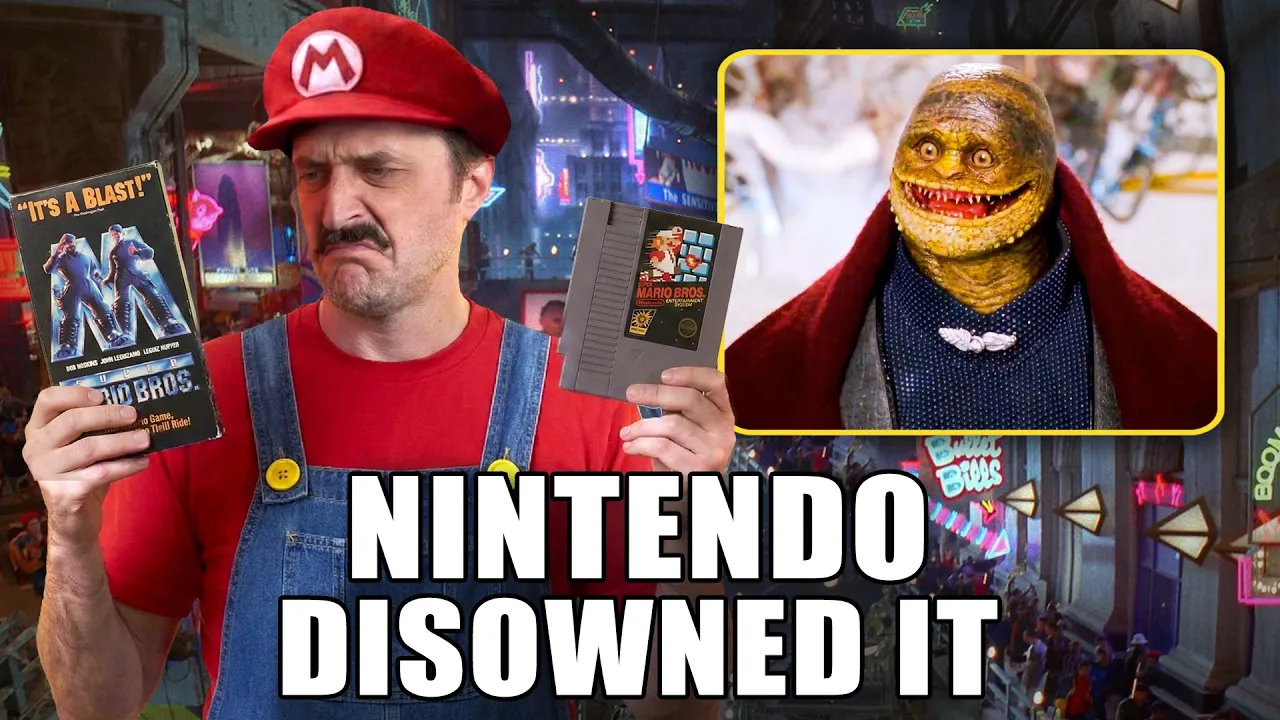
Adapted with AI from Breakdowns & Blockbusters' video of 21 January 2026 and checked against the video before publication. Editorial standards · Corrections
More from @breakdownsandblockbusters
All →

Make videos? Your next one could be an article here.
We turn your videos into articles under your name, linked back to the original. You keep 60% of what they earn, non-exclusive, and you can leave whenever you like.
Become a SubPlotter →